Showing posts with label community. Show all posts

Saturday, 29 March 2025

Awfully Big Adventures in Self-Publishing by Sheena Wilkinson

 It feels very odd to be posting on the 29th day of the month. Ever since I first blogged for ABBA – March 2014 if anyone’s interested, it’s been the 13th. Easy to remember (and as far as I know I’ve only forgotten twice in eleven years). Sometimes I got to blog on Friday 13th, and once a year it fell on St Lucy’s Day, which was always an invitation to write about light at a dark time of year. 

But here I am on the 29th! Out of my comfort zone. Because of the reshuffle of ABBA dates, I haven’t blogged for ages, there having been no 29th February this year. (Oooh, this means that three out of four years I’ll get a month off, and every fourth year I’ll get to blog about Leap Day. Yay!) And it doesn’t matter when I blog: the fact is, Awfully Big Blog Adventure gives me a real sense of community in an often fractured world. There are writers I’ve never met, who feel like friends because we read each other’s posts, writers whose books I will seek out because they are Scattered Authors. 

I am very much a creature of routine and habit, and though I love change and adventure to some extent, I do fear the unknown. I am especially pusillanimous about techy things: that’s probably why it took me until 2023 to get a website.


Another thing I’ve been scared of is self-publishing. No matter how many talks I have been to from really successful and savvy indie authors; no matter how many times other writers have waxed lyrical about having complete control over every aspect of the process; no matter how many self-published books I see with much better sales than I have had for ten traditionally published books, it’s always felt scary, and I’ve always thought I wouldn’t do it. Even when one of my good writing friends, Rachel Ward, self- published the excellent, beautifully produced Write Your Cozy Mystery: a practical, how-to guide, I still couldn’t imagine myself managing to actually make a book happen – writing, after all, is the easy bit!

one traditionally published, one self-published

But later this year I am going to self-publish a novel – a much scarier leap for me than changing my blogging day. And it’s mainly thanks to ABBA – or at least to the Scattered Authors. 

Here’s how.

As we all know, Scattered Authors get about a bit. One place where many of have scattered to over the years has been Charney, the annual, much-missed retreat in Oxfordshire. It was at Charney where I met Linda Newbery, Celia Rees and Adele Geras, who run the excellent, eclectic review blog Writers Review, which I’ve occasionally reviewed for, and was interviewed by in 2023: http://reviewsbywriters.blogspot.com/2023/04/special-feature-q-with-guest-sheena.html

A month or so ago I read in The Bookseller that Writers Review was branching out into publishing, bringing out three books this April: The One True Thing, a new adult novel from award-winning Linda Newbery, and reissues of two highly-acclaimed novels – The Poet’s Wife by Judith Allnatt, and David: The Unauthorised Autobiography by Mary Hoffmann. https://www.thebookseller.com/author-interviews/author-interviews/testing-the-waters-linda-newbery-makes-her-first-foray-into-self-publishing


All three authors are widely published, hugely experienced and highly respected. Reading about their decision to self-publish these novels as a Writers Review initiative made me think about a book of mine, finished this time last year but languishing on my hard drive ever since. If they could do it, maybe I could too? 

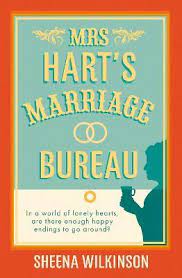
My first adult novel, Mrs Hart’s Marriage Bureau, a 1930s feminist feelgood story, was published in 2023 by HarperCollins Ireland and in UK paperback in 2024 – a year and a day ago, in fact. Readers loved it; reviewers called it ‘a gem’ (Irish Independent) and ‘briskly witty, reminiscent of the best inter-war fiction’ (Irish Times) and the majority of the two hundred Amazon reviews (mostly five star) hoped for a sequel. In fact, the acquiring editor, at our one and only meeting, waxed very enthusiastically about a sequel or even a series. 
But it was a one-book deal and that passionate editor moved on, as is the way in publishing, and though Mrs Hart had clearly struck a chord with readers, there simply weren't enough of them to justify HarperCollins offering for the sequel. So they didn’t. 

And yes, it might have been more sensible to wait for a contract before I wrote it, but the fact is, like readers, I wanted to know what happened next! And as I wrote Miss McVey Takes Charge, set in 1936, I was feeling optimistic and determined. This book would see the light of day. To anyone who enquired, I said blithely that if HarperCollins didn’t take it I would jolly well publish it myself. (I said it very fast, because to be honest I was terrified of the prospect.)

There seemed no point in sending the book elsewhere: publishers are unlikely to want the sequel to a book published by another company. I did look at reworking it to make it less like a sequel, but that was like trying to turn my dog into a cat. 

I hoped that, if I did nothing for a year, something amazing might happen to make HarperCollins change their minds – Mrs Hart might be optioned for TV or go viral for some reason. This didn’t happen, but when I read about the Writers’ Review initiative, it spurred me on to start thinking seriously about taking that kind of action myself. 

And then something lovely happened! Having engaged in a little chat on social media about the trend for respected, successful writers to self-publish, I admitted that I too was considering self-publishing and explained about Miss McVey takes Charge. The next day I had a message from Linda Newbery, inviting me to bring the book to Writers Review! I will still be self-publishing, but with the support and cooperation of writers I really like and trust. And I know that the Writers Review endorsement will give the book a stamp of approval and respectability, and that they will support my book, as I will support theirs. 

three splendid, and beautifully-produced novels from Writers' Review 

Miss McVey Takes Charge will publish late in 2025. I need to leave some breathing space around my forthcoming school story sequel, which publishes in September, and it gives me time to build up (I hope!) some interest in the book. I’ve invested in engaging a really first-class editor and cover illustrator, both of whom have worked on my traditionally published books. I don’t expect to sell thousands of copies or to make any money; it’s not about that. It’s about giving the readers who bought, loved and reviewed the first book the sequel they – and I – want. It’s about taking control in a world where writers’ words are blatantly stolen to train robots, as Claire Fayers blogged about on here only yesterday. https://awfullybigblogadventure.blogspot.com/

And – because without the invitation from Writers’ Review I might still be dithering about this – it’s about community and solidarity, and writers helping each other out. Because that’s what matters. 


Tuesday, 13 November 2018

Pages Of The Sea; Pages of Books by Sheena Wilkinson

Last month I was whingeing on expressing concern about how much travel I was doing. This month I want to share two lovely writerly experiences which happened within a few miles from my home.

my local area 
First, the local Community Association’s Book Group had chosen Star By Star  as their November book, and I was in the strange position of listening to local people, some of whom I knew, some of whom were strangers, tell me what they thought about my book. Luckily they seemed to like it, and their insights were fascinating. I had set the book locally, but changed names and a few topographical features to suit the story, and some people recognised Cuanbeg as Newcastle, whereas some were convinced it was in another county altogether. 


They were all adults, middle-aged and older, but weren’t put off by the fact that the book was primarily aimed at teenagers. Sometimes I answered questions, but on a couple of occasions I was able to sit back and let them argue a point – which was odd but delightful, like eavesdropping on gossip about your nearest and dearest  

As a writer working from home, and a single person in a very traditional, family-oriented rural community – to which I moved only 16 years ago, it’s easy to feel isolated from neighbours. This lovely meeting reminded me that there was no need for that. I have now joined the Book Group. 

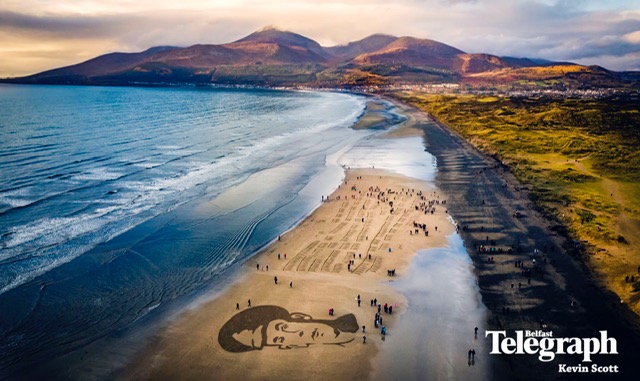
This was a small-scale event. The second experience was nationwide, and yet also intensely local and intimate. Like many of this Blog’s readers I spent several hours of Sunday 11thNovember on the beach at Danny Boyle’s Pages Of The Sea artwork, commissioned as part of the 14-18 Now commemorations. Sand portraits of participants in WW1 – mainly soldiers of course but also nurses, chaplains and others – were etched on the sand, and taken away by the tide.

Murlough beach just before the tide came in 

 My local beach is Murlough, County Down, under the shadow of the Mourne mountains. Star By Star and my earlier WW1 novel Name Upon Name are set wholly or partly in the area, and both of them explore the lives of local soldiers. When I was asked by the Nerve Centre, who co-ordinated the event at Murlough, to lead the crowd in reading Carol Ann Duffy’s searing poem ‘A Wound In Time’ I was immensely honoured. Out of all the opportunities my books have given me, this has to be the most moving.

I arrived at the beach in pouring rain at 8 a.m. The sand portrait of our chosen local solider, Rifleman John McCance, was already in place, and volunteers, including children, were raking the sand to form lines of silhouettes of more people. John McCance was born in Dundrum, less than a mile from the beach we stood on, and enlisted in nearby Downpatrick, where my own soldier grandfather was stationed twenty years later, before he too left these shores to fight in the Second World War. McCance died at Passchendaele and like so many others has no known grave. He is commemorated on the Tyne Cot memorial, along with 35,000 others. I visited Tyne Cot in 2004 and was overwhelmed by the scale of it. 

My own, much less impressive picture of the portrait
Pages of the Sea was also on a huge scale, with events taking place all round the coastline of these islands, and yet it was very personal and local too. Relatives of John McCance attended.  For me, it was a ten-minute drive on country roads, but many people had made long early-morning journeys. A choir sang local traditional songs, and then I led the reading of the poem. I hadn’t expected people to join in but everyone did. By then the rain had stopped and the morning was calm. Against the swish and roll of the incoming tide we read Duffy’s powerful words. And when we dispersed, to go about out normal Sundays, John McCance’s portrait had gone, taken by the sea much more gently than lives were taken at Passchendaele.


Sunday, 10 July 2016

A Sense of Belonging - Eve Ainsworth


I went to a funeral this week for a well loved and respected neighbour. He’d lived in my small close for 40 years and in all that time had built a reputation as a kind, caring gentleman, a man who had time for his neighbours, who would stop you at his garden gate and ask how your day was. He’d always have time for a smile and a wave. In essence, he always made you feel better.

During the wake I got to meet the many people that had come to pay their respects. The majority spoke of years gone by, when the entire street was an open house and everyone felt like part of a community. As one lady said “you could never feel lonely. Or unsafe. We looked after each other.”

During the day I got chatting to current neighbours that I’d only nodded to briefly in the past. I was still relatively new to the street, as most of these people had lived in their houses for many years. It was lovely to have the opportunity to really talk to them, without rushing past and find out people’s backgrounds and histories. By the end of the day, not only did I have new friends, but a street party had been organised to raise money for charity and to reunite our small community further.

I went home glowing, feeling part of something which, considering how bleak the country had felt lately, was a great thing.

Later this week I found I was struggling with various other things. My writing wasn’t going as I’d hoped and the self-doubt monster was biting my neck again, forcing me to believe those deeply negative thoughts – those ones that take over and consume you if you let them.

I spoke to a writer friend, who was immediately on hand with reassuring words and a helpful kick in the butt. And it helped, it really did – because, as we know, writing can be a lonely, isolating activity.

In the past I have turned to others in the industry, to friends in writing communities who are there to dispense advice, wisdom and jokes as required.

It’s made me realise just how important these communities are. Just like my neighbours, writing communities can be there to reassure, give you a sense of belonging and also remind you of the important things – like laughter, love and wine.

So today, against a backdrop of political difficulties ahead of us, I will be raising a glass. And I will be loudly thanking those that make our lives that little brighter.

Let’s keep the light shining.


Eve Ainsworth is the author of Crush and 7 Days (Scholastic)  7 Days was nominated for the 2015/16 Carnegie Medal and was winner of the Dudley Teen Prize and FAB Books Prize 2016

Thursday, 16 April 2015

Tales Round A Camp Fire: The Story of the Avenues Book Club by Tess Berry-Hart

“Do you like books?” asks Anna, a friendly mum who I’m chatting to in the park while our children roll, swing and wail in the background.

She doesn’t know I’m a writer, and to be honest, after six months of a new baby-and-toddler combo, I don’t know I’m a writer either. “Yes, I like books,” I say vaguely. “At least I used to, I think.”

“I’m thinking of starting a book club,” says Anna cheerily. “Do you want to join?”

“Lovely,” I say absently, wiping my baby’s snotty nose while my toddler clings to my leg and screeches for a biscuit. “Count me in.”

Actually I’m saying this to be polite. I’m fighting nappies, beakers and sandwiches, lack of sleep and lack of time. As a child and teenager I spent long hours lying on my bed lost in everything from Judy Blume to Jane Eyre, but as a mother I feel like Alice falling down the rabbit-hole. Where on earth do I get the time to READ a book? I don’t manage to brush my hair or have a shower some days, much less ...

But a few months later I’m sitting around a table in Anna’s house holding a glass of wine and talking about Alan Johnson’s childhood biography “This Boy” with a circle of chatty and intelligent readers all drawn from the surrounding Avenues. Johnson grew up in our neighbourhood in the Fifties and we’re having fun spotting landmarks and discussing how the area has changed. For the first time in a year or so I feel like my brain is connected to the world of information and ideas, and I don’t have to swivel abruptly round and shout “Quiet! Stop running!”

Yet as the months go by and new books are chosen and discussed, I realise there’s something deeper happening. Reading in a group is different to reading on your own. My experience of a book doesn’t end when I close the final page and as a result the story doesn’t remain locked and fossilised in my memory. Other people have their own ideas and through sharing it the story lives, leaps, and bounds again. There is no fixed way to interpret a book; different characters are sympathised with or disliked, an author’s voice can be either believed or distrusted, filtered through the lens of our differing experiences and background. Anya, another fellow book club member and TV producer, says “It's really interesting to see different people’s responses to the stories we read. Some of us might look at a story from a feminist perspective when others don't read the book in that way at all.” Allison, a special needs advisor, agrees. "It's really valuable being able to discuss the books and it can actually change my opinion or perspective on them." In essence, a story isn’t “mine” any longer - it is “ours.”

What is it about sharing a story that makes us feel so connected? Does it go back to our primal urge to communicate, to build meaning out of chaos, the ancient rite of sharing tales round a camp fire with the community?

For Anna the founder, it was exactly her need for a sense of community that made her want to start up a book club. “It’s made living in the crazy capital a little more like being in a village. People want to belong and feel involved in the community. If we're meeting and we're talking than that's a good thing.”

That's not to say that all communal experiences of stories are by definition positive. As a child, piano teacher Linda remembers finding reading “difficult and remember having to read out loud to the class. It was hard and deeply embarrassing, I was slower than others and the result was that it put me off reading in my junior years.” Now as an adult she reads widely and “the group has definitely encouraged me to look at authors that I would not normally look at and I am glad of this. I don't want to get stuck in a rut.”

Reading “in public” is definitely harder in some ways. Going against a majority verdict is difficult, if you love a book that is universally detested, or being the sole voice of dissent in an ocean of love. Some might find reading “to order” tricky, or finishing by a deadline when there’s so much other stuff to be done, but Allison sees this as a positive. “Although I was read to as a child, reading for me has always been a solitary activity. The book club helps me by motivating me to read, or to keep reading a book even if I don't like it.” 

Personally, to my surprise, I find time to read that I didn’t realise I had, and my mind feels refreshed after half an hour’s reading rather than jaded from scrolling through Facebook and Twitter. It’s a treat rather than a workout. And it’s had a positive effect on the book eco-system too, as I try to make time to order the book of the month at the local library, although often I cheat and borrow other people’s Kindles ... 

But aren't book clubs a trend long over, a bit Noughties? Well I suppose like anything, they are what you make them. Our one-year anniversary of the Avenues Book Club is coming up soon, and we plan to go out to dinner to celebrate. Over the last year we’ve read biographies, magic realism, classics, new bestsellers, and science books; we’ve made friends just round the corner and established a social and support network that is often lacking in cities today. I feel tuned in to the world and the local community in a way that I haven’t since I was a kid. As Anya puts it, “A book can draw us into surprisingly frank and intimate conversations about our own lives ... and it has made it clear to me that our own stories, and those of our friends and neighbours, are often as compelling as any story committed to print.”

As adults and parents, we have so little time to ourselves that making time to read feels like a luxury. But is it really a luxury? If some of the major paths to happiness are through connectedness to others and the sense of communication, isn’t reading something really vital and essential?

What do you think? Are you a member of a book club? Or do you prefer to read alone? Let me know!