Showing posts with label book groups. Show all posts

Saturday, 1 August 2020

STILL PERSISTING? A DIFFERENT SLICE OF BOOK GROUP. by Penny Dolan

Last month, here on ABBA, I wrote about "my" Chocolate Biscuit Book Group, and my sadness and worry for future meetings. The news is good. Four of us met one afternoon - we have decided not to meet in the evenings - and enjoyed sitting in a garden surrounded by billowing lavender hedges while we created next year's booklist. And so that story continues . . .

Coffee cake - WikipediaCoronovirus has thrown up a different problem in my other Book Group, which I will call the Lovely Cake Ladies Reading Society.  How did I end up with two groups when one would have been enough?

One wine night, I mentioned to a friend that my Chocolate Biscuit Group was going through a thin patch and might be folding.  A few months afterwards, she invited me to join the Lovely Cake Ladies.


A large cake garnished with strawberriesAs I love books, reading and booktalk, I joined that group too, and was soon revelling in how very different these two gatherings were. Could I have chosen between them? Definitely not, now or then!  
 
The Lovely Cake Ladies met one evening a month on a rota, in someone's comfortable house, and very enjoyable the gatherings were. We sat around a table spread with a cloth, good china, wine glasses and a spread of delicious savouries. (No bare church community room, this!)

And after half-an-hour of friendly chatter, drinks and nibbles, the Lovely Cake Book Discussion proper started. Although there was lots of laughter and a sense of relaxation, this group ran in a fairly formal style, the discussion circling around the table. Gently watched over by the Chair, each person gave their thoughts and comments on that month's title, voted on a score between 1-10, and whether they'd recommend the title. Not everyone agreed all the time, but the discussion felt cheerful and amiable. Odds and ends of information were included in the discussion too: book locations visited, authors heard at festivals, film versions, additional titles and so on. Happy stuff.

Marble cake - Wikipedia
Once the Discussion was done, that evening's Very Lovely Cake was brought in, plus tea or coffee. Now the Lovely Cake Ladies Reading Society moved on to wilder chat, local anecdotes and news about a host of topics.

These evenings, topped up with cake and very good coffee, sent me home with my head buzzing and unable to sleep for hours. To an introverted writer, living an almost solitary life, the magical meetings of the Lovely Cake Reading Society brought welcome exuberance.


And then came Covid. 
For various valid reasons, the Lovely Cake Reading Society could not meet up, nor we were able to move on to Zoom. People, it was decided, would share their thoughts on the month's given book through Whatsapp or by email.  

And this, to me, was where the once-easy book discussion started working differently - and made me wonder whether certain factors affected reader's responses to books more generally. 


Location, location!  
Devil's food cake - WikipediaWith the Lovely Cake Ladies no longer in one room, the once-familiar group body language was missing. 

When we met, that physical language might moderate how strongly we spoke. Now we could not tell by posture or expression whether someone else enjoyed a particular title or not.  Before, we might identify when not press a point, or what toleave out so another could take their turn, or remember that an issue was close to home for another member.  Now, as a group, we were responding blindly, and in a random order, unable to see faces. Who will speak next into the void? Who will be happy to?


So now I'm wondering whether, when classes, teachers, librarians, editors or even reviewers make decisions about books, their responses are affected their reading of the "physical language" of that group? Or by people's roles within that group on that occasion? Does a certain group mood affect the response to a book? A remembered social event make a book a more valued reading experience? Is that why we like and need book events and miss book launches?


 Word Power
Dundee cake - WikipediaAnother difference is that the Lovely Cake Ladies now respond in writing, not speaking with their own personal notes as a reminder. Yet not everyone enjoys putting words down, especially on a screen, orhave the patience for it. Nor does everyone have the same amount of time free for writing or a quiet space.
Is it possible that, without that real-world meeting, some members might feel their voice isn't heard? That they aren't as valuable as the others? Who's in the room and who isn't? How about children trying to cope in those home-school situations where responses have to be written down rather than spoken?

Moreover, language itself creates another social difficulty. What's the right register for this group? What is the right writing tone? How long and thorough should one be, when one can't see the bored faces? How chatty? How brief? Until the next response pops up, how can one judge if the "voice" is right when you can't see people's faces? Besides, for many people, writing about something is longer and harder work than face to face talking and listening, and the Lovely Cake Ladies Reading Society was all about enjoyment and friendly support.


Whose book is it?
Last, there's the niggly matter of the books themselves. Before Covid, the Lovely Cake Ladies obtained a set of books in from the local library. The copies were shared out and gathered back, no matter what people thought of the title. If there weren't enough, copies were handed round or personal copies loaned out and the system was working quite well.


Cake - WikipediaNow, during lockdown, readers had to supply their own copies, At first this seemed fine but some of the pre-chosen titles proved less than popular.

There was the much-hyped feminist comic novel that wasn't; the clunky self-published crime mystery that damages the standing of self-publication everywhere and, sadly, a short, brilliant noir novel set in rural backwoods that some people violently hate. 


Before, with book-loans, one just felt miffed at wasting time. Now, there's real annoyance creeping into people's reactions, which is worrying.
All the niggling and annoyance suggests to me that one shouldn't underestimate the usefulness of  widely stocked libraries (whether in schools or communities)  as sources for browsing, borrowing and widening a reader's experience and responses.  And I know in many places, it is too late and may yet become too late.


Alas, the empty plate!
Plate (dishware) - WikipediaNow, that I've raised all these questions about the Lovely Cake Ladies method of "meeting-but-not-meeting" have raised, I am truly and selfishly worried about how and if this glorious group will survive. There are so many wonderful people that I'm missing right now.

Will there be books one day, and places to meet, and even lovely cake to eat? 
And honey still for tea?
I do hope so.

Penny Dolan
@pennydolan1

ps But if my ABBA mutter this month is as powerful as my ABBA mutter last month, I should feel hopeful already.


Wednesday, 1 July 2020

PERSISTING: The Story of A Book Group by Penny Dolan

During lockdown - surely the most overused opening right now? -  some bookish things changed in my life. Today I want to write about one of these ordinary, everywhere but special groups that many of you may belong or have belonged to - or not belonged to because of your own reading preferences.  Here's my story:

The Chocolate Biscuit Book Group* started years ago as a staff-led, after-hours monthly meeting at the local Waterstones bookshop. The choice slanted towards the next highly promoted title which could be interesting but, even with discount, an expensive obligation if you didn't like the book quite that much. Sometimes, if the choice was a film-tie-in paperback - the kind where actors appear on the front cover - you might have a plainer copy already on the shelf at home. Lucky you! 

Chocolate biscuit - WikipediaHowever, within a year,  both the two staff "minders" had moved to bigger, better branches and nobody wanted the unpaid responsibility of after-hours opening.  Yet people persisted. 

The bookgroup met around eight, in one of the various large bars of local hotels and pubs in town. The "readers" increased, spreading convivially out across the bar but that meant the discussion broke up into small cliques. The long hot summer took away several members and then the dark winter months shrank the group even further.  

What could be done? We, a few remaining members, persisted. In an economical mode.

We rented a small, cheap church community-room opposite the local library, whose only free slot was from quarter-past-six to quarter-past-seven, between church meetings and music rehearsals.

Chocolate biscuit - WikipediaHappily, this odd time worked well for the now all-female group: it fitted easily between work and home, was brief enough for people with caring responsibilities and late night transport was no longer a difficulty. 

The timing might suggest a cocktail hour but we opted for minimum refreshments: tea or coffee and simple chocolate biscuits. We used our sixty minutes for small fragments of news and lots of book talk. Over the years, people came and went - house moves, work moves, family changes - but still the book group was there, persisting.


We also got round the book title problem. We subscribed - like twenty more local book groups - to our library's book group loan scheme. Through this excellent scheme, we could collect multiple copies of one title from central stock just before one meeting and delivered the pile back again in a months time. This quantity of borrowed books also explains publishing's great passion for creating popular Book Group titles and adding those annoying Talking Points pages at the end of novels.  

We could choose our own titles too: each year, during an enjoyable June meeting, we created a reading list that spread across a wide range of genres and interests and all was satisfactory. Each month, the Chocolate Biscuit Book Group* continued meeting.

Chocolate biscuit - WikipediaThen came the cuts. Our town library - one of the original Carnegie libraries - survived the county wide cuts but with a thinned-out staff, service and stock and eventually with an adult education service moving into the building as well. Our supply of monthly Book Group copies grew erratic,  but we persisted. 

We devised a cunning book list, suggesting a choice of three titles per month for the librarian and for a while,  it worked. The librarian ordered in whichever one of the three titles was in greatest stock.


We usually received a mix of hardback, paperback, large print and audio-cd versions so there were often polite discussions about people's preferred formats:
hardback for best design and book feel but heavy to read in bed;
paperback was useful unless the font was tiny; 
large print was enjoyed for easy reading but never (to my mind) beautiful 
while audio was great for listening  but not as speedy as the written word if you were in a rush
We were going well, with titles happily lined up to see us through late spring and early summer.

And then came Covid. 

That was it.  After more than a decade, our small but sociable hour had gone. Some people did not want to commit to reading anything, let alone thinking about it.  Some were involved with shielding or isolating or coping with changes to family arrangements. Some did not want to think beyond the "now" moment, either,  even though they knew it was there.  Some were dealing with all of these and all reactions were sensible and understandable.

Clearly, what many people had liked about the book group was the sociability, the chance to be together with the books as a focus. Maybe even more than they liked the books themselves? An interesting thought.


Chocolate biscuit - WikipediaAnyway,with the library closed its doors, our monthly title no longer mattered a jot, nor among the general awfulness. did the missing meeting matter. What clearly did matter was that not everyone in the group liked using modern technology to the same degree. There would be no Zoom meetings for the Chocolate Biscuit Book Group.*. 

Instead, gradually, we've been sending the group our own email (short or long) each month, keeping in touch with oddments of news or thoughts about any screen stuff seen, or gardens or anything. Just saying hello, really. And, occasionally, some of us mention book titles we've read.  Truly, it's about the people, not the pages.

However, now there's been news of libraries re-opening, but not as we knew them.

Our library, like others, will open in a limited, phased way sometime in July, mainly for the  return of books and the collection of orders; later in the summer, people will be allowed in to use the computer screens . . . 

Chocolate biscuit - WikipediaBut the essential library pleasure of idle browsing is a long long way away, and what will the state of the book stock be by then? Remembering that in the past, library books were thought to spread disease, will anyone in the book want to borrow books as before? Or will it all be e-book loans?

Should the Chocolate Biscuit Book Group* even try to make a new reading list?

Or plan to meet again sometime in the future?

And, after all these years, is persisting even possible for Chocolate Biscuit Book Group* ?

As for your own Book Groups? How are they going?  How are they working?

Penny Dolan
@pennydolan1 

ps The Chocolate Biscuit Book Group* is a fictitious name. But somehow I'm feeling rather peckish right now.

Tuesday, 13 November 2018

Pages Of The Sea; Pages of Books by Sheena Wilkinson

Last month I was whingeing on expressing concern about how much travel I was doing. This month I want to share two lovely writerly experiences which happened within a few miles from my home.

my local area 
First, the local Community Association’s Book Group had chosen Star By Star  as their November book, and I was in the strange position of listening to local people, some of whom I knew, some of whom were strangers, tell me what they thought about my book. Luckily they seemed to like it, and their insights were fascinating. I had set the book locally, but changed names and a few topographical features to suit the story, and some people recognised Cuanbeg as Newcastle, whereas some were convinced it was in another county altogether. 


They were all adults, middle-aged and older, but weren’t put off by the fact that the book was primarily aimed at teenagers. Sometimes I answered questions, but on a couple of occasions I was able to sit back and let them argue a point – which was odd but delightful, like eavesdropping on gossip about your nearest and dearest  

As a writer working from home, and a single person in a very traditional, family-oriented rural community – to which I moved only 16 years ago, it’s easy to feel isolated from neighbours. This lovely meeting reminded me that there was no need for that. I have now joined the Book Group. 

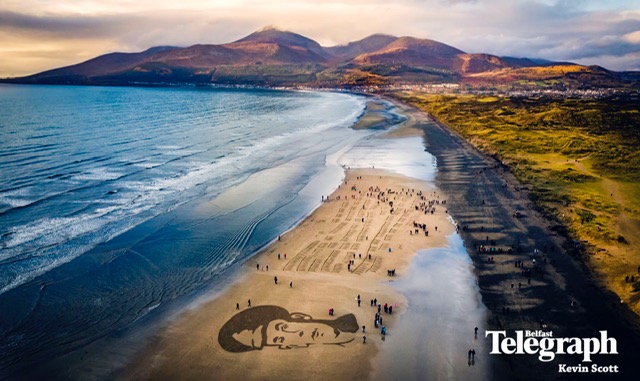
This was a small-scale event. The second experience was nationwide, and yet also intensely local and intimate. Like many of this Blog’s readers I spent several hours of Sunday 11thNovember on the beach at Danny Boyle’s Pages Of The Sea artwork, commissioned as part of the 14-18 Now commemorations. Sand portraits of participants in WW1 – mainly soldiers of course but also nurses, chaplains and others – were etched on the sand, and taken away by the tide.

Murlough beach just before the tide came in 

 My local beach is Murlough, County Down, under the shadow of the Mourne mountains. Star By Star and my earlier WW1 novel Name Upon Name are set wholly or partly in the area, and both of them explore the lives of local soldiers. When I was asked by the Nerve Centre, who co-ordinated the event at Murlough, to lead the crowd in reading Carol Ann Duffy’s searing poem ‘A Wound In Time’ I was immensely honoured. Out of all the opportunities my books have given me, this has to be the most moving.

I arrived at the beach in pouring rain at 8 a.m. The sand portrait of our chosen local solider, Rifleman John McCance, was already in place, and volunteers, including children, were raking the sand to form lines of silhouettes of more people. John McCance was born in Dundrum, less than a mile from the beach we stood on, and enlisted in nearby Downpatrick, where my own soldier grandfather was stationed twenty years later, before he too left these shores to fight in the Second World War. McCance died at Passchendaele and like so many others has no known grave. He is commemorated on the Tyne Cot memorial, along with 35,000 others. I visited Tyne Cot in 2004 and was overwhelmed by the scale of it. 

My own, much less impressive picture of the portrait
Pages of the Sea was also on a huge scale, with events taking place all round the coastline of these islands, and yet it was very personal and local too. Relatives of John McCance attended.  For me, it was a ten-minute drive on country roads, but many people had made long early-morning journeys. A choir sang local traditional songs, and then I led the reading of the poem. I hadn’t expected people to join in but everyone did. By then the rain had stopped and the morning was calm. Against the swish and roll of the incoming tide we read Duffy’s powerful words. And when we dispersed, to go about out normal Sundays, John McCance’s portrait had gone, taken by the sea much more gently than lives were taken at Passchendaele.


Sunday, 29 April 2018

The book group - Hilary Hawkes


I’ve been invited to join a book group – a real life one as opposed to an online/facebook group.

Now, I have a confession to make. While I consider myself a true bookaholic I’m not all that keen on too much reading to dissect and pontificate at great length with others. If I like a book then I like it and the reasons can vary. If I don’t like one then I usually find out in the first few chapters and either hobble to the end or, in extreme cases, abandon altogether. I’m probably a typical reader.

I’ve read books that have won prizes and thought to myself: “This won? Really?” And I’ve read some lovely self-published books and wondered why on earth a commissioning  editor somewhere didn’t snap up such a promising author.

But these are just my views. Someone else will read the same book and think something entirely different. That’s the way it should be. So book groups where everyone has a different view sounds interesting, but would it really enhance my enjoyment of reading? Would it turn my dream past-time into a bit of a chore? Looking at the list of Suggested Books For The Group I shudder at the length of some of those hefty tomes. They really aren’t books I would choose to read.

Perhaps my hesitancy about joining is due to having studied English Literature at A’level and degree level many years ago. Set texts and dissecting of little bits of them reminds me of exams and assessments.  And while I always knew exactly what I thought of a book – and why- I was often reluctant to have my say amongst others who seemed to be much better at analysing and deciding "what the author meant”.

I've always got my own personal TBR pile of fiction (adult novels and children's books) and non-fiction. I occasionally review books and really enjoy that and I love to talk with other children's authors about children's books.

I think all authors are readers first. But I wonder what proportion of book lovers who are also children’s writers are members of adult book groups. Have you tried book groups and what was your experience?  I’d love to know.
Hilary Hawkes