Showing posts with label Anne Booth. Show all posts

Monday, 13 October 2025

Glad to be Hopeful by Anne Booth

 I think that being a children's writer is a great help for me as an adult, because the discipline of finding something to be hopeful about is essential for our job. We shouldn't be twee, or superficial, or bury our heads in the sand, but I do think we have to find something hopeful for our child readers. 


As soon as I write this I can think of arguments against it - what about funny books which have exaggeratedly negative endings, or the fact that some children find scary books thrilling and comforting, maybe because they remind them that real life isn't all that bad ? Maybe even the presence of humour is enough to give an escape from a difficult present and let hope in, and the thrilling scary books do have hope in that they have heroes and heroines who survive. Beautiful illustrations and typeface and design  can also provide something deeply uplifting and  positive apart from the narrative, but as a story teller, I do think the narrative itself is very important.


All  I know is that I am a bit biased about hope in children's books, because as a child I certainly had a life and a personality where I really needed comfort and hope (and humour and escapism )  in my stories, and I have spoken with teachers who work with looked after children, and they say that they look for stories which are hopeful and comforting, as the last thing the children they work with need is to be re immersed imaginatively  in traumatic situations with no happy ending. I would need to do more research, so please take this as a prompt for thought rather than an essay. I know that there is a way of looking at stories in books as mirrors or windows. Mirroring narratives help us see ourselves and our place in the world, and windows help us see others' lives and develop empathy. I still think that in both those models, for both adult and child readers, but especially for child readers, we still need to have Hope, especially in these days, and as a writer, I think it helps us to put Hope in our narratives.


I remember some years ago  reading  the present Children's Laureate, Frank Cottrell Boyce, saying that there was a need for more Utopian fiction, for imagining better futures, better societies, and as a writer I love that idea, for my own self, not only the children I write for. I have to live in the world and in the worlds I write, and personally, it helps me to  put Hope into my stories, so that after working on a story with Hope in it,  I can put down my pen or close my laptop and  look back into the world I live in, and recognise in 'real life'  the Hope which always existed but which rolling traumatic world news makes hard to find sometimes. These days there are just too many bad news stories about, but it helps me to remember (and I think it is essential for children and many adults to be taught)  that even the news is written - that we are getting narratives which serve the narrators - and hateful or hopeless narratives are no more true than relentlessly positive, head-in-the-sand ones.  There is a sweet spot where we recognise that the world is full of good and bad things, and that there definitely ARE bad things, (which as children's writers, if we need to present them, we must present in age appropriate ways) but fundamentally, love is stronger than the bad things, and endures. That's the happy ever after bit, the thing we hope for, because we know deep down that is true.


So I have to get on now - my own hopeful story is that I am on a part-time MA in Children's Book Illustration. I had to take a year off for various reasons, but I am back on the course now, and it really is giving me Hope to be studying alongside the other students, and to be immersed in such a wonderful world. I am also  illustrating a picture book at the moment, and I hope very much that anyone who reads it  feels more hopeful at the end.  I must go and do some work, as I only have two days before I present it again at our weekly tutorials, and I have to hope that it will be good enough by Wednesday! 

I hope everyone has a good day.

Tuesday, 21 May 2024

Fit to write by Anne Booth

 Tomorrow I am going to my second session of Pilates, and after feeling intimidated about the idea of it for years, after doing my first session last week, I am really looking forward to going back. It takes place in a church hall above a church, and is run by a retired ballerina, and the person running the class, and the other people in the group are so lovely. The main reason I am looking forward to going back is that I can feel the difference after  just that one hour. Like many writers the more I work the worse my posture has got, and I knew I needed help.


The week before last I went to my first yoga session on a retreat - over four days I had seven sessions, and that too was amazing. Who could have guessed that I had forgotten how to breathe properly? Again, I know it was good because I felt so much better after doing it, and I am now going to look for Yoga classes.


I want to keep writing into my old age, but I also want to be mobile, and writing for so many hours a day has not been good for my health, so I suspect yoga and pilates will really be necessary if I am going to keep on this writing malarkey!


What do other people do to keep writing fit?


Monday, 21 August 2023

Trusting the process and not giving up.

 I recently went away for a week's retreat and was helped, as a beginner, to paint my first icon, in this case not a celebrity or a button on a computer,  but a religious painting from the Christian Orthodox tradition, painted, or 'written' in a particular way, which is specifically created to be prayed with. Painting or 'writing' an icon involves following a traditional process. There are set prayers to be said before starting to paint, set materials used, there is an order to the painting, and set colours associated with the Sacred subject chosen, but there is also a recognisable form and order in the way to paint it - day one I was taught to transfer the image on to a white prepared board, then prepared the board to add gold leaf, and each day following there were set tasks - adding the double halo, the lettering, painting the garments, the skin, etc.  


It was a wonderful week for me, and I felt great peace, but there were also really difficult parts, because I had never been through that process before. It started off very well - by the end of the first day I had a face traced on the canvas, and I had applied the gold leaf, but as the week went on I felt it descended into chaos and I felt really embarrassed and, at times, despairing. It was really hard to keep going, but our tutor was very gentle and kept saying 'just add another layer' and assured me it would be fine. At the end of the week the icon would be blessed, for us to bring home to pray with,  but only if it was finished, so I was desperate not to mess it up.


I took photos of every stage of the process, and sent them to my friend, an artist, every day, to show her how I was getting on, and I even sent her photos of the work when I felt it was going wrong.  Yesterday I met up with her, and she told me, that as an experienced painter and teacher, she never at any stage felt that I was messing it up. She recognised what was happening as essential to the process. 


Even though writing an icon does not seem to leave room for creativity as such, each finished icon is subtly different, because of the individual iconographer, so I think there is some parallel with our work as writers for children. The whole experience reminded me that there is always a stage when we are embarking on a creative project when everything is shiny and new - we have traced the outline and even have gold leaf shining. But to get to the end, we have at some point to descend into chaos, lose our way, before what we have created becomes clear. I think that applies whether we are writing an icon, or a children's book, whether we are religious or not, but there is always something amazing about trusting the process, not giving up, and getting to the end! 

I won't share all the photos, but here are some examples of stages along the way:


Towards the beginning, feeling positive about how it was going, the halo shining, the image clear.

But as the week went by it got more worrying, and harder to trust in the process...but then the final icon emerged, and it did get blessed, and I do now pray with it every day!


So don't give up, if you are at that worrying middle bit! 


Tuesday, 13 June 2023

Only Connect by Sheena Wilkinson

 Last month I wrote about how much fun it is to visit readers, as Mrs Hart continues her tour of any book group who’ll have her. This month I’m going to talk about collaboration with other writers. Not in the sense of writing together – I have very little experience of that beyond a Chalet School fanfiction collaboration with my friend Susanne. Not in the sense of supportive groups online, though that is a joy and an endless source of help, but in the very specific sense of getting together to do events.


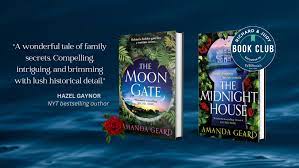
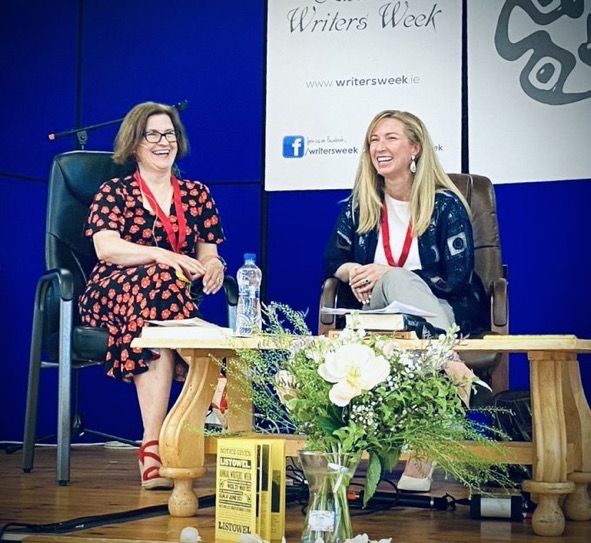
Last week I was at Listowel Writers’ Week, Ireland’s oldest literary festival. The programmer, Stephen Connolly, told me I would be reading with another historical novelist, Tasmanian-born, County Kerry-dwelling Amanda Geard. We had never heard of each other. Our conversation was to be unmoderated so there was tremendous pressure on us to build a rapport. But what if I didn’t like her novel? What if I couldn’t find any points of contact between the books? And there was always the fear that she would hate Mrs Hart’s Marriage Bureau. Maybe she would be a very serious person who would despise a novel set in a marriage bureau? Her first novel, The Midnight House, had been a Richard and Judy pick. Maybe she would be too fancy and successful and I would look like an eejit beside her? 


 Amanda’s second novel, The Moon Gate, arrived in the post. It looked very beautiful and very big. Over 500 pages. Eek. And for a two-person discussion I would have to read every single one. I will never forget my very first literary panel, a reader’s day at a local library. We were talking about favourite books – a sort of Desert Island Books. I took it very seriously, spending weeks reading the other panellists’ choices, to ensure the best discussion for the audience. Three of the other panellists took the same approach. The fourth, who wrote for Mills and Boon, said that she hadn’t read any of the other books, because as a fulltime writer she didn’t have time to read. At the time I had published only a few stories and a lit crit book, but I knew that I was never, ever going to be that person. 


Anyway – hooray! I loved The Moon Gate from the start. With three timelines, and moving between Tasmania, London and Kerry, it’s a sweeping, escapist epic story.  Impressively potted, impeccably researched, it’s full of intrigue and heart. I gulped it down in a few days and I knew that I would like the person who wrote it. And even more of a hooray – the as-yet-unknown Amanda started to post on social media, and then to message me, about Mrs Hart. She loved it too! Even better, though the stories, settings and scope of the two novels were very different, we kept finding little things in common: a concern for the ongoing effects of war; the fascist menace in the 1930s; homesickness and loneliness. 


Businesslike, we exchanged questions by email. We messaged all the week before the festival – OMG, I can’t believe she… I’m at the bit where… How could you have… I think I might know who… 


The event was at two, and we agreed to meet at eleven in the hotel foyer. I sat with my notes, and her questions, nervous again that in three hours’ time an audience (hopefully!) would turn up to be entertained and informed by two authors who had never met. Amanda walked in bearing a box of eggs. ‘From our chooks,’ she said and I knew immediately that I had made a friend. 


We talked and talked. We shared the anxieties we had each had about working with a stranger. We laughed at how silly that seemed now. And when two o’clock came round, and we were facing each other on stage, we settled into what already felt like a chat between old pals. Several of the audience told us later that they couldn’t believe we didn’t already know each other. We loved the chat, and the relationship between the two novels so much that, despite living 350 miles apart, we’ve already planned to pitch ourselves as a duo to other festivals. I can’t wait!


(And the eggs were delicious!)


Amanda and I were thrust together, as it were, by an insightful programmer. Later this week, on Saturday 17th June, I’m appearing at the Belfast Book Festival with Anne Booth. I haven’t met Anne in real life yet. I came across her first on this very blog, and when I read her gorgeous convent-set novel Small Miracles, I recognised in it the same sense of community, friendship and hope that’s central to Mrs Hart. Maybe, I suggested, she’d like to do some events together? I thought she might think I was pushy and crazy, but she was delighted. I pitched the idea of a discussion of ‘feelgood feminist fiction’ to Sophie Hayles, the director of the Belfast Book Festival, and luckily she agreed that it was a great idea. Our chat will be moderated by a fantastic writer and journalist, Sue Leonard, who has interviewed us both and whom I met years ago at the Tyrone Guthrie Centre, an artists’ retreat in County Monaghan.


Anne and I have zoomed, and I know already that we’re also going to have a great chat onstage! And we’re hoping to bring our feelgood feminist event to bookshops in the UK soon. 


Writing can be lonely; publishing can be frustrating, but connecting with writers you admire is one of the things that makes this whole business worthwhile. 


Thursday, 21 April 2022

A Small Miracle of a Retreat by Anne Booth


On Friday I am going to a lovely place, run by two incredibly kind people.  The first time I booked to go, on strong recommendation, was in June 2017, and I cancelled literally the day before I was due to go, because my dad was very ill, and I feared he was going to die. He died the next day, the very day I was due to travel, and I was so lucky to be able to be with him, so I made the right decision.  I will never forget the kindness of Janie and Mickey Wilson, who run Chez Castillon Writers retreat, in the South of France,  because even though I had cancelled the actual day before, they were so lovely and still insisted that I transferred the whole week to another week, and so I ended up going in September and getting loads of work done. Mickey and Janie are wonderful hosts and I have visited a few times since then and have loved it each time.  Chez Castillon is a beautiful, kind place where  I can focus on writing, and I love the company of other writers working, and the delicious  food, and Charlie the cat and Rory the dog and the  town, and the river,  and the church across the road and the bar around the corner!

I am going there to write my sequel to my debut adult novel 'Small Miracles', which is due out in August,


and the fact that I am going there at all this week is itself a small miracle.  Janie and Mickey had to close during lockdown, and when they opened again, starting with this retreat, they sent around emails telling past visitors they were open again. I replied I was so pleased they were open, and I was looking forward to coming back, but I didn't have any money to come at the moment. 'Don't you remember  before lockdown that you already paid a deposit for you and your husband?' came the reply.  I hadn't!  They pandemic has made me forget so many things. If Janie and Mickey were less honest they could have absconded with my cash. Instead, three years after after I first paid some money down in the hope of adding more and coming back with my husband, I am using both deposits for myself and coming back on my own (my husband is very kind!) and hoping that this Friday to Thursday will work small miracles.

I think that with all the bad things going on, it is good to remember that there are still kind, honest people and beautiful places and it is OK sometimes to retreat in order to regain strength and focus. Like many I have got a bit overwhelmed by all the news and not being able to fix things, and I realise I can't carry on trying to change the world by tweeting, and I know I need to get off Twitter and  use my energy to finish writing my contracted book as I am just not getting on fast enough. I am going the week that the writer Jo Thomas is leading a retreat, so I am hoping to get wise advice and tips from her.

I hope if you are feeling overwhelmed or stuck, you too can retreat, even if just by getting offline.  I hope if you need a small or big miracle in order to be able to do it, that it will happen. I totally recommend Chez Castillon to writers if they have deadlines - once you get there, all you are expected to do is write, and eat delicious food, and for a writer, you can't say better than that!


Chez Castillon


Saturday, 5 March 2022

Just a quick note... from Sue Purkiss

 At the moment, the 5th doesn't have a regular inhabitant - so I thought I would slip in very briefly, mostly to commend to you yesterday's thought-provoking post from Ciaran Murtagh. In it, he considers how writing stories for children - stories which embody values such as hope, kindness, empathy: stories in which good people ultimately win - can be balanced against the horrific events we see being rolled out in Ukraine. How can we insist that Right will always prevail over Might, when we are getting constant evidence via our phones and television screens that the reverse is, at the moment, true?

In the comments on Ciaran's piece, Anne Booth provides a link to an article by Frank Cottrell Boyce, the writer of the marvellous and uplifting opening sequence to the 2012 Olympics, in which he discusses the role of the arts in the context of that inclusive, joyous and exuberant portrayal of Britain, and of the very different Britain which came to the fore in the Brexit referendum. He cites a Roma woman, brought up in a series of orphanages in Switzerland, who overcame very difficult circumstances to lead a happy and successful life. 

She had grown up in Switzerland where - shockingly - Roma children were taken away from their parents on the thinnest of pretexts, then brought up in institutions where, supposedly, they would have a better chance of becoming valuable Swiss citizens. Mariella had been in thirteen different institutions, narrowly missed a lobotomy and had her own child confiscated. Yet when I met her she was an articulate, charming, outward-looking politically active, distinguished writer. I asked her about all that rebellion, the repeated expulsions … I asked her … how did you know there was something to rebel for? How did you know - growing up in this regimented institution where you were defined entirely by race - how did you know you were worth more? And she said said something I have never forgotten … it’s the thing that made me want to be a children’s writer … she said, I read Heidi.

There's so much in this article that struck a chord with me. If, as must surely be inevitable, you are feeling downcast at the moment, I would strongly recommend it. If I had to pick out one gem, it would be this: A book is not a learning resource. It's the knife that picks the lock of your isolation. It's a box of delights. Justification enough to keep on writing, even if, at the moment, in the shadow of what is happening, it seems like fiddling while Rome burns. It's not. It's really not.

Here's a link to the article, and thanks to Ciaran and Anne.

https://commons.wikimedia.org/wiki/File:Also_admitted_2014-04-10_23-25.jpg


Thursday, 21 October 2021

Random thoughts about writing and pay, penned from a sick bed! by Anne Booth

 I am not very well today, but my post is due tomorrow, so I thought I would jot down some random thoughts I have been having. The good thing is, if they are obviously wild, I can always blame being ill..


I recently applied for two lovely writer in residence jobs. I was sent details by a friend and encouraged to try. I actually hoped and thought I might be in with a  good chance, but I didn't get either. I know I could have done a good job, and I had lovely rejection emails, talking about the strength of all the applicants, and when I found out who got the posts, I did feel much better and totally understood why - I would have given the residencies to those two writers too!


The thing I want to say is, however, that the main reason I really really wanted those jobs, and why, it seems, so many other very experienced writers did, was because, as well as being very interesting,  these residencies promised guaranteed regular monthly payments over a year. I wonder, if publishers are really serious about diversity and encouraging people who are not from wealthy backgrounds, if they could think about how much this would mean to all writers, existing published  authors and aspiring authors, struggling to budget. 


One of the most stressful things about being freelance is the fact that you can't be sure what you are going to earn from one month from the next, and also when people you have signed contracts for, or already done work for, are going to pay you. Worrying about money is not great for Creativity, contrary to the Romantic image of the starving artist. Publishing advances are paid in instalments, when you sign the contract, when you deliver the finished manuscript,  and when a book is published. The problem is, that when a book is published years after a contract is signed,  which is common, this inevitably means that you then go months and months without more payments, and most advances, contrary to what people think, are not huge in the first place. 

Writers can, of course, do events, but we all know about chasing payments after events. Personally I have been very lucky and schools have paid promptly, but some writers have had nightmares with schools not paying, and writers all know about being asked to do lots of lectures and visits and workshops for free or for 'exposure', and how tiring and embarrassing it is to have to constantly keep explaining to people who themselves are often on a salary, that freelancers need to eat & pay bills!  

The way round it, of course, for full-time writers who have good agents, as I am lucky enough to have, is to hopefully write lots and lots of books, so you are always writing and submitting books,  signing contracts, or receiving royalties, or plr,  or money for translations rights, or visiting schools, but even with the best of agents that's so much easier said than done these days, and it is very very hard work to sustain at the best of times, but especially in a pandemic. Added to that the fact that many good writers are not also natural performers or confident self-promoters, or self-confident at all, and also there are times, like recently, in a pandemic, when publishers are themselves struggling and just not taking on many books, and you have a rather stressful situation. So many existing published writers give up, and so many aspiring writers don't even start, because of  financial stress.

So, I wonder if, to truly encourage and nurture and keep writers from different backgrounds, if the publishing industry could consider how regular monthly payments over a year to more writers, existing and aspiring, however small the amounts, rather than huge headline-grabbing advances to a few celebrities  who are actually not cash-strapped, could really dramatically  help re budgeting and stopping creativity-stifling anxiety? Maybe bigger publishers could even pay new writers, and also writers already on their books, a salary - a monthly amount for a set time, a year say? Established writers could be paid to mentor upcoming writers, or just to produce their new work. I am sure this would encourage and enable more new writers without private means if they knew they could budget and commit to write part-time or even commit to writing full-time, without constantly fretting about bills, and it would stop already published and experienced authors without private means, from giving up. Many existing writers of wonderful books have stopped writing, not because they have run out of ideas or lack ability, but because of financial insecurity, and that can't be right or healthy.  Even small regular amounts from smaller publishers could mount up and help budgeting for bills, and might help the publisher budget too!


I am sure this would help illustrators too.


Right, I don't know if that was the lemsip talking, but I honestly would like to see some sort of change.


Tuesday, 21 September 2021

Parables or Propaganda? The role of the Children's writer.


I went to an online book launch this week, of a book by Philip Reeves, a children's writer whose work I really admire, and whose imagination astounds me.  I bought and read the book, 'Utterly Dark and the Face of the Deep' and frequently had to stop and read bits out loud, as I just love the way he uses words. It's a great story. Philip says he wants to write Art which is accessible to children, and I think he does just that. The way he uses language is amazing, and I highly recommend it. 


Here is the recording of the books launch. It's really worth watching,  for the readings by Philip and also the introduction by Liz Cross and the interview with Nikki Gamble. There were also questions from people there, and someone asked him whether he would ever write for adults.

https://www.youtube.com/watch?v=cV78OU0CF84


In the interview, at 48.51 Philip replied to a question about whether he would ever write for adults,  saying something which really interested me and made me think. He mentioned a trend in children's' books that he didn't like, called 'The Water Babies tendency', a tendency to be didactic and use stories for children to impart lessons for readers. He said that he didn't want to write parables, and that he wanted to write Art, and as long as he could do that he would continue to write for children.


I think that's fascinating, and his mention of 'The Water Babies' really made me want to explore this more.


I totally 'get' what Philip says about didacticism in Children's Literature. Back in 1993-95, I studied for an MA in the History and Development of Children's Literature, and am very interested in Victorian books for children, and have a small collection of them. Anyone who ever reads the incredibly popular  'The Fairchild Family',  (pub in three volumes 1818, 1842, 1847) by Mary Martha Sherwood  - will understand Hilaire Belloc's   'Matilda' and others of his 'Cautionary Tales', which I am sure directly reacted to books like 'The Fairchild Family'. The dire consequences of a lie told by a child in The Fairchild Family' are jaw-droppingly awful! The fascinating thing is that it was seen as delightfully realistic at the time! 


https://en.wikipedia.org/wiki/The_History_of_the_Fairchild_Family

https://en.wikipedia.org/wiki/Cautionary_Tales_for_Children


As a child, and as an adult, I have read my fair share of  stories for children which are just not very good, and which are being used to impose some sort of value system, religious or political. The most extreme examples of this which leaps to mind, which influenced my book 'Girl with a White Dog'  can be seen here:


https://wienerholocaustlibrary.org/exhibition/a-is-for-adolf-teaching-german-children-nazi-values/


I am in no doubt that didacticism and worthiness is fatal for good Art, but I confess that as an adult writing for children I did have a message I wanted to convey in all my MG books - I did want to use story to tell children something about History, and I know I have more stories I want to tell like that. I realise that if I know I have a message, I have to also make extra sure that the quality of my story telling and writing isn't damaged by any existing desire to use story to inform/warn and, I hope, empower children. Luckily, I am not alone, as I have an agent and publishers and editors etc to make sure that the story takes precedence, but it's an important consideration for me, and a real challenge. In the end, the story has to come first.


I have ambivalent feelings about 'The Water Babies' and its author. My mum and dad were Irish,  and I have read some appallingly anti-Irish things written by Charles Kingsley. Reading it now, the actual book is full of moralising. At the same time, I can't help admiring it - I think it is amazing that one children's book could have such power to change the fate of real life children - 'The Water Babies' got through to public consciousness, and had immense influence, helping to bring about the end of the use of climbing boys. 


"Black Beauty' by Anna Sewell was written primarily to draw attention to the cruel treatment of horses, but I think the reason why it is so loved is that it is beautifully written, and a wonderful story. 


I come from a very religious, Christian background, so I am very used to the idea of parables, and the idea of stories being told to impart some truth about life. I love, for example, the parable of the good shepherd, or the Good Samaritan.  I suppose I wrote a sort of a parable about the power of loving attention when I wrote 'Bloom', illustrated by Robyn Wilson-Owen. However, thinking about Art and the power of the unconscious, I realise that I discovered the parable after I had written it. I didn't set out to write a parable - I wasn't even sure what I was writing when I started - I just started to write a story about a little girl who loved a flower, and the words just came.


So I don't have any answers, just that attending this launch and reading this book has reminded me to look out for any clunky didacticism which might damage story, whilst remembering that I am an adult writing for children, and that does affect what I do. I would love my writing to help change the world for the better in however small a way, but that is a desire full of pitfalls. I want primarily to make Art, to be a story-teller, and I am inspired by amazing books which tell great stories. I think as writers we are all inevitably  influenced by our own personal values and belief systems when we write, and that will be communicated, overtly or not. I end with some inspiring words by David Almond from his website:


'To create and to pass on a story is a fundamental, human act. We’ve been sharing stories with each other since the beginning of human time. We’ll be sharing them until the end.'

DAVID ALMOND https://davidalmond.com/on-writing/


Every story that we write or read or act or sing or dance is an act of optimism, a move against the destructive forces that want to stifle us. 

https://davidalmond.com/about/


Saturday, 21 August 2021

Some hopeful, helpful quotes . By Anne Booth

 The news is terrible. I follow Dr Waheed Arian on Twitter (@DrWaheedArian). 

 He is an amazing person who came to Britain from Afghanistan as an unaccompanied child refugee and is now an NHS doctor who has worked throughout the pandemic. He has also written a book about his experiences, and has set up a charity. I recommend you following him. This is an interview with him I read this week, such an awful week for Afghanistan and for the world:

https://www.thenationalnews.com/world/uk-news/2021/08/19/celebrated-british-afghan-nhs-doctor-calls-for-compassion-for-new-refugees/

 I was very struck by this tweet:

I get asked a very difficult question - 'is there any hope in Afghanistan?' No one knows the future and our past traumatic experiences haunt us badly but I can't let go of 'hope', which has helped me survive. I want others not to give up on it too.


I was thinking again of a story by Frank Cottrell Boyce about the role of children's books in keeping hope going in terrible situations - he talks about interviewing a Roma woman called Mariella Mehr:

'She had grown up in Switzerland where - shockingly - Roma children were taken away from their parents on the thinnest of pretexts, then brought up in institutions where, supposedly, they would have a better chance of becoming valuable Swiss citizens. Mariella had been in thirteen different institutions, narrowly missed a lobotomy and had her own child confiscated. Yet when I met her she was an articulate, charming, outward-looking politically active, distinguished writer. I asked her about all that rebellion, the repeated expulsions … I asked her … how did you know there was something to rebel for? How did you know - growing up in this regimented institution where you were defined entirely by race - how did you know you were worth more? And she said said something I have never forgotten … it’s the thing that made me want to be a children’s writer … she said, I read Heidi.'

https://www.theguardian.com/music/2016/jul/15/frank-cottrell-boyce-proms-lecture-what-point-culture-in-brexit-britain


When looking for this quote from Frank Cottrell Boyce ( who is  @frankcottrell_b  on Twitter)  I also came across this blog post by Andrew Wille, also quoting from Frank Cottrell Boyce, and with additional thoughts  which are also, I think, very inspiring for writers:

https://wille.org/tag/frank-cottrell-boyce/


There is so much suffering in the world, and as human beings we must do all we can to alleviate it, but we can only do so much, personally, in our families, locally, nationally and internationally. It is easy to get overwhelmed by so much pain,  and fear that there is nothing we can do, and then despair, and do nothing. I read this following post this week, and felt very helped by it. I shared it on twitter and facebook, where people told me they also found it very helpful, so I  will share it again now. I am very grateful to   Nadia Boltz-Weber  @Sarcasticluther for writing it  

https://thecorners.substack.com/p/if-you-cant-take-in-anymore-theres


I love what she says about mercy, recognising our limitations and supporting,  not judging each other. I think this is especially applicable online, when I think people forget that the people we tweet to have backstories and offline lives that nobody knows about. We don't need to pile on pressure.


I know I am not temperamentally or intellectually suitable to be an NHS doctor, or activist, or politician. I did feel seriously overwhelmed by anxiety and helplessness and guilt about all the issues and problems in the news at the moment and the urgent need  to fix them, but I think trying to keep off/cut down on social media and to use my energy to do what I CAN do has brought me more peace and focus. I want to support all those people working in areas I am not - give money when I can, pray for them, RT and share posts, sign petitions and educate myself - and in turn I must work as hard as I can on things I CAN do.

 We live in a world which is full of suffering but also full of love. I want to do my best to write books which will give hope and comfort and cheer to children and adults living in this world, just as I feel so helped by the people who write the books I read or scripts for the films I watch.  Writing is my job, and all I can do is to try to do that to the best of my ability. For all of us, in order to be able to do the job we are called to do, means looking after our mental and physical and spiritual  health,  praying if we pray, taking time off to relax, having enough sleep, eating and exercising properly, spending time with people we love and who love us, allowing ourselves to be happy, and deciding to not get overwhelmed by social media.

 I hope all the children's writers, (and anyone else reading this who is trying to use their talents to the best of their ability, and to do whatever job they can do to make the world, which is in such a state,  better, wherever they are,) can feel and do the same. 

I recommend reading these articles I have linked to if you need inspiration. Lastly, and obviously,  as writers, like anyone else, we can also donate to organisations on the ground  like the Red Cross, and Safe Passage here,  and ask our government to do more for refugees, and support local initiatives in whatever way we can.


Wednesday, 21 July 2021

Muddled thoughts on a hot night by Anne Booth


Here is a quote  I read on Facebook recently and found very helpful:


I always forget how important the empty days are, how important it may be sometimes not to expect to produce anything, even a few lines in a journal. A day when one has not pushed oneself to the limit seems a damaged damaging day, a sinful day. Not so! The most valuable thing one can do for the psyche, occasionally, is to let it rest, wander, live in the changing light of a room.
~ May Sarton

My husband built  my writing shed from scratch for me in 2002, then took it down when we moved across the village, and built it again in our  new garden in 2005, and it has been there ever since. Unfortunately, it has got a bit filled with family clutter, and my own clutter, so will never be an Instagram hit, but I love it, and I have cleared a little space and put a little copy of an icon on the table and a candle in front of it. The copy is of an ancient Coptic icon from the 6th century, of Christ and Abbot Mena, but it is also known as the Icon of friendship, as Jesus (on the right) has his arm around the Abbot. The original, pictured here, is in the Louvre, but it was made popular by the monks of Taizé, an ecumenical centre in France popular with young people, which I visited in my early twenties with my friend, Katy. I bought her a copy of the icon, and she bought me one, and so I think of her often, I have had this icon for about thirty five years. 


The reason why I mention this today is that life is very difficult at the moment for so many. I have been feeling so stressed about what is going on in our country, tweeting desperately, as if somehow I could, in a few well chosen words, copied in to the right people, singlehandedly with a tweet, change the course of history.  Of course, this does not work and it also does not help AT ALL with getting on with my own work, which also adds stress, and then, too often, I go and join my poor family for a meal and get very cross about politics (the auto correct changed politics to poetics, but alas, that is not true) and rant during dinner, or lunch or whatever meal my poor family are unfortunate enough to join me at. Then I go and tweet something about how we all need to calm down and get things in proportion, but I am a big hypocrite because I am often not calm AT ALL.

So I decided the other day, when I felt particularly desperate, that I needed to stop thinking I could save the world, and go and pray for an extended time,  and I went to my writing shed, and lit a candle in front of the icon of friendship. I looked out the window at my little attempt at a prayer garden, (which I love, but Barney our puppy is having a good go at wrecking, and has even pooed in, which Jung and Freud would both probably have a field day with, if they could ever get Barney to be still enough to go on a psychoanalyst's couch, and if they could understand his woofs and growls and yaps).  Anyway, I have recently planted an apple tree - it cost £33 and that is just the best use of £33 ever - the tree is young but tall with green leaves and no apples as yet, and I can see it from my window, so I looked out at that too. I can also see our kitchen window from my shed, and I love seeing my husband in the kitchen, unaware that I can see him, cooking or washing up or chatting with our children.

I think I may have thought that by going to pray, I would find some special, urgent, words to say that would change the world - a bit like a pious, extra powerful, magical/religious upgrading of tweets - but instead, I lit the candle, looked at the Icon of Friendship, and the apple tree outside, and the birds on the roof, and the  overgrown mint and yellow poppies and nettles and untidy pile of abandoned flower pots under the kitchen window, and the house with my husband and two of our children inside, and I stopped trying. I stopped trying to find the words to change everything, and accepted I didn't have them. I just sat, and looked at the icon of friendship, and at the candle, and the tree, and I just felt suddenly so peaceful. For an hour, the worry stopped, and it didn't feel like burying my head in the sand, or running away from 'reality', but being in a deeper, gentler, kinder, and profoundly true and 'real' reality, deeper than poetics or politics, deeper than words, which was the presence of Love, and a reality present for everyone.

The world isn't lovely for many people now, and I think as writers we do have to try and use words to make it better . This may take the form of protesting tweets about political decisions which hurt children, or funny clerihews, or books to make children laugh or help them cry, or teach them about history or even how to read at all. But we have to know that we CAN stop using words when it is all too much, that it is NOT all up to us, and that there is something real and deep under all this commotion and fear, that is good and strong and gentle and eternal and can't be destroyed. Even if you aren't religious like me, and don't believe in a 'God' or 'gods' as such, I think all the writers I know passionately believe in Love and Goodness and Truth, and in something as everyday, but as beautiful and vital as an apple tree = Friendship. My icon of friendship, bought for me by my friend all those years ago, showing an ancient picture of Jesus with his arm around a Coptic monk, a holy Abbot and therefore his friend, is a great spiritual blessing for me. I hope that all the writers and readers reading this in these very difficult and stressful and often heart-breaking times, find comfort and friendship and blessing and the right words, and if not the right words, deep peace in, and under, and beyond words, in their lives today. I hope everyone feels the presence of Love, if we manage to write, but also if we don't manage to write anything at all.


Monday, 21 June 2021

Reading for Pleasure by Anne Booth

As a child growing up in the 1970s, I lost lots of time off school. Between the ages of 6 and 16 I rarely had more than 3 days attendance in a week, and was often off for a week or two weeks at a time. The reasons were complex - asthma didn't help - but the reason why my whole education wasn't ruined was that I read voraciously for pleasure . As I grew older, missing school did impact me socially and also, from being very good at Maths at Primary school, I fell behind with more advanced Maths and school absence probably did contribute to me losing my way with Physics and Chemistry, but reading definitely helped me keep on top of subjects like English, History,  Religious Education, and French literature. Reading also helped me, isolated at home, still meet people and encounter situations outside my own world and family. It distracted me and made me happy when I was sad, or unable to change situations  which I knew made my family unhappy. 

I read, from an early age, comics like 'Twinkle' and 'Bunty' and 'Tammy' and 'Mandy' and Children's Annuals, like 'Treasure' and 'Look and Learn' and 'The Blue Peter Annuals', but also, simultaneously, when I felt like it, I read classics of children's literature, like 'Anne of Green Gables', or 'The Secret Garden' , but also classics of adult literature like 'Oliver Twist' by Dickens or  'Jane Eyre' by Charlotte Brontë. I read books which were 'too young' for me and books which were 'too old'. I read books which had been published and written for children decades, or even a century before me, as well as contemporary children's books. I read, and kept reading, books for adults by P.G. Wodehouse, and Jerome K Jerome, and I loved books for children about Jennings and Just William and Paddington. I still do. I read natural history books, history books, even books about prayer and spirituality. I had access to the books because I had older brothers, and also because of weekly jumble sales my mum took me to, and because of occasional  trips to a public or, when I was at school, my school library, and because my mum had lots of prayer books and books on spirituality, and had also invested in a set of Arthur Mee's Children's Encylopedia, which she paid off in instalments to help my brothers and me with our education. I loved picking up a volume and reading random articles, and that pleasure helped my general knowledge, and that helped me at school.

I don't need to push the importance of children reading for pleasure on to readers of this blog. But I just want to say that, as an adult, it is also OK to read voraciously for pleasure, and to read all sorts. I do wonder if we should lead by example. If we think children should be allowed to read for pleasure, then do we truly allow ourselves to relax and enjoy all sorts of reading, and admit to it? Do we hide a secret enthusiasm for magazines, for, e.g. romantic or detective novels, for thrillers or commercial blockbusters or even for difficult literary novels? Do we accept that adults too can enjoy, at the same time, reading poetry for pleasure, and romantic fiction, and non-fiction, and detective fiction, and historical fiction, as well as history - social and political and cultural, popular and/or academic - and children's books, and YA books and graphic novels and books about science fiction and politics and economics and theology and spirituality and books about music - popular, folk or classical - and art and natural history and other non-fiction books, and pattern books and maps and gardening books and car manuals etc. Are we embarrassed by our love of a particular genre which we worry is too 'easy', or self-conscious about being pretentious and admitting to liking things which are too 'hard', like philosophy or experimental fiction or works in translation? Can we admit to liking different things for different reasons? If not, why not? Who, or what, are we afraid of? If we want children to feel free to read for pleasure, are we truly allowing ourselves to be free too, or are we anxiously  constrained by our social media image or profile, or as writers, our 'brand'?

So that's all I have to say, really. I don't want children to be ashamed of what they like reading - and I love how a good librarian and teacher can help children find the books they will truly enjoy - to inspire and push them but never shame them. In the same way, I'd like adults also to not feel they have to only enjoy - or admit to enjoying - reading -or writing - one type of book. We have all been through such a lot during this pandemic - when we go back into bookshops and libraries, let's not limit ourselves to one or two sections - let's read voraciously for pleasure and discover the wisdom that comes from letting ourselves encounter and explore other worlds - and bookshop sections - and let's not be ashamed, if we truly love something,  to share what we discover!