Showing posts with label Saviour Pirotta. Show all posts

Friday, 24 November 2023

The Stories That Shape Us, by Saviour Pirotta

 When readers ask me what books from my childhood inspired me to become a writer, my answer is always the same. The Lion, the Witch and the Wardrobe, Treasure Island and Rosemary Sutcliff's The Eagle of the Ninth. The reasons I give are as follows: CS Lewis introduced me to high fantasy; In Treasure Island I met the first antihero; a baddy that had elements of good, someone I actually wanted to meet in real life. And Rosemary Sutcliff taught me that good historical fiction can be timeless. It uses the past to speak about the human condition in the present. 

But, writing film synopses for my historical fiction recently, I realised there is another book that has had a direct influence on my work. That's Ben Hur by Lew Wallace. Most people my age are familiar with the story, probably because they've watched the film version starring Charlton Heston in the title role. I too was introduced to the story via William Wyler's 1959 film, although I was only a baby during its first release. I saw it when it was re-released in cinemas in the mid-sixties.  The story was dismissed as passe by the critics even when the book was first first published in November, 1880. But readers, and later, filmgoers too connected with it in their millions.  The larger than life characters, the setting, the photography, the dialogue, a humdinger of a chariot race and a cracking plot involving friendships turned sour, revenge and ultimately forgiveness made a massive impression on 7 year old Salvatore sitting in his local cinema on a Saturday afternoon.


As I grew up and discovered nouvelle-vague cinema, kitchen sink drama and mid-20th century authors, Judah Ben Hur and his frenemy Messala faded from my mind. Or did they?  Looking through my own work, I can see the direct influence of this timeless story on my writing.

In my Stone Age novel The Stolen Spear and my Golden Islamic Age story The Golden Horsemen of Baghdad,  the main characters make a mistake that has terrible consequences and which sets them on a journey of self discovery and redemption. Like Ben Hur, Thrax in my Ancient Greek Mysteries, is obsessed with finding his lost mother.  Jabir's mother and sisters in The Golden Horsmen are exiled to a cave outside their village, just like Ben Hur's family.


Powerful stories from our childhood tend to stay with us even when we think we have forgotten them. Their leitmotifs help shape our thought process and our world view, especially when they mostly deal with universal truths and imponderables. We often feel impotent when faced by a world that seems to be motivated by greed and anger. But there is something vitally important we writers can do. We can tell out stories to help point young minds in the right direction.

Saviour Pirotta's latest book, The Jackal Graveyard is the third instalment in The Nile Adventures. Follow him on instagram @saviour2858, on X/twitter @spirotta, on threads at saviour2858 and on bluesky @saviour.bsky.social.

Saturday, 24 June 2023

Let's Hear it for the Grannies, by Saviour Pirotta

I was at The Big Malarkey festival in Hull this week and a kid in the audience pointed out that I seem to include grannies in most of my stories. She wasn't wrong: I do have grannies in nearly all of my books. For me grannies are a leitmotif. They represent love, kindness, wisdom, empathy and life-experience, all qualities my real-life gran had in spades.

I was very close to my maternal gran. (I never knew my paternal gran. She died when my dad was only ten, but that's a whole different story, for another time). On most schooldays I'd go over to her house a few doors away from my own home, read to my bedridden grandpa and then have tea. This was invariably a generous tomato paste and olive oil sandwich with tuna, olives, capers, pickled onions and hardboiled eggs. Granny and I would eat it sitting among her potted geraniums on the roof terrace, watching Red Admirals sunning themselves on the wall across the alleyway. 


Illustration by Jane Ray from The Unicorn Prince


Granny passed away the same year I emigrated. I like to think she died of a broken heart - she often said I was her favourite grandson - but she'd had high blood pressure for years.  But the memories of those long balmy evenings spent watching the sun set behind Mount Etna across the sea have never faded. Even today, 42 years after her passing, I still talk to my gran when I feel things getting on top of me, and I always feels she answers with words of sage advice.

I grew up at a time and in a culture where old people were looked up to and respected. They were seen as the bedrock of society, passing on their wisdom to the younger generations, whether that involved advice on marital difficulties or something innocuous like learning to make fresh pasta.  I like to keep that tradition alive in my stories so, yes, Granny always pops up in a lot of my books, in one guise or another. There's Grandma Nabiha, the tribal head of a Bedu nation in The Golden Horsemen of Baghdad; there's Cook in The Ancient Greek Mysteries, who's not the protagonists' actual birth grandmother but takes them under her wings (and plies them with delicious honey cakes).  And there's a herbalist, wise-woman Granny in The Unicorn Prince who infuses the story with familial magic.  And my next Granny? Can't divulge much about her just yet; let's just say she's going to be a seafaring angel with broken wings. But, again, that's another story for another time...


Saviour's latest book The Jackal Graveyard is out now. Follow him on twitter @spirotta and on instagram at saviour2858.


Wednesday, 24 May 2023

The Nile Adventures; writing about Ancient Egypt, by Saviour Pirotta

When this post drops on the 24th of May, it'll only be four days to the publication of the third instalment in The Nile Adventures series. Purely by coincidence, I have just finished the final draft of the last title in the saga: The Serpent's Eclipse. It's been a long journey with the three main characters - Renni, Mahu and Balaal, three children who live during the reign of Ramesses II, considered to be the most glorious period in Ancient Egyptian history. It's a journey that started over twenty five years ago on a trip to Egypt. 

Cruising along the Nile, with stops along the way to visit awe inspiring sites like Kom Ombo, Philae and Abu Simble, I was struck by the grandeur and majesty of it all: the remains of enormous temples, the walkways guarded by sphinxes, the hypostyle halls. I only had to close my eyes and I was back there at the time of the Renni, Mahu and Balaal, when the temples were still standing and the power of Pharaoh over his people was absolute.

But there was a simpler side to the grandeur, one that seems to have survived into present times. Sitting under a canopy on the deck of our vessel, you could see daily life on the banks of the Nile. Farmers tilling the land with hand tools, (the famous Nile inundation does not happen anymore, thanks to the building of the Aswan dam; mums singing as they scrubbed their infant children clean at the water's edge; boys standing still as statues on fishing boats, hoping to spear a tilapia for supper. I didn't need to close my eyes to imagine these people in Ancient Egypt. They were there in the flesh, doing what their ancestors have been doing since the first temples were built. And it was this aspect of Egypt that I wanted to capture in my stories.  Everyone can google facts about he high and mighty; the Pharaohs, the queens, the viziers, the chief priests of the temples. But what was life like for the children of the farmers, the artists, the simple craftsmen, the sailors on Iteru, the grand river?


I soon filled an entire notebook with scribbles and photos, with ideas for plots and set pieces. Doing my research afterwards, I was struck by the duality of Ancient Egyptian life. On the one hand, the Egyptians celebrated life with verve. Even their language was effusive. Celebrations had evocative names like Beautiful Festival of the Valley. A person might refer to the sunrise as 'the glorious coming forth of the light.' People, no matter their class, dressed up for parties - the rich in their mansions, the poor out on the streets or in the courtyards of the grand temples. They were entertained by musicians, jugglers, dancers and deft magicians.

And yet they were also obsessed with death and the afterlife. In a culture where life expectancy was short, where infant mortality was high and accidents in the workplace a daily occurrence, people lived in fear of death. Everything, no matter how beautiful or precious, had a darker side. The great river supplied the means of life itself but it also harboured death in the form of crocodiles, water snakes and storms.  This duality was mirrored in their beliefs. The crocodile was revered as an incarnation of the god Sobek but also feared as ruthless taker of life. 


This was another aspect of Ancient Egypt I wanted to capture in my series. So the stories have their own duality. One story arc deals with the earthly ambitions of the children. Renni wants to be an artist. His elder brother Mahu dreams of being a sailor. Balaal, a Phoenician princess in exile, wants to learn about the Egyptian way of life. The second arc deals with the afterlife as one foolish act by the brothers brings them up against gods, monsters (both human and immortal) and the ka, the spirit of a dead general. 

I hope the two sides of the narrative blend as seamlessly as life and belief did in the real Ancient Egypt. I have grown fond of the characters, especially Renni who is partly based on yours truly and shares my world point of view. It will be difficult, and sad, to let go of them but new eras and new characters beckon. 

Saviour's The Nile Adventures series is published by Maverick. It is illustrated by Jo Lindley.  Follow Saviour on twitetr @spirotta and on insta @spirotta2858.


Friday, 24 March 2023

Manifesto, by Saviour Pirotta

Hi guys, it's been a scramble trying to think what I can post about this month. My father's passing last November threw my writing schedule well out of kilter and I'm still struggling to meet deadlines four months later.  So here's a little manifesto I wrote for myself at my father's bedside. It's a bit twee in places but as Norma Desmond said in Sunset Boulevard, "I wrote it with my heart'.


Friday, 24 February 2023

ON DAHL AND AUGUSTUS GLOOP, by Saviour Pirotta

 When readers ask me why I think historical fiction is important, my standard and honest reply is 'because we have to know the past to understand the present and shape our future.'

    I'm saying this because I have been following the public debate about Puffin's 'retouching' of Roald Dahl's books to make them more acceptable to modern audiences. As I'm sure all followers of this blog know, Penguin hired 'sensitivity readers' to remove language from his work that they think stigmatise people. Many have come out against this decision, and I am against it too, but for different reasons mostly quoted in the press.  


    One of the big changes is apparently calling Augustus Gloop in CATCF 'enormous' instead of 'fat', even though 'enormous' is still a negative label. At least is hasn't got the guilt associated with 'fat'. As someone who's been fat-shamed most of his life, I abhor that label. At school, it followed me around like a vindictive, whispering harpy, crushing what little self-confidence I had, even - I have to admit - driving me to suicidal thoughts at one point. Dahl was not popular in my country of origin when I was growing up. But there was a very similar character in our Italian primer called Pappo il Mangione, Pappo the Big Eater. In the illustrations he looked very much like Billy Bunter, forever stuffing his face, unable to stop binge eating. More often than not, he was shown with his shirt buttons rocketing off his fat belly. I lived in fear of the same thing happening to me and spent years sitting with my back straight and my tummy sucked in case the buttons flew off my school shirt.

    Words are might powerful things, and when they're given legitimacy by an author, in a book, that power is multiplied ad infinitum. The printed page gives them validity and acceptance. We teach kids to admire and look up to writers. If it's ok for them to label someone fat, why shouldn't the kids? 

    After that little rant, you must be wondering by now why I don't support the changes to Dahl's books. The reason is because Dahl wrote those horrible descriptions. He thought it legitimate to put them down on paper. They were a reflection of his world view, and his readers of the time found them acceptable. Millions still do. No amount of tinkering with text is ever going to change that. 

    Thankfully the world of books (and telly, art and films) is moving on from the likes of Roald Dahl and his privileged ilk (David Walliams, John Cleese etc). There's a plethora of books whose authors choose to celebrate the vibrant rainbow that make up humanity rather than sneer at anyone who's different. Let Dahl and his work be a testament to a world we are hopefully leaving behind. We have to know our past to help shape our future.

    Saviour Pirotta is the author of THE GOLDEN HORSEMEN OF BAGHDAD for Bloomsbury and the WOLFSONG and THE NILE ADVENTURES series for Maverick. Follow him on twitter @spirotta and on instagram @saviour2858.


Tuesday, 24 January 2023

We Don't Need No Edukashun, by Saviour Pirotta

Sorry to dump this on you guys, but I'm hopping mad!

The last time I saw my father in a coherent state at his care home, he let on that there was a secret compartment under the bottom drawer in the tallboy. He and my mum used to keep their money in it before they had a bank account. What a thrill! All those years I'd been playing only inches away from hidden treasure.

I looked in the secret compartment and the only thing left there was a bulging envelope marked SALVINU (my Maltese name until I entered the education system where it was anglicized to Saviour. My parents called me Salvinu till the day they passed away.)

The only thing I found was a stash of school reports from my first years at St. Aloysius College. I didn't even know they existed. And I'm not surprised my dad hid them from mein the secret. He didn't want me to see them! Because the vast majority of the reports were damning. There wasn't a single subject I seemed to excel in. There was no hope for me. The teachers were all bitterly disappointed, especially as I was a SCHOLARSHIP boy.


This scholarship business kept rearing its fetid head at me the entire five years I was at that stupid college. My parents weren't paying for my education, so the Jesuits expected me to be grateful, to work harder than the sons of mp's, magistrates, and rich lawyers whose parents were forever sponsoring new school equipment and sports trophies. I only had to step out of line for a fraction of a second and I'd be reminded I was a scholarship student. 

The reports for the subjects I didn't do well had long notes that I'm sure would have made my dad's blood boil. Saviour doesn't pay attention in class. Saviour doesn't try hard enough with his homework. Saviour's test results weren't as good as expected.  The reports for the couple of subjects in which I did manage to get a score of fifty out of hundred, which meant I'd passed, had no hand written notes, just a blue tick. No words of encouragement to make up for my supposed failures, no 'well done'. Just a bloody blue tick.

And guess what my worst subjects were? English and history! I only went on to become an award winning author of historical fiction published in some thirty countries.

What really gets me is that these were meant to be religious people. Their duty was to guide and encourage, to nurture. As it was I came away from college with a lack of self worth so strong, it took years of therapy to overcome.  And I wonder how many other kids they managed to crush.

I wish I could say things have changed since my education in the late 1970s but I suspect they haven't changed that much, but more about that some other time. 

Meanwhile, I'm glad I do what I do for a living. It gives me the opportunity to to encourage kids to do the best they can. As is the duty of everyone involved in education in one way or another.

PS I wanted to upload a couple pics of my reports into the post but I'm writing this in a hotel room in France, where I'm doing research for my next book.

Saviour's latest book, The Crocodile Curse has just been published by Maverick. The Jackal's Graveyard, the next in the series of The Nile Adventures is out in October. 

Follow Saviour on twitter @spirotta

Website saviourpirotta.com


Monday, 24 October 2022

IF YOU CAN DO IT FOR JOY, PUBLISHING TIPS FROM STEPHEN KING, by Saviour Pirotta

Like many teenagers who discovered adult books in the late 1970s, I was an avid horror fan.  Guy Masterson, William Peter Blatty, David Seltzer, Dean Koontz, Frank de Filitta; we waited for their books with bathed breath. But the undisputed top of the heap was Stephen King. We had no access to publishing news in those days, so I would drop by my local bookshop on a weekly basis, hoping to see his latest bestseller (and it was always a bestseller) on the shelves.

Egged on by Brian de Palma's film adaptation, the first Stephen King book I read was Carrie. It was also the first book I read which was a collection of letters, reports and diary entries. (I hadn't yet read the original Bram Stoker's Dracula, only the Bancroft Classics abridged version). I was hooked. As Mr. King's books grew in scope, so did my enthusiasm for his writing. I read The Stand and The Shining over and over again.


My fervour for Mr. King's writing ran aground with Rose Madder. By now I had moved to England. Lured away from horror by more diverse writing discovered at Shepherds Bush library, I just couldn't get into it. And I've never read another horror book since. I still regard Stephen King as a master of his genre, though. Of any genre, really. On Writing is still my go to book when I need a refresher course on plotting and, over the years, I have amassed quite a collection of Stephen King writing tips. Here are my favourites, and how I interpret them, in no particular order:

1. IDEAL READER

Always write for one reader, whom you must keep in mind through the writing process. Stephen King calls him/her IDEAL READER. For me, it's Rosemary Sutcliff, who I imagine sitting beside me, nodding enthusiastically when I get something right and shaking her head sadly when she's not so sure. She's at my elbow all through my writing time, whether I'm chained to my desk or tapping away at my laptop in Espresso Yourself. I even read out loud to her (when I'm at home, obviously, not when I'm in a cafe. That would be weird.)

2. WHAT IF

The most interesting situations can be expressed as a What if? question. I tend to use this a lot, even when I have the plot all worked out. I still keep asking the question. I find it takes me up interesting alleys and along side roads I did not consider first time round.

3. THE CHARACTERS, THE EVENT

A good story always ends up being about the people rather than the event. The characters are what we remember. Can I call the plot to Great Expectations to mind? Only vaguely. What first springs to mind when I hear the title to Dicken's masterpiece is Miss Havisham in her tattered wedding gown, sitting at a wedding table covered in rotting food.

4. 3 PARTS

A story has three parts.

NARRATION, which moves the story from point to point, from event to event.

DESCRIPTION, which creates a sensory experience for the reader.

DIALOGUE, which brings the characters to life through their words.

I think this is one of Mr King's most important writing tips. I write the three words on three different coloured sticky notes and stick them to the side of my screen, moving them up every time I use one of them to make sure they keep abreast of each other.

5 And, finally, a tip (I'm so tempted to use the word 'hack' but I won't, I won't) we should keep in mind through the ups and downs of being published authors.

IF YOU CAN DO IT FOR JOY, YOU CAN DO IT FOREVER.


The Crocodile Curse, Saviour Pirotta's second book in The Nile Adventures series is out from Maverick now.  Otter-Barry Books have reissued his picture book classic Turtle Bay.

Follow Saviour on Twitter @spirotta and on TikTok @saviour_pirotta. His tag on Instagram is saviour2858. 


Saturday, 24 September 2022

NO LIMITS, by Saviour Pirotta

I'm holed up at a Premier Inn in Scunthorpe tonight (Saturday). My knees hurt from walking, my ankles are swollen to the shape of overripe courgettes but I'm blissfully pleased with myself. I've just done my first literary festival since the pandemic.  

It's the No Limits Festival at Normanby Hall in North Lincolnshire, organised by the incomparable Mel, Nick and Emma who run The Rabbit Hole Bookshop in Briggs. I normally say no to festivals when I'm in the middle of editing a wip but The Rabbit Hole team are so passionate about books and literacy, not just for children but for everyone, whatever their age, that I gladly came on board.  Besides, I have a new book and a re-issue to publicise. 


So I took Gino over to a friend's for the weekend, packed my bags and here I am.  I always think the worst is going to happen when I do a festival. There's going to be no audience, no queue for my book signing afterwards, I'm going to make a hash of things, etc. None of that happened, of course. It's been a wonderful day meeting teams from various SLS, readers, parents and fellow authors most of whom I'd only met on social media platforms.

I don't have anything deeper to say, really, only if you get invited to the No Limits festival in the future, say yes without hesitation. Oh, my new books, I hear you say?


Well, the first one is the second book in The Nile Adventures series. Set in Ancient Egypt as the name of the series suggests, it's called The Crocodile Curse and it continues the saga of brothers Renni and Mahu and their best friend the Princess Balaal as they try to make their way in life. There's lots of fights between the forces of darkness and the Egyptian gods and lots of facts about life in Ancient Egypt. It's getting good reviews. 

The re-issue is Turtle Bay, a picture book about marine conservation I originally wrote for Janetta Otter-Barry when she was still at Frances Lincoln. That was twenty five years ago, so the book was slightly ahead of its time. It's great to see it in the hands of new readers.

Well, that's enough bragging for one post. I'm going down to the restaurant to see if there's any good vegetarian options on the menu.  Oh, and scroll down past the little film clip of my books if you want to see a pic of Gino living it large while Cat Daddy is away.


Until next month...

Follow Saviour on twitter @spirotta, on instagram at saviour2858 and TikTok @saviour_pirotta


Monday, 25 July 2022

So what's in a story? by Saviour Pirotta

Hello. Here's a chance to have another look at Saviour Pirotta's nostalgic post from earlier this year. If you are on holiday, ABBA readers, hope you are having the break you need. 

The first brand-new-straight-off-the-bookseller's-shelf book I ever owned was Enid Blyton's The Happy House Children. I think I got it as a first holy communion present from an aunt. It came wrapped in second hand Christmas wrapping paper but I didn't mind. I grew up in an environment where there was plenty of sunshine but not much reading material. Anything with pages covered in print was a treasure as far as I was concerned, no matter what wrapping it came in. I must have read that book until the pages fell out and I had to tape them back in, and it started an obsession with Enid Blyton stories that lasted well into my teens.

I have no idea where my copy of The Happy House children disappeared to. One of my nephews or nieces must have borrowed it after I moved to England. I recently came across another copy at an antiques centre. The same frisson of excitement I had felt when I was seven years old ran through me when I spotted it. It was the same edition (, the same cover with Jane, and Benji frolicking with their dog on the front lawnin their lush front garden and the same title (the book was retitled more than once. I've seen editions called The Happy Home Children and The Children at Happy House). I bought it and took it home.


Well, dear reader, I made myself a mug of cocoa and went to bed early to have a good read. I have to admit I didn't remember much of the story, only a few details. Having read it again as an adult, I can understand why. There's virtually no plot. The conflict when it arises is very much of the domestic kind. The children get accused of lying, get colds, lose their toys. And that's about it. All the little dramas are resolved without much fuss or plot twist. Every chapter has a neat. happy ending.

So what made this book stay with me so long after I read it? It was the setting, the cosy, dreamy, world of post-war Britain that Enid Blyton created. To a boy growing up in a hot, Mediterranean country (think mis-en-scenes by Vittorio De Sica or early Fellini), this lush land of green lawns and thatched cottages felt as magical and out of reach as Narnia or Neverland. The kids there has streams at the bottom of the garden. They were allowed ice-cream even when they had a sore throat. Their cook grew geraniums on the windowsill, INDOORS.

It never occurred to me that this middle-class world of well-behaved pets and chintzy playrooms would be just as much a fantasy for the majority of British kids as it was for me. Call me naive, but it never occurred to me that there was another side of Britain I'd never read about in Enid Blyton books. Not until I moved to London in the 1980s. Working class kids do appear in Blyton books, of course (I'm thinking 'Ern in the Five Find-Outers books here), but they didn't stick in my mind. They didn't come across as real; they were more like characters in a pantomime, inviting you to boo them. I didn't hero worship Ern like I did George or Julian or Fatty.

I guess what I'm trying say in a roundabout way (because I can't really focus after a long day working and I have to post this tonight) is that what we write stays in kids' mind for a long time, even the bits we think of as mere scene setting or plot-pushers. It influences how they think, how they see the world, how they interact with fellow human beings. It's a great responsibility not to be taken lightly.

Saviour Pirotta's latest book, The Heart Scarab is out now. Follow him on twitter @spirotta and on instagram at saviour2858.

Posted originally on May 24th 2022


Sunday, 24 April 2022

St. George for England, Ethiopia, Catalonia, Georgia and.... the village of Qormi in Malta, by Saviour Pirotta

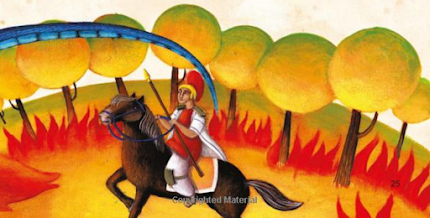
Yesterday, the 23rd of April was St. George's day. St George is the patron Saint of England, usurping the former patron saint - St Edmund the martyr, when King Edward III set up the Order of the Garter in his honour in 1350. He is also the patron saint of Ethipoia, Catalonia, Georgia, Aragon in Spain and Moscow. A truly international saint in all respects, so here are some interesting facts I discovered about Saint George while doing research for my picture book George and the Dragon.

My interest in the saint preceded my research. As a child, I was fascinated by the lives of the many saints in the Catholic canon. A daily churchgoer, I have to admit I spent most of mass, not concentrating on what the priest was doing and saying, but inspecting the many, often lurid, pictures of the saints that adorned  the walls.  Most of these saints were early Christian martyrs, so the backdrops to their deaths were often lush Roman palaces or Middle Eastern deserts. I soon learnt to read the symbols in the paintings that often told the life stories of these brave souls who gave their lives up for their faith.


Today I realise that much of these stories was just hagiography but back then I never doubted they had actually happened. I wholly believed that the Roman guards could not budge Saint Lucy of Syracuse from her knees when they came to arrest her, not even when they hitched a whole team of oxen to her. (not sure how they managed that last bit. The pictures never showed it clearly. You just saw St. Lucy surrounded by oxen. My storyteller's imagination had to fill in the finer detail. You realise now why it was so difficult for me to concentrate on the Mass)

Every village in Malta is dedicated to a patron saint whose feast day is celebrated with great pomp and theatricality. When my cousin starting dating a handsome young shipyard worker from the village of Qormi, I was introduced to the magnificence of its patron saint: Saint George. The shipyard worker, whom my cousin married, was called George after him.)

There are many early Christian and later Muslim texts about Saint George, who was believed to be a Roman soldier of Greek descent from Cappadocia in Turkey. According to fragments of Greek texts now preserved at the British Library, George's father died for his faith when George was fourteen years old. George and his mother returned the land of her birth, Syria Palaestina. When his mother passed away, George travelled to Nicomedia, the eastern capital of the Roman Empire. He joined the Roman army and soon became known for his courage and valour. He was also a devout Christian and this drew the ire of his superior Dadianus or, in some versions of the legend, the emperor Diocletian himself.  Refusing to worship Roman gods, he perished in the great Diocletian persecution of AD303. He was beheaded outside the walls of Nicomedia on 23rd April 303.  His bravery in the face of death so impressed Empress Alexandra of Rome that she became a Christian too. His body was buried in his home city of Lydda (today Lod, in Israel) where his tomb is still venerated.


Today, this story is eclipsed by the legend of the dragon, first recorded in Georgia in the 11th century. It spread through Europe, mostly in the 12th century as part of The Golden Legend, a collection of hagiographies by Jacobus de Voragine.  In this version, the story takes place in the city of Silene in Libya. Here the dragon terrorises a city where the people feed him two sheep a day to stop him from devouring their children. When the populace runs of out sheep, the king's daughter offers to be the sacrifice. But George arrives in time to save her and to vanquish the dragon. In gratitude, the king offers George a fabulous treasure, which the soldier distributes among the poor. 


The English version of the legend has the saint kill the dragon on the brow of Dragon Hill in Uffington, Berkshire. It is said that where the dragon's blood spilled, no grass grows to this very day. No doubt, Shakespeare popularised the idea of Saint George as the patron saint of England when he has King Henry V end his battle speech with the famous rallying cry of "Cry God for Harry, England and Saint George."

So, one saint, many legends. I love how in a world of conflict, stories still have the power to unite us.


Saviour Pirotta's version of George and the Dragon retells the Libyan version. It is published by harpercollins in their Collins Big Cats series. His latest book, The Heart Scarab is set in Ancient Egypt. It is out now.  Follow Saviour on twitter @spirotta and on instagram @saviour2858


Thursday, 24 February 2022

5 BULLET POINTS TO TURBO CHARGE YOUR FUTURE, by Saviour Pirotta

 I don't know about you, but Covid has knocked me for six. Not the diseases itself, I hasten to add. I have managed to evade contracting the dreaded virus thus far. But the pandemic seems to have upended my life. Before, my main source of inspiration was travel. Frequent trips to Greece, Turkey, Spain and Italy used to see me back home energised, my head bursting with ideas for new books, my notebooks full of notes.

Did I ever even as much as open one of those precious notebooks through the various lockdowns? Not once! I had the office redecorated, I gardened, I did a handful of online school events. But actual creative, sit-down-and-write-me work? I managed to write two novels which were part of a series and had been meticulously planned beforehand. But new work? Nope!

The toxic combination of self-isolation and the drip-drip-drip feed in the news of politicians' machinations drained me of all creativity. And the industry seemed to have changed. Editors, those that stayed in their jobs, that is, were working from home. My agent's calls and emails went mostly unanswered. Now the dust seems to be clearing on a new world. Time for new batteries, new plans. So here's a bullet list I drew up for turbo-charging the next phase of my career. 


1 THE PAST IS GONE

Time was when your editor stayed at her job for years. You wrote for one main publisher who promoted your projects and commissioned you to write new stuff. That way of life died during lockdown. Don't base what you're doing now on your past modus operandi. The new world needs new opportunities. Look to new publishers, alongside your main one if you're happy with them. Find new opportunities. Stories don't just come between two covers anymore. 


2 GIVE YOURSELF DEADLINES - HARSH ONES

This is a big one for me. Give me a deadline and I'm glued to my macbook. Day and night. Even on the loo if need be. But take away that point of no return, take away the editor scowling down the ether, the illustrator worried she might not be able to fit your project in her busy schedule, and I'm wasting weeks mulling over plot points while deadheading the roses.

Enough with the displacement activity. Set yourself new deadlines. Harsh ones. Think you can write a synopsis in three weeks. Try to do it in one. Tap out 'the end' before you give yourself a break. Your career will thank you for it.


3 SAY YES MORE THAN NO


Sometimes small opportunities turn into big ones. I used to say no to projects that I'd decided to move on from. Now I discuss projects with my agent before deciding. Could that little project lead to a bigger one. Could it give you more contacts in the industry. If there's a chance that the answer is yes, go for it. It will take less time than you think.


4 SAY NO MORE THAN YES

This might sound like a contradiction to the above but the 'no' here means no to things that chip away at your sense of self-worth. No to free charity sessions, no to free storytelling in church, no to free books for reading groups. Your time is worth is money, your books are worth money. If they want it, they should pay for it.

5 CONCENTRATE ON YOUR ACHIEVEMENTS

I often focus on the negative rather than the positive. Social media is terrible for this. Have you just signed a hundred copies of your books for a school? Go on twitter and I'll bet you'll soon find someone gloating over a pile of five thousand, with more to come when the cramp in their fingers eases off. Don't feel inferior. You might not even know the real story behind that post. Celebrate your achievements, no matter how small or big. Turn off social media if need be. It can often be a wasteland.


And that, gentle reader, is my little online rant for the month. Have a great world book day week, everyone. And don't forget to celebrate yourself as well as the glorious world of books. You are awesome.


Saviour Pirotta's last book in the Wolfsong Series, The Wolf's Song was published by Maverick in January. The first in his Nile Adventures series, The Heart Scarab drops on the 28th February. Follow Saviour on twitter @spirotta and on instagram @saviour2858.

www.saviourpirotta.com


Sunday, 24 October 2021

A Rambling Post about Loss and Emigrating, by Saviour Pirotta

I had plans to celebrate big this October. It's my fortieth anniversary since emigrating to the UK. As I write this, it's actually forty years and twenty six days. I landed at Manchester airport at 6.15pm on the 1st of October 1981. (I wanted to go to London but there were no last minute bargain bin tickets available, and I didn't realise that distances in the UK are so big)

England has been incredibly generous with me. There is a lot to be thankful for: becoming an actual published author, seeing my plays performed, making so many dear friends, my beautiful house in Scarborough, my vast collection of vintage china, my becoming a British citizen even. But if I had to live my life all over, the only night I wouldn't want to go through again would be that night I had to actually leave home.

I emigrated to England long before Malta was an EU member (and when the UK still was). An English theatre director offered me a four week contract writing and directing a children's play at a fringe theatre in London. The pay was pitiful but it might lead to bigger opportunities, he said. I accepted with the recklessness of youth. 

Up until this summer, the night I left home was probably the hardest of my life. Packing my books and clothes, checking that the money from my last pay check at Malta Post was safe in my bum bag, saying goodbye to my mum...

If I'm honest, that last one wasn't the hardest bit. You take your family for granted when you're young. I'd become distanced from my parents, staunch Catholics who thought the arts were the devil's playground. Family will always be there, you think, ready to forgive and welcome back if the project fails. Recently I was told that my mother was inconsolable when I left to catch the last bus to the airport. She never admitted as much to me; I was told it recently by my sister in law.

This summer I reached another life-changing milestone and had another night I wouldn't want to go through again. And this time it's me who's inconsolable. My mother passed away on the 8th of August. She didn't die of Covid but the pandemic certainly gave her a nudge in the right direction. 

Before Covid, my mother was very active. Her day started with a prayer to the Madonna and coffee by candlelight. After 6.00 o'clock Mass, she'd trot off to the butcher, the grocer and the greengrocer's truck in the village square. She visited her sisters for tea and a chat every day. Her Victoria sponge cake was very much sought after at local charity events.  She won Mum of the Year twice in her village but refused the award because all her friends were just as good if not better mothers, she insisted.

The pandemic turned her into a recluse scrubbing vegetables with soapy water. My mum lived for her family. Deprived of physical contact with her sons and beloved grandchildren, she lost her appetite for life and for food. Her blood levels dropped (not sure what that means: doctor speak) She and dad had to move into a care home where, confused by all the Covid restrictions, she convinced herself she'd been tricked into going to hospice.


I have nothing to complain about, really. I enjoyed my mother for much longer than most of my friends. In the last few years, we'd become really close. We'd chat on the phone for hours, swapping recipes. )My mum was a dab hand at Southern Mediterranean dishes but I introduced her to French gastronomy and she soon learnt to whip up a creme pat like a pro.)

During her funeral, I was amazed at the diversity of people that came to pay their respects. Nuns, priests, dog walkers, young, old, straight couples, gay couples, even politicians turned up. A minister sent an extravagant floral tribute. To my dad's astonishment, Mum seemed to have been friends with everyone in the village. A childhood friend and neighbour told me my mother used to cook meals for her brother, a convicted drug dealer. "Everyone saw him as a dangerous criminal," she explained, "but to your mum he was the son of an old school friend."

So I'm afraid a big celebration is the last thing on my mind at the moment. As always when things get though, I find sanctuary in books. Both reading and writing them. I'm devouring books like Cookie Monster gobbling biscuits. And my mother is creeping into my own stories. I'm getting very good at writing mother characters.  My wip is a story set in Ancient Egypt and features Ma'at, the mother goddess whose duty it is to keep order and harmony in the university. Reading my notes and ms, I realise Ma'at is actually based on Ma.  In my mind at least, she'll live on not only through her children and my family's collective memory but also - in a small way - through my work. 

Thanks for reading, everyone. Normal posts about plot and characterisation will resume next month. Meanwhile here are a couple of pictures of my my mother and her neighbour and chief confidant in London. My mum is the one in the brown coat!


Saviour Pirotta's last book in his acclaimed Wolfsong series, The Wolf's Song, is out in January 2022. It's followed in February by the first book in The Nile Adventures, The Heart Scarab. Follow Saviour on twitter @spirotta and on instagram saviour2828.


Saturday, 24 July 2021

STORIES OF SUMMERS PAST, by Saviour Pirotta

Summer was never my favourite season when I was a kid. That was winter, with its Christmas celebrations, trips to the theatre and long baking sessions with my grandma. I also liked spring, the perfect time of year for nature rambles when I'd fill entire notebooks with notes about the local flora and fauna. 

But summer? In the med? For three endless months? Nope, not for me the blinding sunshine, the intense heat that melted the tarmac on the roads and, worst of all, the trauma of being forced to expose my wobbly tummy on the beach. 


The only good thing about summer as far as I was concerned was the time I could spend reading.  I had no access to a public library, so I begged, borrowed and, yes, stole books whenever I got the chance. The house next door to us was rented to British servicemen with large families. They always moved on to Cyprus or Hong Kong and their kids introduced me to British authors I might never had have discovered otherwise: Malcom Saville, Arthur Ransome, John Aiken, Ursula LeGuin. The list is endless.

There were some books I returned to every year and some of those have shaped the writer I became. Some of those stories I still treasure to this very day. Here' my top three.

TREASURE ISLAND, by R.L. Stevenson  was the perfect summer story. It featured pirates and ships. It told of the sea but not as a benign entity lapping gently against a sandy beach packed with idle holiday makers. In Stevenson's story it was a path to dangerous adventure, a link to an outside world I always dreamt of exploring. I fell in love with Long John Silver, who I much preferred to the pompous Dr. Livesey who reminded me of all the respectable men in our village. (PS. I didn't beg, steal or borrow my copy of this book. It was an end of year prize in Year 4.)


THE SILVER SWORD, by Ian Serallier. I borrowed this from my elder brother who was studying it at school. The version I read was part of the Windmill Classics series so it might have been abridged. Nevertheless, I loved travelling with Ruth, Edik and Bronia as they tried to meet up with their parents at the end of World War II. They befriend a mysterious street boy called Jan who you're never sure if he is on their side or not. He has a little wooden box in which he keeps a secret collection of objects. I still have a similar box, which I show to children during school visits. It's filled with little objects that feature in my own books.


TIME AND THE CONWAYS, by J.B. Priestley. This isn't strictly a book, and certainly not a children's story. It's one of Priestlye's Time Plays. I have no idea where I found a Cassell edition of the script but I devoured it in one afternoon. Most of the themes must have gone right over my head but I was gripped by the story of a snobbish family and what happens to them over the years.  What got me most of all was Priestley's manipulation of the time sequence to make his points. Act 1 takes place during a birthday party in 1919. We meed the young Conways and their friends and learn about their hopes for the future. Act 2 takes place twenty years later and we discover what became of the family. Act 3 goes back to the moment it left off in Act 1, forcing us to witness the Conway's actions in a completely different light.  The idea blew my mind.  It was perhaps one of the reading experiences that wanted me to write my own plays.


Saviour Pirotta's Wolfsong series is set in the Neolithic. The final book, The Wolf's Song comes out in January 2022. Follow him on twitter @spirotta.com.

www.saviourpirotta.com


Thursday, 24 June 2021

Creating Dynamic Characters, by Saviour Pirotta

One thing I learnt very early on while talking to kids during school visits is that people remember characters far more than they do plots. They might remember a particular scene or a striking quote but what stays with them the longest are the characters. Ask them what they know about a book and invariably they mention character traits. Harry Potter, sir, he's the best at doing magic but he helps others be as good as him. So here's my to-go list for creating dynamic characters. I started using it while writing The Golden Horsemen of Baghdad which was published by Bloomsbury Ed in 2019.


1. DYNAMIC CHANGE

A dynamic character changes dramatically during the course of the story. They are usually the main character but not always. A good example of this is Scout in To Kill a Mockingbird. To all intents and purposes Dr. Atticus Finch is the main protagonist in the story but the dynamic one is his daughter Scout. She is the one who is irrevocably changed by the end of the book.

Atticus is what is sometimes called 'a well-rounded character'. He has motive, back story and detail but the story doesn't change him much. He's still more or less the same person at the end of the book.


2. CLEAR AND REALISTIC MOTIVATION

Establish what the characters' goal is at the beginning of the book. Make it clear and make achieving it the only driver in the story. At the start of Golden Horsemen, Jabir, the main character, discovers he can't provide for his family with fishing. He goes off to Baghdad to find a job. One way or another he has to earn enough money to keep the evil landlord from making his widowed mother and sisters homeless.


3. INTERNAL CONFLICT

Before the main character can attain their goal, they must resolve an inner conflict. Jabir, being a boy and the eldest in the household, is cosseted all  his life. He's wasted time hanging out with friends on the street when he should have been learning fishing skills from his father. Now suddenly he is out of time and options. Not only must he take on the responsibilities of being the bread-winner in the house but he must also come to terms with the fact that he has failed his family, especially his dead father. The remorse and the will to redeem himself keep his character dynamic and the plot moving along.


3. EXTERNAL CONFLICT

The dynamic character's internal conflict is mirrored in external challenges. Jabir gets caught in a sandstorm, finds himself in jail and, when he does eventually find a job he is good at, the evil landlord tries everything he can to stop him from achieving his goal. I make the challenges bigger and scarier as the story progresses. 

The internal and external conflicts mirror and compliment each other. With each challenge, Jabir changes for the better. Sometimes the change is physical and this acts as a visual marker of the character's inner journey. More often than not, the change is emotional or cerebral. Sometimes it's spiritual. 

Trough the story, Jabir grows emotionally stronger. He starts to mature and takes on his responsibilities with pride. He learns to empathise and to forgive.


4 OFFSET YOUR DYNAMIC CHARACTER WITH STATIC ONES

A dynamic character's journey is highlighted when set against a static one. A static character is one that doesn't change through the story. The genie in Aladdin is a perfect example of a static character. He facilitates Aladdin's journey from a penniless beggar to a prince, from a dissolute thief with no thought to his mother to a caring, well-rounded human being. But the genie himself does not change. He is still the same at the end of the story as he was in the beginning. 

I like to have static characters on either side of the main character's conflict. In Golden Horsemen, they are the landlord, the main source of external conflict. He starts the story being a despicable, cruel person and ends it that way. He is a warning to reader of what happens when someone refuses to change.

At the other end of the spectrum is Jabir's wise grandmother Nabiha (yes, I know I always have grandmothers in my stories. It's my trope, ok?). She comes to the rescue when the golden horsemen of the title are destroyed by the landlord and it seems Jabir is not going to meet his goal. She too doesn't change, mainly because her story-journey was told long before Jabir's narrative started and she has already reached her goal.


Well, those are the four steps I use to create dynamic characters. I hope they are of some use to the readers of this blog. I've been in quarantine for ten days but now the self-isolation is over. I am going to treat myself to fish and chips on the seafront, at a table, with other people around me. If it doesn't start raining before lunchtime...


Saviour's The Golden Horsemen of Baghdad is set during the Islamic Golden Age. It was shortlisted for the North Somerset Teachers' Book Award and other prizes. Published in January 2019, it is now in its fourth reprint.

For more tips on writing follow Saviour on Twitter @spirotta. Visit his website at www.saviourpirotta.com


Saturday, 24 April 2021

Billy Wilder's Ten Screenwriting Tips, by Saviour Pirotta

Billy Wilder is one of my all time heroes. An Austrian by birth, he fled the Nazis first to Paris and then to Hollywood where he quickly established himself as a talented screenwriter, film producer and director. He might be forgotten by many today but his films live on among film afficionados. They include The Lost Weekend, Stalag 17, Some Like It Hot, Emil and the Detectives and one of my absolute favourites, Sunset Boulevard.  The last line in Some Like it Hot is widely considered to be the best comedic end line in cinematic history. When Jack Lemon in drag tells a besotted Joe E. Brown, 'I can't marry you, I'm a man,' the reply is 'Nobody's perfect.'


Wilder always claimed that 80% of a film's success is down to the script, and he spent a lot of time honing the writing, usually in collaboration with his father. In interviews with author Cameron Crowe for Crowe's book, Conversations with Wilder, he listed his ten tips for writing a great screenplay. They work just as well for writing in any genre with a narrative, so here they are:


1. THE AUDIENCE IS FICKLE

By this, Wilder meant that audiences' tastes change very quickly. So don't waste your time chasing trends. Write what you want and feel you can most commit to.


2.  GRAB THEM BY THE THROAT AND NEVER LET THEM GO

Start your story with an eye-popping scene. You have the rest of the book to fill in the 'building up'.


3.  DEVELOP A CLEAN LINE OF ACTION FOR YOUR CHARACTERS

Establish the character's objective and their plan for achieving it. The readers must feel that they are in on the ride. 


4.  KNOW WHERE YOU'RE GOING

This really means where the story is going. It doesn't matter how you plan the character's journey, in a notebook, in a writing programme or on notecards, make sure the characters stick to it and don't wander off.


5. THE MORE SUBTLE YOU ARE AT HIDING YOUR PLOT POINTS, THE BETTER YOU ARE AS A WRITER.

Some people say there are only seven stories that keep being retold over and over again. The hero's journey to redeem himself, the pact with the devil etc. The audience knows this and want you to stick to the script. But they want to forget they know it while reading. Be original in how you deliver the plot points.


6. IF YOU HAVE A PROBLEM WITH THE THIRD ACT, THE REAL PROBLEM IS IN THE FIRST ACT.

I think this is one of Wilder's best tips. The third act features the resolution to the story. If it feels contrived, it's because the foundations laid in act 1, and also 2, weren't solid enough. I try and solve this problem with careful planning and, if I'm writing with planning, I correct during the second edit.


7. LET THE AUDIENCE ADD TWO AND TWO. THEY'LL LOVE YOU FOR IT.

Let your readers anticipate at least some part of what's going to happen. They'll enjoy it because it makes them feel a part of the story.


8. IN DOING VOICE-OVERS, BE CAREFUL NOT TO DESCRIBE WHAT THE AUDIENCE ALREADY SEES. ADD TO WHAT THEY'RE SEEING.

For me, this applies mostly to picture books. Don't describe what's in the illustrations. Add things the readers cannot see - sounds, smells, feelings.


9. THE EVENT THAT TAKES PLACE IN THE SECOND ACT TRIGGERS THE ENDING

The beginning of the book sets the objective and the journey but something HUGE must happen in the second act that triggers the way the ending happens. 


10.  GIVE THEM THE ENDING, THEN DON'T HANG AROUND

The ending must deliver a punch. A grand finale. Once it's done, that's it. Don't add anything else and dilute the action.


I've used these tips in most of my books, although not always all together, in fact hardly ever all ten in the same book. I hope I've explained them clearly and that you find them of some use...nd now I'm ready for my close up, Mr. DeMille.


Wednesday, 24 March 2021

This Used to be my Playground (and other prehistoric temples), by Saviour Pirotta

A lot of readers have been in touch asking about the temples which form the background for the second half of my latest book in the Wolfsong series, The Mysterious Island. 

The island in question is Malta. The main characters in the book chase the series's main baddie there and discover a culture spiritually more advanced than their own. While they are still adherents of animism, believing that every single inanimate object has a spirit that must be honoured and placated, the islanders have moved on to goddess worship. 

Malta has several megalithic temples from the Stone and Bronze ages, some of which are now UNESCO World Heritage Sites and rightfully protected by law, security guards and entrance fees. When I was a kid they were still open to the elements (much like other historical sites, like early Christian tombs, remains of Roman villas etc) and I used to explore them often. I even know guys who played football around the altars, kicking the ball against the standing stones. Can you even imagine?


I only use two of the temples in my book, chosen because of their geographical position and because they fitted into my timeline. The first one is a complex called Tarxien Temples and marks the height of temple building and decoration on the island.  Built from around 3250BC, the temples have elaborate carvings and show signs that they were used for large scale rituals and animal sacrifice. Their use evolved over the years and in the Bronze Age became cremation cemeteries. The builders left enormous stone balls on the site, which were used for transporting and moving the standing stones. They give a rare glimpse into the building methods of the times. An image of a fertility goddess, today called 'the fat lady' was discovered inside it. Its top half is missing, allowing my imagination to run riot as to what the goddess's face would have looked like. Was it motherly? Stern? Benign? Sword and sandal movie type scary?


The second temple is actually an underground necropolis called the Hal Saflieni Hypogeum. Founded circa 4000BC, it has various halls and chambers connected by a labyrinth of steps and corridors. The ceilings are decorated with spirals painted in red ochre that survives to this very day. Its 'holy of holies' faces the winter solstice, and it boasts an 'oracle', a hole in a wall. Apparently, if you stuck your head in it and talked, your voice would echo around the entire temple.


Another statue of a goddess was found here, today called 'the sleeping lady'. She's a big-hipped matron lying asleep on her side. In my book she's referred to as She Who Sleeps and waking her up is inviting mortal danger and chaos. Who was she really? No one knows but one of the joys of writing about ancient history is that you get to fill in the gaps. 

I can no longer play in the prehistoric temples of Malta but they are still my playground in a literary sense, and they will always be.

Saviour Pirotta's Wolfsong much acclaimed series is set at the end of the Neolithic and the beginning of the Bronze Age. The third book, The Mysterious Island, is out now, published by Maverick Books. The final instalment, The Wolf's Song is due in Spring 2022.   Follow Saviour on twitter @spirotta and on instagram @saviour2858.


Wednesday, 24 February 2021

The Major Components of Motivation, by Saviour Pirotta

I have to admit that, like many others I've found the three lockdowns very difficult to deal with. I'd assumed that if I had no distractions, no school visits, no flea markets and charity shops to waste precious writing time in and - most importantly, no money worries - I would sit in my garden or my office and tap away on my macbook like the mean, lean writing machine I know I can be.

Nothing could have turned out further from the truth. I very quickly discovered that my house is a minefield of procrastinating opportunities. Bread to bake, seeds to sew, plants to water and grow, furniture to restore, an attic to sort out, ephemera collections to catalogue. The list was endless. To make matters worse, publishing schedules were put on hold, deadlines pushed back. Suddenly there seemed to be no urgency to keep to a tight writing schedules or a timetable.

I also missed the contact with school children and the chance to bounce my ideas off them. I missed my frequent research trips abroad from whence I returned buzzing with ideas and notebooks full of sketches and notes. As month after month of procrastination rolled by, I decided to pull myself up by the bootstraps, knuckle down and tackle one of the pet projects that I'd put aside for years in favour of more bread and butter work.

To get me through, I adopted a three-pronged motivation approach from my gym days:


ACTIVATION

This is the decision to put aside thinking about the project and to actually START working on the project. To go past the 'that would make a brilliant story' stage. Give yourself a deadline. See the finished result in your head. Visualise the merits. See the book in the shops, in libraries. Visualise yourself showing it off at festivals, in schools. 

Gather all the bits you have so far. A mood board, notes, cuttings from papers and magazines, printouts off the internet. I collate mine in a scrapbook. Treasure that scrapbook. Make it your best friend. I haul mine around withe me (yes, I even took it to the Scarborough Rugby Club where I had my first covid vaccine.) I paste things in it, I make it look pretty.

Write the name of your project along the top of an A4 sheet of paper. And a pair of footsteps at the bottom. Draw another pair, getting closer to the name (the goal) every time your work on your project. 


PERSISTENCE

There's always that Eureka moment when you see something or hear something or read about something that gives you an idea. And there's the rush that follows as you start jotting down ideas. This usually happens to me on trips abroad. I see something in a museum and - ping - my imagination goes into overdrive.

Then other things in life take precedence - that contracted book you have to finish, those school visits you have to plan for - and the vision starts to fade. This is where persistence comes in. Keep on working on the project. Make little steps towards the goal. It might be reading up on the subject at the heart of the story, making a character sketch. It might not be much as things go but it takes you further along the path. Persist! Your motivation will grow stronger with each step.


INTENSITY

At some point the motivation will become so strong, you will move the project from the back burner to the forefront. As those footsteps get you closer to the goal, break into a run. Focus on the golden apple on the tree and pelt towards it. Drop everything else. Ignore the pain. I stop cooking, stop reading anything unconnected to the project, sometimes I even miss sleep. But boy is it worth it when your hands close around the golden apple and you find you have reached your goal. 

It's mad being a writer sometimes so I hope this helps.


Saviour Pirotta's third book in the Wolfsong series is out now. It's called The Mysterious Island.  It's also available as an audiobook on the cloudaloud app. Firebird comes out on kindle on the 28th Feb. Follow Saviour on @spirotta and on instagram @saviour2858. 


Sunday, 24 January 2021

On the Art of Multiplane, by Saviour Pirotta

As a child, Walt Disney (along with R. L. Stevenson) was my hero.  My parents strongly disapproved of the cinema but I watched Walt Disney's World of Colour on the telly. Of course, we only had a black and white set, so the colour element of the series was wasted on me. Still, there was so much to enjoy, it didn't matter. I learnt so much from the programme (I refuse to call television programmes 'shows'. For me, a show is something your dress up for and watch in a theatre).

When I discovered the public library, I borrowed lots of books about Walt Disney, his work and, needless to say, the Golden Wonder Books adaptations of his films and stories. Now these were in glorious colour and I must have spent days just gazing on their lusciousness.

One thing that always fascinated me about Disney's animations was the depth his backgrounds had. Unlike other cartoons, Mickey Mouse and friends seemed to frolic in an environment that seemed to be alive and real. How did the Disney artists achieve this? They used a piece of equipment called a multiplane camera. The name speaks for itself. First developed by the animator Lottie Reiniger for her feature length The Adventures of Prince Achmed, it recorded several different planes of artwork painted on glass. This imitated the human eye and gave the illusion of space and distance. 

To explain properly, I'm posting a still from Bambi below. You can see that the branches at the top and the flowers at the bottom are on one plane. Behind them is a second layer showing Bambi and his friend. Behind them is a third layer with clouds and behind that a fourth one with the sky. All together the four planes give an impression of all-enveloping realness.


I have adapted the multiplane idea for my writing, using words rather than a paintbrush to produce my images. It helps me create environments that are alive and pertinent to the story. The Disney animators could have up to seven planes but I usually stick to four (as in Bambi). The first one is the immediate environment where the action takes place. This I describe in fine detail. Behind it are three more layers, each one with less detail but contributing to a homogeneous whole.

As an example, I'll use a my next book, The Mysterious Island. I have a scene where three kids are searching for a fourth in an underground Neolithic temple. They are hidden in the mouth of a narrow tunnel overlooking the sacrifice chamber.  They are plane 1, so everything is described from this point of view. The fourth kid enters the chamber with renegade priests to try and awake a sleeping goddess. This is Plane 2 and described in fine detail. It describes the fourth kid, the priests and the statue of the goddess they are trying to wake up. Plane 3 behind them describes the chamber and, through a doorway, we catch a glimpse of Plane 4, an oracle littered with human bones. Using this method, I focus on the action in the foreground but also remember to show the background to add to (in this case) a sense of danger and menace to the environment.

In the future I might actually produce the actual layers on transparent plastic. They'd be great to use in school visits once we start doing them again.  Stay safe!


Saviour's The Mysterious Island publishes on the 28th January 2021. Pre-order it from Hive here: https://www.hive.co.uk/Product/Saviour-Pirotta/The-Mysterious-Island/25340096.

Follow Saviour on twitter @spirotta and Instagram https://www.instagram.com/saviour2858/


Tuesday, 24 November 2020

IMAGINE ALL THE PEOPLE, by Saviour Pirotta

I like to think that all my stories are about people. They may be set at memorable historical moments like the opening of the Parthenon in Athens (Shadow of the Centaurs) or in famous places like the village of Skara Brae in Scotland (The Stolen Spear) and Stonehenge (The Whispering Stones). But the driving force is always the characters. I imagine this is true for most writers. It seems people remember the characters in a much-enjoyed story long after the details of the plot have grown hazy. When I think of The Lion the Witch and the Wardrobe, the first things that spring to mind are the lovely Mr. Tumnus and his umbrella, and the wicked Jadis in her carriage? 

I love people watching, trying to guess who they are, what they do for a living, what families they have etc. Scarborough where I live is a fantastic place for this kind of activity. I have a special notebook which I've labelled 'the people pot' where I keep notes of characters I've created based on people I've seen. Over time I've developed this into a writing exercise I often use in schools, and it seems to work very well in online sessions too.

Here is a picture I took at the municipal market while on holiday in Malaga last year. 


I call the characters Papa Red Hoodie and Son Blue Hoodie. But are they in fact father and son? Are there any clues in the picture to prove or disprove that fact? Could they be uncle and nephew? Friends? Boss and employee? What names might they have? Where do they live? What kind of abode? Are they alike in their way of thinking or so dissimilar they prefer not to hang out when the stall shutters come down at the end of the day?

Can you think of what they might have had for breakfast this morning, perhaps churros y chocolates at the market, or just a quick coffee and some leftover tortilla from home, eaten on at the wheel as they drive to the fish suppliers? What are they thinking as they serve their customers? Are they happy, sad?

This picture was the starting point for a story I am writing.  Son Blue Hoodie finds something inside the fish he is filleting, something it swallowed before it was caught. And it's something that triggers an adventure, a story that will use all the details I've imagined for the characters.


Here's a second picture, taken in Malta a few years ago. Look at all the band members, the instruments they are playing. Can you think up of a reason why each musician has gone for the instrument he plays? Is there a story there?

(Incidentally, this is the street where I lived as a child. The decrepit house on the left side features in one of my ghost stories but that's another subject, for another post). Meanwhile, I hope you've enjoyed perusing my pictures and you find my hints for creating character helpful. 

Saviour Pirotta's Mark of the Cyclops won the North Somerset Teachers' Book Award in 2018. His online book Pandora's Box has just been voted the Fiction Express Award for best middle grade novel on their platform. Follow Saviour on twitter @spirotta and instagram on @saviour2858.  Preorder his book here