Part Two
The second part of my interview with storyteller, writer, poet and lyricist Hugh Lupton, carries on the theme of landscape in more detail and relates it particularly to the landscapes of Mid -Wales and Norfolk, and Hugh’s books on John Clare and The Mabinogion. For those of you who particularly enjoyed the selection from Hugh's picture archive last time, I promise you a few more crackers, beginning with the one below.! And if you did miss the first part, you can find it here by backtracking through the archive, or simply typing in my name. Meantime I hope you enjoy this second chat as much as I did.
 |
Hugh, Olivia Ross, Rob Harbron, John Dipper and Chris Wood in front. 'Christmas Champions' 2006.
|
Thanks again, Hugh. Let’s begin by thinking about those two very separate landscapes, of Norfolk, where you live, and North Wales and the Lleyn Peninsula, where for the last twenty five years, you and fellow storyteller Eric Maddern, and year after year of eager students – which four times included me – have been exploring landscape and myth at the entirely wonderful Ty Newydd Writers Centre. They are very different landscapes. How do you feel about them both?
I’m half Saxon and half Celt. When I think about the two dragons that Merlin reveals to King Vortigern on Dinas Emrys, the red dragon of the Celts and the white dragon of the Saxons, I think of the mix in the blood that runs in my veins: the red corpuscles and the white. The two landscapes, East Anglia and Wales, reflect that mix… they are both homelands, I feel comfortable in both.
East Anglia is farmland, largely arable, fertile, traditionally bound by the agricultural cycles of ploughing, harvesting etc. North Wales is mountainous, rugged, a herding culture, traditionally bound by cycles of grazing on high and low pasture. Of course those distinctions don’t mean much today when very few people are engaged in farming… but they inform the consciousness of place on some deep level.

|
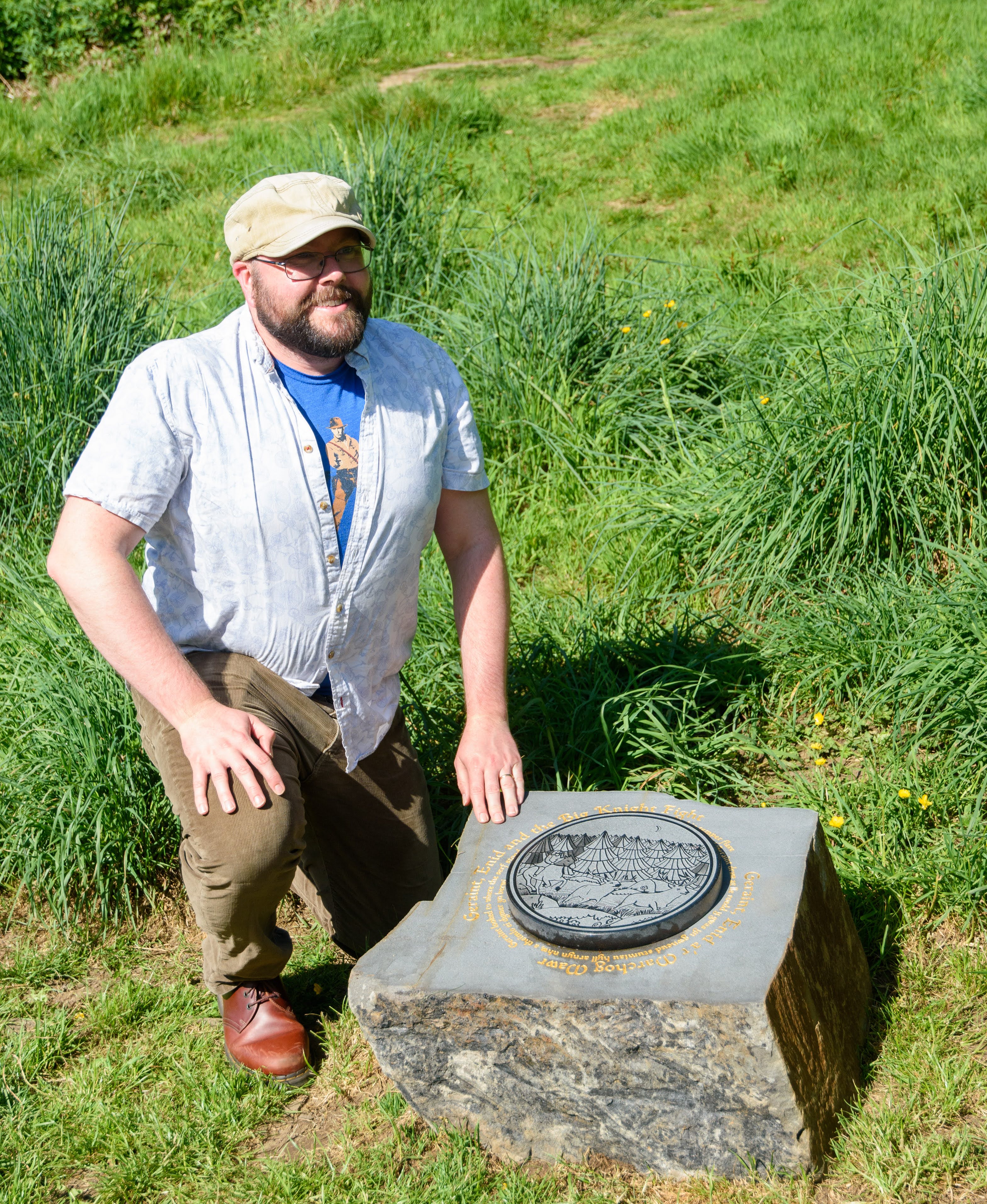
Hugh and Eric attempt to lift the Gronw stone on an early Ty Newydd storytelling retreat in the 1990's.
|
The courses that Eric and I run at Ty Newydd, because of their location and its surrounding landscape, inevitably lean towards the Celtic end of the storytelling repertoire. Though some years we’ve drawn on a more agrarian mythology – The ‘Passion of the Corn’ explored Neolithic myth, ‘Frost and Fire’ explored the cyclic seasonal rituals… and we’ve run several courses where we’ve delved into the Saxon/Norse pantheon.
Looking at the brochure every year I’m always amazed at how you manage to keep things fresh and rarely repeat. How have you done that?
Eric and I have been running these courses for more than twenty-five years. Eric came to storytelling and landscape through his work as a community artist with Aboriginal peoples in the Australian outback. He settled in the UK with the question: ‘What is the white-man’s dreaming?’ as his central concern. I (as I mentioned in the last interview) had become deeply interested in the connections between story and place, and ‘restorying’ the landscape. Eric and I had known each other since Ben Haggarty’s first storytelling festival. I’d visited his wonderful (evolving) place at Cae Mabon a number of times. We’d worked together for English Heritage. We were friends and there was something inevitable about us combining our interests and skills in running these courses at Ty Newydd.
The first course we ran was on the Mabinogion. Ty Newydd is surrounded by places that are mentioned in the second and fourth branches. The course was a mixture of discussion, excursions into landscape and retellings of the stories (which all participants contributed to). We saw ourselves as facilitators rather than teachers, and we found that there was a very high level of shared knowledge about the material within the group. This became a pattern over the years. Each course rang the changes, taking a different theme and connecting it to the landscape. Sometimes we led participants on quite challenging adventures. Among the courses have been: ‘The Battle of the Trees’, ‘Totemic Animals’, ‘The Holy Grail’, ‘The Sword out of the Stone’ (the coming of metal), ‘Bardic Romantics’, ‘Pilgrimage’, ‘Lost Gods of Britain’, ‘Song-lines’, ‘Culhwch and Olwen’, ‘Annwn and the Otherworld’, ‘The Goddess’, ‘Heightened and Prophetic Speech’… There’s no shortage of themes! This year would have been ‘Creation Myths’ but Covid scuppered that plan.
We’ve had wonderful participants over the years, many of them storytellers, some just beginning their journeys into the craft. Many came over a number of years, among them Nick Hennessey, Katy Cawkwell, David Ambrose, Ana Adnam, Sharon Jacksties, Jem Dick, Cath Little, Eleanor Kapp, Jo Blake, Jamie Crawford, Daniel Cohen, June Peters (to name a few)… and you Steve… and the redoubtable and much missed Rob Soldat (always a fount of arcane knowledge).
Each course has a visiting speaker for one evening. We’ve been privileged to welcome (among others) Ronald Hutton (many times), Kevin Crossley-Holland, Gillian Clarke, Hugh Brody, Nikolai Tolstoy, Lindsay Clarke.
I should also say that Ty Newydd has been generous and accommodating in making it possible to run courses that are far from the quiet and sedentary norm for a writer’s centre. It’s a beautiful and comfortable place to work in and from, with a fantastic team who have been enormously supportive over the years.
Again, the courses are very much about walking into landscape and telling stories within. How important is it for a storyteller to have landscape as a backdrop? Does it give you a particular something?
The general title for all these courses has been ‘Storytelling and the Mythological Landscape’. At least one day in the week is spent visiting sites that Eric and I have chosen as being connected with or evocative of the stories we’re exploring. It’s absolutely central to the course that all participants have this experience, so that when we retell the stories at the end of the week we have a shared imaginative world.
The landscape experiences can vary enormously. When we were looking at Parsifal and the Holy Grail we started at Trawsfynydd Nuclear Power Station (decommissioned) as an experience of the ‘Wasteland’ and then we followed an ancient trackway over the high moors to Harlech (as Grail Castle). When we were looking at the mythology of metal we visited the Bronze Age copper mines on the Great Orme… and smelted iron from stones we’d found on the beach. Then, with the Mabinogion-related courses, it’s possible to visit sites that are mentioned in the texts – Dina Dinlleu, Cynfael River, the Dylan Stone, Taliesin’s grave etc. I’m endebted to Eric’s deep knowledge of the North Wales sites for making these experiences possible.
So yes, to answer your question, it gives something fundamental to the retelling of the stories… more than a backdrop, something immersive.
*For a similar amount of time yourself and colleague Daniel Morden have been running a similar, weekend introductory course to storytelling there. Do you find with those that people need a lot of nudging to believe in themselves, considering they’ve made the decision to come there?
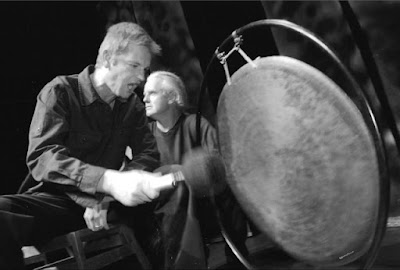 |
Hugh with Daniel in mid-story in the Iliad. |
The fact that people have elected to come and have coughed up the fee means that there’s a genuine interest in what we’re offering. People come to those beginners courses with a wide variety of expectations and needs. Because Ty Newydd is a ‘Writers Centre’ Daniel and I often have to start by shaking off any notion that we’re going to be writing stories and reading them aloud. People are not always familiar with traditional storytelling or with the form and structure of traditional tales. The idea of improvisation can be terrifying. We spend the first part of the weekend with games and exercises that help people relax into speech and start to feel comfortable with each other. We end with a shared telling - participants work in pairs and tell folk tales to the rest of the group. We’ve had some wonderful tellings over the years, there’s something about the moment someone finds his or her voice for the first time that can be very moving.
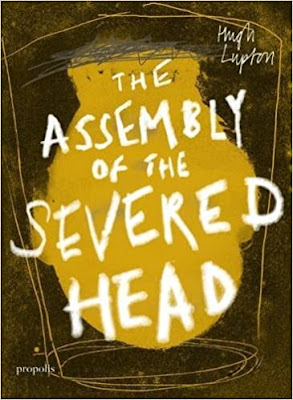
It seems a natural progression from a retreat centre in Wales to the mythic world of The Mabinogion, and especially the four linked tales which are known as the four branches. Considering your love of the tales and the various explorations on all those courses, it took until 2018 for you to produce your book, ‘The Assembly of the Severed Head’. Was it something you’d always had brewing and you were just waiting for the right opportunity? How did the setting down of this story end up coming about?
 |
Add caption
|
It had been brewing for a long time, but I’d never planned to write it down. I’d wanted to do an extended performance of the Four Branches, focussing on Pryderi as the central character. I’d thought I might record it. Also Eric and I had been talking (are still talking) about making a book about the courses we’ve run, and obviously the Four Branches and their geography would be part of that.
But then Henry Layte, who runs Propolis Books, turned up on the doorstep one day and said he’d like to commission a retelling of the Mabinogion. Well, as you know Steve, commissions don’t grow on trees, so I immediately said ‘yes’ and started thinking how it might work.
I knew I wanted to write something that liberated the story from the text and returned it to its oral, bardic origins. I’d always found the text strangely lifeless, though the material is extraordinary. Then, one morning, I had the idea: ‘What if there were two texts, a spoken and a written? What if the scribe is reluctant, disapproving and lacking the breadth of vision of the teller?’ I started reading about the history of early thirteenth century Wales (when scholars reckon the stories were first set on the page). It was the time of King John’s brutal incursions into Gwynedd and the humiliation of Llywelyn. It seemed highly likely that Llywelyn would have used his bards to fire up the Welsh troops with patriotic fervour in their resistance to the Normans. I thought: ‘What if there was a massacre of the bards? What if only one survived? What if he was the sole repository of the old knowledge? What if he knew that the only way his ‘matter’ could survive was through the written word?’ Slowly the frame story began to form in my imagination.
And, of course, it was the monks who were the book-makers and who, in their scriptoriums, set words onto the page. I knew that the scribe had to be a monk… and that he would have been writing, against his better judgement, this profane material from the old times. This tension between ancient lore and Christian teaching began to underpin the story and give it a tension… especially as the stories of the Mabinogi, told over a number of months in a Cistercian monastery, began to echo the ritual and liturgy of the church.
So (I hope) the book works on two levels. For someone who doesn’t know the Four Branches it serves as a lively and palatable introduction to one of the corner-stones of a British ‘Dreaming’. For someone who’s familiar with the original text it explores the moment a living oral telling is hardened and diminished into the written word.
At the same time it’s a celebration of the making of a book (a major operation in thirteenth century Wales) and of the fact that without that book the stories would have been lost completely. So hats off to Brother Iago and his stylus and quill!
As a storyteller with such a love of the country, Hugh, it seems natural for you to have written a book about John Clare, the ultimate country poet. Is he someone you’ve had a lifetime’s admiration for? Are there any other poets whose work you particularly love? In general, how important a part of your journey has poetry been?Many years ago I had a conversation with a First Nation storyteller called Jo Bruchac. He’s an Abnaki (a branch of the Mohawk people). He said that when his people were put into reservations it was as though they were ‘taken out of their mind’. In that culture landscape and consciousness are so intertwined that to be taken out of your place is to be taken out of your mind. As he was talking I started thinking about the English Enclosures of the late eighteenth and early nineteenth centuries. The common lands, heaths and wastes were privatised and fenced, and the ‘landless poor’ who had always depended on them as part of a subsistence economy (grazing for their hogs, snaring & trapping, firewood, timber, berries, basket-making etc) could no longer make ends meet and were forced to leave their villages and move to the new mill and mining towns and become part of the ‘proletariat’ of the burgeoning Industrial Revolution. They were ‘taken out of their minds’.
John Clare lived through that moment of history. He was attuned to his place (the village of Helpston, near Peterborough), its animals, birds, plants, rituals, songs, agricultural cycles, in a way that echoes a First Nation sensibility. For him the enclosure of his parish and its losses marked a fall from a personal Eden. And he was taken out of his mind (he spent the last twenty five years of his life in a lunatic asylum).
I’d always loved his poetry. He wrote these finely observed ecstatic snap-shots of the world of his place in a language that by-passed the mannered poetry of his time. He was a labourer. He was literate but had grown up in an oral culture, he composed as he was walking or working and wrote when he could afford to buy paper. His story seemed an important one to tell today, seven generations on, when the full implications of that ‘enclosure moment’ are playing themselves out in the environmental crisis we’re all facing, and at a time when more than half the population of the world has been forced to move from village to city. The novel is set in 1810, the year of the Enclosure of Helpston, when Clare was seventeen and just beginning to find his poetic voice.
In answer to your second question… yes, poetry has always been central for me. I’ve always written poetry and in some ways it’s been my core concern. In fact myth and (true) poetry are sprung from the same source. What Coleridge called Imagination. Here’s a list of key figures (off the top of my head): Mother Goose, Chaucer, John Skelton, Shakespeare, John Donne, Wordsworth & Coleridge (pre 1810), Blake, John Clare, Edward Lear, Edward Thomas, D. H. Lawence, T.S. Eliot, Robert Frost, Robert Graves, Yeats, Dylan Thomas, Kathleen Raine, Ted Hughes, Sylvia Plath, R.S. Thomas, Charles Causley, George Mackay Brown, Alice Oswald… and most of all the ever fertile anon’.
I should add that song is so closely allied to poetry that it should be acknowledged in the same breath… so here’s to Bob Dylan, Robin Williamson, Leonard Cohen, Joni Mitchell, Tom Waits, Lal Waterson, Lou Reed, Paul Simon, Gillian Welch… and once again (and an even more resounding cheer) the anon’ of the ballads and folk songs.
Was it a big challenge to write about someone whose work you so admired? As you know, I’ve recently been doing similar with the composer Ralph Vaughan Williams. In doing so, I’ve often had the fear of misrepresenting him as a person or character. Did you feel that with John Clare? After all he’s never really been as highly regarded as he might have been until recently.During John Clare’s life there was a passing fashion for ‘peasant poets’. For a little while he was feted in literary London. Three volumes of his poems were published (cleaned up & tidied for mass consumption) then he was dropped and forgotten. His best work was written after his fall from grace… it would be more than a hundred years before much of it was published. He was rediscovered in the twentieth century and is now regarded as the founding father of ‘eco-poetry’ (I hope that isn’t another passing fashion).
Not very much is known about his early life, so I had a certain amount of leeway… and anyway I never pretended that the novel was anything other than a ‘fiction’. But at the same time I felt a duty to be true to my sense of John Clare, who he was and what drove him, and to stay within the few parameters of what biography there is. His early love for Mary Joyce is attested in many of his poems, but nothing is known of what actually happened between them. My story is pure conjecture, but I hope it makes it possible for the reader to then go to the poetry and understand how the loss of the commons and the loss of Mary somehow get entangled in his imagination… she becomes his muse and the presiding spirit of his place.
I couldn’t let you go without talking to you about Greek Myth and your performing partnership with Daniel Morden. I was certainly thrilled when we saw you do ‘Metamorphoses’, and I think there might be something about the great Greek stories – something powerful, but also visceral – which gives them real impact when out across to an audience. And, apart from anything else, these are some of the greatest stories ever written. What would be the main pitfalls in telling them?
You’re right, these are magnificent, visceral stories. There’s a challenge in telling them though, they’ve become sort of main-stream. There are so many layers that have to be scraped back to get at their energy. There’s an academic overlay, a psycho-analytic overlay, there are Victorian, Enlightenment, Renaissance and Roman layers that have to be scratched at to get to the essential stuff. Various poets have shown the way. Christopher Logue’s ‘War Music’ and Ted Hughes’ ‘Tales from Ovid’ re-charged the material. Daniel and I have done performances of the Odyssey and the Iliad with professors of Classics in the audience, their response is often: ‘I’ve been studying this material all my life but I’ve never experienced it as a story before, I’ve never been moved by it before.’ That was our aim, to get to the humanity that’s at the root of the Homeric tales.
We started with the Odyssey. Our angle on it was that this is a story about a veteran’s return from war. Odysseus’ journey home with all its mythic encounters charts the stripping away of his warrior bravado, so that when he finally reaches Ithaca he has become ‘nobody’, and only then is he ready to be re-united with Penelope. The more we told it the more we realised it only made sense if it was preceded by the Iliad, so that an audience came to the Odyssey having witnessed the bloody excesses of the Trojan War. But then, when we started telling the Iliad, it became clear that it also is imbued with a deep humanity and understanding. Homer never takes sides. War is never a simple case of right and wrong… and most of it is outside human agency altogether, it has its own terrible momentum.
Homer is a master! He/she’s up there with Shakespeare & Tolstoy. And the wonderful thing is that Homer is really anon’, he’s standing at the end of five hundred years worth of oral transmission, he’s just the moment it reaches the page.
To tell those stories is to engage with the Greek Gods and Goddesses. Daniel and I found the whole Olympian Pantheon, each with his or her powers, provinces and ‘force-fields’… each of them flawed, but with the power to level a city on a whim… we found them deeply absorbing… and with a certain reality… we found ourselves being careful how we addressed and acknowledged them. So the next stage in our Greek adventure was to tell the stories of its divinities, and that was how ‘Metamorphoses’ came about. Then we moved on to Prometheus, Theseus, Jason… we’re currently working on a set of Greek myths about the constellations.
To answer your question though, the main pitfall is to lose the emotional journey the stories chart. An audience needs to care about the characters, its heart need to be touched. The outward harshness of the Greek stories can make this difficult to achieve.
It appears from an outsider’s viewpoint that you’ve spent a great deal of times collaborating and working with others on every level. You’re clearly a very social person. Do you prefer a mix of both, or is it project to project?
I like collaborating, it’s a form of play.
I remember when I was a boy, I’d go round to someone’s house and nothing much would happen. I’d watch his electric train set go round and round and then we’d sit in front of the telly. Then the next day I’d go round to someone else’s house and something clicked, before I knew it we were clambering around in a tree and imagining we were part of a tribe of monkeys. It was those people who became friends. The people who I’ve collaborated with (there aren’t that many of them) are people who can play. Ben & Pomme, Daniel, Eric, Nick Hennessey, Chris Wood… when I set off in the car with Eric to explore possible sites for a Ty Newydd course… when Chris and I are matching words and music… when I’m locked in conversation with Daniel… these are all clambering around in a tree moments. It’s all about the excitement of that dynamic… when you’re making something that’s bigger than both of you.
I also like collaborating with musicians (and its not called playing an instrument for nothing). It’s a delicate thing putting music and story together and I’ve had wonderful collaborations with Helen Chadwick, Rick Wilson, Sherry Robinson, John Dipper, Rob Harbron, Sam Sweeney...(Chris Wood is a musician too, of course, but he’s also a word-smith, and in his own okkard way, a bit of a visionary).
The other thing about collaborating is that it’s much more fun when you go on tour. Solo tours can be miserable affairs, solitary meals, long drives, drab b&bs… but shared tours lift the whole experience… the post-gig pints… the late night Indian… the shared sound-track in the car etc. Chris and I used to tour with a copy of the Good Pub Guide and take long detours to fit in a rattling good lunch.

|
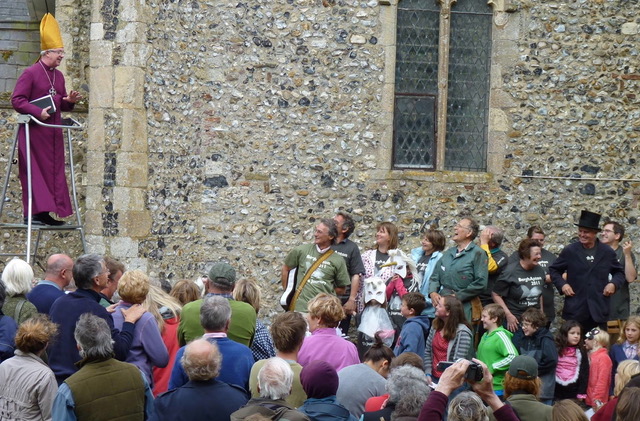
Hugh on the right in the top hat in the Bergh Apton Mystery Play in 2012. And yes - you're eyes are not deceiving you! That is the bishop of Norwich as God!
|
So yes… I like collaboration… but I also like working on my own… I like dreaming a book or a performance into being… I like walking and muttering to myself… I like balancing on that tight-rope between being in control and being a conduit for something that’s speaking through me. In many ways I’m a bit of a solitary.
Another form of collaboration I’ve been involved with recently has been ‘community plays’. There’s a village in Norfolk called Bergh Apton with a very strong interest in community arts. I’ve worked with them on four plays. I wrote a cycle of ‘Mystery Plays’, which were performed over a day as a processional performance with a cast of maybe fifty people. We’ve made a performance on the rituals of winter called ‘A Midwinter Dreaming’ and one on inundation and global warming called ‘A Songline for Doggerland’. The plays are all written in negotiation with the community and involve workshops (writing, mask making, printmaking, lantern making etc) with a host of local artists. We’re currently working on ‘One for the Rook’, a performance about the geology, flora and fauna of the parish. I’ve been lucky to work with some very skilled local community artists: Davis Farmer, Charlotte Arculus and Mary Lovett.
And I should also mention in passing, although it’s worth a whole interview in its own right, my long friendship, collaboration with and apprenticeship with the late Duncan Williamson, the Scottish traveller, teller, singer, and extraordinary bearer of oral tradition.
My final question takes us back to storytelling. You and I share a fascination for a series of tales called ‘Tales of the Lincolnshire Carrs’. I know that you did a cassette version which included two or three of these tales years ago. Now, even, allowing for some of the stranger products of those many nations who tell what we call ‘traditional tales’, they really are fantastically dark and also quite disturbing. For me, Lincolnshire born as I am, admittedly, they rather stick out like a sore thumb in their themes and atmosphere, and the fact that they’re written nearly all in dialect. The very particular landscape of the Fens really did produce and evoke a nightmare world, didn’t it?I didn’t know you’re a Lincolnshire lad Steve!
I think you’re talking about the stories retold by Mrs Balfour. Yes, I included some of them in my ‘Tales of the Fens’ performance: ‘Tiddy Mun’, ‘The Dead Moon’ and ‘The Green Mist’. She was a niece of Robert Louis Stevenson and had literary aspirations. The stories are very strange in a feverish sort of way. They include strong folk motifs but seem to me to have been ‘worked up’ either by her or by her informant. There was a big tradition of taking laudanum in the Fens (sovereign against Marsh Fever) and the ‘Tales of the Lincolnshire Carrs’ have a tinge of the opium-induced nightmare about them. They are amazing stories though. And yes, the flat, water-logged landscape of the Fens does seem to have generated some dark narratives.
Well, thanks again, Hugh, it’s been a pleasure to catch up and share some thoughts.
Many thanks Steve… it’s been a pleasure, and great to be interviewed by someone who has such a long perspective on my various doings over the years.
And it only seems far after you've put all that splendid work in, to guide people to your excellent website, where they can see - and buy - lots of goodies.
http://hughlupton.co.uk/
Next month I will be chatting again to Kevin Crossley Holland, about the ways he sees and writes about landscape, especially in his poetry.
-- .Steve Gladwin - Stories of Feeling and Being
Writer, Drama Practitioner, Storyteller and Blogger.
Creation and Story Enhancement.
Author of 'The Seven', 'Fragon Tales' and 'The Raven's Call'