Showing posts with label Harry Potter. Show all posts

Thursday, 6 August 2020

Elizabeth Goudge's The Little White Horse by Paul May

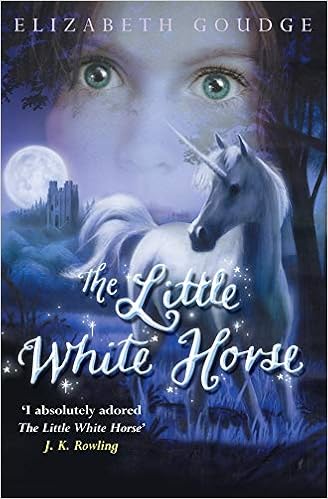
The Little White Horse by Elizabeth Goudge won the Carnegie Medal in 1946, the year of its publication, and it is just as much of a wartime book as We Couldn’t Leave Dinah and Visitors from London. It was written in the heart of the Devon countryside that forms its setting and Elizabeth Goudge wrote that ‘those were the war years and it was good to escape sometimes from the fearful realities of that time into a world where a unicorn cantered behind the trees.’


This is a pastoral novel. The action takes place in the bucolic semi-paradise of Moonacre, a country estate hemmed in by hills and the sea, entirely separate from the rest of the world, in the year 1842. As I read it, I was reminded of many other stories. The unicorn theme suggested Alan Garner's Elidor, a book that didn't win the Carnegie, apparently because the judges, astonishingly, didn't like the Charles Keeping illustrations. Then that pastoral quality made me think both of Shakespeare's A Winter's Tale and of the Ahlbergs' Each Peach Pear Plum.


The Winter's Tale element includes a shepherd for the heroine, Maria, to fall in love with and marry. Humbling her pride to marry a common shepherd is one of the things she has to do to redeem the sins of her ancestors. Except that this shepherd is not a prince in disguise like Florizel, but possibly a god or a hero from the past. He's called Robin, but he also has echoes of the god, Pan, as he makes his first physical appearance: 'Maria . . . was aware of a slim brown figure bounding towards her, of a curly head lowered like that of a butting goat, and then over went the Black Man flat on his back . . .'


The Black Men are not black-skinned, but like Tolkien's Black Riders or the Arthurian Black Knight are dressed in black and carry black cockerels on their shoulders. Their blackness is a symbolic absence of colour which is contrasted with the heightened colour of everything else in Moonacre—this really is a very colourful book. And it's not just the colours; all the senses are enhanced, and feelings too. People take one look in each others eyes and love each other instantly. There is magic in the air. 


At first, because everything in Moonacre seems so lovely and so perfect, I found myself thinking of Ursula LeGuin’s story The Ones Who Walk Away from Omelas. That story concerns a city where everyone lives in unimaginable happiness, but at a cost. In a windowless room somewhere in the city a small child is imprisoned in misery. ‘If the child were brought up out of that vile place . . .all the prosperity and beauty and delight of Omelas would wither and be destroyed.’ All the residents of Omelas know about the child. They are shown the child at a certain point in their adolescence and told of the bargain: the happiness of thousands depends upon the misery of one. And some of them, having been shown, walk away.


Illustration by C. Walter Hodges

Well, The Little White Horse isn’t that kind of a story, it turns out, but the darkness is there all the same. Moonacre is a genuine paradise, rather like the Garden of Eden, into which people have brought their own trouble. This trouble takes a variety of forms – greed, cruelty, deceit, envy, curiosity (strange one that) vanity, and being aggravating. The task of the heroine, Maria Merryweather, is to purge the evil from Moonacre through courage and self-sacrifice. I think that Elizabeth Goudge was probably influenced in her plotting by Shakespeare’s comedies, and it’s no coincidence that a lot of marrying goes on at the end.


This is, like LeGuin's, a moral story. It appears in places to be explicitly didactic, although it is the characters rather than the author who make such statements as this: ‘That’s our family motto, my dear . . .It is also, perhaps, a device for linking together those four qualities that go to make up perfection – courage, purity, love and joy.’ But the high moral tone is usually slightly undermined in some way, in this case thus: ‘Sir Benjamin paused a moment and then with intense relief suddenly bellowed, “Sausages!!!” For a moment Maria thought that Sausage was another thing that one must have to attain perfection . . .’


That mention of 'purity' is important. There are several references in the book to the Virgin Mary, and Maria's name is no coincidence. The myth is that only a virgin can tame the unicorn, and this must have been in the author's mind, but in the end, having sown all the seeds (and this is a very plotty book) she seems to have decided not to go down this route, the route which Alan Garner did take in his novel.


On another occasion, Loveday Minette warns Maria, 'Don’t make my mistakes, Maria, whatever you do.'

    'What were your mistakes?' asked Maria

    'Too many to tell you,' said Loveday, 'but they all grew out of being aggravating and losing my temper.' 


     'I’m like Lady Letitia, Loveday,' Maria says, a few pages later,  'I don’t like pink either.'

     ‘What?’ cried Loveday. ‘You ride there beside me, Maria, and dare to tell me that you don’t like pink?’ And Loveday drew herself up, and her eyes flashed cold fire and she seemed to be freezing all over.’


I think it’s this kind of thing that makes the moralising acceptable. Even the vicar, who delivers damning moral judgements on his parishioners, is not above reproach. All the characters, including our heroine, have their flaws and contradictions, and in this self-contained world the bad people are bad for understandable reasons and are willing, in the right circumstances, to be reformed. Marcus Crouch says ‘The Little White Horse is a ‘moral tale’, an allegory, in which an acceptable lesson is carried through the medium of an enchanting story. Children, who in any case are less averse to a moral than their elders, have shown no wish to complain that this story, with its excitement, its vividly realised setting and its many colourful characters, is concerned with the nature of good and evil and with the importance of self-discipline.’


I think that’s right. Reviews on Amazon and Good Reads are a real mixture of praise from modern children and from adults who loved the book when they were young and still reread it today. There's very little  'I bought this for my granddaughter and she seems to love it'. And a whole new audience has come to the book after J K Rowling said it was one of her favourites as a child, and acknowledged its influence on Harry Potter, chiefly through its extravagant descriptions of food.


Elizabeth Goudge

I have a feeling that this book might also have influenced Joan Aiken in her creation of the alternative England of James III, the setting for the Wolves of Willoughby Chase series. Can anyone suggest a sensible reason why Joan Aiken never won the Carnegie? She was shortlisted once in 1968 for The Whispering Mountain, but that's all.


And, come to think of it, Loveday Minette's bit of relationship counselling is really quite sound and I will try to take it to heart. 'Don't be aggravating and keep your temper.'


Paul May's website

Sunday, 12 April 2020

Go to books by Vanessa Harbour


If you celebrate Happy Easter, if not, I’d say enjoy the day but it seems a little inappropriate considering the current circumstances. We should all be at home unless we are keyworkers. If you are a keyworker, I’d like to say thank you for all you are doing.

This is going to be a short post this month as it is a holiday weekend. I thought I would take the opportunity to talk about books that you go to when you feel the need to be cheered up, your comfort blanket books. Or am I the only one who has those? As a family we have them, we also have our go-to films and tv programmes. They used to be Shrek, Friends and Ally McBeal, particularly for my daughter. Recently she had surgery and I found her watching Friends again as she was too ill to read.

I have some go-to books for when I am feeling overwhelmed and I need to escape I will often reread one of the following.


Ballet Shoes by Noel Streatfeild. I have loved this book since I was a child. My mother introduced me to it. It was a book I’d often read when things were difficult at school.


Silver Brumby by Elyne Mitchell. I was introduced to this book by my sister Jacky. It is such an evocative story and of course, it is about horses.

Then there is Charlie and the Chocolate Factory and The BFG by Roald Dahl, I know these might be contentious, but they are still stories I love.


Elizabeth Goudge’s The Little White Horse, again another very evocative story. I love her descriptions of food.


Markus Zusak’s The Book Thief, such a powerful book based in World War 2. Something I can easily get lost in.


Finally, is the first Harry Potter story, Harry Potter and the Philosopher's Stone by J K Rowling, I read this with my children. I also studied it at university. It has fond memories, so for me, it is like being wrapped in a big hug.


I have only really looked at the MG and YA books that I use. I do have some adult books that I reach for occasionally but I must be honest most of the time I reach for one of the above if I am feeling anxious or I need to escape from the real world for a bit. Judge me if you want, but they are in the main beautifully written.

What are your go-to books if you have them when you need to escape?

Dr Vanessa Harbour
@VanessaHarbour

Thursday, 12 December 2019

The Importance of Food by Vanessa Harbour


I can remember hearing the wonderful Barry Cunningham talking about the importance of food at a Golden Egg Academy workshop many years ago and it is something that has stuck with me ever since. He spoke about how food and meals are something that a child can empathise with. Children understand food.

Food can be used as a powerful tool in writing. It can illustrate so much so easily, adding depth. Regardless of what sort of genre your story is that you are writing – realist, historical, fantasy, sci-fi etc – you need to consider your food or how people are going to be sustained. Use it effectively and it can have a real impact. Lifting your narrative. Food can be used to show social standing, poverty, wealth, celebrations, emotions etc.


I believe J.K. Rowling with her Harry Potter stories is the master. I get my students to read her work to see how cleverly she uses food and meals. Think of the meals at the Dursleys in comparison to meals at the Weasleys. One might not have as much money but the meals are full of love. Then, of course, there are the feasts at Hogwarts.
Image result for harry potter and the philosopher's stone book


Elizabeth Goudge’s The Little White Horse is another author who was brilliant with food. I remember it from when I was a child and there was a tea scene that stuck with me. Her description was extraordinary and so evocative. I dreamt of having a tea like that. (It never happened)
Image result for the little white horse


I love the way Vashti Hardy describes food. She is another one who writes really evocatively: ‘Their parents made delicious pumpkin soup and pie, spiced with cinnamon; it tasted like autumn.’ (From Wildspark published by Scholastic, 2019)

Wildspark: A Ghost Machine Adventure
When I write I try to ensure that the reader can get truly involved in the experience and it is something they can relate to. It is part of the dramatization. With Flight, I did a lot of research into what they might be eating at the time. My current work in progress I have been writing some scenes where the characters have been involved in preparing food.


I am sure you all have your own favourite ‘food’ books perhaps in the comment section below tell me about them.

I was going to write a different post today as it is election day. I felt I ought to write something about hope but in all honesty, I am terrified. I am worried about today and what is going to happen. All I am going to say is that we have got to keep writing children’s books that show there is hope, there is a way out and that there is a way that they can take control. There are stories they can escape into.

 Keep writing and may today’s result be the one you want it to be.

Dr Vanessa Harbour
@VanessaHarbour

Wednesday, 6 December 2017

Film Adaptations of my Favourite Books by Val Tyler

I think some novels can be made into excellent films; others not. In my opinion, the best film-makers have writers who adapt the original text whilst keeping the story close to the original. Sometimes I like the changes that are made and sometime I do not.

I thought the changes made by Robert Nelson Jacobs to Joanne Harris’ Chocolat, and Tony Morphett’s TV adaptation of D’Arcy Niland’s The Shiralee worked exceptionally well. Both are well worth watching. But when it comes to Harry Potter, I find reading the books a better experience than viewing the films – of course, this is entirely personal preference.

Johnny Depp and Juliette Binoche in Chocolat

Bryan Brown and Rebecca Smart in The Shiralee

Rupert Grint, Emma Watson and Daniel Radcliff

Naturally, it’s easy to have a fixed view when I only know one adaptation of each book. When it comes to the classics, there are so many that a definitive opinion might be more difficult.

I don’t think I’ll ever get over seeing Mrs Bennet and her daughters running down the street, screaming and showing their knees in that peculiar 1940s Hollywood adaptation. To a lesser extent, I was exasperated to watch Margaret Schlegel and Aunt Juley walking down a London street hatless. I can never quite work out whether the film makers are simply lazy or have a shallow notion of what makes a story relatable to a modern audience.

Greer Garson with her family in Pride and Prejudice.
Check out those weird costumes.

It is probably unfair to dwell on that awful Pride and Prejudice when we have Colin Firth’s amazing version (adapted by the magnificent Andrew Davies) and, despite the hatless scene, I have enjoyed Howard’s End (adapted by Kenneth Lonergan) that has just finished on TV.

This is more like it. BBC's 1995 wonderful adaptation.


 Hayley Atwell, Matthew Macfadyen and Tracey Ullman in Howard's End (BBC)

One tale has to be mentioned in December. A Christmas Carol has, arguably, been adapted more often than any other story, and a whole load of nonsense has been written about it too. I would like to confront one right now. Charles Dickens did not invent Christmas, as the title of the new film tells us. His wonderful story, teaching Ebenezer to value human beings more than money, is set at Christmas time, but is not about Christmas. The setting is what Dickens observed in his own day. Inventive as the characters and plot may be, his depiction of Christmas is not.

Michael Caine with the Muppets in The Muppets' Christmas Carol

A Christmas Carol is one of the few Dickens’ novels that I have read several times. I have, on the other hand, seen The Muppets’ Christmas Carol every Christmas for the last twenty years. I find I sometimes muddle what Mr Dickens wrote with dear old Kermit. These days I cannot read the line, ‘…and to Tiny Tim, who did not die,’ without hearing Gonzo’s strongly American inflection.

But I do know the original story was not big on present-giving. The only present given was an enormous turkey to the Cratchit family. Michael Caine handing around presents at the end of the Muppets’ film was most definitely added by the Hensons.


Dickens was only suggesting that people should show good will towards each other at Christmas and, as Ebenezer is totally out of step with the rest of society, I’m guessing Dickens did not invent that. He popularised snow at Christmas, something I am told usually happened back then, but he did not invent it. He simply relayed Christmas as he knew it and in such an enchanting (and short) way that it’s still eminently readable today.

I find it interesting that the nativity is never mentioned in the book. Recently, I heard a man on the radio talking about A Christmas Carol and he referred to ‘the other Christmas story’. It took me a moment to realise he was referring to the nativity. It has become the ‘other Christmas Story’, the implication being that A Christmas Carol is the real one, or at least the one that matters. I think Dickens would have liked that, I’m not too sure about the church...


I like to think that our family knows ‘how to keep Christmas well’ and I hope it is not too early to be one of those idiots ‘who goes about with “Merry Christmas” on his lips’ while hoping not to ‘be boiled with his own pudding, and buried with a stake of holly through his heart,’ to wish you all very merry this Christmas.