Showing posts with label Alan Garner. Show all posts

Monday, 6 September 2021

Owls or Flowers? Re-reading The Owl Service by Paul May

It was 1967—The Summer of Love—but for me it was The Summer of Selling Doughnuts and Pies from door to door on the Norfolk coast, and in the evenings working in a burger van in various car-parks in Norwich. I can still smell the onions.  During the day, when we weren't working, me and my cousin would hang out in a small amusement arcade in Wroxham listening to All You Need is Love and Baby You're a Rich Man on the jukebox while we played the pinball machines. Our other main pastime was sitting beside Wroxham bridge where we watched over-confident men in yachting caps attempting to show off their boat-handling skills to their admiring families. They steered their newly-rented holiday boats through the narrow arch of the bridge—or into it. Crashes were frequent and often spectacular. Occasionally the entire superstructure was ripped off as a boat collided with the bridge at speed. It was never-ending free entertainment but it's sadly no longer available. You have to hire a pilot to take you through these days.


The Owl Service is a book about love, so I suppose it's appropriate that it was published that same year, although it's mostly about love gone wrong. And it's about flowers, too. Just the thing for a year when we were encouraged to wear flowers in our hair. But look what happens—you make a girl out of flowers for your son to marry and she goes and falls in love with another man, so the other man kills your son (except he doesn't die but turns into an eagle), and you turn the girl into an owl as punishment, then you turn your son back into a man and he kills the girl's lover. The flowers turn into owls, and they're not nice owls, either. They're hunters and killers.


In 1968 I was back in Wroxham, staying with my cousin again as I did most summer holidays. This summer we were making jewellery out of brass and copper, huge bangles that we sold to the new-fangled boutiques in Norwich—that was my cousin putting his metalwork lessons to good use. And I have the most vivid recollection of sitting in his front room watching the black-and-white TV showing Russian tanks rolling into Prague. The Summer of Love had been followed by The Prague Spring as the new Czech leader Alexander Dubcek introduced liberal reforms, but on August 20th 1968 Soviet troops invaded Czechoslovakia, and they did it live on TV, or it felt live even if it wasn't. It was all flowers to start with but it ended up as owls.

I probably didn't read The Owl Service in 1967, but I certainly knew of it, another significant happening in that year of Sergeant Pepper's Lonely Hearts Club Band and the world's first live satellite broadcast of All You Need is Love. I watched that with my parents and my sisters to the accompaniment of my father's sneering at the 'banality' of the lyrics and the music. More owls and flowers. This was known as 'the generation gap.' I was fourteen, and the brief window of time when I read children's books had already partially closed. I had moved on to thrillers, science fiction and Thomas Hardy.


My dad didn't think much of 
Magical Mystery Tour either!


I can't remember exactly when I first read The Owl Service, but I can remember how I felt about it. It was a gripping, terrifying read. I felt for Gwyn, the Welsh boy with a chip on his shoulder, struggling to better himself and leave his origins behind him, and I disliked Roger, son of a wealthy father deserted by his wife who has just remarried  and whose recently widowed wife has a daughter, Alison. It's to Alison that the holiday home in a remote Welsh valley technically belongs, and the newly-married couple and their children are there together as a family for the first time as a kind of bonding exercise. I understood all this when I first read the book. I got that Gwyn was the son of the housekeeper (and, as it turns out, of Huw the gardener) and I understood that Gwyn and Alison were attracted to each other and that, when she found out, Alison's mother forbade her to have anything more to do with him. I understood that the characters were all trapped in the oppressive summer heat, and that a crisis was brewing, but as for the stuff about owls and flowers, well, I simply accepted what was written and didn't try to figure out what was going on.

I still think that this is the best way to approach the book, to let the imagery and the mythic element operate on a subconscious level and not to try to work out precise correspondences between the modern-day characters and their equivalents in the story from the Mabinogion. In this claustrophobic Welsh valley groups of people are compelled with every generation to repeat the mistakes of the past. Neil Philip, in A Fine Anger, says this:

That the contemporary story should be played out against the backdrop of the sour ruins of the previous generation's tragedy, and under that generation's jealously watchful eye, adds an emotional resonance which transforms the story from a simple tale of adolescent passion to a penetrating comment on the human predicament.

The Owl Service asks the question that we all ask from time to time: How can people treat each other so badly? And why do they do it? The wounds that the young people inflict on each other here are bitter and painful. Words will never hurt me, we used to chant as children when words had actually hurt us. It never worked. And even though one character seems at the end to break the cycle of violence and hate—to let Alison be flowers and not owls—we are still left with the uneasy possibility, or more likely the probability, that events will repeat themselves in another generation with a less good outcome.
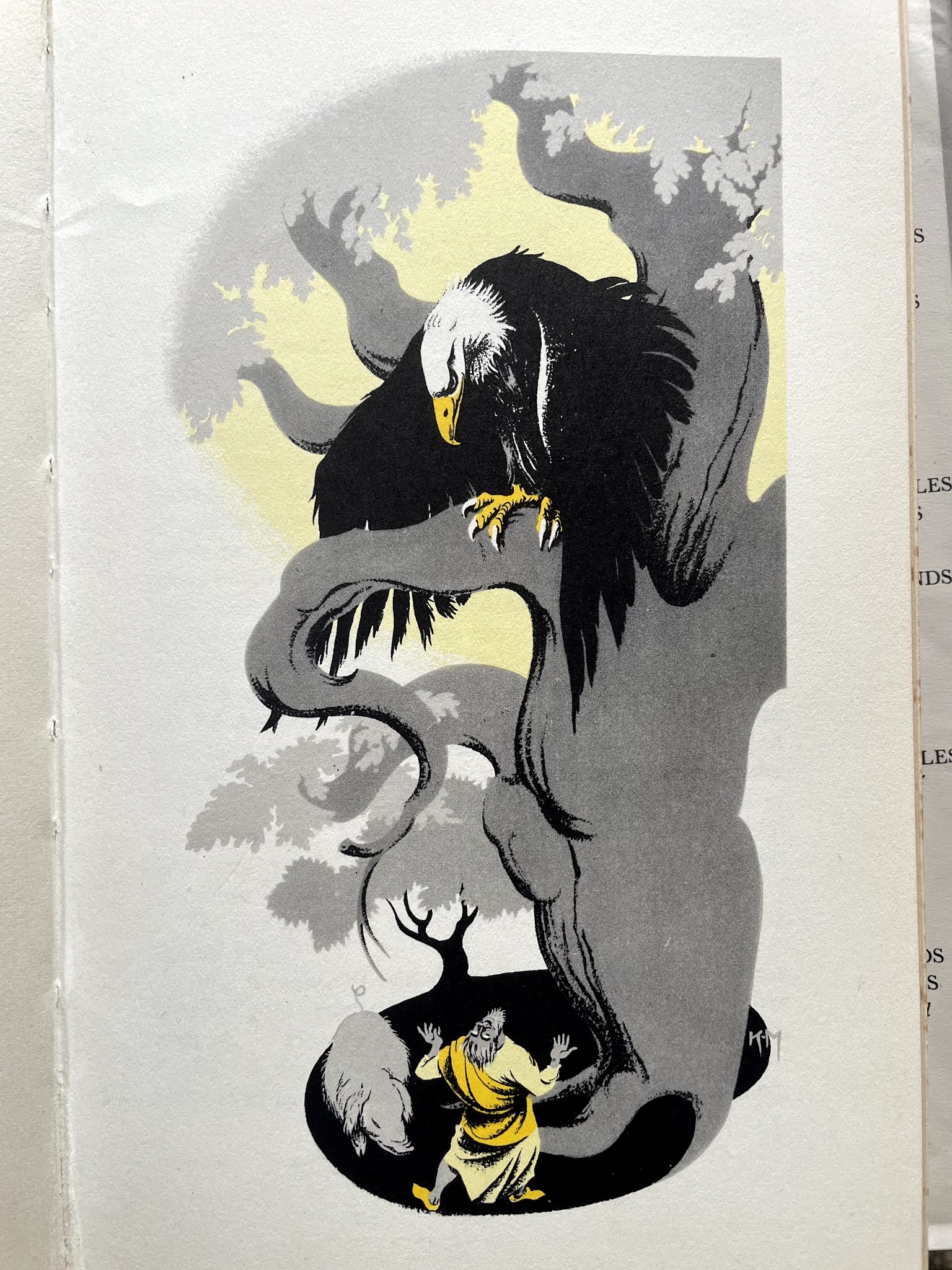
This illustration by Joan Kiddell-Monroe from 
Welsh Folk Tales and Legends shows Lleu Llaw Gyffes as an eagle,
 his father, and the sow that eats the bones he drops from his perch.
They have something to do with The Owl Service. If you want to know
 what exactly I refer you to Neil Philip's book, or to
The Owl Service itself.

The prevailing mood of The Owl Service is dark. There are moments when there seems to be a possibility of freedom, as when Gwyn and Alison climb out of the valley together and discuss what's happening to them. But then, as their conversation suddenly becomes freer and more natural, they both reveal confidences which later form the basis of betrayal and wounding. I find it hard to see it as an optimistic book, despite the release of tension at the end, and I suspect it's this darkness, and elements of the book's subject matter that led to critics making some curious remarks about it. 

For the third edition of Chosen For Children, the Library Association's account of the Carnegie, Alec Ellis took over from Marcus Crouch as editor, and The Owl Service was the first book he wrote about. I think it's reasonable to assume that Ellis represents the views of the Association. He describes the plot in a factual and superficial manner and succeeds in being both patronising and dull: 'The characterisation in the book is good, both of major and minor characters, as might of course be expected from an author of Alan Garner's calibre. He deals sensitively with the delicate relationship between the affluent, middle class English children and the Welsh boy . . . '

I never for one moment thought of the characters in this book as 'children' and I never think of the characters I write about as children. There's something jarring in the way Ellis says this. It made me think of those tweed-jacketed journalists you see in newsreels from the 1960s, interviewing the Rolling Stones or Bob Dylan or the Beatles and asking ludicrous questions—Why must you have such untidy hair? That kind of thing. Some reviewers talk about 'the generation gap' in the context of The Owl Service, but I don't see it. The generations here repeat the mistakes of their elders, and where we see Gwyn pushing against his mum's limited vision for his life we see someone trying to 'better himself' in a very traditional way. There's no rebellion from Roger and Alison. This is not long-haired free-loving, drug-taking non-conformism against the bowler-hatted uptight establishment. You would never guess that the Beatles and Bob Dylan even existed. Not until Tom puts on his headphones to listen to music in Red Shift in 1973 do Garner's characters seem to have a real connection to the contemporary world. It's in reviews like Alec Ellis's that the real generation gap is revealed. Here's how he ends his summary: 'Some critics would consider The Owl Service to be not as outstanding a book as the earlier Elidor, but nevertheless  it was still the best to be published in 1967 and is perhaps better than the selections of some other years.' 

Did he like it? I think not.

Also puzzling was a review by Philippa Pearce (in Children's Book News, July/August 1967), who was clearly in two minds about the book:

... the narrative power of the book may be the undoing of the susceptible reader, hurrying him in headlong excitement towards a total of mental confusion. It isn't up to the author to explain everything of course, but he should make plain. In Elidor there are plenty of inexplicables, but this happens; in The Owl Service, on the whole, it does not.

...there is a masterly appreciation of class idioms and snobberies, and an awareness of their deadly potentiality as weapons. Not the happiest of subjects for young readers, some may say. Others will be almost certain to add that even unhappier is the choice of illegitimacy and adultery, jealousy and revenge as recurring themes in the story.

My repeated objection, however, is not that young readers (and adults too, for that matter) may understand too much, but that they are likely to understand too little.

This comment about 'making plain' seems strange to me, (though I'm not convinced that Elidor is made any plainer by its author than The Owl Service), and I believe, though I can't find the reference, that Philippa Pearce later revised this opinion. Writing in 2003 about Red Shift, Victor Watson (in his introduction to Coming of Age in Children's Literature) sees this refusal to 'make plain' as a strength, and I agree with him. He sees Garner as 'engaged in seeking new ways of representing the effects on maturing young people of the fragmented complexities and conflicts of the post-modern world.'  He says that, in The Owl Service, 'Garner had made no concessions for young readers. He seemed to be working towards a narrative manner which - in William Blake's phrase - 'rouses the faculties to act', providing no authorial explanations and frustrating the traditional expectation that the narrator's voice should provide constant reassurance.' 

What is most modern about The Owl Service is not simply its subject matter, but just this refusal to 'make plain'. You can read it as a novel of suspense and the supernatural—or, as Alan Garner once described it, as 'a kind of ghost story'—but you are always aware of the mysterious complexity below the surface. It's useful though that Philippa Pearce pinpoints those themes that might also suggest a change in direction in 'children's books', and an opening up of new possibilities. Except that it wasn't really a change of direction, or at least not in the world of the Carnegie. The following year, 1968, the Carnegie judges selected The Moon in the Cloud by Rosemary Harris, and you can feel how much more comfortable they were with this when you read Alec Ellis's concluding remarks on that book. 'The Moon in the Cloud is a book which repays more than one reading, for with each fresh insight may be gained and hidden delights discovered.'

More of those delights (and they are genuine delights) next month as the Carnegie moves as far as possible from any contemporary relevance with a book set in ancient Egypt.

A Fine Anger by Neil Philip is an invaluable and erudite companion to Alan Garner's work up to and including The Stone Book Quartet. It's out of print but, as with most books these days, easily found second-hand.

The Carnegie Medal was not awarded in 1966 as no book was considered 'suitable'.

Paul May's website is here.


Thursday, 6 August 2020

Elizabeth Goudge's The Little White Horse by Paul May

The Little White Horse by Elizabeth Goudge won the Carnegie Medal in 1946, the year of its publication, and it is just as much of a wartime book as We Couldn’t Leave Dinah and Visitors from London. It was written in the heart of the Devon countryside that forms its setting and Elizabeth Goudge wrote that ‘those were the war years and it was good to escape sometimes from the fearful realities of that time into a world where a unicorn cantered behind the trees.’


This is a pastoral novel. The action takes place in the bucolic semi-paradise of Moonacre, a country estate hemmed in by hills and the sea, entirely separate from the rest of the world, in the year 1842. As I read it, I was reminded of many other stories. The unicorn theme suggested Alan Garner's Elidor, a book that didn't win the Carnegie, apparently because the judges, astonishingly, didn't like the Charles Keeping illustrations. Then that pastoral quality made me think both of Shakespeare's A Winter's Tale and of the Ahlbergs' Each Peach Pear Plum.


The Winter's Tale element includes a shepherd for the heroine, Maria, to fall in love with and marry. Humbling her pride to marry a common shepherd is one of the things she has to do to redeem the sins of her ancestors. Except that this shepherd is not a prince in disguise like Florizel, but possibly a god or a hero from the past. He's called Robin, but he also has echoes of the god, Pan, as he makes his first physical appearance: 'Maria . . . was aware of a slim brown figure bounding towards her, of a curly head lowered like that of a butting goat, and then over went the Black Man flat on his back . . .'


The Black Men are not black-skinned, but like Tolkien's Black Riders or the Arthurian Black Knight are dressed in black and carry black cockerels on their shoulders. Their blackness is a symbolic absence of colour which is contrasted with the heightened colour of everything else in Moonacre—this really is a very colourful book. And it's not just the colours; all the senses are enhanced, and feelings too. People take one look in each others eyes and love each other instantly. There is magic in the air. 


At first, because everything in Moonacre seems so lovely and so perfect, I found myself thinking of Ursula LeGuin’s story The Ones Who Walk Away from Omelas. That story concerns a city where everyone lives in unimaginable happiness, but at a cost. In a windowless room somewhere in the city a small child is imprisoned in misery. ‘If the child were brought up out of that vile place . . .all the prosperity and beauty and delight of Omelas would wither and be destroyed.’ All the residents of Omelas know about the child. They are shown the child at a certain point in their adolescence and told of the bargain: the happiness of thousands depends upon the misery of one. And some of them, having been shown, walk away.


Illustration by C. Walter Hodges

Well, The Little White Horse isn’t that kind of a story, it turns out, but the darkness is there all the same. Moonacre is a genuine paradise, rather like the Garden of Eden, into which people have brought their own trouble. This trouble takes a variety of forms – greed, cruelty, deceit, envy, curiosity (strange one that) vanity, and being aggravating. The task of the heroine, Maria Merryweather, is to purge the evil from Moonacre through courage and self-sacrifice. I think that Elizabeth Goudge was probably influenced in her plotting by Shakespeare’s comedies, and it’s no coincidence that a lot of marrying goes on at the end.


This is, like LeGuin's, a moral story. It appears in places to be explicitly didactic, although it is the characters rather than the author who make such statements as this: ‘That’s our family motto, my dear . . .It is also, perhaps, a device for linking together those four qualities that go to make up perfection – courage, purity, love and joy.’ But the high moral tone is usually slightly undermined in some way, in this case thus: ‘Sir Benjamin paused a moment and then with intense relief suddenly bellowed, “Sausages!!!” For a moment Maria thought that Sausage was another thing that one must have to attain perfection . . .’


That mention of 'purity' is important. There are several references in the book to the Virgin Mary, and Maria's name is no coincidence. The myth is that only a virgin can tame the unicorn, and this must have been in the author's mind, but in the end, having sown all the seeds (and this is a very plotty book) she seems to have decided not to go down this route, the route which Alan Garner did take in his novel.


On another occasion, Loveday Minette warns Maria, 'Don’t make my mistakes, Maria, whatever you do.'

    'What were your mistakes?' asked Maria

    'Too many to tell you,' said Loveday, 'but they all grew out of being aggravating and losing my temper.' 


     'I’m like Lady Letitia, Loveday,' Maria says, a few pages later,  'I don’t like pink either.'

     ‘What?’ cried Loveday. ‘You ride there beside me, Maria, and dare to tell me that you don’t like pink?’ And Loveday drew herself up, and her eyes flashed cold fire and she seemed to be freezing all over.’


I think it’s this kind of thing that makes the moralising acceptable. Even the vicar, who delivers damning moral judgements on his parishioners, is not above reproach. All the characters, including our heroine, have their flaws and contradictions, and in this self-contained world the bad people are bad for understandable reasons and are willing, in the right circumstances, to be reformed. Marcus Crouch says ‘The Little White Horse is a ‘moral tale’, an allegory, in which an acceptable lesson is carried through the medium of an enchanting story. Children, who in any case are less averse to a moral than their elders, have shown no wish to complain that this story, with its excitement, its vividly realised setting and its many colourful characters, is concerned with the nature of good and evil and with the importance of self-discipline.’


I think that’s right. Reviews on Amazon and Good Reads are a real mixture of praise from modern children and from adults who loved the book when they were young and still reread it today. There's very little  'I bought this for my granddaughter and she seems to love it'. And a whole new audience has come to the book after J K Rowling said it was one of her favourites as a child, and acknowledged its influence on Harry Potter, chiefly through its extravagant descriptions of food.


Elizabeth Goudge

I have a feeling that this book might also have influenced Joan Aiken in her creation of the alternative England of James III, the setting for the Wolves of Willoughby Chase series. Can anyone suggest a sensible reason why Joan Aiken never won the Carnegie? She was shortlisted once in 1968 for The Whispering Mountain, but that's all.


And, come to think of it, Loveday Minette's bit of relationship counselling is really quite sound and I will try to take it to heart. 'Don't be aggravating and keep your temper.'


Paul May's website

Sunday, 27 October 2013

Home is where the library is - Lily Hyde


For years, like many people I suppose, visiting my parents has also been revisiting childhood landscapes, dreams, hopes – and books.

In one specific way, these are all the same thing. I grew up in Alan Garner country. From the field above our house you could see Shuttlingsloe, Shining Tor, Mow Cop. These were simultaneously the hills my parents dragged me to for boring walks (boring because I’d much rather have been at home reading books) and perilous places of terror and enchantment where the Morrigan rode and Roman legionaries went native far from home – all inside those same Garner books. 

These days I’d rather stomp over the hills than read even a fantastic book. But it’s a tradition that, when visiting my parents, I’ll follow a walk through those semi-mythical landscapes by curling up with the books of my childhood, which my parents have kept in a wonderful library collected over the years. Alongside Garner there’s Diana Wynne Jones, Rosemary Sutcliff, Peter Dickinson, Joan Aiken, Leon Garfield, Susan Cooper, Noel Streatfeild, Elizabeth Goudge, Robert Westall… It is partly a retreat into the voracious reading of childhood, when the world of the book is more real than the real world (Tom and Jan on Mow Cop in Red Shift more immediate and vital than any boring walk there with my parents), partly a salute to these authors who inspired me to start writing myself (when those walks ceased to be boring, as I dreamed up stories to fit the landscapes) and partly an investigation as a writer, always learning, always hoping, always marvelling at how the masters manage it.      

Now my parents are downsizing (isn’t everybody?). There isn’t room for everything, so I spent last week packing up the children’s library to send off to its new home with my brother, in a different county, far from the landscapes of childhood.
One box packed, ten to go...
I also sorted through a drawer of my own adolescent writings. Most of them are awful. I can read them now and identify, paragraph by paragraph, here is Rosemary Sutcliff, here is Diana Wynne Jones, here is Ursula le Guin, Sutcliff again, Peter Dickinson, again Sutcliff… 

But in among the styles and stories lifted wholesale from other authors and legends and fairytales and films, the one thing that rings at all true is the landscape. I knew from Garner that stories as deep as myth could be written about an everyday real place. I took Narnia and Dalemark and Camelot and transposed them to the field above our house, to the hills and moors you can see from there. And in the process, I think I started to find myself as a writer.

I moved away from my parents years ago, and I’ve never written about that landscape since. I don't know if I ever will; I can’t lay claim to Alderley Edge or Shuttlingsloe the way Alan Garner can; though I grew up with them, the roots go no further back. Yet the roots do run deep. I’ll miss the children’s library; in a way it was what made my parents’ house still home. But the landscape, informed as it is by that library, is even more important to me. Those fields and hills are full not only of the dreams and truths I read in The Moon of Gomrath or Red Shift, but of my own dreams of stories and hopes to be a writer.

Friday, 31 May 2013

Why Colin can't remember - reflections on Alan Garner's 'Boneland' by John Ward

Cave paintings, Lascaux, France
(image courtesy of Prof saxx, via Wikimedia Commons)
Boneland must be one of the strangest sequels ever written. It is not Alan Garner’s best book, but for the questions it poses, it is of great interest to all of us who write for children.

It purports to complete the trilogy begun fifty years ago with his earliest books, The Weirdstone of Brisingamen and The Moon of Gomrath. The first made a powerful impression on me, perhaps because I heard it on the wireless before I read it (and I was startled to discover, on rereading it, that it was the source of a key part of the climactic scene in my own first book, The Secret of the Alchemist - a borrowing of which I was entirely unconscious). Yet the second made so little impact that only when I took it out of the library last year, in preparation for reading Boneland, did I realise I had read it before.

The strangeness of Boneland as a sequel stems from its lack of sequence: of the two characters who feature centrally in the other books, one - Susan - is conspicuous by her absence, while the other - her brother Colin - is effectively a different character: as the result of a traumatic experience in adolescence, he has undergone a personality change, becoming an autistic polymath who is now, in adult life, a professor of astronomy.

He has also lost all memory of the events of those first two books. In other words, to all intents and purposes, he has no connection with the earlier books at all (and even things that seem like links - the fact that Colin and Susan are twins, that she addresses him as ‘Col’, that their parents are killed in an aircrash, that Susan disappears - none of these actually features in the earlier books).

At first sight this seems almost perverse, as if Boneland were less a sequel, more a repudiation of that earlier work - and in a way, it is; but the question to ask is, could it have been otherwise?

Let us suppose that Colin survives into adulthood with his memory intact: here is someone who has personally encountered wizards, witches and warlocks, elves, dwarves and goblins, sleeping Arthurian knights and house-high troll-women, all in the Cheshire countryside; at the very least, he would have become a professor of comparative folklore rather than astronomy - it is impossible to believe that such events would not have shaped the rest of his life.

But the truth of the matter is that it simply will not do: elves and goblins belong in storybooks; there is no way to reconcile Colin’s childhood encounters with the reality of his adult life that would be believable. The only thing is to have him conveniently forget it all.

So am I conceding what some critics have long asserted, that fantasy is childish stuff, of no interest to adults, and of doubtful value to children, who would be better served by books about the ‘real world’?

By no means.

Fantasy, as it happens, does succeed best with children of a certain age, but for reasons that are the opposite of those put forward by its detractors: far from being an escape from the real world, it is for them an image of it.

Consider that the child entering adolescence stands on the verge of a mysterious world that he must soon enter, a world of which he knows little, governed by powerful hidden forces, a place where anything might happen: it is a prospect both daunting and exciting, in equal measure. Mapped, that world would resemble the products of mediaeval cartographers - a tiny area (home, school) that is familiar, surrounded by huge blank spaces furnished by the imagination, where be dragons.

Tabula Rogeriana, 1154 (image from Wikimedia Commons: public domain)
In other words, fantasy literature is a metaphorical embodiment of the fears and hopes we all experience on the verge of adulthood, when, though we long for freedom and independence, we are still the responsibility of other people - our parents, or those who stand in their stead. We seek reassurance that we can enter that world alone and survive on our own resources, and the emotional experience of doing that is what fantasy adventures allow us to try out.

Garner’s problems with Boneland do not arise from the fact that the earlier books are fantasy, but from his failure to keep the worlds in them separate. Colin and Susan’s encounters take place where they live; they do not go to the monsters - the monsters come to them. And because Colin, as an adult, continues to inhabit the same landscape, the question of what happened to all those fabulous creatures becomes an awkward one.

In his later story, Elidor - a fine work that manages to evoke an epic world without being of epic length - Garner ensures that there is a portal (in the liminal space of an abandoned church in the process of being demolished) so that the children in that tale pass into another world for their magical encounters; even the magical objects they bring back with them are transformed, in the mundane world, into mundane things.

But Colin, if he could remember, would know that the Weirdstone of Brisingamen - Susan’s Tear - is just up the road a way, under Alderley Edge, in Fundindelve, where Arthur's knights and their stallions lie asleep; he would know that Angharad Golden-hand’s floating island is down that way, somewhere on Redesmere - and it is unlikely that he would be more interested in distant galaxies, with that on his doorstep.

The View from Sormy Point, Alderley Edge (image courtesy of Randomgurn via Wikimedia Commons)

However, there is a second reason for Colin’s inability to remember, which has to do with Garner himself, and how he has come to view the business of storytelling. It is interesting that he rejects the label of ‘children’s writer’ - "I certainly have never written for children," he is on record as saying, though it is hard to argue that his first two books are not primarily aimed at a young audience.

What he is, first and foremost, is a writer rooted in a particular landscape - what Orkney was to George Mackay Brown, the Cheshire countryside in the vicinity of Alderley Edge is to him. However, in those first two books the spirit of place is heavily overlaid with a rather motley heap of borrowings from Arthurian, Norse and Celtic myth.

In his later writing, he dispenses with this: increasingly, it is the landscape itself, its history and prehistory, that furnishes the element of wonder that legendary borrowings supplied before. The prehistoric bull-painting in the cavern that features in The Stone Book establishes a theme that runs through all his later work. That is the other reason why Garner has Colin forget his earlier adventures: that way of telling stories no longer works for him.

Boneland, in fact, has much more in common with Garner’s more recent works, Thursbitch and Strandloper. A key figure in all three is the Shaman, who mediates between the tribe and the forces beyond - forces that imbue the landscape, forces with which the tribe must come to terms if it is to survive, controlling (or at least harnessing) them by enmeshing them in a web of ritual and story.

In Boneland, the Shaman (who is also an aspect of Colin himself) is the last survivor of an extinguished  pre-human race, probably Neanderthals; in Strandloper, it is an 18th century Cheshire labourer who is transported for sedition and becomes an Aboriginal medicine man; in Thursbitch, it is a Cheshire packman, who keeps alive the ancient Mithraic bull-cult among the country folk residing in a remote valley.

The implication is that the storyteller stands in a direct line of descent from the shaman of old, and the ideas and images on which he draws are an inheritance we all share from our earliest beginnings, but which in modern times we are doing our best to deny and forget.

The world of the fantasy story resonates with child on the verge of adolescence because she recognises it as an image of her own situation, something the adult is unable to do, because the very process of ‘growing up’ and entering ‘the real world’ is actually about acquiring a whole set of elaborate constructs to protect us from reality (which, as Eliot wisely remarked, humankind cannot bear very much).

We have work, we have mortgages, we have ‘lifestyles’ (a fine pretence, that we are actually able to shape and style our lives as we please, as if the unexpected was not at any moment liable to come down on us like a giant hammer) and - in the developed world at least, and in those countries where the social fabric still holds together and order is not breaking down - we collude in the communal self-deception that we have everything under control, that it’s all sorted, pretty much.

What Garner reminds us, as writers, is that our task is to open a crack in the walls of that complacency, and let in the light of wonder.

- John Ward
see my blog at Compleat Trowzer