Showing posts with label teaching writing. Show all posts

Tuesday, 13 September 2022

Lapping the Lough by Sheena Wilkinson

Like most writers I do a lot of teaching, of both creative and academic writing. I do it because it pays the bills more reliably (and generously) than book advances and royalties, but also because I enjoy sharing skills and knowledge. 

I’m always on the lookout for helpful images to illustrate insights about writing, and for years I’ve wheeled out my old friend the mountain. I’d explain to students that writing a story or an essay was like climbing a mountain: you had to get all your gear together (planning and researching), and then clamber as best you could up to base camp (writing the first draft). Subsequent edits, for structure and style, got you in stages to the top. It’s a good clear image and I’m sure I’ll keep using it. 
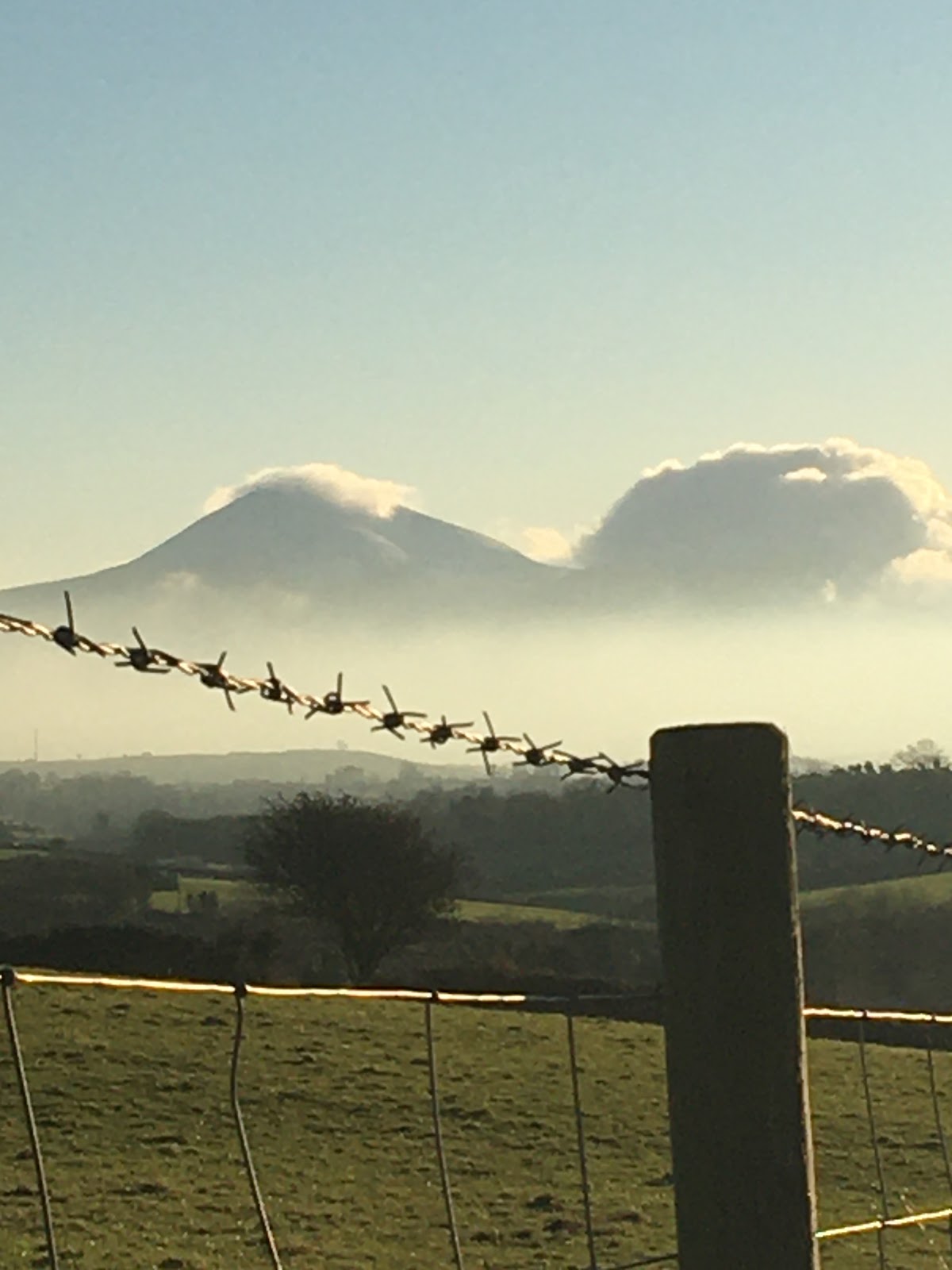


The road where I used to live: you can see
why the mountain image came so readily. 

But recently there’s a new image in town! A fortnight ago I participated in my very first sporting event, a 90-mile cycle around Lough Neagh, known as Lap the Lough. As regular readers will remember (only joking: I wouldn’t expect anyone to remember what I blogged about last month, let alone in 2020), I bought myself a bike in lockdown, not having cycled since I was in my early twenties.  (https://awfullybigblogadventure.blogspot.com/search?q=two+wheels+good) What a shame, I said, that we can’t do Lap the Lough. How disappointed I am!  I said it, dear reader, safe in the knowledge that organised sporting events were all cancelled for the duration.


Well, you can guess what happened next. This spring, when entries opened, my husband said, So we’re doing this, aren’t we? (He has done it many times, but he is a Crazy Person who has cycled up actual mountains.) Of course! I said. And the end of August seemed ages away, like when you have a year to write a book and it feels like d-e-c-a-d-e-s.


In Donegal in 2020; the mountains are purely for background effect -- I am neither mixing my metaphors nor suggesting I could cycle up more than a small hill. 


Until it doesn’t. We started off well, though it felt weird to unsporty me to say I was training for something. Suddenly, it wasn’t enough to head off for a cycle picnic because it was a good day; we had to cycle regularly even when it was windy, or we were busy and didn’t feel like it. I actually never really felt like it. It reminded me of when I started to take writing seriously, about fifteen years ago, and prioritising it instead of writing when I felt like it. And yes, in a way some of the joy was lost, but in its place was a sense of satisfaction. Last week I couldn’t cycle twenty miles without a break. This week I can. I felt myself get fitter and stronger, just as I could see results when my writing started to improve. 


As with writing, there were setbacks. Covid robbed me of a month of cycling. I fell off one day and bashed both my body and my confidence. I’m training for Lap the Lough, I told people, but I’m not sure if I’ll actually be able for it. By mid-August I was cycling 45 miles comfortably, and no longer whingeing at the hills, but 45 miles was not 90. What if I needed the loo? What if I fell off? What if I just stopped with exhaustion and cried and disgraced myself forever? (All these things had happened in training.) 


It was like when I lost confidence in writing. I know I used to be able to write, I’ve often thought, but I don’t know how to write this book. 


But my husband, and my own inner Sensible Voice, which isn’t nearly as vocal as my Catastrophising Voice, told me to relax. It’s essentially four cycles, Seamus told me, because you stop three times. And each of those cycles is under 25 miles, which you know you can do easily. After all, nobody knows better than a novelist how to break something down into stages. OK, I might get progressively tireder, just as, towards the end of a writing project I can lose momentum and enthusiasm, but it was a helpful way to see it. 


And the analogy with writing and editing was closer than I realised. The first fifty miles were on roads I didn’t know. The first draft! I was fresh, and had the enthusiasm of novelty, seeing a new landscape and feeling part of a big, popular event.  Getting going after lunch was, as I had always known it would be, tough, even though people cheered us up the main street in Randalstown as they sat eating ice creams outside a cafe. My back and shoulders were aching and I wasn’t looking forward to getting to the third stop. This was in Ballyronan, which is the village where I live. How could I, after seventy miles, drag my aching bones back on to the bike and cycle another twenty-odd miles, when home was a tempting 0.7 of a mile away? 


The Lap the Lough route


But that would be like giving up on a book when I’d written it, just because I couldn’t be bothered to edit. I couldn't let Seamus carry on alone: that would be like abandoning my characters! And in fact the last twenty miles were just like those final stages of editing. I knew these roads so well; they were the roads I cycled all the time in training. I knew where there were potholes; I knew where the donkeys were that I always said hello to; I looked forward to the place where you could freewheel all down one hill and be taken most of the way up the next. I had thought familiarity would make this part of the cycle difficult, but the reverse was true. I was even able to encourage other people. There’s a lovely downhill coming up, I told a portly male cyclist as I passed him. 


I had been dreading the last mile because we had driven it and it had looked like a long drag uphill – just as I often dread a final edit or proofread when I am too tired even to see what I have written, and familiarity had bred too much contempt for my words.  I should have remembered the adrenalin effect – elated with triumph, I managed to fly up that hill, passing lots of other cyclists and, I think, surprising my husband. 


Not as much as I surprised myself. 


at the finish line


Last week I did four days of essay-writing workshops for sixth formers, funded by the Royal Literary Fund. It was a tough week – I wouldn’t normally do four days of all-day workshops back to back – but on the second day, as I struggled to make the group understand the principle of breaking writing down into manageable stages, I remembered that day in late August, the anxiety, the bone-aching exhaustion, and then the final, exultant pull up the hill. It had given me a great sense of achievement, but it’s also given me a great image to use for the future. 

Thursday, 30 August 2018

So you want to write, by Sophia Bennett

Back to school time.

I always love this time of year. The occasional smell of burning leaves, the autumn colours, the trip to WH Smith to fill up your pencil case with new rubbers and gel tip pens you probably won't use ...

Except, now I'm the teacher. I teach at St George's Hospital, where I'm the Royal Literary Fund Fellow. Funded by Winnie the Pooh, my job is to help medical students who haven't written an essay in years suddenly tackle a research proposal of 2,000 words, or a final year dissertation.

I also (because, as we all know, very very few writers these days can afford to write full-time, and also, it turns out, because I really love it) teach writing for children at City University. This is not 'writing' for-children-at-City (that would be weird), but 'writing for children' for adults who choose to attend a short 10-week course at City, because they think they have a children's book or two inside them, and they're not sure how to get it out.

I've done both for a while now, and while a medical dissertation and a gripping chapter book for seven year-olds may not seem to have a lot in common, here are a few tips I've learned that help if you are stuck, whatever kind of writing you are trying to do.


  1. Don't try too hard to make your writing look 'difficult'. This is especially true of new students trying to impress their professor with their medical knowledge, by using as many long words, sentences and paragraphs as they can think of.
  2. If in doubt, start on chapter two. Or section 2, if it's an essay. I suggest that at first, my medical students leave out that all-important introduction. It's a nightmare! I get them to try writing the bit they know well first, and go from there. They can go back to the introduction later, when they have a structure and know what they're introducing. And if it's a book, students may just find they don't need that missed-out Chapter 1 at all. You started with the action. Somehow you fitted in more of the backstory than you expected to, without going overboard with it. The reader is gripped. You just saved yourself a month of worry. You're welcome. 
  3. Read your work aloud. 
  4. Read your work aloud. 
  5. Read your work aloud. 
  6. READ YOUR WORK ALOUD! If they do only one thing, it should be this. Best of all, at City I ask them to get someone else to read it for them. (Not my idea - Keren David taught it to me.) Instantly, they hear what jars, what doesn't make sense, what takes too long, what's boring, what's really-quite-good-actually, what works. Medical students get so much from it too. They see where their argument has gone a bit flabby, and where they used words whose meaning they weren't entirely sure of (see point 1) and didn't entirely get away with it. 
  7. Don't try to say too much at the beginning. Grip the reader. Let me know what direction I'm heading in. (See point 1 and point 2). I don't want detail yet. I want to trust you as a writer. Tell me what this is about. Let me hear your voice. Give me an intriguing image or two. Get me on your side. Then you can bamboozle me with facts and backstory.
  8. Ah, voice. As Joan Lennon recently said on this blog, it's the thing that matters. I liken voice to the late Terry Wogan. (Not to the medical students who, bless them, would have no idea who I'm talking about. I am about 104.) Remember - do you remember? - when his dark honey voice reached you from the radio? He sounded so confident, so pleased about what he was going to tell you, and he was going to tell it to only you. It was as if he'd put his arm around your shoulder and was walking beside you. A great voice sounds incredibly easy, as if the writer simply couldn't do it any other way, and it is SO BLOOMIN' DIFFICULT. I struggle with it every single time. It takes me longer than anything. But without it, I might as well not bother because it's what makes the reader want to know my story. 
  9. If a sentence can be short, great. 
  10. Read. I know we all know this. All the best medical students I see have one thing in common: they read in their spare time, or they certainly used to until recently. Many of them didn't discover reading for pleasure until their teens, but then they read voraciously. They're embarrassed about doing it now ('It's only novels', 'It's only biographies', 'It's only things I like from magazines') because they think they have to be studying medicine 24/7, but simply by reading, they've absorbed by osmosis most of the things I have to tell their friends. And my City students delight me with how much reading they do between classes, on top of their regular jobs and looking after their families. They learn. They grow. You can see it in their writing. 


    Reading for pleasure is the most important thing. It's why I cling on to every school librarian, teacher and bookseller I meet. I know we all work so hard to keep libraries open and support our indie booksellers, because we know what a fabulous job they do - not only making our work available, but opening up the world of the imagination to a new generation. If you have ever encouraged a child or a young adult to find a book they love, you have my undying appreciation. Thank you! You're educating new writers more than I ever could. 
Sophia Bennett
Twitter - @sophiabennett


Monday, 9 May 2016

Oh no! Exclamation marks! Call the grammar-police!

I don't usually mention my books on here, but this latest one is in trouble. Look at that. It has an exclamation mark, shamelessly flaunting itself in an inappropriate way, right there on the cover. Can't see that book selling. Or the others in the hugely successful series. It's obviously been put together by a bunch of incompetents who don't know how to write...If you agree, you are probably the Secretary of State for Education.

There is a lot of kerfuffle about the teaching and testing of grammar and creative writing in primary schools at the moment. I posted in March about 'wow' words. Wow-words are just one of many problems. There is also the little issue of the exclamation mark. This innocent line-and-dot combo is going to have to watch its step. It might as well be a teenager in a hoodie hanging around a bus stop after dark, or an Arabic-speaker boarding a plane - it's just asking for trouble if it goes somewhere those in authority consider the 'wrong place'.

According to the curriculum authority, a young writer should gain no credit for exclamations such as these:

"He has to open it!" (Louis Sachar, Holes)

"Look! There's a kingfisher." (C.S.Lewis, The Lion, the Witch and the Wardrobe)

"It's stress!" said Ron. "He'd be fine if that stupid great furball left him alone!" (J.K.Rowling, Harry Potter and the Philosopher's Stone) [actually, that one might actually be about the ! itself: it would be fine if the stupid great furball left it alone]

"There! It's easy - a bit rocky near the middle." (Alan Garner, The Weirdstone of Brisingamen)

"My mummy is very big. Like this!" (Chris Haughton, A Little Bit Lost)

"Let the wild rumpus begin!" (Maurice Sendak, Where the Wild Things Are)

'I carried naught but a spear. A spear!' (Tanya Landeman, Apache)

An exclamation mark, apparently, should only be used with a sentence that starts with 'What' or 'How'. After all, what do writers know? Who would you trust to use words effectively - a Carnegie-winner or the Education Secretary?

Children learn by example. We want them to read, and they learn to write through reading. If they read good books, they will come across exclamation marks used properly. Won't they then wonder why the rules for using them don't match use-in-practice? Of course they will. It's not as though exclamation marks are only safe in the hands of grown-ups. It isn't like not letting them drive or drink alcohol or join the army - all things they can do when they are older but are against the rules in primary school. No one is going to be hurt by a sharp exclamation mark.

I'm getting a bit sick of being polite about this. WTF does the government think it's doing? There is no sense to this rule, just as there is no sense to making up grammatical terms, like 'fronted adverb,' insisting children learn them and then testing them on those made-up terms. Grammar is useful, and teaching it appropriately is a good thing. But the key word there is 'appropriately'. (It's an adverb. It goes with the verb 'teaching'. 'Grammar' is a noun, as is 'thing'. And 'good' is an adjective. That's all you need to know to start with. More can follow later if necessary, but if we stuck to teaching just those, at a suitable point (not age 6) that would be enough for most purposes.)

But back to the exclamation marks. This is a made-up rule. The only rule about exclamation marks is pretty simple - use them to show an exclamation.

Help. Is that a noun? Is it a verb? If so, in what form?
Help! Verb, imperative, conveying urgency.

Punctuation adds or clarifies meaning. That's what it's for. It's not there to make dumb rules about.

Today, the Society of Authors publishes a statement from the Children's Writers and Illustrators Group and the Educational Writers Group calling on the government to alter the way children are taught to write. I am chair of EWG and another ABBA blogger, Nicola Morgan, is chair of CWIG. The members of both committees feel strongly about this issue. You can read the statement on the Society's website. Nicola's post about the ridiculous pseudo-names for grammatical parts and constructions is also published today. Please help to spread the word and free children to enjoy writing for pleasure.

Later addition: the statement is reported in today's Guardian (Wednesday).

Anne Rooney
New blog: The Shipwrecked Rhino


Sunday, 13 April 2014

The Arvon Habit by Sheena Wilkinson

I’ve got a serious Arvon addiction. Over the last seven years I’ve averaged a course a year, as student, accompanying teacher, and latterly tutor. I just can’t keep away.

Lumb Bank -- where it all started for this Arvon junkie
Like thousands of others, I value the beautiful old houses which feel so homely, the bookish environment, the magical way the week gallops and yet feels long and special. I have made lasting friendships at Arvon, and had the privilege of working with amazing writers such as Lee Weatherly, Celia Rees, Linda Newbery and Malorie Blackman.

I spend a lot of time and earn a good part of my living facilitating the creativity of others, in workshops and residencies in schools or colleges. In general I love it. Nineteen years teaching secondary English and watching in horror as the curriculum allows less and less for the creativity of learners and teachers has made me especially value working with teenagers who have somehow managed to hold onto their love for writing.

Since 2011 I have run a network of sixth form writers from schools across Belfast.  Last month I took this group on their second Arvon residential.
Totleigh Barton

Arvon, the national writing charity, has played a crucial role in my career. In 2007, with ambitions, a half-finished first draft and not much else, I attended a course on YA with Malorie Blackman and Lee Weatherly at Lumb Bank.  It was my first proper contact with real writers, and I could hardly believe that these published, award-winning goddesses would deign to read my words, comment on them and, even more amazingly, tell me that at least some of the words weren’t that bad. Lee, indeed, was kind enough to keep in touch and give me feedback on the finished novel, which became Taking Flight. She’s now a good writing pal, and, in a neat full-circle which would be far too cheesy in a novel, has twice tutored my sixth formers at Arvon.

But though I adore Arvon, and genuinely enjoy seeing its magic work on the students, for once I felt I wasn’t really up for it last month. Having been an Arvon tutor myself for the first time in December, I worried that I’d find it hard to go back to the role of accompanying adult and workshop participant. OK, maybe I’m a slight control freak. Besides, I had looming Deadlines – those fancy professional things I used to long for. Specifically an academic chapter about Jacqueline Wilson, and my forthcoming novel to sort out after an editorial meeting involved five minutes of my editors telling me what they liked and 55 minutes telling me what they hated (I can’t plug it here because one of the things they hated was the title). I just hadn’t time for Arvon unless I Used It Wisely.

The Arvon day is very structured, with workshops in the morning and readings in the evenings. Being in loco parentis, I and my colleague Maureen, a poet and teacher, had certain responsibilities but even so, we had free time in the afternoons to do our own work. And boy, I had plenty of it to do.

Would it be the academic writing, or the novel editing? Both were (and still are) pressing. Neither appealed. Arvon, for me, is an environment for experimentation, for being at the exciting start of something, for letting things happen. Shortly before I went, my agent, after listening with her usual patience to me witter on about a new idea – for the novel-after-next, said Write me an outline. (Possibly to shut me up.) OK, I thought, I’ll schedule that for July. In the meantime, I have to do the things I’m contracted to do. Because I’m professional and serious.

Then I got to Totleigh Barton on a kind March day, with my lovely sixth formers, all at the exciting start of everything.
view from Lumb Bank

Our tutors were the lovely Lee and the equally lovely Yemisi Blake, and as always on a course for young writers, there was a mix of poetry and prose. Mornings were spent in workshops, and like many teachers I love being able to sit back and be taught by a talented tutor. Then came the first afternoon. The students were on their lawful pursuits, writing or having individual tutorials. I wasn’t on cooking duty. I had from two until seven to sit in my quiet little room and Get Things Done.
Poetry Library at Totleigh

I opened the Jacqueline Wilson file. Hmm. I opened and swiftly closed the forthcoming novel file. If there is a season for everything, then the season for both these projects was – not yet. Not here.  I was surrounded by spring, and young people. I looked out at the daffodils and the coming-to-life kitchen garden and decided that this was no place for academic writing and certainly not for intensive editing.

I couldn’t possibly work on the novel-after-next, could I?

That first afternoon I did about 1200 words. And the same the next day. It felt illicit and fun and exciting – something writing hasn’t been recently.  Perhaps because of this the narrator’s voice came to me easily, cheekily; sparkier and more original than he’d seemed in my neat planning notebook.  About 200 words in I realised something surprising  about him which I’d not known before and which will make the book much better.

Arvon came to an end; it always does. I wasn’t one syllable further on with the academic chapter or the edit. But you know what? I am now. It will be fine.

And more importantly, I’ve remembered what I love about making up stories in the first place. Being surprised. I’m sensible and professional and have Deadlines, so I’m not allowed to open that file I started at Arvon. Yet.  But when the time comes, I’m ready. Being a bit of a control freak, I have the date marked in my diary.

Thanks Arvon. Again. 
Note the open gate


Tuesday, 25 March 2014

In Which I Am Lost For Words - Tamsyn Murray

I'm not often lost for words (obviously a jolly good thing in a writer) but tonight I was asked a question about writing I didn't know how to answer. As you might already know, I teach Writing For Children at City University and we're approaching the end of the course, where the students are preparing to submit a piece of writing to me for feedback. And this evening, one of my students told me he had been reading a how to write book and one of the things it had apparently advised was to avoid 'friendly uncle' type characters in your stories as these could be perceived as immunising children against the risks of potential child abuse. Should he cut the mad professor character he had in his story, my student wanted to know, in case it was taken the wrong way and it went against him when being read by agents and editors?

My first reaction (after a startled, 'What?') was disbelief that any writing book would advise this. Then I started to think about it and I could kind of see what the book was getting at but still found it mind-boggling that anyone would come away from any of the children's book I've read with that thought uppermost in their mind. There are hundreds (thousands) of innocent characters in books whose actions could be misconstrued if you chose to see them in that light - does that mean that they shouldn't exist? Or is it offensive to friendly uncles and men in books everywhere to tar them with this horrible brush?

I failed to come up with a satisfactory answer to the question, partly because I was struggling to get my head around the idea. I advised the student not to get too bogged down in that kind of advice - to write the story and the characters the way he sees them in his head and not allow them to be subject to the projected interpretations of adults. I also said it might be a nice idea to make his nutty professor a woman, since it's a reasonable subversion of a well-used trope and side-steps the whole issue. But I walked away uneasy. Obviously, we have a responsibility to our young audience when we write. How far should we take that responsibility?

Friday, 29 March 2013

Back To School - by Emma Barnes


7th March 2013 was World Book Day. As usual, the requests came in: “Would you like to visit our school for Book Week...the children would love to meet a real, live author”. This year I visited primaries in Sheffield, Leeds, North Yorkshire and Edinburgh and, now that all the rushing about is over, I’ve time to reflect a bit about what authors can bring to schools.

When I visit a school, part of it is “the talk” – often to an assembly group. In this session I’m trying to do a few things: share my excitement about books and reading, get across that reading is not a “worthy” activity but something that can take you into new worlds and generate real, edge-of –the-seat excitement; and convey that my job is fundamentally about STORY – creating narratives that people want to read, and where all the time they are demanding “what happens next?”

 It’s important for primary children to realise that this is an entirely different skill to handwriting, spelling or punctuation (which they may be bad at, and heartily dislike.) It’s not necessarily got much to do with adverbs, “openers”, “connectives” or “wow words” either. These are just parts of the tool-kit, that can be brought out when required. The aim is to create the world – the characters within it – and their story.

As well as talking to the children, I do workshops. I spend a lot of time preparing these, and asking myself the question – what extra thing can I, as a writer, bring to the children? What can I provide, that a teacher, however well-trained and inspired, might not?

....What if your mother was a witch?
Illustrator: Emma Chichester Clark
Increasingly, I focus on story. A lot of the writing that children do in class is not based around creating stories – yet for me, that is the key part of being a writer. And it’s hard, incredibly hard, to come up with a gripping story – one that holds attention, suspends disbelief and both surprises and satisfies.

Imagine Jessica's problem....

So most of my workshops are about finding different ways into a story. Whether it’s about inventing a surprising character (a mermaid who can’t swim, a dragon that can’t breathe fire), looking at a place you know and searching out the things that happen there, or thinking about a “What If...” situation...What if your mother was a witch? (Jessica Haggerthwaite: Witch Dispatcher). What if your new dog turned out to be a wolf? (Wolfie).

Some of the most fun I’ve had in schools recently has been creating stories in groups. I start the ball rolling...”What is your character’s name?” “How old are they?” And in a surprisingly short time we will develop a story...sometimes an amazing story, in which I will be astonished by the creativity and imagination all around me. “I think I’ll steal this one for my next book” I tell them (actually quite tempted!)

Best of all are the comments from teachers, about the children who have taken their stories home, or gone on working at them at playtime or in class. Sometimes I’m sent copies of the finished versions!

Emma Barnes's web-site
Emma's latest book is Wolfie - available from Amazon
 Wolfie: "funny, clever and satisfying" - Book of the Week, Books for Keeps

Wednesday, 23 January 2013

An Introduction to Abraham Maslow - Lynne Garner


Recently I treated myself to 'Your Creative Writing Masterclass' by Jurgen Wolff. A section of the book discusses what drives a person and makes them act as they do, important when trying to create believable characters. 

As part of this discussion the author discusses Abraham Maslow (1st April 1908 - 8th June 1970) and his hierarchy of needs. This is often shown as a pyramid made up of five sections. Each of these sections link to the stages of growth in a human and what they seek/need at each level. Maslow believed that the lower levels must be fulfilled for a person to be able to concern themselves with the higher levels. These five levels are:

Level one:
This consists of the basic needs to survive including: food, water, shelter, sex and sleep.

Level two:
This is the security of the individual, the family and the home. In today's modern world this could include: a safe home and environment, the need for a secure job and the knowledge that close family will be 'looked after' should something happen to us (life insurance).

Level three:
Covers the need and desire for love and belonging. This includes the love of a spouse/partner and family plus good relationships with friends and perhaps even belonging to a group.

Level four:
Once a person feels the needs of the previous three levels have been fulfilled they can start to concern themselves with self-esteem: how others view them, they receive respect from others, they respect themselves and have a sense of worth.

Level five:
In this top layer a person can begin to express themselves creatively, consider their spiritual needs, focus on their morals beliefs and express them in what they say and how they act.

Being introduced to this theory has already helped me with a story I'm in the process of planning. I've placed my lead character in level one for the first chapter, so he has a longer climb to reach level five (where I need him to be by the middle of the story). 

Now I'd like to ask: what have you learnt recently that has helped you with your writing?

Lynne Garner