Showing posts with label a writing life. Show all posts

Thursday, 4 June 2020

Finding New Ways - Ciaran Murtagh

How we all doing? It's tough isn't it. It's like that last bit of a long distance flight, we've watched all the good films, the food's been eaten, the novelty's worn off and now we just want to get off the plane. Unfortunately it turns out our Captain doesn't know where he's going, he can't fly a plane, and he's just told us we're going round again.


I've been lucky, I've had work to do and I've kept on doing it, squeezed around home schooling, supporting sick relatives and everything else. But now things have started to get a little tricky.

Working in animation you tend to work on contracts that last a year or two. The processes are set up and established, you have your teams and you know what is expected of you. For the past few months, I've been working on shows that have been in progress -  Ninja Express and Viking Skool. They've been a lot of fun, but now they're coming to an end. I'm at a point in the creative process where I'm gearing up for some new projects and figuring out how to move forward with new people and new relationships.

Ninja Express - coming to a screen near you soon. 

This is a tricky thing.  You may have worked with some of the people involved before, but not always. Some of them may be in different countries, some will speak different languages and you have to come together to find a process that works for everybody in order to get a project up and running. It's a very delicate thing, it breaks easily and it's all about relationships.

Viking Skool - also coming to a screen near you soon.

The usual way to do this is to get everyone into a big room and thrash it all out over sandwiches, biscuits and a bucket of coffee for a few days. It always works. The ice is broken, you find out you're all fairly decent, professional people who want the same thing and you commit to getting it done as painlessly as possible. Of course you are. But you have to go through that process to know that. However, right now, in these times, that's not possible and that makes all of this difficult.


An eight hour Zoom call is never fun, and when you're on a call you don't tend to chit chat - you're there to work. You can't form informal relationships over a juddering screen with twelve other people fighting the same barrier. I always knew how important the personal relationships formed at the start of these processes are, they're just as important as the professional ones when it comes to getting  you through the sticky mid series humps. It's nuanced and it's balanced and it starts right at the very beginning.


So far, I've been muddling through, getting stuff done that's been in play, stuff that's already trundling down a well established track. I can't do that any more. I'm about to embark on an 18 month project without doing any of the things I would usually do. We haven't even built the track.


In the scheme of what everyone else is going through it's small beer, but finding new ways to be creative in these difficult times is a challenge. I was hoping I could wait it out until things got back to normal and start things properly, but with the plane going round again and the Captain not having a clue, it looks like I'm going to have to try and generate some kind of spark, jet lagged and exhausted. It's not a good recipe for creativity, but right now it's all we've got.

Oh. And I need a haircut.


Wednesday, 27 May 2020

A day in the life of a writer in lockdown with a toddler - Holly Race

6am - Alarm goes off. Snooze it several times during early morning browse of Netgalley and Goodreads. My first novel is being published on 11th June and I have not yet found it within myself to heed my fellow authors' advice to step away from the reviews, Holly.

6:30am - Reluctantly get up and even more reluctantly do some yoga to ease the toddler-related back pain that has been plaguing me since the second week of lockdown.

7am - Load up 4thewords.com and speed write 500 words of second novel, keeping an eye on the baby monitor for signs of movement. For those not in the know, 4thewords has been my lifesaver during lockdown. I have always found it best to write early drafts as quickly as possible, and using programs or games that encourage me to type against the clock are the best way to get me to ignore my inner editor. 4thewords is extra brilliant because every word you type helps to fight monsters and buy equipment like golden chests and raw gold. A good one for writers who also enjoy D&D.

8:30am - 2-year-old daughter wakes up and demands Peppa Pig for the first - but not last - time today. My feelings on Peppa are very similar to Stanley Tucci's, but if it keeps her occupied for twenty minutes then I'm not complaining. I spend my time well, browsing Netgalley and Goodreads just in case anyone's posted a review in the last two hours.

9am - Attempt to fool the toddler into believing that Duplo, train tracks and serving cake to her soft toys are every bit as exciting as they were when we started playing them nine weeks ago. Eventually give up and let her daub the kitchen in paint while I catch up on emails.

10am - Bribe toddler with raisins to get her to behave while I call my cousin on Zoom. We moan at each other for thirty minutes solid. It feels amazing.


10:30am - Say 'tag!' cheerily to husband as he gets off his morning work calls and lie to him that 'she's in a good mood today'. Maybe if he goes into it with optimism it'll rub off on the little one. Speed write another 500 words on 4thewords while husband and toddler run backwards and forwards past my office door. Defeat a 'Wignow', which looks like a cross between a hedgehog and a gerbil. Would quite like one as a pet.

11am - Facetime with a scriptwriter who I am doing some freelance editing work with. The majority of our dealings have occurred during lockdown so we've never met in person, but we have already shared in depth details of our various bodily pains, and photos of ourselves wearing onesies. She's brilliant and I am a bit in love with her.

12pm - Retrieve obligatory lockdown homemade sourdough from the bread bin and attempt to persuade the toddler to eat some with poached egg. Eventually give in and hand her a fruit pouch. Husband and I make comforting noises but share dispirited glances: she is regressing during lockdown and it's making us feel like utter failures.

1pm - Read The Gruffalo and If I Had a Dinosaur for the millionth time. Share a cuddle with toddler as she tries to convince us that she can fall asleep in our bed. Heart swells as she scrunches her eyes up and makes loud breathing noises. Gives up after three minutes, licks my nose and giggles loudly. We take her to her cot, tuck her in and close the door. Agree that she really is the cutest. Especially when she's asleep.

1:30pm - Attempt to write while listening to toddler babbling away happily to herself upstairs. It's becoming abundantly clear that she is ready to drop her lunch nap. Reader, we are not ready for her to drop her lunch nap. Give up on writing and read 'The Bookseller' instead, adding a multitude of books mentioned in its pages to my already bulging Amazon wishlist. Ten weeks ago I had somewhat foolishly imagined that lockdown would give me a chance to catch up on my reading pile, apparently forgetting that I have several jobs and a sproglet.

2:30pm - Give up on all pretence of work and spend twenty minutes eating crisps and watching clips from The Greatest Showman on YouTube,  just to admire the perfection that is Zendaya.

3pm - Admit that toddler is not going to sleep and let her drink milk while watching CBeebies. Browse Netgalley and Goodreads - it's been a whole five hours, after all.

3:21pm - Surprise delivery! The proofs of my book have arrived! They've been stuck in a warehouse since the start of lockdown and I actually received the finished copies a few days ago, but this is still thrilling! Persuade toddler to hand me the books one by one so I can arrange them on my bookshelves. Only a few get creased covers in the process.

4pm - Husband takes toddler out for a walk while I attempt to write another 1000 words and write five blog posts and record a video for my publicist and read a script for a production company. I manage 200 words, a bullet point and a social media browse before he returns.

5:30pm - Take toddler into the garden while husband returns to work. Get her to load the mealworms into the bird feeder because I am creeped out by them and she isn't. Try to convince her that watering herbs is a fun game.

6pm - Concede to toddler's demands to watch 'Hey Duggee' and retire to the kitchen to make dinner. Try to listen to podcasts for intellectual stimulation but instead can only hear the distant beat of 'Stick stick stick stick sticky sticky stick stick' coming from the sitting room.

6:30pm - Sit down for dinner. Attempt to discuss news and work with husband but just end up explaining thirty times in a row why toddler can't get down from her high chair until we've all finished eating.


7:30pm - Begin bedtime routine. Read entire collection of picture books before toddler finally concedes that she is actually quite tired.

9pm - Tidy house in manner of zombie and collapse onto sofa to answer emails, Zoom friends and cry quietly about how little work we have actually got done today compared to how much we needed to get done. Briefly consider trying to write a bit more but admit defeat.

10pm - Go to bed, but spend at least an hour refreshing Netgalley and Goodreads in a cloud of self-reproach before finally falling asleep.


Holly Race worked for many years as a script editor in film and television, before becoming a writer.

Her debut novel, Midnight's Twins, is published by Hot Key Books on 11th June 2020. She also selectively undertakes freelance script editing and story consultant work.

Monday, 4 May 2020

Keep Your Eye on the Road - Ciaran Murtagh

I don't have much to say this month, not because a lot hasn't happened - it has -  but because it feels like it's all been said by many people, in many ways, many times before. 

I feel like I'm in the midway through a trans Atlantic journey on some rickety old boat, no land in sight, just the knowledge that somewhere just beyond the horizon is the place I need to be. 


Days become weeks with precious little change and everybody seems to be in a holding pattern that started six weeks ago and is now getting harder to sustain. For a few weeks we could make do and scramble to regain a semblance of normality. We could work late, work early, home school, exercise with Joe Whoeverheis and keep the car on the road. Now we're six weeks in,  with no end in sight and starting to doubt the value of the car in the first place. 


It's at times like these that we have to remember why we set out in the first place. What it is we want to achieve - not in a 'I learned the lute in Covid' kind of way, in a much more profound, 'these are my values' and I hold them true regardless of the nonsense coming at me from all angles' kind of way. 


I'm taking comfort in music and - maybe because of the boat analogy, or the fact that we've just crossed some sort of Rubicon - it's The Waterboys who are really doing it for me.  This is the Sea sums up my feelings of where we are pretty well. 


You're trying to make sense
Of something that you just can't see
Trying to make sense now
And you know you once held the key
But that was the river
And this is the sea...


But as we drift out of our depth to who knows where, it's another Waterboys song that gives me hope. Keep keeping on and don't lose sight of what you hold dear. Know where you're going, be true to yourself and no matter what distractions, turbulence and nonsense lie ahead, trust that you'll get there eventually. Somehow. 
Keep the river on your right
And the highway at your shoulder
And the front line in your sights, pioneer


Wednesday, 5 February 2020

Writing forward by Alex English

I’ve always had the habit of writing in bits and bobs, going back and forwards through my story picking out various scenes, tweaking here and changing there. When I wrote my forthcoming novel, Sky Pirates: Echo Quickthorn and the Great Beyond, I had no idea if it would be a series or a stand-alone book (or even whether it would be published). I just wrote it, very much pantsing my way through and discovering the world along with my character. I didn't have a long series arc mapped out or plans for a trilogy. But now that the first book is more-or-less finished (off to typesetting this week – hurrah!) and I have started writing the second book in the series, I’ve realised that this time I can’t go back and change the beginning. The first book is fixed and I have to go on. A scary thought for a fiddler like me.
Help! Photo by Daniel Jensen on Unsplash
In an improv workshop with Sally Nichols many years ago at a SCBWI retreat we played various games but one particularly stuck in my mind. We stood in a circle and built a story step by step – each person had to make up one story beat, the story then moved on to the next person and the next around the circle. I can’t remember the fine details of the exercise, but one thing that did really stick with me was Sally’s exhortation to keep the story progressing forward. Each beat needed to change something and move the story on, but more than that there was no possibility of going back to seed in something at the beginning that you need at the end. 
Often when I write it’s only when I get to the end that I realise what the beginning needs to be. But when stories are told orally and real-time like this you can only use what you already have, however small the detail, and build on it.

Whenever we got stuck in the improv exercise, Sally urged us to look back at what had gone before. What skills did our characters have? What experiences had they gone through? What possessions did they own? Which of those side-characters that made cameos earlier could come in useful now? Which of those small details that we thought were just for colour could prove to be more significant?

Onward! Photo by Priscilla Du Preez on Unsplash
As I was chatting to a friend at the recent Folly Farm retreat, it occurred to me that this concept is going to come in very useful when writing a series. Yes, the first book is finished. Any opportunities to go back and sneak in a crucial clue for use in future books are now gone. But that’s okay – thinking back to Sally’s workshop has made me realise I have everything I need. I'll take what I have and write forward. The only way out is on! 

Alex English is a graduate of Bath Spa University's MA Writing for Young People. Her new middle-grade series SKY PIRATES launches in July 2020 with Simon & Schuster. 

Her picture books Yuck said the Yak, Pirates Don't Drive Diggers and Mine Mine Mine said the Porcupine are published by Maverick Arts Publishing. More of her picture books are forthcoming in 2021/2022.
 

www.alexenglish.co.uk

Saturday, 4 January 2020

Ciaran Murtagh - Getting Back in the Saddle

This time of year is always tough for me. It feels like I've only just got back into my working rhythm after the disruption of the summer holidays then Christmas is upon us and it all goes out of the window.  The house is full, space is limited, the opportunity for routine is a Christmas wish too far and knuckling down for a few hours to get something meaningful written is nigh on impossible. Besides, everyone else seems to have given up on work for a month so why not join them?

So you do, and then here comes the new year and you're in the same house, but now everyone's gone, the decorations are down and the only company you have is a blank piece of paper. The solitude you've been longing for is all yours and you haven't a clue what to write. Typical.

The start of any year feels like I'm grinding through gears. It's at times like this that I envy the routine of an office job. You turn up, you know what you have to do, you get on with it and you get paid. Right now, I'm not ready for 2020. I really can't be bothered. I've got nothing I'm burning to write and the stuff I have to write is the fag end stuff that didn't quite make it into 2019.

The New Year should feel like the start of many new opportunities, and I'm sure they will come, but right now the prospect of getting off my mince pie saturated arse and digging them out is a daunting one. It's making something out of nothing. Again. Can I really be bothered to get back on the horse when pay is shrinking and work is hard to find?

It was the same at the start of 2019 and 2018 too. I know I will come out of it and get down to business, but for now, on the Saturday before 2020 really starts, I'm having a bit of a wallow. Christmas is over, the New Year is here, and it's much the same as last year really...

There is one thing that has changed though. I have another year of experience. I have another year of work under my belt. I'm aware that I always feel like this and that I will inevitably dig it out. At the moment 2020 already seems like an exhausting prospect. In a couple of days it may just seem like a year full of possibility and opportunity. But first, there's a couple of Quality Street left in the bottom of the tin and no one even bothered opening the mulled wine.  Seems a shame to waste it. See you in a month.

Wednesday, 16 October 2019

When 'I Need to Write Something' becomes 'I Need to Write This' by Claire Fayers

In my conversations with other writers recently, one topic keeps coming up: remembering why we started to write. This seems to be equally true for published and yet-to-be-published writers.

"I've realised I've started to focus so much on getting a book finished recently that I forgot why I started," one friend said. "Because I enjoy writing!"

Another friend, sharing the familiar frustration of friends and family seeing her writing as a hobby commented, "But in the end it should be like a hobby. We do it because we love it."

I need to remind myself of this often. Because writing can often feel like this:


And in those time when writing feels like pushing a boulder up a never-ending hill, we wonder why we ever started this. We find ourselves writing just for the sake of reaching the top of the hill and everything until that point becomes drudgery.

I admit, I've been struggling to write this year. Still, I sat down dutifully at the computer every day with the aim of just writing something, anything. Because that's what writers, do isn't it - they write. Then last week two minor villains wandered into my draft and made me fall off my chair laughing. I raced through an entire chapter, eager to see what they'd get up to. In a matter of seconds, 'I need to write something' became 'I need to write this story.'


So I have my plan for the winter months, and I even have a few productivity tools to keep myself going. I don't use many because I find that productivity tools can become distractions in themselves, but these are the ones I've stuck with. I'm sure these are all familiar already, but I thought I'd share them in case they're helpful.

Word processor shortcuts

I've tried every writing method from notebooks and pens (too slow) to Scrivener (too organised.) I like to claw my raw material into one messy heap and then chip away at it until it looks like a story. I keep one document for the draft and one for background notes - useful for quickly checking everything from the colour of someone's hair to the customs of an alien planet.

I used to use bookmarks and comments to find my way around my draft, but now I add in scene headers and use the navigation bar, which is much more efficient. Write a brief description of your scene, go to the home tab and change the style to Heading 1. Then go to the view tab and tick the Navigation Pane box. You'll get a handy side-bar with a list of all your headings, and clicking on any of them will take you straight to it.

I've recently discovered Word's 'focus' button on the bottom right of the screen and I wish I'd known about this before. Click this and everything surrounding your words disappears. It is amazingly useful for cutting out on-screen distractions. 


Go away Internet

There are many apps which will block your access to the Internet. I use Leechblock which is very easy to use - simply list the sites you want to block and when you want to block them. You can allow yourself limited access to sites, too. I am allowed 5 minutes per hour on Twitter after which I'm thrown out.

Spreadsheeting your progress

These can either be extremely useful for setting deadlines and motivating yourself to write, or ghastly things that only serve to highlight how far behind you are. I like them because they let you see how much progress you've made already.

You can find loads of templates online but I've written my own and kept them simple.

The wordcount spreadsheet lets me set a target wordcount for each day, add in my actual wordcount, then it tells me how I'm doing, many days I have left to go and my projected end date, allowing for weekends off. 


Then I have an editing spreadsheet, which serves a practical purpose as it will help me with the structure of my novel once I've finished the first draft. I always include POV as I use multiple third person. The structural analysis column is to mark major points in the story. Once I've finished the draft, I'll spend a couple of days with this spreadsheet, seeing where material needs to be cut or moved about - which will be easy to do as all my scenes in Word are already labelled.


If you'd like the spreadsheet templates, let me know! And happy writing.


Claire Fayers is the author of the Accidental Pirates series, Mirror Magic and Storm Hound. Website www.clairefayers.com Twitter @clairefayers


Tuesday, 20 August 2019

How Writing Changes the Writer - Joan Lennon

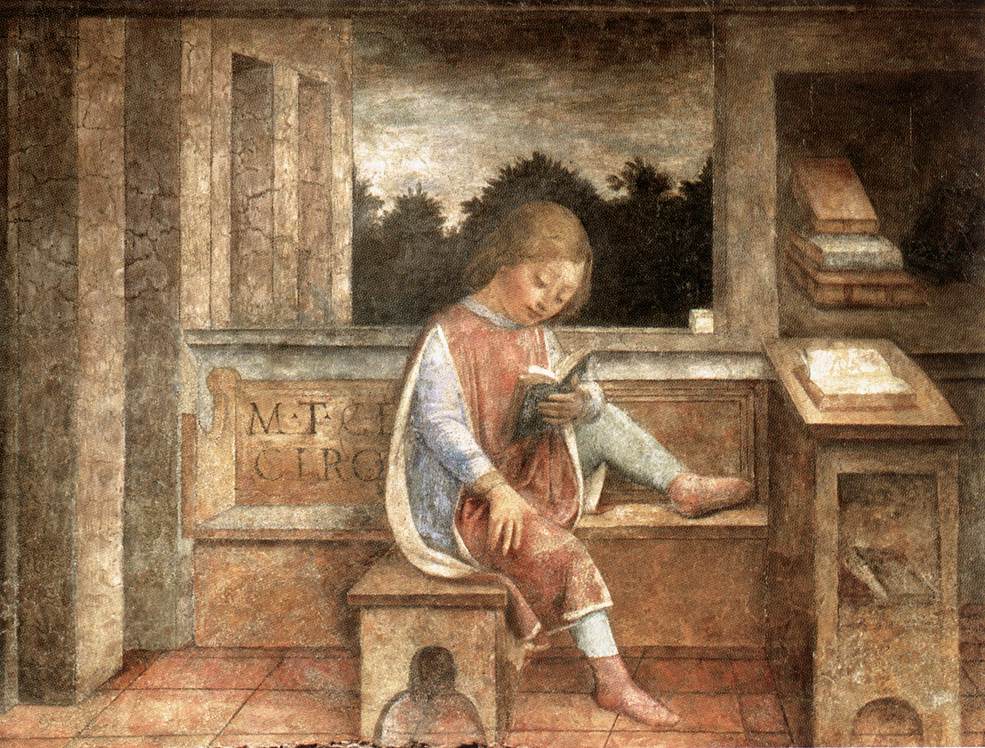
I'm over on the RLF Vox site* with a podcast on How Writing Changes the Writer.  I couldn't think of an image to add that would fit that title, so instead how about The Young Cicero Reading?


Vincenzo Foppa (1427-1515) 
(wiki commons)

* Vox is a collection of bite-sized podcasts by writers chatting about things writerly.  There is some fabulous browsing to be had!


Joan Lennon's website.
Joan Lennon's blog.
Walking Mountain.

Sunday, 30 June 2019

A little bit, word by word ... by Sophia Bennett

I write this in my shed, on the hottest day of the year, to the sounds of next door's barbecue wafting through the open doors. In a minute I'll go and make a salad to feed the children (12, 17 and 18), then dash off to visit my husband in intensive care before the end of visiting hours.

I haven't made much progress on the book this week. OK, any progress.

I've spent a lot of time in the garden, fulfilling my teaching commitments, buying and making food, and reassuring the family my husband isn't as ill as the last time he was in intensive care. The 'write ABBA blog post' has been at the top of my to do list for days but, like the growing list underneath it, has been put off from day to day. Until now, when the deadline is midnight.

Just as I imagined, it feels good to feel my fingers on the keyboard, to search for words and find them, sometimes, and reach for a rhythm that comes and goes. It is a step towards getting back to the book and I'm looking forward to next week, when I'll find more time to insert myself into the intricacies of its plot, and eek the word count forwards a little bit, word by word ...

I'm inspired by other writers, who write about writing through times far more difficult and complicated than this one. Parents who sit beside their very sick children and crack on with the story; PD James, who wrote for years with a senior Civil Service job to do and a sick and difficult husband to care for, who had been broken by his experiences in the Second World War; writers who've been bereaved or betrayed, and still kept to the deadline somehow, and kept the words coming.

Sometimes you can't, of course. A good friend of mine, one of the most talented children's writers I know, lost her husband suddenly and couldn't write for a year. So she painted, and looked after herself and her children, and eventually the words returned. I've had times when I simply couldn't face the empty page, but this isn't one of them. The story is plotted, my characters are brimming with life and I've left them in suspended animation at a critical moment, which I'm keen to get them out of.  Nothing would cheer my husband up more than for me to waft in with tales of chapters written and plot points resolved.

But I've learned over the years to be kind to myself. Like the nurses in intensive care, I'll take this day to day. If I can make progress, I will, and if I can't, I won't add to the stress by berating myself. I'll try and be inspired, too, though, by the many, many children I've encountered over the years on school visits who've overcome unbelievably tough experiences to be creative, and have used creativity to get through. If the boys and girls of Kensington Aldridge Academy can write a fantastic story, surely so can I?

And we need stories. They get us through the tough times. They're what inspired me to write in the first place, when I was little and freshly transplanted to the other side of the world, with only my favourite books for company. E. Nesbit, Noel Streatfeild and Anthony Buckeridge saved me for a while. One of the things that makes me most happy is to know that Threads, my first novel, is the go-to book for lots of stressed-out teens who read it when they were 10 or 12, and keep it as their under-the-duvet read. I'd love the new book to be that kind of story too.

But first I must write it. A few words at a time. After I've done this blog post (a good writing exercise), and made the salad and been to the hospital, and watered the garden on this blazing hot, glorious, English summer's day.

Sophia Bennett
www.sophiabennett.com

Thursday, 28 March 2019

Do you think one day you’ll stop writing? – Clémentine Beauvais


That question arises quite often when I do school visits. ‘Do you plan to stop writing some day?’ ‘When will you stop writing, do you think?’ (I try not to take it as a Britishly polite way to say ‘Please do us all a favour and stop writing’.)

I find this quite an interesting question, especially as it’s more often asked by the younger children, say 7-13, than by teenagers. At that age, maybe, they see hobbies and activities as transient, quickly likely to get boring. But at the same time, it is surprising, because they often also have quite strong views about what they are definitely going to do their whole lives, and it involves very certain, very definite things, a clear career, getting married, a house to live in, stability. Personally, I don’t recall ever asking a grown-up if they thought of quitting their day job, or indeed their hobby.

Beyond that, the question is interesting because it involves a kind of doublethink. I don’t currently think one day I’ll stop writing. There may be good incentives not to (though it is not my main job, so I don’t technically depend on it). I’ve always written, so I can’t quite imagine a world where I wouldn’t. However, I also know that existential shifts of this magnitude do happen from time to time, so I would never give an absolute ‘No’ in response. 

Furthermore, when you’re a children’s writer, there are a fair amount of good reasons, more or less independent of your own volition, to stop writing. First, ours is a literary business tied to a fickle market, which may change beyond recognition – at least beyond our recognition. It might reject our work in the process, or we might feel so uncomfortable with that market that we elect to retire from it.

Or, we might feel like we just can’t talk to children and teenagers anymore. Already at thirty I sometimes feel less comfortable tackling topics that I had no trouble tackling at 22 – I was, for instance, much more explicit about sexuality, much more frontal, because in a way I was describing practices that were my own too – ‘my generation’s’. Today’s teenagers aren’t my generation. I try to connect with them on different levels – reaching more for the universal than for the particular. I try to get, in literary ways of course, to what might constitute the core of that experience of childhood and adolescence, the newness, the intensity, the excitement, instead of composing literary ethnographies of practices. In this way I see my writing has evolved with my age, but I still feel comfortable with it. 

What if one day I can no longer feel that this 'universal' is within literary grasp? Either because I can no longer see it – or because it was never there…

Or, publishing might simply take on new formats that we no longer have the literacy competence to tackle. Whether through technology or through advanced hybridity of format – visual, verbal, typographical, who knows what House of Leaves-style books may emerge in the next ten years – it is not unlikely that the children’s and YA literature of tomorrow will leave the multimodally illiterate writer behind. Or at least, the ones not versed in contemporary forms of multimodal literacy.

Or, all children and teenagers might stop reading, costing us all a job. When I suggest this, they all say ‘Noooooo!!!!’.

Or I might decide that this writing thing has run its course, and try my hand at something else. It is not as fanciful a proposition as it sounds, we all change.

When you make a list like this, it quickly becomes vertiginous, that possibility. To stop writing. 

Maybe. I don’t think I will. But I don’t think I won’t, either. Between the things that depend on us, and those that don’t. But I like that uncertainty, because of course it’s life. 


-------------------------------
Clémentine Beauvais is a writer and literary translator. Her YA novels in English are Piglettes (Pushkin, 2017) and In Paris with You (trans. Sam Taylor, Faber, 2018).

Friday, 1 March 2019

ME, THE DEAD DESKTOP AND THE NEW BLUE by Penny Dolan

A rather self-focused post, I’m afraid.

Being a creature of habit, this month has been an odd one. As I said at the start of February, my main computer - a desktop model - crashed and died, and took my main email set-up with it.

As my tax returns had just been done, there was a certain kindness in the machine’s demise. Besides, I knew all was not lost; the material was merely inaccessible for a while. So, while the big box was being mended by a generous friend, my days took on a different rhythm.

The email thing. 

I did have a “travelling” gmail account, so I could email family, some of my friends and a few essential contacts when away from home, but with the desktop gone, I was unable to access my main email account.

Consequently, for most of February, my main incoming emails were invisible – at least to me. All the usual information was coming in and/or being rejected somewhere but, for this patch of time, there was nothing I can do about it.

I was concerned about anyone truly trying to reach me and hoped they’d try other methods.(Sorry, if the silence included you.)

I was also slightly worried that the offer of a lifetime might have been rebuffed but I didn’t, truly, think it was likely.

What,  however, was not arriving was the weight of everyday information, from book releases and media promotions through to shopping and spam. Day by day, everything felt lighter – and the silence was strangely liberating. And enjoyable

There was another sideways effect.

I tried using my newish laptop much more but the dainty keys responded all too well to the lightest touch of my fat fingers. Any mis-tap on the key-board set the laptop swallowing lumps of text before I'd had time to see what was being eaten. In my technically anxious state, I dare not trust my WIP to my elegant laptop in case I lots the lot.

Instead, I read and I pottered around the house, doing practical things, and let myself think about the WIP too. Steadily, while I was away from the tyranny of my own blooming wads of words, various ideas and answers arrived and useful thoughts got thunk. The WIP moved on and that was a second delightful result of my disaster.

Today is the first day of March, and a new (but not-yet-tried) desktop is in place and ready. 

I am still not sure how my various email setups will work out, but something will, though I shall try to be less in thrall and maybe unsubscribe more often.

My time away with my New Blue laptop, partly unconnected, has been unexpectedly useful and we will be staying better working friends than we were. So a g.ood and useful patch of time, all in all!

That's it. A new month has arrived, so have a good March yourself, and  I will try to write a more outgoing post for the start of April, if that’s possible by then. 

Sigh. 
By then, it may be a whole other story . . .

Penny Dolan