I write this in my shed, on the hottest day of the year, to the sounds of next door's barbecue wafting through the open doors. In a minute I'll go and make a salad to feed the children (12, 17 and 18), then dash off to visit my husband in intensive care before the end of visiting hours.
I haven't made much progress on the book this week. OK, any progress.
I've spent a lot of time in the garden, fulfilling my teaching commitments, buying and making food, and reassuring the family my husband isn't as ill as the last time he was in intensive care. The 'write ABBA blog post' has been at the top of my to do list for days but, like the growing list underneath it, has been put off from day to day. Until now, when the deadline is midnight.
Just as I imagined, it feels good to feel my fingers on the keyboard, to search for words and find them, sometimes, and reach for a rhythm that comes and goes. It is a step towards getting back to the book and I'm looking forward to next week, when I'll find more time to insert myself into the intricacies of its plot, and eek the word count forwards a little bit, word by word ...
I'm inspired by other writers, who write about writing through times far more difficult and complicated than this one. Parents who sit beside their very sick children and crack on with the story; PD James, who wrote for years with a senior Civil Service job to do and a sick and difficult husband to care for, who had been broken by his experiences in the Second World War; writers who've been bereaved or betrayed, and still kept to the deadline somehow, and kept the words coming.
Sometimes you can't, of course. A good friend of mine, one of the most talented children's writers I know, lost her husband suddenly and couldn't write for a year. So she painted, and looked after herself and her children, and eventually the words returned. I've had times when I simply couldn't face the empty page, but this isn't one of them. The story is plotted, my characters are brimming with life and I've left them in suspended animation at a critical moment, which I'm keen to get them out of. Nothing would cheer my husband up more than for me to waft in with tales of chapters written and plot points resolved.
But I've learned over the years to be kind to myself. Like the nurses in intensive care, I'll take this day to day. If I can make progress, I will, and if I can't, I won't add to the stress by berating myself. I'll try and be inspired, too, though, by the many, many children I've encountered over the years on school visits who've overcome unbelievably tough experiences to be creative, and have used creativity to get through. If the boys and girls of Kensington Aldridge Academy can write a fantastic story, surely so can I?
And we need stories. They get us through the tough times. They're what inspired me to write in the first place, when I was little and freshly transplanted to the other side of the world, with only my favourite books for company. E. Nesbit, Noel Streatfeild and Anthony Buckeridge saved me for a while. One of the things that makes me most happy is to know that Threads, my first novel, is the go-to book for lots of stressed-out teens who read it when they were 10 or 12, and keep it as their under-the-duvet read. I'd love the new book to be that kind of story too.
But first I must write it. A few words at a time. After I've done this blog post (a good writing exercise), and made the salad and been to the hospital, and watered the garden on this blazing hot, glorious, English summer's day.
Sophia Bennett
www.sophiabennett.com


Showing posts with label answers. Show all posts
Showing posts with label answers. Show all posts
Sunday, 30 June 2019


Sunday, 2 June 2019
Making Hay, by Sophia Bennett
Last week I had the wonderful experience of being invited to speak at Hay. It's my third visit, and each one is special in its own way.
This time, the specialness started as we pulled up at our B&B, where we were met by the curious chickens. They came to check us out every time. Not sure we passed the first inspection.

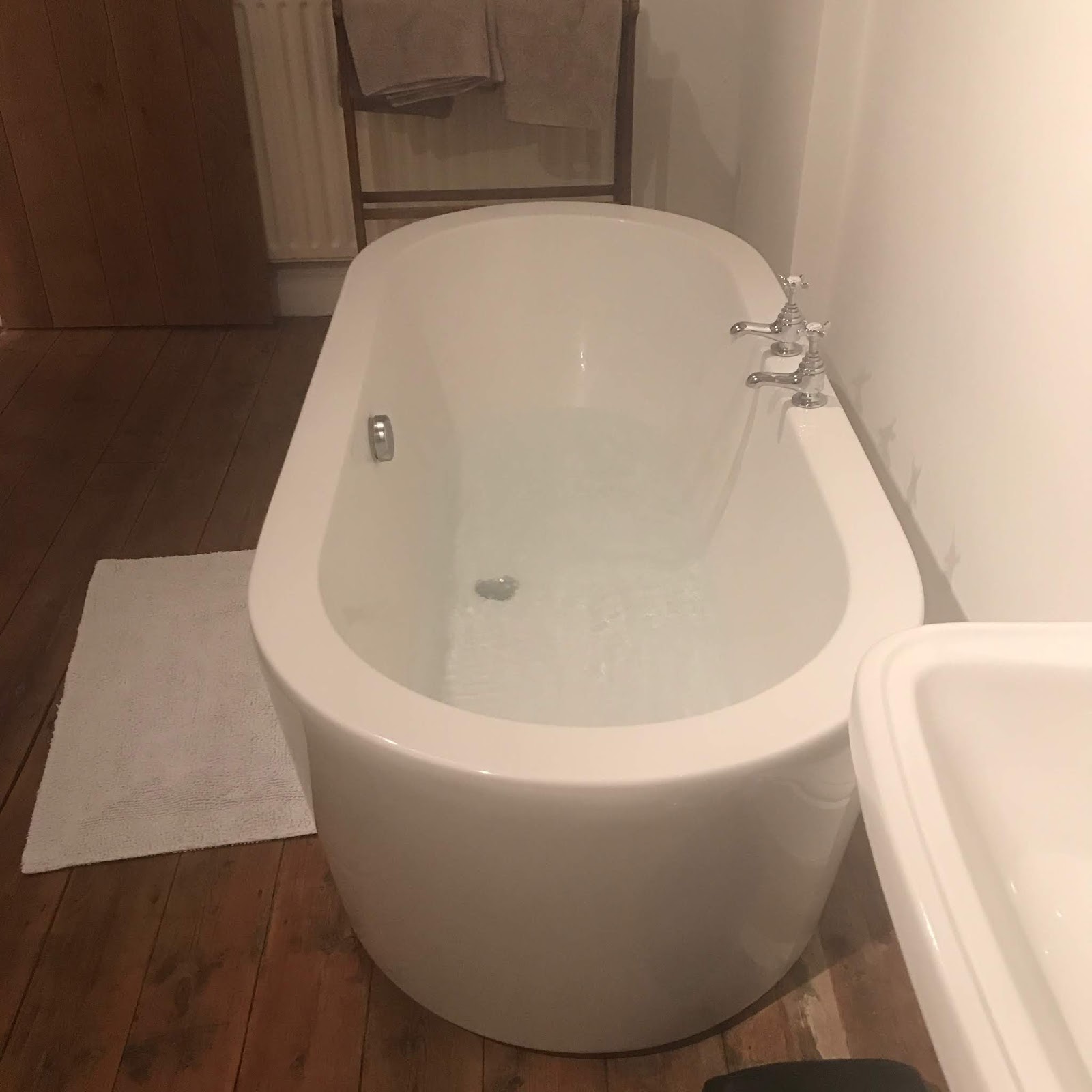
But it wasn't just about the creature comforts. There were also books to be discussed, in a big tent (actually lots of big tents), in a field (probably lots of fields - but hard to tell, under the tents) in a village on the border between England and Wales, and most definitely heaven.

Talking of which, the first talk I went to was by Ben Lewis, talking to Kirsty Lang, and was all about Jesus. Or rather, Leonardo da Vinci's painting of him in the Salvator Mundi. Or WAS it Da Vinci? That's what Ben's book is about. By the end we all agreed that nobody really knows, but it's probably about 20% da Vinci. Great hand, though. A hand by the hand of the master, probably. Great talk.

And the following day (after we'd tried out the bath), we were back in a big tent with Kirsty again, who was talking to Horatio Clare this time about a walk he did in Germany, in the footsteps of JS Bach. If you ever get the chance to listen to Horatio, do. (He's on Radio 3, so not hard to find.) He has a voice for broadcasting, a beautiful turn of phrase, innate hope about the natural world, and always something interesting to say. As an audience, we were gripped. Afterwards, Horatio signed for nearly two hours. (I bought 2 copies of 'Something of His Art'. Check out the gorgeous cover on the link.)

And then there was the Artists' Room, where we were treated like royalty. I didn't spot any actual royalty (although it's been known), but did see Michael Gove, Jeanette Winterson, Robert Macfarlane and Jackie Morris (who kindly signed my copy of 'The Lost Words' for me and let me fangirl) and many other Famous Faces. My husband and I had a lovely long chat with Candy Gourlay, who's produced all sorts of content from Hay this year - so if you want to know the full story, follow her on Twitter, her website and wherever else you can find her!


I was going to be speaking in the same tent as Frank and Lauren, and it was big! Lots of people! This was my view from halfway back in the audience. I assumed there would be about 20 people for mine, but actually it was pretty full too. Which shows that 1) Hay audiences have great taste and want to know about women in the art world and 2) the great Hay festival organisers are brilliant at getting people enthused. Hooray! (These are my books in the bookshop by the way.)


The sun shone. Not all the time, but enough. Make Hay and all that ...

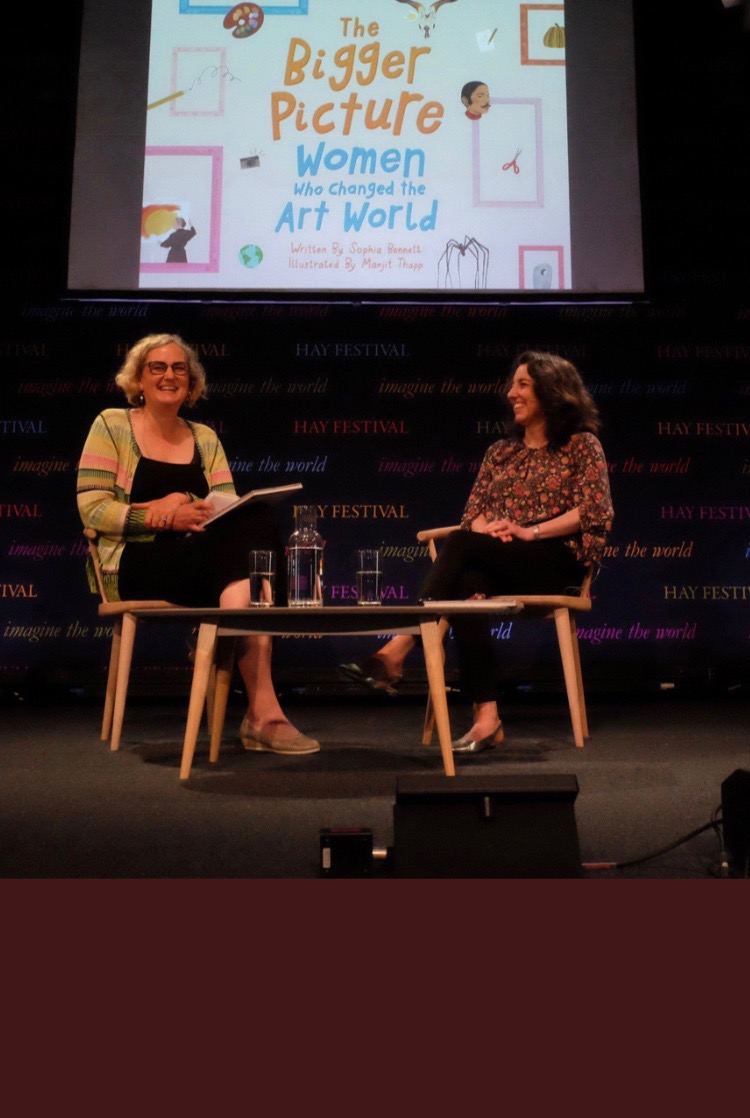
And then it was time for my event with Claire Armitstead from the Guardian. She was a brilliant, gentle, thoughtful, (prepared!), funny chair. She let me do my thing, talking about some of my favourite artists from 'The Bigger Picture: Women Who Changed the Art World' and what I find fascinating about their lives and work. Claire ended with the quiz from the back of the book - asking the audience some hand-picked questions, which they could now cheerfully answer! Candy was in the audience and took these pictures. Thanks Candy! (My husband was there too but he was too busy cheering - very loudly and embarrassingly - to take a photo.)

Here he is afterwards. Still cheery.

And then it was party time. Again, no pictures from husband, so resorting to a selfie to give the general idea.

And this is what it looked like when we got there. I say 'we' - I was sharing the B&B with Jessie Burton, as you do, and we went together. She was LOVELY, and obligingly signed my copy of 'The Restless Girls' after breakfast the next day. If you want a feminist fairytale for older girls, with magnificent illustrations by Angela Barrett, then this is the one. It is odd but nice to share toast and marmalade with your literary heroes. At Hay, that's the sort of thing that happens.


 Home time. Such a beautiful view from the Second Severn Crossing. And a memento: the very last 2017 30th anniversary Hay mug, by Emma Bridgewater, with a fantastic image of Hay by her husband, Matthew Rice. Guess what I'm drinking my tea out of as I write ...
Tuesday, 30 April 2019
How to make your brain solve a problem while you're away ... by Sophia Bennett
I've just booked our summer holiday. Yes! We're going to Devon for a few days, to the kind of place the Famous Five would have recognised - an area redolent of wreckers, sublimely beautiful with a hint of historic danger. I'm practically there already.

But first I have to work, to earn the price of a few nights of fish and chips, and maybe the odd massage if I'm very lucky ...
And on Thursday I'm running a workshop for research students at my local university hospital. They're working on life-saving ideas to treat cancer, and neonatal diseases and MRSA. I know I wouldn't be able to understand their research in detail, but I can help them write. I can also help them think about writing. And I thought today I'd share the exercise I most enjoyed doing when it was given to me, and I was a participant. It was given by Heather Dyer, at an event I did with the Royal Literary Fund. Of everything we did that day, it was the simplest and easiest to reproduce.
It goes like this.

We're going to do some free writing. You're going to spend a minute or two thinking of a problem that's on your mind at the moment. It might be something in your work in progress, or something in real life (that life that seems to fade into the background when the WIP is going really well). There. Are you thinking about it?
Great. Now we're going to write for three minutes. And the rule is simply this: you have to keep writing that whole time. We're after quantity, not quality. No pausing for thought, no pausing full stop. If you can't think what say then just write the last word you wrote down before your brain dried up and keep writing it until the thoughts come flowing back again. OK? Three minutes. And I want you to write about ...
What the solution to the problem isn't.
Got that? Three minutes. Go.
...
...
...
Done? Lovely.

Did your brain fight back? Mine did, when I did the exercise. It started off magnificently explaining a couple of solutions that would never work and then after about a minute it deliberately, mischievously decided to ignore the clear instruction and start to tell me what the solution to the problem was.
What to do? To obey the instruction to keep writing, which didn't give me time to work out how to tell my brain to behave, or to follow what it was telling me to write instead?
How you choose to write is up to you.

I loved that exercise. But that was just part one. Heather then told us to look through what we'd written and find two words that stood out, then spend a few seconds thinking about those words, then ... three more minutes of free-writing - whatever came to us, this time. And in those two exercises combined I solved three major stumbling blocks (can you solve a block? you know what I mean) about how to tackle the narration of my latest story idea.

It's a simple premise: our brains often like to solve problems subconsciously, when we're thinking about something else. Sometimes we just have to give them room to do that work, and grab onto the results and go with them when they come. I'm hoping that my days in Devon will give my brain a similar opportunity to go off and have fun while I stare out towards Burgh Island, so beloved of Agatha Christie, then come back to me with a series of problems solved.

We'll see what happens. And if it doesn't work this time, there's always the fish and chips.


But first I have to work, to earn the price of a few nights of fish and chips, and maybe the odd massage if I'm very lucky ...
And on Thursday I'm running a workshop for research students at my local university hospital. They're working on life-saving ideas to treat cancer, and neonatal diseases and MRSA. I know I wouldn't be able to understand their research in detail, but I can help them write. I can also help them think about writing. And I thought today I'd share the exercise I most enjoyed doing when it was given to me, and I was a participant. It was given by Heather Dyer, at an event I did with the Royal Literary Fund. Of everything we did that day, it was the simplest and easiest to reproduce.
It goes like this.

We're going to do some free writing. You're going to spend a minute or two thinking of a problem that's on your mind at the moment. It might be something in your work in progress, or something in real life (that life that seems to fade into the background when the WIP is going really well). There. Are you thinking about it?
Great. Now we're going to write for three minutes. And the rule is simply this: you have to keep writing that whole time. We're after quantity, not quality. No pausing for thought, no pausing full stop. If you can't think what say then just write the last word you wrote down before your brain dried up and keep writing it until the thoughts come flowing back again. OK? Three minutes. And I want you to write about ...
What the solution to the problem isn't.
Got that? Three minutes. Go.
...
...
...
Done? Lovely.

Did your brain fight back? Mine did, when I did the exercise. It started off magnificently explaining a couple of solutions that would never work and then after about a minute it deliberately, mischievously decided to ignore the clear instruction and start to tell me what the solution to the problem was.
What to do? To obey the instruction to keep writing, which didn't give me time to work out how to tell my brain to behave, or to follow what it was telling me to write instead?
How you choose to write is up to you.

I loved that exercise. But that was just part one. Heather then told us to look through what we'd written and find two words that stood out, then spend a few seconds thinking about those words, then ... three more minutes of free-writing - whatever came to us, this time. And in those two exercises combined I solved three major stumbling blocks (can you solve a block? you know what I mean) about how to tackle the narration of my latest story idea.

It's a simple premise: our brains often like to solve problems subconsciously, when we're thinking about something else. Sometimes we just have to give them room to do that work, and grab onto the results and go with them when they come. I'm hoping that my days in Devon will give my brain a similar opportunity to go off and have fun while I stare out towards Burgh Island, so beloved of Agatha Christie, then come back to me with a series of problems solved.

We'll see what happens. And if it doesn't work this time, there's always the fish and chips.

Saturday, 30 March 2019
10 Things You May Not Know About Working With An Illustrator Until You Try, by Sophia Bennett

 My latest book came out on World Book Day this month. The Bigger Picture is the first non-fiction title I've written: the stories of over 30 great women artists from the last 150 years, including many who are still practising. Because it was commissioned by the Tate, several of the artists even gave interviews. If you want to know what Yayoi Kusama has to say to 12 year-old would-be artists, check it out.
But the best bit for me was realising a long-held ambition: working with an illustrator. To be specific, Manjit Thapp, who created the look of the fabulously colourful spreads.

I knew a few of things about working with illustrators. These included:
On this project, Manjit's role was so important she was (rightly) hired for the job before I was.
- You don't need to find your own illustrator. Publishers love putting the right illustrator on a project and they're really good at it, so you can leave it to them.
I haven't met Manjit yet. I'm meeting her next week for our first festival event together and I can't wait.
- You may not even meet your illustrator. The work goes through the editor, so he or she (usually she) will manage who does what when. This is sensible and practical, but sad.

This was less of an issue in The Bigger Picture, but when you look at the spreads your first impression of the artist's work comes from Manjit's choice of colour and tone, and the little details in the illustrations. Even though it's a book for teens it's still very much a picture book with words, not a text with pictures.
- Pictures can tell so much of the story. When you're writing, all sorts of humour, expressions and character personalities can be captured in the images alone, freeing you up to write the bits where only words will do.

Here are 10 things I didn't know (but now do):
1

2
You will now want her to illustrate all your backlist and keep picturing how amazing it would look.
3
Nothing beats seeing a line in your text taken, and understood, and turned into a drawing.
4
It's a back-and-forth process: seeing the words on an illustrated page often makes you want to go back and change them.
5
But you have to work to strict deadlines because there's a production line going on here, people.
6
It's very technical! For example, the text of a full-colour book needs to be black. It's different in the US, but in the UK if a picture book (even one for teens) is going to make any money for the publisher it needs to be sold in translation. This means the text has to work in different languages. Because colours are printed in layers and it's cost efficient only to change one layer, and that tends to be the black one. If you have colour-on-colour you will see where the original text was removed and replaced.
7
You may also need to save some space around your text, because for example German tends to take up more space on a page than English.
8
Therefore, as well as an illustrator, you generally need a designer who knows about printing issues like this, and how best to accommodate them. Ours was Margaret Hope, and she was an integral part of the team too. (And I never met her either, dammit.)
9
When your book finally arrives in printed form it will be beautiful, and you will want to stroke it. It will even smell good.
10
If you are lucky enough to finally meet and do events with your illustrator, your PowerPoint slides will be awesome. Manjit created the look of ours for the Stratford Literary Festival next month, and they are gorgeous. Literally, we could just sit there and watch them scroll by and the event would be fine.
You can buy The Bigger Picture at the Tate's online shop, by the way - and all good bookshops! It's written for readers from 10+.

Wednesday, 30 January 2019
Book Pen Pals (Part 2) by Sophia Bennett

They've been at it again.
Year 8. Writing. Two schools of them now. Lots more questions to answer.
I’m an Author Pen Pal. If you want to see how it all started, check out my December post here.
These are some of the questions Year 8s ask writers if they get half a chance. And some of my answers.

How long have you been writing for?
There are lots of answers to that question. I’ve been writing since I was six or seven, when I wrote my first book, ‘Harry the Horse’. But a lot of that was school writing and business writing. I’ve been writing books for about twenty years, but half of that time I wasn’t published. I’ve been writing books and getting paid for it for ten years, almost exactly.
You’d think so, wouldn’t you? I loved English if it involved reading or creative writing, but didn’t enjoy it at all if we were required to criticise a book. I was never very good at it. It took many years for me to realise there’s no perfect ‘answer’ to what a book is about. You just have to learn a particular style of criticism and apply it. My favourite way to criticise books is just to read them and chat about them with friends. I still think it’s the best way to do it, but you can’t be examined very easily that way.

When it comes to creative writing, I like it when you’re given an idea and you can just do whatever you feel like. However, I learned a lot from all the grammar and punctuation and style lessons I had. They taught me how to appreciate good writing – why it was good. I'm still grateful for that.
A book by a writer who recently died called William Goldman. It’s called ‘Adventures
in the Screen Trade’ and it’s all about his life as a screenwriter and how, in
Hollywood ‘nobody knows anything’. It’s full of anecdotes about famous actors
and films and I’m really enjoying it.
I think what made me want to be a writer was moving to Hong Kong (on the other side of the world) when I was seven, and leaving all my schoolfriends behind. I was very lonely for a while and read a lot of books to keep myself occupied. I loved those books – by writers like E Nesbit, Frances Hodgson Burnett, Joan Aiken and Noel Streatfeild – very much and wanted to do it too.

But I didn’t have the courage to try until another book came out many many years later. That book was ‘Harry Potter’, and once I’d read it I gave up my job and started writing seriously. I didn’t get published for another 10 years, but that’s when I properly started.
By doing it. Literally just that. I didn’t know anyone who was an author, or worked in publishing. I didn’t know how you were supposed to start, or what was supposed to be in a story. But I read a lot and I had all these ideas and I just practised and practised until I came up with something I thought was good. And it got rejected. And so did the next one. And so did the next one. And so did the next one. But the one after that got published and so did the next nine. (Malorie Blackman, who wrote ‘Noughts and Crosses’ among many other great books, got rejected over 80 times!)
How did you know you wanted to be a writer?
All those story ideas. I had to get them out somehow.
All those story ideas. I had to get them out somehow.

Would you ever change your job?
Quite possibly, if it stops paying the bills. Even writers need to eat.
Quite possibly, if it stops paying the bills. Even writers need to eat.
If you did change it, what would it be?
In a perfect world, dancer.

In the real world, I’m not sure. Maybe someone who runs a B&B. I love the idea of all those people coming to stay and all the stories you’d find out about them. But that would just make me a writer again …

1 Did you ever wish you weren’t a writer?
No. It really is the best job in the world. Not the best paid, but the best.
No. It really is the best job in the world. Not the best paid, but the best.
If you could tell your younger writer self something, what
would it be?
Practise copying other writers. Seriously. If you publish something that’s copied it’s called plagiarism. But if you just do it as a writing exercise you learn how good writers put stories, jokes and characters together. Then you can develop your own style. I didn’t really do that as I was growing up, but I think it would have been very useful if I had.
Also - it will happen. Incredible as it may seem, if you keep trying hard enough, you'll be a published author.
Practise copying other writers. Seriously. If you publish something that’s copied it’s called plagiarism. But if you just do it as a writing exercise you learn how good writers put stories, jokes and characters together. Then you can develop your own style. I didn’t really do that as I was growing up, but I think it would have been very useful if I had.
Also - it will happen. Incredible as it may seem, if you keep trying hard enough, you'll be a published author.
How can someone become a good writer?
Read. A lot. Copy, a bit. And write as much as you can. By writing a lot of rubbish you learn to write something good one day. Also, find other people who love books and talk about stories with them.
1 Do you have any tips for English?
Short sentences are very useful.
See if you can learn a new word every day.
Read your work out loud before you submit it. It’s the best way of checking for mistakes.

Short sentences are very useful.
See if you can learn a new word every day.
Read your work out loud before you submit it. It’s the best way of checking for mistakes.

Sunday, 30 December 2018
Book Pen Pals (Part 1) by Sophia Bennett

It all started with an email from Kate Scott (@KateScottWriter on Twitter). She was setting up a scheme called Book Pen Pals. Very simple: she would pair up authors with schools, and each author would send the school one postcard a month, recommending books. Easy, no? I felt I was taking on a bit too much, what with various other things I do, but ... a postcard a month? I could do that. I said yes.
Kate set me up with two schools, in different parts of the country, and in both cases I'd be corresponding with Year 8, as well as any bookish Year 9s and 10s who were interested. Both Year 8s are big, multi-form intakes and contain avid readers and those who, quite frankly (and they've told me so), can't really see the point of books although they get that other people like them.
A postcard a month. Just recommend a book. Easy.
Not so easy. First of all, I found myself setting up a spreadsheet so I could keep track of which books I was recommending to each school and not repeat myself. Because I couldn't recommend just one each month, obviously. I mean, what about the readers who want to be stretched by the politics of The Hate U Give, the aspiration of Becoming or the wit and adventure of Skulduggery Pleasant? They're not going to want the same thing as those who want to be nurtured, not scared off reading and reassured that loving Tom Gates is PERFECTLY OK and I and my family do too. (And Liz Pichon is a genius, as well as being one of the very nicest authors I know, and the best at running a workshop, but I digress.) And what if one book will certainly appeal to many girls but not so many boys? I would say vice versa, too, but from experience, I have never found that girls are put off 'boysy' books. Not sure there's even such a thing. Boys, on the other hand, are very vocal about the fact - in Year 8 at least - that books featuring lots of girls on the cover are almost certainly not for them. (Like most of mine, for example.) They are polite but firm on this matter.
So, at least 3 books at a time. And you want to say something about why they're so good. A recommendation isn't just a title, it's a bit of explanation too. And you can't fit that on a postcard. Eventually each postcard ended up going out with a letter, and do you know what ...? I love writing to Year 8s. It's practically my job anyway. I've been doing it, in novel form, for the last 10 years. Try and stop me, basically.
At this point, I should say that Kate Scott is also a genius, and Book Pen Pals (@bookpenpals) should be spread around the country, and particularly aimed at Years 7 to 9 when kids tend to stop reading with their parents and start switching from stories in books to stories in games, and need to be reminded why reading is fantastic, relaxing and fun, rather than scared off by pre-GCSE testing on frontal adverbials and the inner meaning of texts they didn't choose and don't necessarily identify with or like.
But I digress again. Book Pen Pals is brilliant is because it puts real, live children's authors in touch with real, live students. If you're a practising children's author reading this, and you're not already in regular postcard/letter contact with a school, I recommend remedying that fact pronto. I think the Book Pen Pals scheme may be full for now, but keep an eye on it via Twitter - and there's nothing to stop you finding a friendly Year 8 teacher (or whatever year group works for you) and setting out on your own. Ditto if you know some school kids who'd love to talk to an author: if you know some children's authors, why not suggest they get involved?
The thing about writing to school kids is, though, that they start writing back. A lot. Some letters have been fairly frank. To paraphrase, 'I don't like reading and I can't see the point. I don't have a good vocabulary. I can't think of anything to ask you. I hope you are well. Goodbye.' These are from kids I would call future readers. They just haven't found the right kick-starter book yet. I want to hug every one.
Other letters have been all about what they're reading now, and why they do or don't like it, and how they've expanded their reading list because of the recommendations. They're expanding mine too, reminding me to include fabulous authors like Lauren St John and Sophie McKenzie. I get the sense that reading has come a bit more alive to them, because it's not just spines of books in the school library, but books are a thing made by a real person, who they can talk to - and maybe even one day they can copy and write books themselves. I never had that sort of person in my life at school: someone accessible, who did the thing I always wanted to do, and whom I could batter with questions about what it was like. I'd have loved it.
They batter me with questions, some straightforward, some more left field. I've so enjoyed answering them and try and make sure I answer every one. Here are some recent examples, along with some of my replies.
What would you have said?
How did you start writing?
Did you like English at school?
Not always! I hated English comprehension and I was rubbish at it. I was 21 before I realised that there is no perfect way to ‘understand’ a book. Sometimes you just have to learn how they want you to answer a question and do that, regardless of whether you like the book or not. Most of the authors I know didn’t like comprehension either – we all just wanted to read.
My perfect English lesson would be the whole class on beanbags, reading books, sometimes aloud to each other, and just talking about them. Followed by 25 minutes of writing your own story. Unfortunately, you don’t get good marks at GCSE for doing that. L
Having said all of that, I’m truly grateful for all the grammar I learned. I know how to construct a good sentence and why it’s good. That’s really useful. Thank you, all those English teachers from many years ago.
How long does it take to write a book? How do you carry on writing once you’ve started?
I plan.
I used to write without a plan and I’d get to a point where I couldn’t work out what to do next, so now I have quite a detailed plot plan to follow. If you’re writing stories and this happens to you, I suggest that you
a) make a big plot before you start (just write it up on a piece of paper, or draw it out in a cartoon strip – it’s fun) or
How do you write a book and be social with everyone?
Great question. It’s REALLY HARD! Writing a book often has to happen when you’re not doing other work, or with your family, and in order to get it done I have to miss social events, go off to my shed and just write.
I’d say while I’m writing I’m really un-social (not anti-social because I don’t dislike seeing all my friends, I just don’t have time). But the great thing is that when the book is done I have a big launch party and spend lots of time celebrating, sharing it and making up for all the social events I missed.
Do you like Manga?
What do you do if you don’t like books?
You set your school librarian a challenge to find a book you like. It’s there – you just have to find it. Maybe it’s a biography of someone who’s interesting to you. Maybe it’s a book for grown-ups, or a very, very funny cartoon series. It's worth persisting, because people who read books tend to get on better in life. A good book is waiting for you, don’t worry.
Subscribe to:
Posts (Atom)