Showing posts with label cats. Show all posts

Saturday, 19 February 2022

Writing in Cat, by Joan Haig

One thing I enjoy about social media is meeting the cats that keep fellow writers company. My own two cats, Flotsam and Pip, are excellent tea-break conversationalists and we like taking a little lunchtime poke around the garden. They are unsurpassed as partners for afternoon snoozes and they like to sit right up front in Zoom calls.
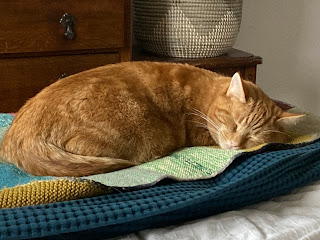
Catnaps with Pip ©Joan Haig

They’ve helped me in other ways, too. My first novel features a tiger, and big cat experts might note that several of its movements resemble more closely the domestic moggy. I did visit tigers in captivity to observe their movements, but I also spent hours gazing at my cats. (Hey! It was legitimate research.)

It was different when it came to the tiger’s spoken communication. It speaks a magical language. And it’s a language that, at first, only the protagonist’s younger brother Dilip can hear. My tiger yawns, chuffs, huffs and snarls. And – just once – it roars. But it conveys its messages in non-verbal ways, too – physically and telepathically – and Dilip and the other children in the story translate these different linguistic modes into their human language.

Writer Vanessa Bee is a horse communicator – a whisperer – whose books on horse agility are full of insight into human-animal interactions. We met at Moniack Mhor – the creating writing centre in the Highlands where I first started to write fiction. I was so affected by Vanessa’s books that, with permission, I lifted a sentence from one of them, swapping her ‘horse’ for my ‘tiger’:

Tigers say ‘yes’ or ‘no’; they never say ‘maybe’.

This isn’t true of domestic cats, as T.S. Eliot’s Old Possum’s Book of Practical Cats shows us. Tout au contraire: cats make an art of the ‘maybe’. Of course, not all cats (real or fictional) are as crafty or linguistically articulate as Macavity and crew. Those that are include characters in the excellent Varjak Paw by S.F. Said. They are not presented as speaking a Cat Language, as such, but Said nevertheless captures beautifully how cats move and talk.

The cats in my work-in-progress communicate with human characters much like my tiger does – in an ethereal way that cannot be precisely defined. (At least, I have not precisely defined it.) As well as vocalisation, their exchanges involve body language, synaesthesia and magic.

In the real world, cats often communicate through body language rather than vocalisation, and humans are still trying to make sense of both. The most frequently cited study remains that by Mildred Moelk, who, in 1944, identified vowels and consonants in Cat Language and transcribed cat sounds.

More recently, Susanne Schötz, a research academic in the Centre for Languages and Literature at the University of Lund, Sweden, has contributed greatly to our understanding of cat phonetics. Amongst other things, she has shown that cats communicate with humans in significantly different ways from the way they communicate with fellow felines. Her recent project – excellently titled ‘Meowsic’ – showed that cats have learnt to discern and mimic melody (intonation) and prosody (pattern and rhythm) in human speech. Schötz also explores the ways in which humans perceive these efforts by cats, and hopes that developing our knowledge will lead to closer relationships and more compassionate animal care.

Certainly in the books I’ve read – and children’s books, especially – cats’ vocabulary is often limited to ‘miaow’. So, arguably, even if we are able to perceive cats’ multiple sounds, we have not been much bothered to represent them in literature. What a pity!

For one thing, cat words look great on the page – they purr, mhrr, chirrup, mew, chatter, shriek, snarl, hiss, yowl, howl, mowl, trill, moan, tweedle, brrp, purrieu, coo, poopoo, and more. (I am already getting excited about my cat-themed school visits!) And if we want to delve deeper into the mechanics and meanings of these words, we can turn to an even earlier taxonomy of cat language, by Alphonse Leon Grimaldi. One paper on Grimaldi provides this most wonderful example of his translations:

‘[He] mentions the cat’s “significant war-cry /... / mie-ouw, vow, wow teiow yow tiow, wow yow, ts-s-s-s-syow”, an expression so bold that Grimaldi refrains from putting it in English. However, given that the word “yow” means “extermination from the face of the earth” one can easily guess what the above utterance is meant to signal.’ (Eklund, 2015, p28)

What’s more – Grimaldi spoke in French; his study was written up in English in 1895 by editor and author Marvin Clark in his own publication, ‘PUSSY and Her Language’. I am yet to do my homework on the differences in sounds between French-speaking cats and English-speaking ones, or indeed those from any other culturo-linguistic background.

In any case, those who continue to research human-felid communication are doing us writers of fiction a huge service. They are giving us a richer, more nuanced and realistic set of vocabulary to employ, with definitions attached. You can even listen to Schötz’s recordings of cat sounds and their meanings here.

I hope I've convinced you that the catch-all ‘miaow’, even with its various spellings, is no longer enough. And now, back to work...


Working with Flotsam ©Joan Haig

References:

Bee, V. (2013) 3-Minute Horsemanship. Trafalgar Square Books.

Clark, M. (1895). PUSSY and Her Language. Including a Paper on the Wonderful Discovery of the Cat Language by Alphonse Leon Grimaldi, F. R. S., etc. Publisher not known.

Eklund, R. (2015). ‘Grimaldi’s “Discovery of the Cat Language”: A theory in need of revival (or perhaps not?)’ in Proceedings from Fonetik, Working Papers.

Eliot, T.S. (2013) Old Possum's Book of Practical Cats. Faber Classics.

Haig, J. (2020) Tiger Skin Rug. Cranachan Publishing (UK) and Europa Editions (North America).

Moelk, M. (1944). ‘Vocalizing in the House-Cat: A Phonetic and Functional Study’ in The American Journal of Psychology 57(2): 184–205.

Said, S.F. (2003) Varjak Paw. David Fickling Books.

Schötz, S. (2018). The Secret Language of Cats : How to understand your cat for a better, happier relationship. Hanover Square Press.

ALSO - I highly recommend typing 'cat' into the ABBA search box to unearth lots of previous posts by other authors on cats in books, cats and writing, cats in art history...

Saturday, 25 July 2020

A recipe for a YA fantasy sequel - Holly Race

The deadline for the first draft of my second novel is looming, so I'm keeping my post short this month! Here you have it - my very own recipe for writing said sequel:

- Take one (1) Chosen One trope, established in the first novel. Subvert.

- Extract the world building from the first book, add a little more context and lore, knead and allow to rise for a month or two until bubbly.

- Blend plot and character arcs together until thoroughly combined. Add the world building and bring all together in a nice messy gloop.

- Marinade a handful of secondary characters until they are established and likeable. This will be made harder by the fact that you killed off a load of them in your first book and now need to create new ones. Stir into the mixture in the knowledge that only a few will survive to the third book.

- Crack three fight scenes and a battle into the mixture one by one, making sure each of them is more ambitious than those in the first book, despite the fact that when you wrote the first book, you went all in.

- Decide that you don't have enough storylines and decide to include a mystery plot, ostensibly for complexity of flavour but also because you just love a good mystery.

- Add one (or two) romances into the mix, for sweetness, and fold in lightly.

- Bake for a year, turning the temperature up to 'anxiety and panic' for the final week.

- Decorate with a pretty cover and atmospheric blurb, and present next to your first book for comparison and judgement.

Saturday, 16 February 2019

Fictional Felines by Claire Fayers


Before I became a cat-owner, I had a fantasy. I would sit and write, and my cat would sleep in the cat bed nearby. Every so often I’d look up and say ‘All right, cat?’ My cat would reply ‘Mrowl,’ and we’d both go back to writing or sleeping.

The reality, of course, was somewhat different.

My first cat, Moosh, liked to sleep curled up behind me on my chair so I wrote with raging back ache. Then Penelope came along. Named after Penelope Pitstop and her constant cries of ‘Heyulp! Heyulp!’ she wouldn’t even come into my office but stood at the door and shouted at me. She grew in confidence as she got older, and would bring me gifts of dead flies which she deposited gently on my feet while I was writing.

Penelope...


...and Penelope


The least said about our third cat, Tallis, the better. He spends most of the day outside annoying the neighbours. He thinks my sole purpose in life is to open and shut the door for him.

I popped into the British Library this week to see their Cats on the Page exhibition. It’s on until the 17th March so there’s still time to catch it. I had an excellent time reacquainting myself with favourite fictional felines. Here are some of my own favourites.

Gobbolino the Witch’s Cat by Ursula Moray Williams


I came across this book as a child – or rather, my sister did. She came home from school in tears, sobbing ‘It’s over! It’s over!’ It turned out her class had just finished reading this book. It’s the only time I saw my non-reading sister affected by a book, proving that there is a story out there for everyone. It also underlines the importance of reading aloud to children, whether at home or in class. 

Gobbolino is a sweet tale of a witch's cat who wants a normal life. It comes with a big thank you to all teachers who read to their classes.

Plain Kate by Erin Bow


This book had me sobbing into the pages. Why do so many cat books make their readers cry? It’s the tale of an orphan girl and her cat Taggle, who, through a magician’s bargain, gains the power of speech. The dark and compelling story explores friendship, family, sacrifice and grief. If you haven’t read it, please do, but keep the tissues close by.

The Last Free Cat by Jon Blake


A happy cat book! Jon Blake imagines a future where a deadly cat flu has meant that cats are now registered and monitored, and only the super-rich can afford them. When Jade finds a cat without a collar, she’s determined to save it, and they go on the run together. An adventurous story, set in a dystopian Britain, it will appeal to teen readers.

Varjak Paw SF Said


I have to include the cat martial-artist Varjak Paw. I’m a big fan of the evil black cats. They are thoroughly creepy and yet I feel an odd pity for them.I do enjoy villains that gain the reader's sympathy. But the best part of the book, of course, is Varjak. He's a true hero – brave, tough and determined, he starts off as the underdog (undercat?) and proves himself over and over again.

To Be a Cat by Matt Haig


Who wouldn’t want to be a cat? Well, Barney Willow for a start, and so he’s not too happy when he swaps bodies with a cat. The fun story deals with some deeper themes of family break-up, friendship, and accepting yourself for who you are. And I love the villainous headmistress.

Storm Hound by Claire Fayers


It’s a bit of a cheek to sneak this one in, but Storm Hound is published next week and I'm a little bit excited. As a lifelong cat person, it was a surprise to find myself writing about a dog. Storm is a ferocious stormhound from the Wild Hunt. Crash-landed on Earth and transformed into a very cute little puppy he has to come to terms with life as a pet.

There is, of course, a cat. Nutmeg, Storm’s feline neighbour, is based on my Penelope. I made her a few years younger, but I kept her imperious tone, her unassailable belief in her own superiority, and her cautious attempts at assistance because she is the cat with the kindest heart.


Then of course, there are all TS Eliot’s cats; the Cat in the Hat; the Cheshire Cat; the Owl and the Pussycat; Puss in Boots; Dick Whittington’s cat, and all the other cats I don’t have space to mention. Which ones are your favourites?


This blog post was written in memory of Penelope who died last month, age 19 and a bit. She was the best cat.

Claire Fayers is the author of the Accidental Pirates series, Mirror Magic and Storm Hound. Website www.clairefayers.com Twitter @clairefayers

Tuesday, 30 May 2017

Writing under siege by wildlife – Lari Don

I’ve spent most of the last few months, winter and spring, working on the last two books in my Spellchasers trilogy. And due to the inevitable noise and increasingly late bedtimes of the teenagers with whom I share my small terraced house, I’ve done most of that work in the garden shed.

But not on my own. Despite going out there for peace and quiet, I am never alone in my shed.
My small wooden box

The magical world I’ve created in the Spellchasers trilogy is about human beings shapeshifting into animals and birds (and even a few creepy crawlies, in the final book) so the constant presence of creatures in and around my writing space has been occasionally inspiring and sometimes a bit threatening.

My shed backs onto a tree-lined path, so there is almost constant birdsong, which is always lovely. But there are also occasional quarrelling and swooping crows. The baddie in the trilogy is called Corbie (Scots for crow) and he is often aided by his flock of curse-hatched crows. So the clamour and flurry of crows just a few feet away from me as I sit in a thin wooden box has sometimes felt quite threatening, especially when I am in the midst of helping my heroines and heroes defeat a flock of crows. Do they know what I’m writing, I wonder? Are they annoyed about it? Are they about to fly in here? Will they ambush me when I leave?

A helpful cat
Then there are the cats, and the dogs. Both animals feature in the trilogy, usually as a danger to my heroine Molly, who is a part-time hare and an occasional mouse. My own cats regularly try to distract me from writing by lying on manuscripts and draping tails over keyboards. And their wet and muddy pawprints (a cat walking into a shed from a rainy garden and jumping straight onto pg 121, leaves impressive pawprints) can be quite atmospheric in a scene about a girl being stalked by a predator... The cats next door often tap dance, noisily and surprisingly, on the shed roof. And dogs, barking in neighbouring gardens,or being walked on the path behind, can be equally surprising for both me and Molly, especially as her transformations are triggered by the sound of predators.

And then there are the insects, creepy crawlies and mini beasts. I don’t mind the slaters (Scots for woodlice) or the ants or the daddy longlegs or the little beetles with shiny wingcases (in fact, I found a minor role for those jewel-like beetles in the third book, the Witch’s Guide to Magical Combat.) I find the persistence of wasps trying to build their nests in my shed, from the scraped off wood OF my shed, rather admirable - though I do discourage them quite firmly. But I don’t like the spiders. In fact I’m terrified of spiders. I have to check the shed for spiders every single day before sitting down to write. And they still appear. Above my head or in the dark corners... And that constant fear of the suddenly lurking spiders informs every dangerous and tense scene in my adventures.

I’ve not been visited by a toad, wyrm, kelpie or sphinx, but the final book in the Spellchasers trilogy doesn’t go to printer until next month, so there's still time!

So, the wildlife in and around my writing space has definitely added to the writing experience, and influenced the content of my trilogy.

And now that I’m nearly done, I wonder what I will write next, and whether it will contain birdsong, barks and pawprints.

I’m fairly sure there won’t be any spiders. Not as characters, anyway. They may be present as a lingering sense of danger though, lurking in the corners of everything I write...

Do other authors feel that where they write influences what they write?


Lari Don is the award-winning author of more than 20 books for all ages, including fantasy novels for 8 – 12s, picture books, retellings of traditional tales, a teen thriller and novellas for reluctant readers.