Showing posts with label SF Said. Show all posts

Thursday, 7 July 2022

Tyger - written by SF Said, illustrated by Dave McKean - reviewed by Dawn Finch (McLachlan)


First the blurb...

"In a strange alternate world, where the British Empire is still a cruel ruling force, a young boy called Adam has uncovered something incredible in a rubbish dump in London. A mysterious mythical animal.

A TYGER

The Tyger is in danger, and Aam and his friend Zadie are determined to help. However, they soon realise it isn't just the Tyger's life at stake: the world they live in is also on the precipice of darkness. Luckily, the two children have great powers within them, and the Tyger can show them how to harness what's inside."

It is not hyperbole to say that this is one of the most anticipated books of the past few years. Talk and whispers of what Tyger might look and read like have been drifting around social media for a good long time and it was with no small delight that I opened the package that dropped onto my mat. An advance proof of a book with such an advance buzz around it is always a thrill and this was no different. 

Said is a most unusual writer because it is so hard to fit his books into any particular slot. They often walk a beautiful line along the parallels of graphic novel (working alongside the superb illustrations of Dave McKean* SEE FOOTNOTE) and cult novel. Said's fans (of which I'm one) are happy to talk for hours about the subtle undertones and messages within the text and to discuss deeper meanings. Varjak Paw is an absolute classic and with books like Phoenix adding to the Said shelf it is clear that there was a lot of weight and expectation on Tyger.

Breathe easy, it delivers. In spades.

Adam lives in London. A sort-of London. A London of slavery and subjugation, of violence, racism, and ruin. A London where the Empire continued to develop into brutal colonial fascistic masters. Art, imagination and creativity are crushed and there is no space for many for anything other than adherence to the brutal rules of the state, In this hideously broken (yet painfully familiar) city Adam ekes out an existence helping his father with deliveries from their little alterations and repairs shop. It is on one of these deliveries that Adam is saved from a violent attack when he is protected by a great beast that is hiding out in a vast city rubbish tip.

This is Tyger. This wounded and hunted beast has been speared through its shoulder and yet still comes to Adam's rescue. Adam instinctively does not fear this wild animal and instead helps to remove the broken arrow. The great animal then thanks him. Not with an animalistic sound or act, but with a voice that he can hear and that makes his skin tingle. She calls him "Guardian" and thanks him for helping her.

This is the start of an adventure that whirls through the streets of this hideous London as Adam learns more about Tyger and her purpose and her needs and his vital importance in finding this "Guardian". He meets both friends and foes as he develops his own natural gifts and the city is revealed to him as something new and different. Bit by bit Tyger teaches Adam that everything is not always what it seems to be. In darkness there is light, in desperation there is hope, in filth there is gold. As Adam's perception is altered and expanded by these new powers and philosophies the city and his life takes on a new perspective.

Adam, and his new friend Zadie, must do all they can to protect and help Tyger, but she is hunted. They are being stalked by forces that want to trap Tyger and cage her, and kill her. If this happens she will never fulfill her purpose. In a city that is bubbling up with fear, hate, resentment and violence, can Adam and Zadie save her and and help her carry out her task on Midwinter Night before the hangings? Nothing is certain...

There is no doubt that this book earns one of those rare spots on the shelf marked "Future Classics". It is a remarkable work that will be forever discussed and dissected as people analyse every aspect and write essays on the metaphors and deeper meanings. But set that aside for now because to dissect this work too much is to risk the joy of losing yourself to the story and the imagery. Tyger is not a blunt instrument of warning or metaphor but rather an elegant tapestry of threads that catch you and make you look longer, and deeper. A tapestry that you will return to and follow the threads anew to things you had not noticed at your first glance.

We can learn from Tyger, but not in a way that preaches or nags, We can absolutely learn that nothing is ordinary.

Tyger - written by SF Said and illustrated by Dave McKean will be published by David Fickling Books in October 2022

*FOOTNOTE ABOUT THE ILLUSTRATIONS 

It is worth noting here that I have chosen to not review the illustrations for Tyger yet as the proof copy only has a very small selection. The first few, however, show that this book is going to be every bit as extraordinary as McKean's work usually is. I have decided that I will review the illustrations of Tyger separately later in the year when I can do them justice and review the visual experience of the book properly.


Dawn Finch (McLachlan) is a children's writer and poet and is the current chair of the Children's Writers and Illustrators Group (CWIG) at the Society of Authors.

www.dawnmclachlan.com

tweets @dawnafinch

instagram @dawnamclachlan


Saturday, 19 February 2022

Writing in Cat, by Joan Haig

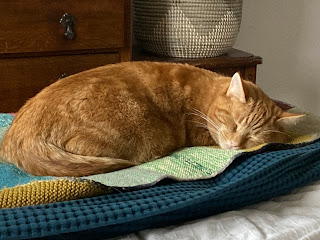
One thing I enjoy about social media is meeting the cats that keep fellow writers company. My own two cats, Flotsam and Pip, are excellent tea-break conversationalists and we like taking a little lunchtime poke around the garden. They are unsurpassed as partners for afternoon snoozes and they like to sit right up front in Zoom calls.

Catnaps with Pip ©Joan Haig

They’ve helped me in other ways, too. My first novel features a tiger, and big cat experts might note that several of its movements resemble more closely the domestic moggy. I did visit tigers in captivity to observe their movements, but I also spent hours gazing at my cats. (Hey! It was legitimate research.)

It was different when it came to the tiger’s spoken communication. It speaks a magical language. And it’s a language that, at first, only the protagonist’s younger brother Dilip can hear. My tiger yawns, chuffs, huffs and snarls. And – just once – it roars. But it conveys its messages in non-verbal ways, too – physically and telepathically – and Dilip and the other children in the story translate these different linguistic modes into their human language.

Writer Vanessa Bee is a horse communicator – a whisperer – whose books on horse agility are full of insight into human-animal interactions. We met at Moniack Mhor – the creating writing centre in the Highlands where I first started to write fiction. I was so affected by Vanessa’s books that, with permission, I lifted a sentence from one of them, swapping her ‘horse’ for my ‘tiger’:

Tigers say ‘yes’ or ‘no’; they never say ‘maybe’.

This isn’t true of domestic cats, as T.S. Eliot’s Old Possum’s Book of Practical Cats shows us. Tout au contraire: cats make an art of the ‘maybe’. Of course, not all cats (real or fictional) are as crafty or linguistically articulate as Macavity and crew. Those that are include characters in the excellent Varjak Paw by S.F. Said. They are not presented as speaking a Cat Language, as such, but Said nevertheless captures beautifully how cats move and talk.

The cats in my work-in-progress communicate with human characters much like my tiger does – in an ethereal way that cannot be precisely defined. (At least, I have not precisely defined it.) As well as vocalisation, their exchanges involve body language, synaesthesia and magic.

In the real world, cats often communicate through body language rather than vocalisation, and humans are still trying to make sense of both. The most frequently cited study remains that by Mildred Moelk, who, in 1944, identified vowels and consonants in Cat Language and transcribed cat sounds.

More recently, Susanne Schötz, a research academic in the Centre for Languages and Literature at the University of Lund, Sweden, has contributed greatly to our understanding of cat phonetics. Amongst other things, she has shown that cats communicate with humans in significantly different ways from the way they communicate with fellow felines. Her recent project – excellently titled ‘Meowsic’ – showed that cats have learnt to discern and mimic melody (intonation) and prosody (pattern and rhythm) in human speech. Schötz also explores the ways in which humans perceive these efforts by cats, and hopes that developing our knowledge will lead to closer relationships and more compassionate animal care.

Certainly in the books I’ve read – and children’s books, especially – cats’ vocabulary is often limited to ‘miaow’. So, arguably, even if we are able to perceive cats’ multiple sounds, we have not been much bothered to represent them in literature. What a pity!

For one thing, cat words look great on the page – they purr, mhrr, chirrup, mew, chatter, shriek, snarl, hiss, yowl, howl, mowl, trill, moan, tweedle, brrp, purrieu, coo, poopoo, and more. (I am already getting excited about my cat-themed school visits!) And if we want to delve deeper into the mechanics and meanings of these words, we can turn to an even earlier taxonomy of cat language, by Alphonse Leon Grimaldi. One paper on Grimaldi provides this most wonderful example of his translations:

‘[He] mentions the cat’s “significant war-cry /... / mie-ouw, vow, wow teiow yow tiow, wow yow, ts-s-s-s-syow”, an expression so bold that Grimaldi refrains from putting it in English. However, given that the word “yow” means “extermination from the face of the earth” one can easily guess what the above utterance is meant to signal.’ (Eklund, 2015, p28)

What’s more – Grimaldi spoke in French; his study was written up in English in 1895 by editor and author Marvin Clark in his own publication, ‘PUSSY and Her Language’. I am yet to do my homework on the differences in sounds between French-speaking cats and English-speaking ones, or indeed those from any other culturo-linguistic background.

In any case, those who continue to research human-felid communication are doing us writers of fiction a huge service. They are giving us a richer, more nuanced and realistic set of vocabulary to employ, with definitions attached. You can even listen to Schötz’s recordings of cat sounds and their meanings here.

I hope I've convinced you that the catch-all ‘miaow’, even with its various spellings, is no longer enough. And now, back to work...


Working with Flotsam ©Joan Haig

References:

Bee, V. (2013) 3-Minute Horsemanship. Trafalgar Square Books.

Clark, M. (1895). PUSSY and Her Language. Including a Paper on the Wonderful Discovery of the Cat Language by Alphonse Leon Grimaldi, F. R. S., etc. Publisher not known.

Eklund, R. (2015). ‘Grimaldi’s “Discovery of the Cat Language”: A theory in need of revival (or perhaps not?)’ in Proceedings from Fonetik, Working Papers.

Eliot, T.S. (2013) Old Possum's Book of Practical Cats. Faber Classics.

Haig, J. (2020) Tiger Skin Rug. Cranachan Publishing (UK) and Europa Editions (North America).

Moelk, M. (1944). ‘Vocalizing in the House-Cat: A Phonetic and Functional Study’ in The American Journal of Psychology 57(2): 184–205.

Said, S.F. (2003) Varjak Paw. David Fickling Books.

Schötz, S. (2018). The Secret Language of Cats : How to understand your cat for a better, happier relationship. Hanover Square Press.

ALSO - I highly recommend typing 'cat' into the ABBA search box to unearth lots of previous posts by other authors on cats in books, cats and writing, cats in art history...

Friday, 5 January 2018

Teen/YA reading group favourite books of 2017 by Savita Kalhan


Here’s my yearly round-up of some of my teen reading group’s favourite library books of 2017. The reading group ranges from ages 11 to 15 years old, and is a mix of boys and girls – with most of them reading three or four library books a month on top of any other reading they do. The kids are enthusiastic and love talking about the books they've enjoyed, books they would recommend, and books they haven't liked as much. They write review cards, which go up on on the teen reading group board in the library. 

In many ways it was a challenging year for us: the library was closed for two months while it moved premises, the catalogue of books available has diminished, with many books that are ‘missing’ not being replaced, and many books published in 2016 and 2017 not being bought for the library.

But, nonetheless, here is the list of some of my teen group's favourite books, in no particular order -

Orangeboy by Patrice Lawrence
The Last Leaves Falling by Sarah Benwell
The Unlikely Hero of Room 13B by Teresa Toten
Salt to the Sea by Ruta Sepetys
Beetle Boy by MG Leonard
Holding Up the Universe by Jennifer Niven
Shadow Magic by Joshua Khan
Gorilla Dawn by Gill Lewis
      
Booked by Kwame Alexander


The Harder They Fall by Bali Rai
Phoenix by SF Said


The Book Thief by Marcus Zusak
Goodbye Stranger by Rebecca Stead
The Astounding Broccoli Boy by Frank Cottrell Boyce


We all like having a choice in what we read. Some of us can buy books, and some of us use the library. I would really like to see 2018 be the year which brings back more choice of books for kids, and for their availability to be better reflected on the book shelves. And there should be at least one copy of every teen and young adult book published in a year on the library shelves.

Don’t you agree?


Tuesday, 18 April 2017

Creating worlds by Lu Hersey

Like most writers, I try to include a real sense of place in whatever I write. A place that feels so real to the reader, they can almost touch it. And up until now, that’s always been a landscape I’m really familiar with.


Setting my first novel, Deep Water, in Cornwall gave me the excuse to spend huge amounts of time there. Holidays spent snorkelling over sunlight Cornish seas, traipsing across rugged clifftop paths, exploring villages, soaking up the ambience of Cornish graveyards and chapels - and many rainy days of research in the Witchcraft Museum in Boscastle.


I immersed myself in Daphne du Maurier books, Helen Dunmore’s Ingo series, and tomes on Cornish myth and legend. I told myself it would be easier to write, and the book would only work, if I covered every angle of the geography and the atmosphere of the world it's set in. The upshot was it took blooming YEARS to write.


The same thing happened when writing my second book, Broken Ground (currently undergoing its zillionth edit). The setting for this one is a fictionalised version of the area around Silbury Hill and Avebury. I spent so long immersing myself in the Neolithic in this part of the country, I probably deserve a burial space in West Kennet longbarrow. And, of course, all the months of research meant Broken Ground also took an eon to write.


But my current work in progress is a complete departure. It’s a myth-based sci-fi story, much of it set in a desert world. I know little of deserts. Once, when I was about seven, my parents drove us over the Atlas mountains to the edge of the Sahara. All I remember is it was hot and dry, and smelt of camel dung. But there are no camels in my fictional world. And it’s not the Sahara.

I haven’t been to this place, because it exists only in my imagination. My research on deserts, and desert plants and animals, is done entirely online - where scale is almost impossible to judge, and you can’t smell a thing. The upshot is I’m writing much, much faster this time round. I can’t spend time faffing about in deserts because I don't have the time or the money, so the plot is cracking along at a good pace. 

To help me work out how to conjure up the ambience of an unknown environment, I’ve been reading lots of extraordinary, inspirational books set in imaginary landscapes to see how other writers do it. Most recently, I've re-explored Wrath, the dump world where Eugene Lambert’s brilliant The Sign of One sci-fi novel is set, with the publication of the gripping sequel, Into the No Zone. I've skirted around the vast expanse of SF Said's amazing universe in Phoenix, and am currently captivated by the fantastic seascapes and ice lands of Sarah Driver’s Sea. I’m awed by the way these writers conjure fantastical worlds which have such a real feel to them that the reader is totally sucked in. And hopefully, by reading, I've learnt something.


Now I'm wondering why I didn't think of creating a landscape earlier. Today my desert world needs a dog creature, so I can make one up, from the smell of its rancid fur to the noise it makes in its throat. I don’t need to spend weeks hanging out with dingos, or African painted dogs – my dog creature is conjured from years of David Attenborough documentaries and a childhood growing up with a couple of smelly corgis. 

The dunes in my desert can be as ochre red as they like, riddled with all the caves and hiding places I need for the characters to hide. Animals and plants grow according to how much danger I need, or simply because the characters need to eat.

So would I go back to real world landscape? Yes of course. The book I write after this may well be set in Cornwall again. Or Somerset. Or Wiltshire. Somewhere I know well. But it might not. The landscapes seeded in my mind have taught me a lot. I can set a story anywhere my imagination can take me.


However, if anyone has a spare ticket, I’d really appreciate a quick research trip to the Sonoran Desert…


Lu Hersey
twitter: @LuWrites
Instagram: luwrites
blog: Lu Writes