

One thing I enjoy about social media is meeting the cats that keep fellow writers company. My own two cats, Flotsam and Pip, are excellent tea-break conversationalists and we like taking a little lunchtime poke around the garden. They are unsurpassed as partners for afternoon snoozes and they like to sit right up front in Zoom calls.
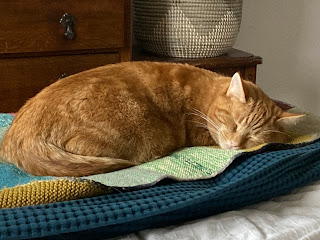
Catnaps with Pip ©Joan Haig
They’ve helped me in other ways, too. My first novel features a tiger, and big cat experts might note that several of its movements resemble more closely the domestic moggy. I did visit tigers in captivity to observe their movements, but I also spent hours gazing at my cats. (Hey! It was legitimate research.)
It was different when it came to the tiger’s spoken communication. It speaks a magical language. And it’s a language that, at first, only the protagonist’s younger brother Dilip can hear. My tiger yawns, chuffs, huffs and snarls. And – just once – it roars. But it conveys its messages in non-verbal ways, too – physically and telepathically – and Dilip and the other children in the story translate these different linguistic modes into their human language.
Writer Vanessa Bee is a horse communicator – a whisperer – whose books on horse agility are full of insight into human-animal interactions. We met at Moniack Mhor – the creating writing centre in the Highlands where I first started to write fiction. I was so affected by Vanessa’s books that, with permission, I lifted a sentence from one of them, swapping her ‘horse’ for my ‘tiger’:
Tigers say ‘yes’ or ‘no’; they never say ‘maybe’.
This isn’t true of domestic cats, as T.S. Eliot’s Old Possum’s Book of Practical Cats shows us. Tout au contraire: cats make an art of the ‘maybe’. Of course, not all cats (real or fictional) are as crafty or linguistically articulate as Macavity and crew. Those that are include characters in the excellent Varjak Paw by S.F. Said. They are not presented as speaking a Cat Language, as such, but Said nevertheless captures beautifully how cats move and talk.
The cats in my work-in-progress communicate with human
characters much like my tiger does – in an ethereal way that cannot be
precisely defined. (At least, I have not precisely defined it.) As well as vocalisation, their exchanges involve body language,
synaesthesia and magic.
In the real world, cats often communicate through body language rather than vocalisation, and humans are still trying to make sense of both. The most frequently cited study remains that by Mildred Moelk, who, in 1944, identified vowels and consonants in Cat Language and transcribed cat sounds.
More recently, Susanne Schötz, a research academic in the Centre for Languages and Literature at the University of Lund, Sweden, has contributed greatly to our understanding of cat phonetics. Amongst other things, she has shown that cats communicate with humans in significantly different ways from the way they communicate with fellow felines. Her recent project – excellently titled ‘Meowsic’ – showed that cats have learnt to discern and mimic melody (intonation) and prosody (pattern and rhythm) in human speech. Schötz also explores the ways in which humans perceive these efforts by cats, and hopes that developing our knowledge will lead to closer relationships and more compassionate animal care.
Certainly in the books I’ve read – and children’s books,
especially – cats’ vocabulary is often limited to ‘miaow’. So, arguably, even
if we are able to perceive cats’ multiple sounds, we have not been much
bothered to represent them in literature. What a pity!
For one thing, cat words look great on the page – they purr, mhrr, chirrup, mew, chatter, shriek, snarl, hiss, yowl, howl, mowl, trill, moan, tweedle, brrp, purrieu, coo, poopoo, and more. (I am already getting excited about my cat-themed school visits!) And if we want to delve deeper into the mechanics and meanings of these words, we can turn to an even earlier taxonomy of cat language, by Alphonse Leon Grimaldi. One paper on Grimaldi provides this most wonderful example of his translations:
‘[He] mentions the cat’s “significant war-cry /... / mie-ouw, vow, wow teiow yow tiow, wow yow, ts-s-s-s-syow”, an expression so bold that Grimaldi refrains from putting it in English. However, given that the word “yow” means “extermination from the face of the earth” one can easily guess what the above utterance is meant to signal.’ (Eklund, 2015, p28)
What’s more – Grimaldi spoke in French; his study was written up in English in 1895 by editor and author Marvin Clark in his own publication, ‘PUSSY and Her Language’. I am yet to do my homework on the differences in sounds between French-speaking cats and English-speaking ones, or indeed those from any other culturo-linguistic background.
In any case, those who continue to research human-felid communication are doing us writers of fiction a huge service. They are giving us a richer, more nuanced and realistic set of vocabulary to employ, with definitions attached. You can even listen to Schötz’s recordings of cat sounds and their meanings here.
I hope I've convinced you that the catch-all ‘miaow’, even with its various spellings, is no longer enough. And now, back to work...
References:
Bee, V. (2013) 3-Minute Horsemanship. Trafalgar Square Books.
Clark, M. (1895). PUSSY and Her Language. Including a Paper on the Wonderful Discovery of the Cat Language by Alphonse Leon Grimaldi, F. R. S., etc. Publisher not known.
Eklund, R. (2015). ‘Grimaldi’s “Discovery of the Cat Language”: A theory in need of revival (or perhaps not?)’ in Proceedings from Fonetik, Working Papers.
Eliot, T.S. (2013) Old Possum's Book of Practical Cats. Faber Classics.
Haig, J. (2020) Tiger Skin Rug. Cranachan Publishing (UK) and Europa Editions (North America).
Moelk, M. (1944). ‘Vocalizing in the House-Cat: A Phonetic and Functional Study’ in The American Journal of Psychology 57(2): 184–205.
Said, S.F. (2003) Varjak Paw. David Fickling Books.
Schötz, S. (2018). The Secret Language of Cats : How to understand your cat for a better, happier relationship. Hanover Square Press.
ALSO - I highly recommend typing 'cat' into the ABBA search box to unearth lots of previous posts by other authors on cats in books, cats and writing, cats in art history...


