Showing posts with label audiobooks. Show all posts

Thursday, 29 May 2025

The Listener by Sheena Wilkinson


I have always been a lover of audio content. When I was ten, I used my first cassette recorder to make my own radio programmes, Cherry’s Chat (I can still remember the jingle, written and performed by me of course, and aren’t you lucky there isn’t an audio facility on this blog?) and Arthur’s Book Reviews (I was going through an Arthur Ransome phase) as well as numerous phone-ins where I did all the voices -- though I have absolutely no memory of what the conversations were about, my interests at the time being mostly reading and animals. (So maybe things haven't changed much.)  

I love music too – I remember travelling by bus to Prague in 1992 with my Sony Walkman and five cassettes – but I prefer to be distracted and entertained by the spoken word, so when podcasts and BBC Sounds became a thing I was an enthusiastic adopter. I’ve always liked to read while cleaning my teeth/doing the hoovering/ cooking the dinner etc but it’s amazing how much more productive I am with a podcast or audio book on instead and both hands free.

I walk for miles every day and having something to listen makes me walk further and more joyfully – and yes, I know I should be appreciating nature and thinking beautiful thoughts but I can do all three; as a freelance writer I’m an inveterate multi-tasker.

So what do I listen to? Well, it depends on my mood and what else I'm doing, but at any one time I will tend to have on the go –

An audio book in the car – a physical CD from the local library. I often to listen things which are a little more romantic/saga-ish than the books I read with my eyes, simply because the library’s stock of physical audio books is probably geared towards an older demographic (though in fairness I am 56).

An audio book on my phone, again from the local library service, borrowed through the Libby or Borrowbox apps. If you don’t know these apps, they are wonderful: all you need is a library card and you have access to thousands of books. I have heard people say that audiobooks don’t count as reading: I think this is nonsense. Of course it’s a different reading experience than reading the words with your eyes, but I don’t see how it’s any less valid. 

From BBC Sounds: episodes of The Archers, plus The Archers podcast; Brain of Britain or Round Britain Quiz according to the season, and lots of drama content. I have exhausted the archive of Desert Island Discs, but I thoroughly recommend it, especially for listening to favourite (long-dead) writers. 


From my podcast app: whatever takes my fancy, and I go through phases, but some podcasts I have been loyal to, and which might be of interest to ABBA followers are: 


Writer's Routine, with Dan Simpson, is the ultimate podcast for writers who are interested in other writers' routines. Dan interviews a wide variety of writers, some very well known, others less so, and the conversation is always insightful. I often find myself talking back (which must look and sound odd, but luckily I am usually walking in lonely places), saying 'Yes! I do that!' or, 'Gosh, that's a funny way to do it,' or, 'Hmm, I might try that.' Definitely a writer's podcast. 


I am also very fond of the eclectic Tea or Books, which has introduced me to many books I might not otherwise have known. 

About to celebrate its tenth anniversary, this jolly, friendly podcast involves friends and book bloggers Simon (Stuck in a Book) and Rachel (Book Snob) talking about -- yes, books. There's a preponderance for the mid-century, which is why it appeals so much to me, but they do cover a wide range of reading. A typical episode will include a dilemma/ question -- for example, Can literary fiction be a comfort read?; Resolved or unresolved endings?; Do we care about authors' personal lives? followed by a comparison of two books. I have been listening for so long that it feels like eavesdropping on two pals chatting about books I'm likely to enjoy. 


Finally, because I haven't mentioned the Chalet School for, oh, it must be a couple of months, the exuberant Tophole! Hosted by Chalet Fan Deborah Lofts, and often featuring a chat with her sister Wendy, this too is a friendly, knowledgable chat about the Chalet School and related matters. 

These are only a few of my regular podast listens -- I am also very fond of Sheduunit, How to Fail, Off Air, and pretty much anything which features an interview with writers I like. I don't seem to like switching off from words, but listening to podcasts or audio books, or radio shows, at least stops me talking and gets me listening. 


I'm sure many readers have their own recommendations! 


Tuesday, 20 June 2023

Happy Audiobook Month by Joan Lennon


Wiki Commons Attribution: Sushant Savla

June is Audiobook Month! 

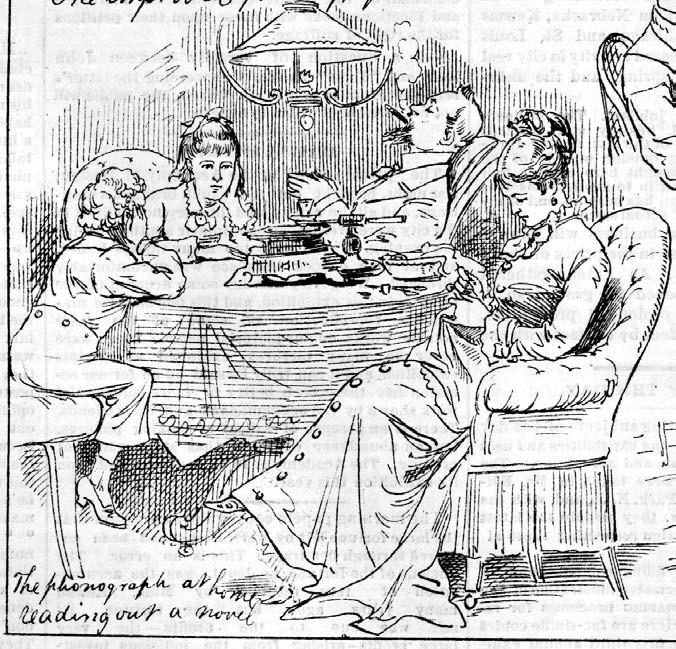
Part of Alexander Graham Bell's original vision for recording and playing back words was the idea of making novels for the sight impaired more easily accessible. At 4 minutes at a time, however, the earliest cylinders weren't up to the task. Even the next step of recording onto flat platters only allowed 12, and then 20 minutes of audio. Sixty minute cassettes were developed in the 1970s - I remember those! Very exciting, but still bulky and awkward to keep changing. And then, CDs. Bliss.

"The phonograph at home reading out a novel." Daily Graphic (New York) April2, 1878 - a vision of the future

One way or another, I've spent a lot of time over the years searching for, choosing, collecting and discussing audiobooks. I had an avid reader mum who lost her sight and 3 of my 4 sons are dyslexic book lovers, and audiobooks made a world of difference to their lives. (I've had a few of my own books made into audiobooks,* which has given them continuing life after the all-too-familiar fate of going out of print.)

It took a while for Alexander Graham Bell's phonographic books to beat the tech problems, but it's been worth the wait.

Happy Audiobook Month - three cheers for audiobooks and all who sail in them!

P.S. Hilary Hawkes wrote an interesting ABBA blog back in 2018 about Narrating audio books - have a look!


Joan Lennon website

Joan Lennon Instagram

* Ely Plot (Wickit Chronicles) and Fen Gold (Wickit Chronicles) are on Audible, and The Night of the Kelpies is available as part of the Ulverscroft/Oakhill Publishing's Read Hear series. 

Saturday, 20 August 2022

A Resource of Stories - Joan Lennon


Teachers, parents, kids - welcome to Read Me a Story Ink - a website full of children's stories to read and to listen to. The collection grew out of Robert Topp's '30 year hobby' of reading aloud in primary schools plus his experience of 49 years as a bookseller. An excellent resource!


Joan Lennon website

Joan Lennon Instagram

Monday, 20 December 2021

Christmas on a New Planet - Joan Lennon

I got a nice pre-Christmas gift the other day - an email from Robert Topp, the lovely man behind Read Me a Story Ink, a wonderful resource of children's stories to read or listen to.

Robert Topp of Read Me a Story Ink

He'd written to tell me he'd made a recording of my story Out of the Shadows - a Christmas tale about a weather witch on a new planet where the terraforming has been having trouble with ghosts ... You can have a listen here.

And if you'd like to visit the story in its first home, you can find it keeping some excellent company in Girls Heart ChristmasJoin Julie Sykes, Paula Harrison, Jo Cotterill, Jenny Smith, S C Ransom, Deirdre Sullivan, Luisa Plaja, Lynda Waterhouse, Alex Campbell and me for 10 Christmas stories for girls and boys aged 8-12.


Merry Christmas and may your New Year be full of books!


Joan Lennon Instagram


Friday, 11 September 2020

Audiobooks: A Scientific Study by Kelly McCaughrain et al (2020)


Experimental conditions:
  1. I've gained almost a stone during lockdown
  2. The only exercise I really enjoy is walking
  3. Walking a decent distance takes AGES and I feel guilty about wasting time when I should be working.
Hypothesis:

But if you're a writer, reading IS working. Right? So if I listen to audiobooks, I can walk for hours, lose loads of weight, and not feel guilty!

Method:

  1. Sign up for Audible membership (£8 a month)
  2. Borrow your Ma's FitBit and spend a whole day working out how to use it

Findings:

1. Audiobooks appear to be quite expensive, but with Audible you get one every month for £8, which you'd pay for a paperback anyway so I thought that was fair enough. Plus they seem to have members sales occasionally when everything is the price of a paperback, so I don't think it works out any more expensive than my usual bookbuying habits.

2. They have a really good selection, which my library doesn't, though it is worth checking every title to see if it's available at the library before you buy it.

3. You can also 'read' audiobooks in bed when your eyes are tired and your husband wants the light out.

4. Listening to audiobooks in bed is a really effective way to fall asleep.

5. I have qualms about the Amazon thing. I don't like Amazon and I try not to buy much from them, and I never buy books from them because I know authors and publishers get a raw deal from their reduced prices. I thought the audiobooks would be different because the prices were so high, but they do have those sales so maybe they're not different at all. I don't know. I'm conflicted and if anyone has info/advice/alternatives I'm open to hearing them.

6. Audiobooks make exercise funner. I'm just saying, if Frodo had had LOTR on audiobook, the journey to Mordor would have seemed a lot shorter. 

7. Novels work but Short stories are better on paper.

8. Juliet Stevenson has the best reading voice ever in the history of the universe.


Results:

I've lost 9lb in five weeks.


Kelly McCaughrain is the author of the Children's Books Ireland Book of the Year,
Flying Tips for Flightless Birds

She is the Children's Writing Fellow for Northern Ireland #CWFNI

She also blogs at The Blank Page

@KMcCaughrain


Thursday, 29 November 2018

Narrating audio books


One of the best ways to get a child really engaged in a story is to let them hear it read out loud. Even older, usually non-reader children can become engrossed in a story when it is shared with lots of expression and meaning.
When my own children were small we always made sure to take “stories for listening to” on long car journeys. My youngest in particular loved story tapes with a passion and one year asked Santa for his very own cassette player. It must have got hundreds, possibly thousands, of hours of use and was carted into school for show and tell numerous times. There was the phase when after reading him bedtime stories he still wasn’t ready for sleep until he’d listened to one side of Stories for Five year olds .
There can be something magically calming and soothing about stories read by a skilled narrator who can bring out humour, personalities of the characters or, of course, the excitement and conflict, with expert timing and tone. When a story is read well children appreciate language, develop concentration and listening skills and even discover stories that might be beyond their current reading ability.
For children with sight loss, audio books might be the only way they can discover stories independently. They can offer children with dyslexia a good way into books too. And they’re great for youngsters whose first language isn’t English.
I’ve often wondered what it’s like to be the narrator whose job it is to bring those stories so wonderfully to life.


So I’d like to introduce you to Sharon Hoyland who has been narrating books, including children’s books, for many years. I discovered Sharon and her wonderful narrating skills when looking for someone to narrate a cd for the children's groups who use our family business/project resources.  Sharon kindly agreed to let me “interview” her for ABBA. So here are the questions I asked and her informative answers:

 Me: First of all, how did you begin your career as a narrator and what was the first book you recorded?


Sharon: I deliberately looked for work that was quiet, dry and passive; as a contrast to my noisy, wet and active job as a swimming teacher!  My first audiobook was Black Beauty by Anna Sewell.


Me: When you receive a script and read it through, what things do you look for? How do you prepare a script for narrating?

Sharon: Firstly, I think, will I enjoy reading this? Secondly, can I convey the author’s meaning in a natural, tension-free way? In a nutshell, preparing a script focuses on understanding the overall ‘feel’/the target audience/any character analysis/being prepared to deliver different styles for your client to choose from. Plus useful markings on pauses, intonation and emphasis etc.

Me:  How long does a novel take to prepare, narrate and edit?

Sharon:  Ages! The Secret Garden by Frances Hodgson Burnett was very long with over 80,000 words. Voiceover work is part time for me, so this book took nearly ten months. I’d practice reading out loud each chapter many times (after I’d got the character voices fixed), then record that chapter, begin editing and proofreading the following morning. Selecting the best takes, embedding any sound effects and adjusting sound levels takes time, but is very satisfying when it’s all done. It’s also quite usual to re-record the first few chapters, as you’re so much more relaxed by the end of the book that you can hear the difference in your voice.

Me:  How do you ensure you look after your voice?

Sharon: I sing with a choir so have a range of favourite warm-ups before recording and I try not to really shout or scream at all. Sips of water and small bites of apple are great for long sessions. Also timing meals is important with nothing too rich or heavy as mics are so powerful they’ll pick up everything!

Me:  Are you a book fan yourself and do you prefer reading physical books or listening to audio?

Sharon:  Love books. The feel, smell, touch of a real book can’t be beaten. Non-fiction and Fiction audiobooks are great whilst doing quiet uncomplicated tasks and I’m less tempted to read ahead. Often, well produced audio can be better than my imagination, is great for emergent readers and wonderful for anybody with sight problems.

Me: Any plans for the future?

Sharon:  I’ve now completed my final narration, ‘Edwin and the Climbing Boys’ – this children’s book is an exciting adventure, based on fact, and packed with hazards and humour. Written by my mother last year, it creates an intriguing insight into chimney sweeping in 18th century London. I currently enjoy working as a freelance audiobook editor and now produce for other narrators, with a profile on LinkedIn.com.

Thank you so much, Sharon.

Follow these links to  a couple of Sharon Hoyland’s favourites, narrated and produced by herself, and then click "sample" to hear parts of the stories.


Our audio and cd Imagine! Eight nurturing, fun, interactive narratives. Calming relaxation for children with music was also narrated by Sharon Hoyland and is part of our Story Therapy® series of resources.


Hilary Hawkes

Wednesday, 29 August 2018

Living Paintings - bringing stories alive


I’ve always loved discovering “book charities” who work to share the benefits and joy of reading with people who would otherwise miss out. Not everyone has easy access to books and reading. There are as many reasons for this as there are situations in which people find themselves.

My mother loved books, but from the age of about 65 her sight began to deteriorate. Most of us would find this a source of huge frustration and annoyance, particularly if one of your favourite pastimes is reading. My father spent time every day reading aloud to my mother so that she didn’t miss out on her favourite authors, books or newspapers. She also signed up to a listening book library who delivered audio books to the house.

But what can it be like for children who have lived with sight loss their entire lives or who lose most of their sight after an illness or accident?


Living Paintings – books for the blind,  create the most amazing tactile and audio books.  They go beyond recordings of favourite or bestselling stories. Their team of talented and dedicated creators make tactile books and items that accompany the audios so that listeners can feel and sense the world of the characters or story.

Back in 1989 the idea had been the brainchild of Alison Oldland MBE, formerly a lecturer in Art History.  After adopting a rejected trainee guide dog she gave a lecture to raise money for Guide Dogs for the Blind. The then Head of Appeals for the charity attended and made a special request: could she record descriptions of works of art for him? This seemed like such a novel idea to Alison as she realised that blind people valued and got a lot out of enjoying pictures. She was inspired to do more and came up with the idea of Living Paintings.

With feedback from blind and partially sighted people she set up a registered charity that would make  accompanying relief images for audio tracks or pages of a story. Living Paintings was born and began creating beautiful Touch and See children’s books (as well as the books for adults) – thus opening up the wonderful world of stories for children who were blind or partially sighted in a new and unique way.
Alison received awards for her brilliant work including an M.B.E in 1997. She died in 2008 but her charity is still going strong along with her ethos and goal to “break down the barriers in a sighted world”.
Those with sight loss “see” through touch in a way the rest of us do not. Living Paintings enables children to explore and discover stories in a tactile and exciting way using this heightened sense and ability. Such books mean these children can enjoy sharing stories –and story times are  important for social, communication and emotional development. The books and products are available to any family, school etc in the UK and members can borrow braille versions as well as tactile accompanied books and audios. Take a look https://www.livingpaintings.org/marking-national-garden-week-with-tactile-books-for-blind-children

All children should have access to the benefits, fun and educational value of stories and books. The wonderful Living Paintings makes this possible for many who would otherwise be excluded or find themselves with limited access.
Official site:  https://www.livingpaintings.org
Photos © Living Paintings website, with their permission.

Hilary Hawkes


Monday, 22 January 2018

My Top 6 Podcasts for Us Writery Types, by Dan Metcalf


Continuing my array of listicles for this blog, I thought I’d dip into the world of podcasts. I’m a podcast addict. I love nothing more than to pop in a pair of earbuds and listen to the vast range of talk-radio style downloads available to the public for free. Free. D’you hear that? Free.

For those unfamiliar with the medium, a podcast is essentially a radio show that had been put onto the internet as a file which you listen to on your computer/phone either by streaming (when you’re on-line) or downloading (for when you’re off-line). That’s it. The BBC website has hundreds of their radio shows which you can download for free, including dramas, new music, news, debate, science and loads more. It’s worth a look if you are new to podcasts and want to find shows in your interest area.

Pleasingly, many series have been going for sometime so have a large back catalogue available to listen to straight away. I have recently been binging on some series and it’s a great way to learn about new subjects, especially as you can be a passive participant in the conversation and listen while you walk, exercise, cook or paint the kitchen.

I listen to a wide variety of podcast on tons of different subjects. I like to fill my ears with distractions aplenty which may inspire my life or writing, so I listen to drama (Tracks), technology (DigitalHuman), science (Infinite Monkey Cage) and Comedy (Beef and DairyPodcast) among others. For this post however I’d thought I’d keep my recommendations to those shows of interest to writers and readers. In no particular order, here goes nothin’:

1. Guardian Children’s Books Podcast is produced by the bestselling left wing newspaper of the same name and features talks and interviews with such luminaries as Jacqueline Wilson, Jeff Kinney, Eoin Colfer and Judith Kerr. There are around 80 episodes available at the time of writing and updates are sporadic (presumably due to the lack of coverage of children’s book in newspapers – that’s a subject for another day)


2. Jedlie’s Reading with Your Kids: One of the few children’s literature podcasts out there, this updates a LOT, with an enthusiastic host in the shape of magician Jedlie. It’s also open to requests for interviews, so if you have a book to plug, get over to the site and put in a request. And oooh look: Here's an episode with me on it! LINK!


3. One for the illustrators among you, Make It Then Tell Everybody is a series of podcast interviews on comics and drawing. The host is Dan Berry (www.thingsbydan.com) a comic artist and lecturer at Glydwr Univeristy. In each podcast, lasting roughly 30-40 minutes, he chats easily with his subjects about their background and their work, focussing in detail on their working methods. For artists, it's a great chance to hear the nitty gritty of working in the comics and illustration trade, and Berry has also talked to some writers, providing listeners with interviews that go into a level of detail that you rarely hear. His podcast with comics and screenwriter Tony Lee is one of the best I've ever heard, and is pleasingly frank about the industry.


Running through the interviews is the mantra which is reflected in the title of the website. The practical nature of the conversations can be inspiring, leaving the listener with a desire to go and create, even if, like me, you can barely draw a straight line.

Berry has a great presenting voice (almost soporific in its effect – one tweeter suggested he should do hypnosis CDs), and an easy, jokey manner with his interviewees. The quality of the audio is also astounding, better than some BBC productions, which adds an air of slickness to the operation. www.makeitthentelleverybody.com is a great find, and I recommend downloading a few podcasts straight away (did I mention it's all free?) and contributing to Dan's 'donate' fund, even if you don't think that comics are your 'thing'. Truly inspiring stuff.


4. If you’re interested in screenwriting: Created and hosted by Ben Blacker, a TV writer of shows such as Supernatural and Supaninjas, the Nerdist Writers Panel Podcast takes writers of TV, film, comics and books (but mostly TV) and grills them under a high heat until well and truly cooked. The panels have writers from hit TV shows such as Buffy, New Girl, Dollhouse, M*A*S*H, Bones, Lost, CSI, Friends, Sesame Street and many, many more. It's well worth listening to the entire run of 120-odd podcasts (at time of writing), even if you've never heard of the writers or the TV shows they've worked for. The stories of being inside the industry and pitching shows are fascinating and often hilarious.


Describing itself as a talk about the craft and business of writing, the show delves deep into the technical aspects of writing in the US. Know what 'breaking a story' is? Or 'A' story and 'B' story? Listen and you'll find out. I've learned so much about the modern TV industry just from tuning in every week and letting the masters of their craft chat into my earholes (more maybe than I did in university? Shh, don't tell the lecturers...).

Personal favourites are the Sesame Street Writers, anything with Jane Espensen, and the highly inspiring talk from the creators of The Lizzie Bennett Diaries, on the complexities of Transmedia storytelling. Go on, jump in, get wet. (if you like this, also check out the UK Scriptwriters Podcast)

5. Spektrmodule by Warren Ellis is a collection of music, haunting sounds and ambient tunes. Ellis himself is the writer of legendary comics such as Transmetropolitan, Iron Man, Fantastic Four, Trees, RED, and now the Netflix series Castlevania. I have found the podcast to be perfect writing music: dark and eerie, with few lyrics to distract you from your work. It also makes great reading music.


6. The Creative Penn is a series which has been going for some 300+ episodes under the amiable hand of Joanna Penn, who writes thrillers under the pen name JF Penn. She is an indie author and an authority on the indie publishing movement. While most of the content focuses on publishing adult books yourself, anyone interested in writing can take away some nuggets of gold on marketing, creating and producing your own fiction. If you like this, then also seek out the Self Publishing Formula with Mark Dawson, and the Bestseller Experiment.


7. A new one to me, but packed with great info for writers The Folklore Podcast is a deep dive into folklore and fairytales with experts and academtics. Hosted by Mark Norman, this is a fine example of the podcasts put out there for free by enthusiasts. I highly recommend the one on Hansel & Gretel - I'll never read the story at bedtime to my son in the same way again...

I've given up trying to limit myself to a top 5 so you'll have to make do with seven. More recommendations as I find them.

As always, tell me about any I’ve missed in the comments on on Twitter @metcalfwriter.
 -
Dan Metcalf is a writer for children. Find out more about him and his books at www.danmetcalf.co.uk


Thursday, 22 June 2017

New Voices, by Dan Metcalf

I've been thinking a lot about audiobooks nowadays since talking to a friend of mine who is a postman. He listens to a lot, walking 4 hours a day which is the perfect way to consume talking books. But he did something I wasn't really aware of: he gets books via Google Books and sets their speakbot up to tell the story to him. I know Kindle did this waaaay back when they first launched, and my friend tells me that is how he started doing it, but lawyers got involved and argued that it contravines the talking book right in the contracts, when kindle had only paid for ebook rights. Or something. I'm vague on the details. 

So I tried it. https://www.naturalreaders.com/ is a site with great voices which sound, well, natural. Ish. Just cut and paste text and it will read it to you, in a variety of male, female, British, American, French, German voices and more (all hilariously nicknamed things like 'Bruce', 'Graham' and 'Audrey'). It works. Mostly. I also got the app for my phone (which comes with free auto-installed versions of Alice in Wonderland and Sherlock Holmes Stories) and the extension for my web browser which can read my emails to me.

But of course I am behind the times in all this. The Amazon Echo will already speak to you like your best (if slightly robotic) mate, and Google are hot on their heels with what is now called a 'Digital Assistant'. So what next? Well, the sky is the limit. How about an interactive story for the Echo, one that you can choose where the story goes? Or you can place yourself in the story and ask the characters questions? You can be the detective in the murder mystery. With artificial intelligence and natural sounding voices on the up, this should be possible very soon. It just needs the right combination of writers and programmers – thinking about it, it is essentially a text adventure like those of the 1980s but read out loud by the computer.
By Peter Langston [Public domain], via Wikimedia Commons
But just as iPhones surprised everyone with their ubiquitousness, and pushed the tablet revolution onwards, maybe the next big thing is not voice activated? Could it be Virtual Reality, gesture activated or linking directly to your neurons? Will it take place not via a speaker or a screen, or even a book, but centred in your own mind? The future is limitless.

++

Dan Metcalf is a writer in SW England. His new book, Codebusters, is out in July 2017.