Showing posts with label young adult fiction. Show all posts

Saturday, 12 October 2019

The Importance of Books by Vanessa Harbour


We all know how important books are. We know what a vital role they play. Sometimes though it really helps to be reminded why. Some of you may have seen a tweet I posted earlier this week about an experience I had when lecturing. In discussion with a group of students about character I asked them who their favourite characters were. The answers were diverse and eclectic but often what accompanied their answer was an explanation. This explanation nearly always included how the characters and/or the book had helped them and why. For some it had been through a darkest moment, for others, it had been to deal with difficult situations and overwhelmingly, it was how they had helped them get through adolescence. Sorry, I’m not listing the books here as I don’t want any student feeling they are being talked about.  Here I am talking in generalities. The majority of these books were young adult fiction. Another reminder of how important young adult fiction is and how vital it is that publishers continue to produce amazing YA by the incredible YA authors from the UK. I picked up one the other day at the mass book launch and publisher launch for Guppy Publishing. Gloves Off by Louisa Reid, is brilliant and so powerful. A must read.


But as I said, we know books do this. We know books can provide an escape and support when needed. Maybe that metaphoric hug just when craved. No character in a book will judge. Books are places where you can tell the characters your deepest darkest secret. A book can be whatever you need it to be. Between those pages is a safe place to be and that is what we, as writers, create.

Books do so much more. They can open a dialogue, providing a chance to discuss difficult and/or sensitive subjects. The reader can ask questions of the text, of themselves and, when they are ready, of others – whether that is parents, teachers, siblings or friends. Again, this is not news. Windows and mirrors, a chance to see someone experiencing the same issues as them or a chance to try and understand what it is like to experience those issues, walking in their shoes.

Back in 2011 in my PhD, the research I did highlighted how important it was that young adult fiction continued to cover challenging subjects. The thesis looked at the representation of sex, drugs and alcohol in young adult fiction, but I believe it is so much more, covering many more difficult and sensitive subjects, and not restricted to young adult fiction. Philip Pullman has previously stated that there are some themes too large for adult fiction and can only be dealt with adequately in children’s fiction while Melvin Burgess also suggests that children can cope with anything as long as it is in context. Both of these have helped me understand so much for many years now.
Melvin Burgess
Philip Pullman


The important phrase there is ‘in context’. I do have an issue when contentious subjects are used for shock value or the scene is just gratuitous. It needs to serve a purpose and be part of the narrative. I have been a little concerned in some areas of Twitter to see a call for some issues to be ‘white-washed out’ and never ever included.  This for me is a problem. The moment you exclude something and refuse to talk about it, there is a risk it will become mysterious and exciting. This creates the exact problem those who wish to 'white-wash' them out have been trying to avoid. The issue suddenly becomes something intriguing. If you include issues in a piece fiction, ensuring it is not sensationalised or glamorised, then it provides an opportunity for dialogue. A chance to discuss these issues in a meaningful way. I personally believe this is important.

More than anything I want to say to people and, in particular, young adult writers, keep writing. Your books make a real difference.

Dr Vanessa Harbour
@VanessaHarbour

Wednesday, 28 November 2018

It happens in translation – Clémentine Beauvais


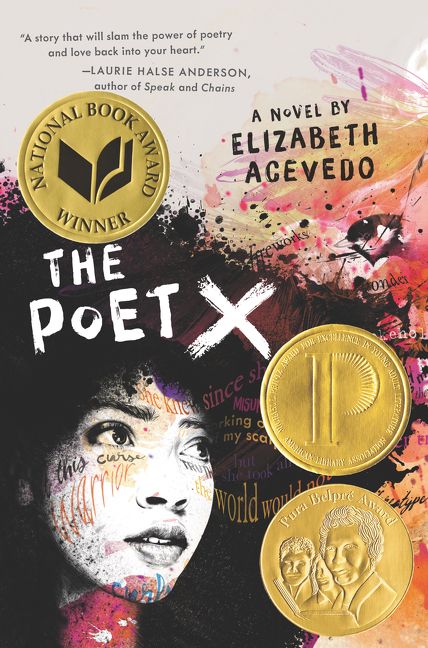
A few days ago I was doing a literary translation workshop with French teenagers in London, using as my English text a slice of Elizabeth Acevedo’s splendid, National-Book-Award-Winning The Poet X, which I’ve had the pleasure (/honour/ insane luck) of translating into French.

Image result for elizabeth acevedo the poet x


Elizabeth Acevedo, in case you haven’t heard of her, is this remarkable spoken word poet and writer:


The Poet X is the Künstlerroman of a young Dominican-American woman who discovers spoken word poetry, rebels (selectively) against her family, loves her brother, and loves, too, a sensitive young man in her Biology class. She writes in a notebook, and she writes things about her everyday life, such as church, food, masturbation, and street harassment:


(Transcr:
It happens when I'm at bodegas.
It happens when I'm at school.
It happens when I'm on the train.
It happens when I'm standing on the platform.
It happens when I'm sitting on the stoop.
It happens when I'm turning the corner.
It happens when I forget to be on guard.
It happens all the time.)

This is the poem I asked the French teenagers to translate (well, only the first stanza – we only had an hour). As you can guess, there’s plenty of fascinating challenges for a translator there, and we always begin by reading the poem out loud, testing out different stresses, different rhythms, feeling the beats and letting the sounds fill our mouths, before we start making decisions about translation. I won’t focus on all the aspects in this blog post, but I want to talk about one particularly interesting thing that came out of the exercise.

The first stanza, obviously, makes striking use of the anaphora ‘It happens’. What is ‘it’ that happens? It’s alluded to in the next stanza – touching, allusions, compliments. The usual catcalling and groping sort of business.

How do you translate that into French? Well, there’s at least one absolutely literal translation: ‘Ca arrive’ (it happens). The problem is the hiatus (a hiatus is what happens when you have to force a break between two similar-sounding vowels): Ca-arrive. That a-a sounds fairly unpleasant to the ear – this is what I think secretly, but of course I say nothing to the teenagers ; it’s my opinion. But among the six groups that day, no one opted for ‘Ca arrive’.

Two groups opted for the next most literal option, ‘Ca m’arrive’ (It happens to me), which has the advantage of getting rid of the hiatus. Interestingly, this option makes the victim explicitly central in the French text – no way of avoiding this ‘m’ which explodes from the front of the mouth and provides a nice labial echo to the ‘haPpens’ in the English version. Full disclosure, this is the one I picked for my own translation, too.


Another table chose, interestingly, not to translate ‘It happens’ at all. Instead, they started every single line directly with ‘Quand’ (when). The effect was funny: the stanza becomes a bit of a riddle, to be solved in the very last line. ‘When I’m there, when I’m there, when I’m there, when I’m there… It happens’. More suspense, but less emphasis on the relentlessness of the harassment.


Another group opted for the hugely alliterative ‘Ca se passe’ (pronounced ‘Sasspass’), which more or less means ‘It happens’. I like this solution, which sounds like hissing, and preserves the plosive ‘P’ of ‘haPPens’. It is perhaps the closest to the source text in both meaning and effect. I had considered it (and am still considering it) for my translation.


Another group, finally, had an idea I hadn’t considered at all, and which I find especially interesting. It is to begin each line with ‘Ils le font’, namely, ‘They do it’ (with the ‘ils’ explicitly male in French). Complete change of focus all of a sudden: the perpetrators are at the very beginning of the line, of each line. The impersonal ‘it happens’, which makes it sound like it’s some kind of unavoidable meteorological phenomenon, suddenly acquires a body (even several bodies: a threatening army of bodies); it acquires malevolent agency, and it acquires a gender. 


A radical solution, which arguably lacks elegance in its sounds, but strongly signals the translator’s commitment to naming and blaming the perpetrators. Before you ask, the table who came up with this solution was composed exclusively of boys.

What a world of connotations separates ‘Ca m’arrive’, which focuses Acevedo’s text onto the victim, ‘Ca se passe’, which renders the impersonal inevitability of the original, and ‘Ils le font’, which foregrounds the harassers.

All three solutions are acceptable, and all commit the translator differently. Those little decisional acts we perform on a text we translate are what makes a translation a literary practice, and a practice through which words have an effect on the world. Each of those three poems would have a different effect on the world, because they each focalise our attention differently. 

Three ways of looking at street harassment. And I was of three minds.

-------------------------------

Clémentine Beauvais is a writer and literary translator. Her YA novels in English are Piglettes (Pushkin, 2017) and In Paris with You (trans. Sam Taylor, Faber, 2018).

Tuesday, 10 February 2015

It's the most wonderful MONTH of the year - Eve Ainsworth


Usually I hate February. It’s a dark, bleak little month. Rain dances through the days and frost greets every morning. You have no money and little motivation. Additional weight gained at Christmas still hangs from your waist like a guilty secret and the resolution to take regular jogs feels like a long forgotten joke.

Yep, it’s usually a month I enter with fear and loathing. It’s usually the month I put a big black cross through, before rushing back to bed and reading myself through it.
 Except this year! This year was different.
February 2015 would be significant for me in many ways.
1    
      1.  I would leave my job
      2.   I would run my first Author visit
      3.  7 Days would finally be published.

Leaving my job was the first positive more. It was a tiring and stressful job that was no good for me in the long term. A job where I would go home and feel mentally and physically exhausted, barely able to think, let alone type. Resigning was like a strange release and I already know it’s the best thing I could’ve done. Yeah ok, we’re poorer. But I’m calmer and that has to be a good thing, right?
Next was a thing that filled me with fear. What doesn’t kill you, makes you stronger right? That’s exactly how I felt about stepping out of my comfort zone and entering a brand new school as an author.

I’d done events at my own schools, but this was new and alien. I walked into the building, clutching my bag and trying to ignore the gnawing feeling in the pit of my tummy. BUT it ended up being the best. The students I met were so lovely and engaged and so interested in both 7 Days and my work as an author. I left feeling both inspired and accepted. I realised the buzz I’d gained was a totally new and refreshing experience. This was good for me.

And finally, February was when 7 Days was let out into the big bad world.

And it was a lovely day. I had cake mid-morning (why not). I treated myself to a dress. I received lots of wonderful tweets from supportive followers everywhere. I chatted on-line to other fabulous authors who were being published on the same day. We were all doing different things, but we all felt the same mixture of excitement and anticipation.


Then in the afternoon, I received a wonderful bouquet of flowers from my publisher that so far I have managed not to kill (a new record I feel). 


Later, I went for a meal with my husband. I had a lovely cocktail and a delicious Caribbean curry and toasted the start of an amazing year.

Because it will be an amazing year. This will be the first year I can actually admit to myself that I have ‘done it’, I have accomplished a dream. And whatever life throws at me, whatever the new ups and downs – I need to remind myself of this one moment.

The moment when I became a published author.


The moment when I finally felt like me.


Saturday, 30 August 2014

Publishing deleted scenes – risky, cringeworthy, helpful? Lari Don

Publishers want lots of ‘stuff’ from authors now. Not just the book, but lots of other stuff. Content, it’s called, for online things.

One of the bits of content I’ve given my publishers recently is a file of deleted scenes, from my new(ish) teen thriller Mind Blind.

It wasn’t hard for me to find half a dozen deleted scenes, because I delete lots from my manuscripts as I rewrite and redraft. It’s not unusual for me to reduce the length of a book by 20,000 words or more between first draft and final publication. Which sounds very inefficient – wouldn’t I be better just writing shorter books in the first place?

But I’m not a planner and plotter. I discover the story as I write, as I follow the characters on their journey, and that means diversions and doubling back. I never deliberately write anything that I know is irrelevant at the time, every word helps me find out about the characters, their reactions to problems and my own feelings about the story. But once I reach the end and get a sense of the main thrust of the story, it’s usually clear that I've regularly wandered off the narrative path, and that some scenes are now unnecessary. They may have been necessary to get me to the end, but they’re not necessary to get the reader to the end. So I'm ruthless in slashing them out. I reckon that if you can slice out a scene without it seriously affecting the rest of the story, it probably wasn’t that important.

And in a thriller like MindBlind, where it’s very important to keep the pace up and the pages turning, I also removed scenes or parts of scenes because they slowed the story down too much. (Here’s an example of one.)

And sometimes I cut a scene, not because it’s slowing the story down or because it’s an unnecessary diversion, but because I come up with a stronger idea once I know the story and characters better. However, the original scene is still part of the way I got to know the character, so it’s part of my history with them. Here’s an example of that – it’s the first scene I ever wrote about Ciaran Bain, the hero (anti-hero) of the book. It’s not in the book, but it’s still the place I first met him!

Of course, it’s misleading to suggest that all this slashing and slicing is my idea. Quite a lot of it is, but some of it is in response to gentle prompts from my wonderful editor.
a mountain of many Mind Blind manuscripts

So, I have no problem removing large chunks of my first draft or even my fourteenth draft, because as I’m writing, I know that I’m just discovering the story, not finding the perfect way of telling it first time around. And I know that it takes a lot of work to make that original mess of scribbled ideas into a book.

But having taken all this stuff out, why on earth would I want to show it to anyone? These deleted scenes have often been removed quite early in the process, so they’re not that polished (why would I polish them, once I’ve deleted them?) So it does feel quite weird and slightly uncomfortable, revealing these unfinished bits of my creative process to the public gaze.

Even if these are scenes that I took out for plot or pace reasons, rather than pieces of writing I don’t like, they are still parts of the story that didn’t make it into the book. So is it a bit of a risk to show less than perfect examples of your writing to the world? And why on earth do it?

The first reason is the pragmatic one of feeding the voracious social media monster. (This is not a particularly good reason.)

But I wonder if a much better reason is that realising how much an author cuts from their early drafts can be useful, especially for young writers. It’s a very practical way to show that published writers don’t get it right all the time, that our first drafts are just the start of the process and that we have to work at them, slash at them, perhaps radically change them, to get them into shape. Deleted scenes are perhaps the online version of showing manuscripts covered in lots of scribbles and scorings out to groups of kids at author visits. ‘Look, I don’t get it right first time, so you don’t have to either. Just write, and see what happens!’

So, while I was wincing and cringing this week as yet another deleted scene appeared on Tumblr, I wondered:
How much do other writers delete?
Are other writers happy to let the world see the bits they sliced out?
And do readers learn anything about the writing process from deleted scenes?


Lari Don is the award-winning author of 21 books for all ages, including a teen thriller, fantasy novels for 8 – 12s, picture books, retellings of traditional tales and novellas for reluctant readers. 

Thursday, 28 February 2013

Wearing two hats, by Maxine Linnell


After my blog last month, Lynda Waterhouse asked me about what it’s like to be a psychotherapist and a novelist. Thanks Lynda, you made me think about it some more! 

I’ll start off with two people I’ve met who’ve been both a writer and a therapist. About 25 years ago I knew a  therapist who worked with people for a couple of years, then suddenly stopped for no obvious reason. A few months later her book of short stories was published. The linking theme of the collection was the relationship between a psychotherapist and her clients. I knew one of her clients, who was pretty sure one of the stories was about her.

A few years ago I met a well-known novelist, who was a psychotherapist for many years. As her books became well-known, she began to have problems in her therapy world. She worked hard not to use any of the people she had met in her consulting room. Her clients read her books. Some were convinced they were the basis of a character, and were angry. Some were hurt and angry that they were missing from her books! Eventually writing took over, and she no longer works  as a therapist. 

It’s a bit of a minefield, and clearly not just for me. I’ve never used the experience of someone I’ve worked with in my books, stories, plays or poems. I feel very strongly about the privilege of people sharing very private aspects of themselves with me, and would not knowingly betray their trust. So I’ve been very careful. But some of the themes and difficulties I write about have been issues for people I’ve worked with. It could be easy for someone to feel betrayed by reading my books, even if I think there’s nothing that comes from them in the stories. It feels very important not to cause harm. 

On the positive side, there’s so much I’ve learned from the people I’ve known, sometimes over years. I’ve learned to listen very deeply, to hear what people say, and what they might be saying under the surface. I wouldn’t presume to say I know, but in the job it’s important to ask, to check it out. So I’ve heard a great deal. I also know a little of how people get hurt, the strategies we find to cope, the best and the worst aspects of human beings. And how none of us is only one thing, and all of us change over time.

I think that’s helpful for writing - I like to think I trust my readers to look beneath the obvious, to be able to handle characters who aren’t just good or bad, heroes or monsters, who develop and change, often through meetings with important people in their lives. 


And there’s that tricky job for novelists, finding an authentic, consistent voice for our characters and ourselves. In Closer, Mel speaks of her experience, what she knows, what she guesses, and what she’d rather not know. Readers usually work it out long before Mel does, and have to go along with her as she discovers the truth, her reactions and feelings, and eventually finds a way through. Perhaps I’m inviting people who read my books to listen as accurately as I try to as a psychotherapist, to look beyond the words on the page.

The training and the work of a therapist also develop empathy. It’s essential to be able to imagine what other people think and feel, to walk in their shoes. There is some research to show that reading stories and novels develops empathy. Through identifying with characters in books who might have very different lives from our own, we can find compassion and understanding for real people. There have been so many times too, when as a reader I've felt a writer really 'got' something I've been feeling or experiencing - and it's helped me know what's going on. Deborah Moggach said recently ‘reading sensitises us as human beings’ - though perhaps that depends on what we read! We can recognise that people have different perspectives, different backgrounds and cultures, different needs and intentions. Writers also need empathy to be able to create believable characters whose lives readers will want to follow. The connections are clear.

Most of the time we look at people from the outside, and they seem all in one piece. I’ve learnt in my therapy work that so many people are walking miracles. They adapt, they learn, they recover, they love, even when they’ve experienced huge suffering and damage over many years. That’s something I want to pass on in my writing: the recognition of how each of us has come through something and managed the best way we can.

Maxine Linnell
www.maxinelinnell.com
Vintage and Closer, published by Five Leaves
Breaking the Rules, published by Bloomsbury
The Mayor of Casterbridge, Far from the Madding Crowd and Tess of the d'Urbervilles retold, published by Real Reads.
Mentoring and teaching.