Showing posts with label procrastination. Show all posts

Sunday, 19 April 2026

Creating a new (very small) world - by Lu Hersey

 It all started with the house leeks. Or maybe it was when I bought that bowl in a charity shop. the kind of thing my mother would have considered unbelievably tasteless but my grandmother would have loved. In fact, maybe it all started over half a century ago, and I can blame it on my grandmother.

Back in the time before she came to live with us, among many wonderful treasures in her bungalow, (my mother's opinion of them differed) she had a potted cactus garden which I absolutely loved. Hidden between the cacti there was a tiny ceramic bridge over a mirror pond, and a tiny ceramic Chinese pagoda nearby. I always wished there were tiny people to go with it. Maybe that's what makes us start writing, creating fantasy lands in stories, like capsule worlds we can control. Unlike the news.

Anyway, because of the bowl, the house leeks or my grandmother, I strayed into a whole new universe. Turns out there must be countless others out there, like me, creating fantasy worlds, whether it's for model trains, mini dinosaur parks, or tiny tanks and soldiers for war games. We start sensibly in places like ebay and etsy, then tumble right down into a snake pit called Temu. Beware! Temu can suck sensible people into rabbit holes it's hard to escape from. There is literally no end to the fascinating awfulness that Temu can produce.

And even as I worried somewhere at the back of my mind about the poor Chinese people who work creating bizarre stuff no one needs and which will inevitably lead to the collapse of Western civilisation, I found it almost impossible to stop searching for tiny objects to put in my new fairy bowl universe. 

Fortunately I was saved by the cat, demanding second breakfast. She started yowling loudly and consistently, just as I was about to hit PAY on Temu. 

As I grumbled downstairs to appease the beast, it suddenly occurred to me - I already had everything I needed! I'd only needed to leave the Temuverse for a moment to remember. Even better, I realised what I had was much classier (in my opinion - others might disagree) than anything my online search had come up with. 

A quick hunt after feeding the cat unearthed some glow in the dark forest spirits from Princess Mononoke which had been lurking under a money plant downstairs for so long, they'd almost vanished into the compost. They look very happy to be rescued.

Even better, I remembered a magical Christmas present, handmade for me by my friend Dandelion and buried somewhere behind a pile of notebooks on my desk. It's perfect. (If you like it, he sells all kinds of wonders in his Glastonbury shop, Dandelion Dreamz, which are also available online),


It might need a bit of tweaking (and occasional watering) but I'm quite proud of my new, Temu-free, magical universe.

And having finished procrastinating, suppose it's time to actually go and write something...

Dandelion at work


Lu Hersey

web: https://www.lu-hersey.com/


Saturday, 13 September 2025

Doing nothing is doing something (Anne Rooney)


Back to Cambridge University Library

Penny Dolan posted about procrastination a few days ago. This is not quite an apologia for procrastination, but more a plea to be easy on yourself if you're not doing enough. I've not been writing full time (as in, 35 hours a week) since before the pandemic. A string of deaths and other disasters/disrupters, plus turmoil in the publishing industry, have made it pretty much impossible. 

 I thought I'd get back to it this autumn, but I'm honestly not sure I even want to. Publishing is still turmoily, AI is wreaking havoc, and the three book projects I have in prospect are, as often happens, waiting on design decisions. They will then turn into a panicked rush to get samples together in time for the Frankfurt Book Fair in October (which is not very far away). 

While waiting for publishers to get their act together, I've returned to a book I started before the pandemic and then had to give up as it was based on material in the British Library which was inaccessible . It's fun poking around at it, though I'm still not sure what shape it will eventually take, if any. I've also decided to learn some new skills, nothing to do with writing. And although this looks like 'doing nothing', it's already throwing up new ideas. Even the doing nothing that is gardening or walking around the fields looking for sloes lets some slow mental composting go on, and that all feeds into work when work happens. At least, that's what I'm telling myself...

Anne Rooney

Out now: Weird and Wonderful Dinosaur Facts, illustrated by Ro Ledesma, Arcurus 2025


Monday, 1 September 2025

THE PROCRASTINATION THINGY by Penny Dolan

Today is the first of September, bringing the turmoil of the start of a new academic year. Stationery stores are full of eager acquisitive children and concerned parents. Shoeshops are busy with purchasers. Even the weather is in a quieter mood.

Meanwhile here, at home, we are co-ordinating diaries, calendars and life for the months to come and then the troublesome thoughts start to arrive . . .  not only Where's that red Pomodoro timer? but the more serious worries: What have I achieved? What did I actually complete? And the follower-ons such as What am I going to do now? What writing do I want to work on next?  

There are plenty of ideas and stuff: the never-ending tome that I really would like to finish, a short story project, a collection of poems that needs fattening, some non-fiction titles I need to research and fiction I must read, as well as a monthly blog, and the daily journal and . . . and . . . and . . . and then there’s the eternal problem.

 PROCRASTINATION!  

I, by way of procrastination, read a bit about that subject, so I'm start by focusing this post  on the aforementioned Tome, which has been hanging around for too many years. I have more questions to ask.

What level of priority does this manuscrip have in my life? Am I avoiding the m/s because of its complexity? Am I having problems choosing what work needs to done on the m/s?  Do I need a more sensible, well-structured completion of the plot? More research about historical aspects of the setting? A deep analysis of the structure? A culling of words and scenes? And on and on. 

Alongside, with a loud metallic clang in the mind, comes my worry about managing that overwhelming list of tasks - as well as the fear that I no longer have the skills to do what must be done, or even to create a story worth reading. Is there honestly any urgency about this Tome, this fantasy, Penny? No publisher is interested. 

Do I actually have the energy for self publication? Or even the personality needed for such an idea to succeed? Why am I even spending time on it in the first place?  

For a while, I persist, and a few happy past author experiences creep into my mind. I remember working on projects and events that went well, and where I made genuine progress. Then I start to think of the times when - for many reasons - things didn’t work out or went wrong. Is it honestly worth starting on something that will be failure, that nobody will want or care about? Who have I thought I am, anyway? A writer, no. An imposter, yes. And a moaning groaning one at that. Where’s the joy? The belief?
 

And this is when I, the procrastinator, any procrastinator, sitting at the desk, is in danger. There is, a voice inside me suggests, a feel-good alternative to working on this wretched writing. Surely, there must be something smaller and easier to spend my time on? Some action or activity that will actually be of use to society, that will please people and be better worth the time than – sshhh! - this wretched dragged-out thing that I am half-bored with already?  

In that unsettled moment, the ideas come roaring in: all the distracting, dangerous, doing-good rewarding alternatives. The washing still stuck in the machine. The shopping that needs doing before the rush. This domestic task. That domestic task. A good home-made cake that will be higher up life’s scale, surely, than a boring unwieldy manuscript, Penny?  

Then the small distractions start muttering at me too. The phone on the desk, bringing news, breaking the tension? Those Whatsapps I heard pinging in? The various emails that really do need reading, and maybe responses too? Suddenly I hear the chattering of social commitments that need my attention: arrangements that need doing for others, not simply for my own sake. Now I am feeling anxious, imagining the host of people who need to be contacted, spoken to, visited, and to whom, mostly, my writing work has no relevance or value. Surely this writing lark deserves to be discarded?  

And, at this point, in sneak more hard words and sad feelings. You vain imposter, you feeble creature, you upstart crow, you witless podge of a garden pigeon and, of course, now you’ve mentioned it, there are all the birds in the garden with feeders to fill before the evening meal so I’d better . . .  on and on

But, golly gosh, with all this wittering about my work and procrastination, I’ve only just remembered a blog that I simply must write, now, today. The wretched task has been hanging about at the back of my mind for ages, and it’s certainly higher priority than any of my own writing ideas . . .
 

Enough, enough. So often the dance in the head goes on like this, mental patterns of procrastination going round and round, like one of those Rolodex rotating files from the offices in old films. But I know there are better days as well and my pattern is not always this. I’m hoping, by recognising these thoughts as they arise, to push back at all the distractions and temptations, to organise my days better, and have a more useful Autumn. 

 See you in October. By which time my project will be well on its way. Won’t it?
Penny Dolan.
 

NB. This personal account of the ‘cycling’ nature of procrastination came about from information in the book ADHD UNPACKED by Alex Conner and James Brown, which I was reading out of more general interest. I did start on a straightforward post about procrastination, based on the analysis in the book, but the version above seemed more truthful and recognisable to me. Conner and Brown are the Founders of the ADHD Adults Podcast.

Sunday, 22 September 2019

Writing Retreats - Heather Dyer

Hawthornden Castle

I’ve applied for a grant to buy time to write. This might sound odd, since I’m a freelancer and already spend most of my time writing. But writing at home isn’t the same as writing at a dedicated writing retreat.

A writing retreat is the most effective way I can think of for converting money into creative output. I once spent five days at retreat at Ty Newydd, and wrote 10,000 words. At another retreat I conceived a whole new structure and voice for a long-term project.

Ty Newydd

Still, spending six days at somewhere like Retreats for You would normally be beyond my reach. I suppose I could try and manufacture a retreat at home. I could turn off my phone and router, send the dog to kennels, tell everyone I’ve gone on holiday, take down my calendar and hide all reminders of my freelance work, prepare all my meals in advance. But it wouldn’t be the same. I’d still be thinking about the cleaning or the laundry or getting up to sign for a delivery.
Retreats for You

So, I Google writing retreats like others might Google luxury holidays or houses. I lust after their empty rooms, furnished with just a single bed, chair, desk and view. I love reading about the healthy local food they serve, the picnic baskets they leave outside your door at lunchtime. I imagine myself walking in the grounds lost in thought, or sitting on veranda with my notebook on my lap. It feels like a luxury to be able to do nothing but think and work as hard as I can.

But it’s not just the extra time a retreat gives you – it’s the extra headspace. In filling out the application, I reflected on why exactly retreats are so productive. Here are the reasons I gave:
  1. Not having to prepare food or do any other routine tasks allows me to function on autopilot. Because I don’t have to drag myself back to the real world to think about what I’m going to make for dinner, or do the dishes, or walk the dog, I can remain preoccupied by my work 24/7. It’s the first thing I think of when I wake up and the last thing I do before going to bed. I can wander about lost in thought, and make notes at the dinner table.
  2. This uninterrupted focus deepens my immersion in the material, which allows unconscious connections to rise to the surface and results in new insights.
  3. Shutting down all other mental ‘bandwidths’ relieves stress, and this also helps create an expansive, creative mindset. Until I’m on retreat, I don't realize how much ‘noise’ is going on inside my head, keeping me distracted.
  4. I set out-of-office/voicemail messages as though I’m on vacation, which helps me feel detached, and sustain an inward focus. Immediately, it’s as though the real world and my real life have been whisked away, and all I’m left with is the material I brought to work on.
  5. Knowing that time on retreat is limited makes me feel justified – and obliged – to give my creative work priority. Usually, the opposite is true. Even though writing is always my priority, there are a million smaller, less important things that are more urgent. So they take precedence. Working on ‘my own stuff’ begins to feel like a guilty pleasure. Every moment on retreat is precious, because here you are a writer above all else.
  6. Being around other writers is motivating and inspiring – both chatting with them and just knowing they’re behind the walls, also working. There’s a lovely kind of understanding that happens, where you can go about lost in thought, and everyone understands. Or, there are people to talk to about writing who really understand.
  7. The progress made during a retreat generates momentum that continues for months afterwards, so it’s easier to continue building on this progress in smaller chunks of time.
But you don't have to be a writer to have a working retreat. You could have a workation, at a centre dedicated to working stays, set up with superfast wifi, social areas and restaurants. With the rise in people working remotely, more and more people are working on the move. I’ve heard of other people attending spiritual or religious retreats to work, too, in the peace and quiet.

Have you been to any retreats you’d recommend? Has anyone made retreating-at-home work for them?


Heather Dyer is a consultant in writing for children. She provides editorial and publishing advice through The Literary Consultancy, The Writers' Advice Centre for Children's Books, and privately. For feedback on your work-in-progress contact Heather at heatherdyerbooks@gmail.com

Heather’s children’s novel The Girl with the Broken Wing was one of Richard and Judy’s book club picks, and The Boy in the Biscuit Tin was nominated for a Galaxy Best British Children’s Book award. Heather also teaches creative writing for the University of the Creative Arts, and facilitates workshops in creative thinking techniques for creatives and academics.


Monday, 17 June 2019

Struggling to navigate the halfway point - Tracy Darnton

DISCLAIMER *Any publisher or editor who [has signed/is contemplating] a publishing contract with me should completely ignore all of the following.


I’m at the halfway point.

Wading through treacle.
Self-doubt.
Imposter syndrome.
The “why did I make this book so complex?” stage.
The “why don’t I write really short books with basic plots?” stage.
The “please, will someone else write my book for me?” stage.

Shall I watch ‘The Wife’ film again?


*Spoiler Alert* I want Glenn Close to write all my books and win the Nobel Prize for Literature for me. I could go to Stockholm again and eat cinnamon rolls.

I interrupt my son’s revision to ask him what cinnamon rolls are called in Swedish. Kanelbullar. That's a nice word. Kanelbullar.


Full-on procrastination cleaning out the fridge, hoovering the cutlery drawer, watching ‘The Thick of It’ on iPlayer, dusting my desk and sharpening pencils.
I am so good at procrastinating.
I am good at something! Yay me.

I take it up a gear.
I count the days before book delivery date and do a pie chart to show how many are possible writing days. I calculate the average word count I need to meet my contractual target. I adjust my figures to allow for sickness, family obligations, a holiday… I wonder if I should have used my A’ levels in Maths and Further Maths in a more constructive way.
I like graphs. I'd forgotten how much I like charts and graphs.


Shall I forget writing and become a statistician? Yes, my life will be so much easier. Won’t it?

I complete a memory research request on voice-recognition. I am delighted that my short-term memory is excellent at discerning chiming bells and voices.  But I worry that I performed badly on today’s long-term test on voices I heard ten days ago. Old voice? New voice?

I interrupt my son’s revision to ask him if I have performed any better than a random monkey randomly answering the fifty-fifty old or new voice questions. He explains probability to me and makes me doubt my aforementioned A' levels in Maths and Further Maths.

I cannot become a statistician after all. I have to carry on being an author.
Also, bad news, I am not as proficient as a random monkey tapping at the keyboard.


I write lists of questions in my notebook to make me feel better about plot holes in my novel.
I give the questions a heading: The Unsurmountables. I like the heading. I picture an action movie with Sean Connery and The Rock.

I check if ‘unsurmountable’ is a word and the difference between ‘insurmountable’. The WikiDiff entry makes no sense whatsoever. I should rewrite it.

I worry about my cast list. Too old? How old is Sean Connery?

1930! Sean Connery was born in 1930. He is too old for my action movie. I shall recast.

I laugh at a tweet with a funny picture from author Marie Basting about two and a half hours writing and her word count has gone up by seven words. Her tweet is longer than her WIP output for the day. I have a brief warm glow that there’s a whole community of #amwriting people out there feeling like this. 

Or is just me? That’s the self-doubt again. I check my word count so far for the day. Marie has beaten me.

I interrupt my son’s revision so he can thrash me at table tennis. I feel slightly better.


I buck up, eat a biscuit, and tell myself that it will pass. 

I pick up my notebook and turn to The Unsurmountables. Jodie Comer. I shall cast her. Boom! I am current and hip. I add more insurmountable questions to the list.

I look at The Truth About Lies on the shelf and wonder how on earth I wrote it and ponder the nature of selective memory that has removed the bad times to make sure it is not my only novel.
Logic tells me this stage will pass again and become a distant, buried memory.

I write this blog.

I sneak up on my novel late at night when it’s not expecting me to put in an appearance. I start typing. I put one sentence after another and watch the word count slowly, slowly grow.


Tracy Darnton is the author of The Truth About Lies, shortlisted for The Waterstones Children’s Book Prize 2019. She has an MA in Writing for Young People.


Thursday, 17 January 2019

Writing resolutions by Tracy Darnton

It's mid-January. How are we all doing on the New Year writing resolutions?

Here are mine:

  • I shall write every day   other day   at least once a week month
  • I shall not waste time looking at Tweets on Brexit or Trump which tend to wind me up and make me incapable of writing anything
  • I shall diligently update my website, Linked In profile and Facebook pages even though I am terrible at it and hate doing it
  • I shall schedule my blogs in advance and solve why my photos are always blurry
  • I shall file all my receipts immediately 
  • I shall produce efficient To Do lists


  • I shall plan any novel in great detail before I write anything
  • I shall not bribe myself with Creme Eggs from the very handy Co-op
  • I shall not distract myself from writing a novel by a sudden urge to clean out the cutlery drawer or put photos from the last ten years in albums
  • I shall write an amazing best-selling novel forthwith
  • I shall not endlessly fiddle about with all the lovely stationery I got for Christmas
  • I shall not set myself unrealistic writing goals

Please tell me it's OK that all of them are broken already?


Tracy Darnton's YA thriller The Truth About Lies was published by Stripes in July. She has an MA in Writing for Young People. You can follow Tracy on Twitter @TracyDarnton. 


Monday, 20 March 2017

The Disadvantage of Success - Joan Lennon

I often put off reading articles that I come across on-line, especially if (being honest here) they're longer than a few paragraphs and are short on pictures.  I file them away, with all good intentions, but more often than not, I don't actually get back to them at all.  But then I saw an article from The Atlantic by Megan McArdle called Why Writers are the Worst Procrastinators - the psychological origins of waiting (... and waiting, and waiting) to write.

So I decided to buck my trend and read the thing on the spot.  Why are writers so good at this procrastination lark?  This is what McArdle has to say:


Over the years, I developed a theory about why writers are such procrastinators: We were too good in English class. This sounds crazy, but hear me out.

Most writers were the kids who easily, almost automatically, got A's in English class. (There are exceptions, but they often also seem to be exceptions to the general writerly habit of putting off writing as long as possible.) At an early age, when grammar [i.e. primary] school teachers were struggling to inculcate the lesson that effort was the main key to success in school, these future scribblers gave the obvious lie to this assertion. Where others read haltingly, they were plowing two grades ahead in the reading workbooks. These are the kids who turned in a completed YA novel for their fifth-grade project. It isn’t that they never failed, but at a very early age, they didn’t have to fail much; their natural talents kept them at the head of the class.

This teaches a very bad, very false lesson: that success in work mostly depends on natural talent...

If you’ve spent most of your life cruising ahead on natural ability, doing what came easily and quickly, every word you write [as an adult] becomes a test of just how much ability you have... 

It's a thought.  I was one of those kids.  It took me a (very) long time to get down to writing full-time.  And I'm very good at procrastinating and of fearing that I won't be able to write the next book.

At the same time, I know I'm a better writer than I was 10 years ago, and I know that that's because of 10 years' worth of hard work.

So what do you think?  Were you one of the ones McArdle describes?  Has early facility been a disadvantage and/or procrastination instigator?  Or did you struggle back in primary school and still embrace delaying tactics of every variety and shade?  I'll be interested to hear your thoughts.

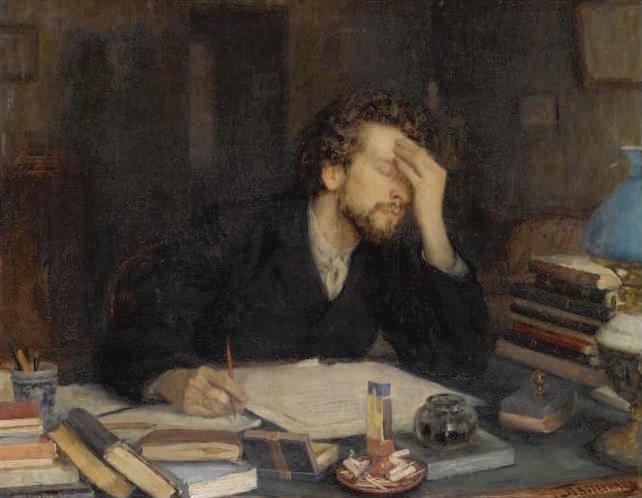
And, because I do like a post with a picture, here's one of my favourite images of the struggling writer ...

  
Leonid Pasternak's The Passion of Creation (wiki commons)

We've all been there.


Joan Lennon's website.
Joan Lennon's blog.

Wednesday, 24 June 2015

Riding the wave of procrastination - Liz Kessler

My actual job at this moment is to write a book. It will be my second YA novel. It is due with my editor in September. I am loving writing it. But because I am cursed with The Procrastinatory Mind Of The Writer, my days involve a LOT, LOT more than actual writing of this book.

And by the way, The Procrastinatory Mind Of The Writer is an actual thing. If you don’t believe me, ask yourself – why are you here? What are you REALLY meant to be doing whilst you are instead reading this? Huh?

Exactly.

Oh, and before you accuse me of having written about this before. Well, yes. Maybe I have. Twice. But it’s a big subject and there’s a lot to say – so I’m saying it again.

My daily work target is to write 1,500 words. In theory, I do NOTHING until I have done at least half of this. No internet, no walking the dog, no phoning my mum. Nothing.

Here’s what I did yesterday before writing a word of my novel. I think the first group of activities count as work.
  • Watched the live feed of the Carnegie Medal award. (It’s about writers.)
  • Looked up methods of exorcising ghosts. (Research for current book.)
  • Made about seven cups of tea. (Fuel?)
  • Answered some questions for a friend’s article in The Author. (A magazine for writers.)
  • Looked up articles about gender and language to prepare for a Radio Three programme I’m going to be on this week. (Raising profile.)
  • Replied to many emails. (Mostly work.)

The next few activities might not be quite so easily classified as work:
  • Made arrangements for meeting up with my mum next week.
  • Ditto for meeting up with sister.
  • Started a long thread on Facebook about a splinter in my toe.
  • Removed said splinter with the help of partner, tweezers, needle and iPhone torch.
Yay!
  • Frightened myself silly over various friends’ splinter-related horror stories.
  • Ordered a birthday present for partner.
  • Generally chatted with friends on Facebook.
  • And Twitter.
  • And maybe posted a photo on Instagram.
  • Perhaps had a few goes of a ridiculously addictive game called 'Dots'. (Don't look it up. Don't do it. Take it from me: you will lose days of your life to it.)
  • Looked out at the sea and wondered about going surfing. 
  • Ate fridge cake.

At some point, meandering through all of this like a river determined to reach its destination despite looking very much like a half-hearted trickle in places, the words got written. They got written! All 1,500 of them.

There's a voice inside me somewhere, shouting: ‘But this isn’t how I want to work!!!!!’ It’s disjointed, it’s messy, it’s lacking in solid focus, it’s undisciplined.

But then there’s another voice. This one is coming from the side of me that has learned about mindfulness techniques where you accept what ‘is’ rather than battle against it. And it’s the side that remembers many conversations with my lovely friend Jen who introduced me to the idea that the process of writing a book has seasons.

This voice says: look, the book is getting written. It’s happening. You’re on schedule. So why sweat it? Yes, you could switch off the internet a bit more. Yes, you could write maybe a little more than one sentence at a time before distracting yourself with yet another activity that is not writing the book. But maybe all of these things are what you need to do, while the story brews in the background.

I’m liking this voice. 

And in fact, I only have to look outside my window for confirmation that it might be right. Watching people surf – or being on the waves myself – is a good example of how this whole thing works. See, there is a lot more to surfing than the moment when you ride a wave. You have to hoik yourself into your wetsuit, get your board, go down to the beach, do a few stretches, run down to the water, paddle out to the breaking waves, sit on your board and wait, then paddle like crazy and then, THEN, you get maybe ten seconds – at most – of that exhilarating feeling of riding the wave. That moment is a fraction of the whole experience.

So perhaps that is how it is with writing, too. All the other activities are the warm-ups and preparation. The writing – the bit that does in fact make my heart sing – is the moment of riding the wave. 

Once I accept this fact, I can already start to relax. This doesn’t mean I can give myself permission to faff for almost the entire day. The background work needs to feel more focussed, I admit, and genuinely needs to be part of supporting the writing process in one way or another. But there’s no point in thinking that I can just jump out of bed and onto a wave. It simply doesn’t work like that for me. 

I’ve often told beginner writers that they need to learn what their own process is and be happy with it. So I need to do the same.

On which note, I am off to catch a metaphorical wave.

But I might just do one or two more metaphorical stretching exercises first.


Follow Liz on Twitter
Join Liz's Facebook page
Check out Liz's Website

Tuesday, 16 June 2015

Writer’s Block? No, I have Writer's Intrusive Thoughts! by Tess Berry-Hart

I don’t generally suffer from writers’ block in the generally accepted sense of a creative slowdown where I can’t come up with new ideas or produce new work. However I DO suffer from “existential block” sometimes and with it comes an attendant number of what I can only call Writer’s Intrusive Thoughts  (which I’m here rather grandiosely terming WITs) that can derail my writing even before I sit down at the computer. 

[oh my word what a boring intro! people will NEVER read this!]

So following on from my post on procrastination a few months ago I thought I'd have a crack at defining – and thus hopefully skewering – my five biggest WITs. I’m not suggesting these Writer's Intrusive Thoughts are the only ones that writers can suffer from, but they are definitely the biggest stumbling blocks that I experience, and I’m limiting myself to five so that this post doesn’t take years to write. And I look forward to hearing some of yours at the end of this blog! 

(1) NOBODY CARES WHAT YOU HAVE TO SAY

Why not start with the greatest momma of them all – the inertia-creating, anxiety-producing, existential despair that NOBODY CARES. AT ALL. SO WHY EVEN BOTHER?!

NOBODY CARES is like a cloud that periodically follows me round, finding new ways to rain on my parade whatever the circumstances. NOBODY CARES can attack at any time – whether I’m going on Twitter or Facebook (just look at all those other brilliant novels/plays out there, who gives a hang about mine!) or up in the attic with no distractions trying to bang out a first draft (WHY am I spending all this time on something that nobody will EVER READ!). It can seep down onto me when I’ve just sealed a deal with a publisher/producer (this project will NEVER get anywhere!), or it can hang around for days when I have a manuscript rejected (I TOLD you it was RUBBISH). It can graft itself finely onto any situation and augment the lose-lose aspect of a creative project which disheartens me even before I start.

So how do I get around it? Well it depends. A cognitive psychologist would identify these self-defeating thought patterns as cognitive distortions, when your brain tries to convince you of something that isn’t actually true.  Cognitive behavioural therapy (CBT) supplies various good strategies to get out of the slough of despond.  Identifying your thinking is the starting point, for once you’ve put a name to something you’re half-way to dealing with it. My main distortions are “looking through a negative filter” and “black and white thinking.” A negative filter is where you pick out the most disheartening aspect of any situation and blow it up large so it discolours the whole lens. Concentrating on the poor sales of a previous book, perhaps, might lead you to assuming that nobody will ever want to read anything you write ever again. Black and white thinking is an example of polarized thinking – if your latest manuscript was turned down by a publisher you might see yourself as an abject failure and not want to put yourself in the same position again, thereby convincing yourself of the futility of your project before it even happens.

So the important next step is refuting the thinking. This is something that is best done physically – writing down with pen and paper (ACTUAL writing makes you slow down and concentrate on what it is you are thinking, and therefore you can take it in more effectively.)

[ugh, I bet people are already clicking off this article and googling for better posts]

Examining the context of something to find out whether it is true gives you a base grounding in reality. For example you could write a list of all the positives – from listing people (actual people, not “likes”) who read your latest book and liked it. If you feel that everybody hates what you write, read some of the comments or reviews where people HAVE liked it. Humans are hard-wired to look for patterns, and sometimes you can interpret a couple of setbacks as a never-ending pattern of defeat, but there will always be some people who like and enjoy what you write – and listing them helps your brain recognise that it is painting a black picture for itself. And don’t restrict yourself to readership feedback either – there can be positives even from apparent defeat – the fact that a publisher couldn’t find a home for something yet is interested in seeing some of your future work can also go on that list.

(2) THIS MANUSCRIPT/SCRIPT/ PILOT IS NOT INTERESTING AT ALL!

The self-critical voice, or inner critic, has a lot to answer for. And there’s a time and place for that – but NOT when you’re trying to release your inner id and let it gambol free. Many writers know the feeling when they’ve spent a couple of hours on something, only to read it back and cringe. (“It seemed SO much better when I was actually writing it!”).

But wait! Maybe it is – but you’re looking at it with the wrong glasses. If we set ourselves up a mental filter (here we go again) in which you’re actively LOOKING for mistakes, you’ll see lots of them. If you’re reading it to evaluate the emotional effect, or hell, just for enjoyment’s sake – you’ll see it completely differently.

A useful cognitive strategy is to apportion a time-limit to my own self-doubts and worries. “Ok, Inner Critic, you can have your say, but not until tomorrow when I let you loose on editing. Until then, all bets are off!”  Sometimes I allow myself five minutes worrying and brow-beating just to get it out of the way so I can saddle up and ride off into the blue. The cathartic effect of voiding one’s own fears and anxieties can give rise to an exuberant and devil-may-care attitude which in turn, breeds creativity and leads to taking risks that my Inner Critic might otherwise talk me out of.

(3) SOMEBODY ELSE HAS ALREADY DONE MY IDEA – AND DONE IT BETTER!

 This is one of my especial kickers. SOMEBODY’S BETTER is the ultimate comparative beat-down, the self-deprecating paralleling of somebody else’s glowing achievement with your own half-baked inspiration. They got there first! They’ve queered the pitch for me! Everybody will think I’m copying them!

[i bet there’s a MUCH better article somewhere on EXACTLY this topic ...]

OK. Relax and regroup. So first of all there isn’t any copyright in an idea. Not in a formless, vague concept at least, before its ephemeral beauty is netted in words or solidified in celluloid. Plus do you really think that any book, play or film can thoroughly explore ALL aspect of an idea? Sure, you might want to angle your USP so that you’re not treading over EXACTLY the same ground, and stay away from plagiarism, but a good work of fiction would always cast its net wide. And there’s always a knock-on effect from having a group of artists tackle a subject. You could be part of a zeitgeist, or movement. Once there’s an appetite for a particular thing, you can help feed it!

(4) YOU SHOULD BE DOING [PROMOTION/PUBLICITY] FOR YOUR OTHER STUFF INSTEAD OF ...

One of the Gordian knots that I am often tying for myself goes like this: I don’t want to put all my eggs in one basket, so I make sure I have a couple of projects on the go at all times. But that means I’m constantly in a state of flux – if one project is on the up, so to speak then other more embryonic ones need to be coddled and nurtured, often at the most inconvenient times. Or if I have a show on, promotion and publicity to audience or industry contacts is the immediate preoccupation, but when it’s gone, it’s gone, and I suddenly find there’s a big void where there should be green sprouts.

[omg you have just spent so long on this post! what about all the other stuff you have to do!]

Sometimes it feels like I'm having a long luxurious bath when I write, that the muddy plot of creative fertility is just one extended hog-wallow that often churns up little of value. Sometimes it feels that the “good” part of writing is the sharpening and tightening of a story that is already there – so you can feel that you’ve “got somewhere” with it. Or if someone asks to have a look, and all you can think of is how it’s JUST NOT READY -

 [ugh look at the time – why have you spent so much of the morning on this]

Again, for this one, compartmentalisation is your friend. Give yourself ring-fenced time for self-indulgent and non-reflective creativity, no matter how ugly the result, and whenever a WIT leaps into your brain, write it down and consign it to later. Comfort your raging anxiety with the  knowledge that in one hour (or earlier today) you can (or have) done whatever literary or theatrical admin/ naked self-publicity is required, and that you can recharge in the volcanic mud bath of invention once more.

[the time, the time! come on!]

Which brings us to ...

(5) MY EDITOR/ PRODUCER/DIRECTOR HAS SUGGESTED SOME CHANGES WHICH I AGREE WITH BUT  CAN'T INCORPORATE!

This last one is a toughie ‘cos it ain’t just you this time. You’ve submitted your story to a publisher/producer, it’s been received well and there’s plans afoot to publish/produce it. But now comes the editing process, and the delicately-phrased “may require some further work” comes into play. You sit down with your editor/producer and are presented with (some) well-observed and on-point suggestions that will definitely assist your story. (Obviously first you have to use your judgement to determine whether you’re happy with suggested changes or not, and I’m assuming the former.) In fact, your original story now seems but a pale wraith against a bursting rainbow of yet unrealised beauty. But what seems fine in theory leads to almost crippling indecision when faced with the problem of intertwining these new suggestions into the tightly woven mesh of the existing text. And when you do manage to do it, there’s the third eye in your forehead commenting and worrying and ...

[i am TOTALLY messing up this post now]

So I’m leaving aside any rubbish edits which you are free to contest or ignore as you see fit. Again, I’m talking about ACTUALLY GOOD edits that you can see would really help, but you’re feeling down about because you’re not sure how to do them. 

Emotional Reasoning – assuming that because you’re feeling a certain way means that something is true and Jumping to Conclusions are my particular horrors.  I’m particularly prone to mind-reading (“they obviously HATED my original piece”) and fortune telling (“if I can’t do this it will be the end of everything”) but once you start to externalise suggestions you run the risk of having a wonky hybrid story which can’t run because it has extra arms and legs grafted on in unwieldy places. Without being too hippy about it, when faced with good and far-reaching suggestions, I try to meditate on them for a few days, internalise the content, and then rewrite from scratch. Again, keeping a list of the positives helps – after all, your editor/ producer wouldn’t be spending their valuable time on it if it wasn’t pretty good, would they?! 

And while you’re at it, make a list of all the people who really don’t care – like REALLY DON’T CARE – whether you succeed or fail at this writer thing. In my case, my children are too young to even know what a writer is and my cat TOTALLY doesn’t give a toss at my degrees of failure or success. All they care about is playtime and cuddles, and when things are going badly with this writer thing, then there’s plenty of those!

[stop rabbiting on, you're boring people! WRAP IT UP! WRAP IT UP!]

There's plenty more where those came from but I'll wrap up now and I’d love to hear about some of yours!

So you missed out on the Carnegie? That sucks. Now where's my stroke?


Monday, 3 November 2014

Bird by Bird - Heather Dyer

 
© nao-cha

“Bird by bird, son,” says Mr. Lamott, when his son is overwhelmed by a school project on birds and doesn’t know where to begin: “Just take it bird by bird.”

'Bird by bird,' is also what I tell myself when I’m facing the immensity of writing a new book. Often a new creative endeavour is a journey into the unknown. We advance paragraph by paragraph, scene by scene – often without being entirely sure where we’re headed. We keep our heads down, measuring our progress word by word.
But sometimes it's helpful to measure our progress not by word count, but by time spent writing. Therefore, 'bird by bird' could also mean ‘moment by moment’.

In October, Nicola Morgan set up an October ‘NanoWrimo’ (Novel Writing Group) for authors in the Scattered Authors’ Society. All those who signed up agreed to declare our writing goals at the beginning of the month and encourage each other to keep on track daily via Facebook.

I signed up for the group to help motivate myself to write. But I didn’t declare a daily word count. My goal was simply to open one of my two writing projects – one fiction, one non-fiction – and work on it for an unspecified time first thing every morning. Only after this could I start my other work: editorial report writing, lesson planning, admin, errands…
I used to clear the decks of all this 'other stuff' before tackling my creative writing. But last year other work built up to such an extent that the decks were never clear. I ended up batting off one ‘urgent’ task after another, just to keep up. If I did get to pause I found myself panting and out of breath – not a conducive state of mind for creativity. I realized one day that it had been nearly a year since I’d properly given some attention to the sort of writing that all my other work was meant to support.

And what did I discover during the October Wrimo? I discovered that even fiddling ineffectually with my writing projects tended to produce at least a sentence or an idea that I could build on the following day.
Also, dipping into the worlds of my books – even for just half an hour – allowed these worlds to develop bit by bit in my unconscious. Then, in quiet or preoccupied moments (like walking to work or showering or meditating) lines of dialogue or new ideas tended to arise in my consciousness like bubbles in a pot of porridge on a low heat.
Bird by bird my projects grew, so that at the end of the week I was undeniably further on than I had been at the beginning.
But best of all, I no longer felt the guilt associated with not having been 'creative’. It was only once this guilt was lifted that I realized that I had been struggling to work through a low-level stress caused by the knowledge that I had neglected something that was important but not shouting for attention; something hovering in the background, waiting. I found that by attending to my creative work first, this stress disappeared.
And in the end, I still got as much 'other' work done. If anything, I became more efficient, more patient,  and worked with a greater focus – because I have already satisfied that ‘thing’ hovering in the background.

This way of working is not new to me – in fact, I advise all my students to try working this way. But somehow I had let my priorities slide. The October NanoWrimo group prompted me to remember my priorities. I feel better for it – and so does my writing.

 Bird by bird,” is the title of Anne Lamott’s book about writing and about being a writer.
Heather Dyer's latest book is The Flying Bedroom.
www.heatherdyer.co.uk


Wednesday, 19 December 2012

Truth, Lies and MRI Scans.


Anthony Burgess, on being told he had a brain tumour, and only a year to live, was jubilant. Great, he thought, a whole year in which I’m not going to get knocked over by a bus, or die in a car crash.  Worried that his premature death would leave his wife with nothing, he threw himself into writing.  The brain tumour disappeared, Anthony Burgess established himself as a major novelist.

This little story, which Burgess describes in his autobiography, may or may not be true.  I doubt that it is.  But regardless of its veracity, it’s been going round and round in my head for some time.

Like everyone else who writes and reads this blog, I am writing a book.  It’s a book I’ve been working on for five or six years.  It’s the one I’ve always wanted to write. I’m sure you all have one like it. But like plenty of novels writers write, I have struggled to finish it.

However, I had an Anthony Burgess moment.

In April this year I had an MRI scan that suggested the arteries in my head were unusually thickened, and I was at risk from a developing an aneurysm.  I’ve written about this in an earlier blog, so won’t go through all the gruesome details again. I’ll just mention that the specialist took five months to tell me, by which time, I thought, I’m lucky to still be here.

More recently I had a second ‘enhanced’ scan, using state of the art MRI that, if the first had something of the 1970s about it, this one was 2001.  I was sucked into the mouth of Hal.  Abandon hope all ye who enter here.

This second MRI machine was right next to a bank of monitors displaying my skull, brains and all that mazy Hampton Court stuff. How I longed to see a little homunculus sitting there in the middle, arms pulling the levers, sweat pouring down his little brow.

“Look!” I imagined yelling to the radiographer, “there, in the middle, a tiny man! And he’s gobbling chips!” The radiographer frowns.  “That’s very common,” she says.

Look, not all of this is true. The truth is not that exciting. I had the scan, I went home.  The radiographer didn’t say anything at all.  She smiled and nodded and I wondered, as I got my coat, whether she was looking at me that way because I had six months to live, or because she thinks I’m an idiot.

What if it was both?

But, when I got the report, it was reassuring.  Whatever was on the previous MRI scan, it was not on this one.  “No abnormalities in the brain, no lesions, the orbits, pituitary, corpus callosum, brain stem” and so on, all normal. Things are flowing as they should be.  The homunculus needs a new armchair, but otherwise, nothing.

What, I asked the specialist, has happened?  Why has thickening, or arteritis, or aneurysm, or infection disappeared?  I thought these things were either irreversible, or cured only by colossal amounts of steroids.

No answer.  A shrug. “An over enthusiastic radiographer,” he muttered.

“What?” I yelled, picking him up by the collar and holding him against the wall.  “Are you saying my illness was the product of someone’s imagination?”

“Please,” he said, “it’s not my fault!”

He reached out and pressed an alarm button, two orderlies charged in, and in seconds I was strapped up, restrained, and couldn’t move.

“I just want the truth, doc,” I said, struggling to free myself.

“Put it this way,” he said.  “Perhaps we in the NHS love to create fictions, too.  Why should all the imaginative stuff be left to writers?” 

For whether I was ill, and after a long rest, am cured, or whether there was nothing there in the first place, the fear that I had something eating away at my brains was the spur I needed.  It wasn’t that I was afraid I wouldn’t finish my book before I died, it was that writing kept the worry away.  As long as I wrote, I didn’t dwell.

I have nearly finished my book.  I’m proud of what I’ve written, but know that finding a publisher for it will not be easy.  It is, to say the least, very idiosyncratic.

But does that matter? I’m going to live.