Showing posts with label nature. Show all posts

Monday, 28 March 2022

More Places We Write... by Kelly McKain

 More Places We Write... 

Well, as you can imagine, I was very thrilled when I sat down to write my blog for this month, to see that Claire Fayers had just written something about writing in different places. Which I was about to do. And still am - except now it's a follow on from Claire's piece.

It's been a very interesting couple of years for me, writing-places wise. I went through a divorce in 2020 and that, coupled with COVID making finding places to stay a challenge, gave me a very different landscape writing-wise.

First I found myself about to rent a small place in a nearby town to live and write for three days a week, and then the offices of the rental company (part of a country estate) suddenly closed due to COVID and I had nowhere to go. Some wonderful friends came to the rescue and we moved my caravan to beside their cottage. Owing to having to look after horses, I was permitted to travel there during lockdown (not in contact with anyone, I might add!) and work/live in the beautiful Willow for a few months on and off. I had the best view in Surrey, especially in the evenings!


In May, at Beltane, I danced under the big oak tree in the field adjoining the land I was staying on - boots kicked off, sunshine on my face, then went back to work via Whatsapp on a screenplay with the very talented SASsie Steve Gladwin.


In the late summer it was hot until almost midnight. I worked with the door and windows all open and there was plenty of inspiration for a fairy book in the fields nearby - where I walked barefoot for three days in a row over Lammas.


Winter 2020 brought a stay at a magical hut near Glastonbury and I so enjoyed walking with a rewrite of my YA fantasy novel, Green Witch (copy-edit of which just returned to my editor ten minutes ago - woo hoo!)


Spring saw an exciting move with my children into our own new home in West Sussex, and the discovery that I had bought an incredible sun-trap, which was sit-out-in-able right from March. From there, I got to work on a new mindfulness series out next year, The Feeling Good Club, and started my Intuitive Guidance and Energy Healing business.


Then to Bristol last autumn, where my lovely partner Tim lives - and the fantastic discovery of two things: First, the joy of Coffee #1 as a work space, where this February half term I worked up the synopses for a follow-up series to The Fairy House, which had been commissioned by my Japanese publisher. And second, the hilarity and companionship of working across a studio room with someone else, who occasionally erupts into fits of pique about missing or un-useable bits of things that he needs for doing stuff (as you can tell, the technical terms pass me by, but he's a video editor!)
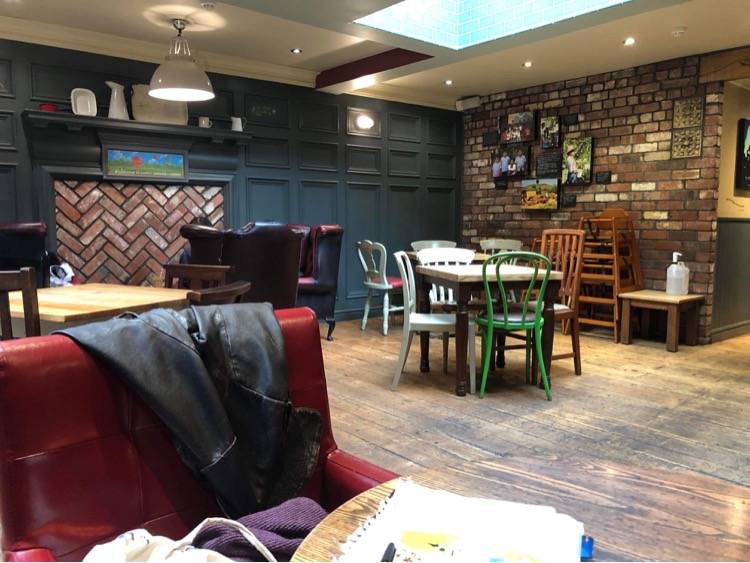


Now, I'm sitting in my ex-husband's partner's study writing this, as I'm house-sitting while they're in Africa. It has grown dark outside while I've been writing, and, while it's not Claire's stunning view, the treetops, some branches still bare, look beautiful against the inky sky. Spring is coming, I'm very, very fortunate now to have my own lovely home to work in, but I've got the taste for writing here, there and everywhere again, and I can't wait to see what writing adventures and new views this year will bring!

by Kelly McKain


www.kellymckain.co.uk

https://kellymckain.co.uk/authors-hour-of-power/ Creative and strategic consultations for aspiring and working authors.

https://www.facebook.com/kelly.mckain.5/

Sunday, 28 November 2021

Folly Farm: Returning to Magical Places by Kelly McKain


This week I grabbed one of the final places at the SAS’s Folly Farm Winter Warmer retreat. I’m excited about the opportunity to connect and collaborate with old friends, and to meet new ones… And we certainly do collaborate and inspire one another! One year, Liz Kessler, with music playing in her headphones from the previous evening’s drinks, tunes and general vibe out, took an early morning walk with her camera… and came back with an entire novel fully formed, which had unfolded within her over the walk. I think it was the following year, or a couple of years after, she presented it to a very honoured June Crebbins, Elen Caldecott and I, dedicated to us with thanks for our little part in igniting the creation. The book? Haunt Me. If you haven’t read it, I highly recommend it. It’s got all the misty magic of that Folly Farm morning, and all of Liz’s breath-taking depth of spirit and breadth of heart held within it. And that’s just one Folly Farm creative story. I know there are many, many, many more! (If you have one, maybe add it in the comments!)


At Folly Farm (probably in about 2015), I began powerfully imagining and playing with a project of my own, Green Witch. I walked in the incredibly beautiful wild wood there and felt my characters come to life – Tol, the broody, beautiful, troubled young man who appears to be walking between worlds while in a coma, stalking terrified heroine Delilah in dreams and visions. I could almost see Delilah herself slipping between the trees ahead of me, a fragile, braced young woman with no confidence who then comes into her power as the next Green Witch in a long line, with a huge destiny and mission ahead of her. A bit slower off the mark than Liz (!) I wrote the book, and Green Witch is out next year. 


When I return to Folly Farm in January I’ll be walking in the same wild wood, soaking up the same magic, and closing some kind of circle with gratitude and appreciation as Green Witch is ushered out into the world on a wave of grace and magic (and like most of our beloved creations, probably a bit of a wing and a prayer!). I’ll be sitting by the fire with fellow writers - old friends and new – and all old souls for sure. We’ll be raising a glass to the beautiful, magical soul Kit Berry who very sadly passed away this year. Dear Kit, I will have a good roll round the floor to Wuthering Heights while screeching the lyrics at the top of my voice to properly honour you… 😉

Connection with nature is deeply sustaining, the friendship of warm, kind, funny people is deeply sustaining, writing and creativity is a deep, deep primal well of truth… Folly Farm has all of this, plus probably someone will bring a massive tub of Quality Street, and I cannot wait to find out what gifts are there for me in January…


Find Kelly at www.kellymckain.co.uk and www.soulsparks.space and out in the wild wood.

Wednesday, 13 May 2020

Noticing the Bluebells by Sheena Wilkinson

I was coping really well. Baking my bread, doing my crochet and my yoga and even managing 1000 words a day (most days) of a new novel without too much despair about the likelihood of said book ever being published. I was enjoying walking and running on my local country roads, and genuinely grateful to live in beautiful rural Northern Ireland, with no shortage of fresh air and not too many people. 

This is my road and I am grateful for it

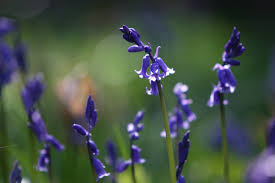
Then in late April someone put a picture of a bluebell wood on Facebook. And the kick of pain surprised me. I haven’t walked in ‘my’ forest for two months. I love that forest in every season, but there has always been something special about May and the bluebells. And this year I was going to miss out. I couldn’t bear it. 


Sally, my parents' dog, in 'my' forest 
I have not cried about missing my parents (or Sally, forest companion extraordinaire)  or not seeing my friends or sister, or my loss of income, or the silence surrounding my March-published novel, but the thought of not seeing and smelling those carpetty drifts of hazy blue seemed suddenly the cruellest cut.


What I am not seeing this year 

I fell in love with bluebells as a small child. I remember telling my parents I could only get  married in May so I could have a bluebell bouquet (I’m not sure that would work actually, but I was only nine when I conceived that fancy.)  How could I go a whole May without seeing them?


Did I always know they grew along the roadsides? I suppose I did, but because I was able to take for granted that I would see them in more dramatic splendour in the forest I didn’t bother noticing. This May, confined to the roads, I have noticed them peeping through the green, brightening up odd corners, and I am thankful. For the bluebells and for the noticing. 

I hope you are all finding something to notice. 


Roadside bluebells (plus Daisy).

Friday, 13 May 2016

A GLUT OF PLUMS


I had a glut of plums. I loved saying it. They were such plump words, and the scene they conjured so country-gardenish. I loved looking out at the plum tree, so heavy with fruit. I loved having plums with everything – plum crumble is a lovesome thing, God wot. (I was going a bit overboard with the country garden thing.)
a glut of plums 

‘You must be a great gardener,’ people said as they accepted baskets of fat ripe  homegrown Victoria plums. (It had to be a basket, a Tesco’s bag-for-life would have been a much less lovesome thing.)

I was not a great gardener. I had planted the tree and it had grown, acquired twigs and leaves and blossom and what-not; all the plum tree things you’d expect. It had thrived on neglect. It had no choice. I was so busy, trying to get a writing career off the ground while working fulltime, that the whole garden just sort of rampaged outside the kitchen window. The plum tree bloomed and fruited as enthusiastically as my words.
enthusiasm 

Sometimes I didn’t even have time to pick them. The plums, that is. I was very careful picking my words.  I took it for granted the plum tree would always provide, just as I took it for granted the words would always come, and people would always look on those words as enthusiastically as they had accepted the baskets of plums.

And then last spring there was hardly any blossom. And the plums, when they came, were few and feeble, fit only for the birds.

I felt guilty. By now I had taken the rest of the garden in hand, weeded and planted and tidied, and though I am still not a great gardener, I do actually garden these days. But I had never given the tree any attention. 
I do garden these days. 

Clearly the poor plum tree, all sprawl and spot, was sulking. I would prune it. After all, had I not recently cut down the first draft of a novel from 113,000 words to 60,000? And didn’t the rose bush come back fat and strong and groaning with blooms after I had cut it back to a stalk? The plum tree would respond likewise.

Perhaps I went overboard. It was War And Peace and I hacked it down to a haiku. It looked naked and sad and ugly, more cat’s climbing post than living thing. But at least it didn’t rock in the winter storms, and spring would eventually come. I looked forward to the gradual greening, and then the blossom and eventually the plums. Perhaps, for the first time in years, even a glut.
sulking and sad


It is late spring. The may is flowering and the coconut-scented whins glow golden. Even in my hilly garden, always late and windswept, there are flowers. But the plum tree has sulked on. Nothing but bare branches. I have edited it to death, I think. I have been too harsh. It will not forgive me now.

It is hard to look at the bare stumpy thing and remember that blossom once frothed without being asked or helped, that there was once a glut.  It reminds me too much of myself, once carelessly assuming that my writing career would blossom as rampantly as it did at the start. It makes Gerard Manley Hopkins’s words echo too loudly in my head, as, like the plum tree, I seem not to breed one work that wakes. How many seasons should I give the tree to  revive? What do I owe it? Perhaps I should just cut it down, and do something else with the space. Move on.

Last week, though, there was a leaf. Just one. Pathetic to be so pleased, when everyone else’s trees are rampantly in bloom. Still, a leave is a lovesome thing. A hopeful thing.

And now there is a tiny twig. And a little bunch of leaves. And the same on that branch. And that one. Leavèd how thick! Well, not quite yet. 


There won't be a glut this year. But there is a start.

a start 

Monday, 4 January 2016

The Call of the Wild – David Thorpe

An argument in eight parts:

1.


What do you wish for in the year ahead? Going further: what is the purpose of your life?

It's the time of year for such soul-searching questions, yet questions like these are asked constantly by teenagers all the year round.

Why am I here? Why am I not more popular? Why am I not more beautiful/fit/clever/likeable? How will I pass these exams? How can I bear to go to school tomorrow knowing that those people detest me so much? What can I do about my enemies? Why does nobody understand me? Why am I so alone?


2.


Things get too straight
I can't bear it
I feel stuck, stuck on a pin
I'm trying to break in
But I know it's not for me
And the sight of it all
Makes me sad and ill
That's when I want - some weird sin
Just to relax with
Yeah, some dumb, weird sin
For a while anyway
With my head on the ledge
That's what you get out on the edge.

 Some Weird Sin – Lyrics by Iggy Pop


The song describes the feeling of alienation, when all the choices available to you are no good. The pressure's too much, you need an escape, a way out, otherwise you will explode.

What could it be?

3.


Self-harm, eating disorders, poor mental health, suicidal feelings, porn addiction, the huge obesity problem, alcohol and drug abuse, mobile phone/screen addiction. The list goes on. Pressures on children and teenagers are greater than they ever have been. The effect of this is seen in statistics on the increasing prevalence amongst children and teenagers of damaging behaviour.

In a UNICEF study released in 2007, the UK came bottom of a list ranking industrialised nations in terms of child wellbeing.

Yet despite all of this, many youngsters still courageously manage to achieve higher grades than ever before and are opting for healthy diets.

But whichever choice they make, the need for an escape is crucial when children and teenagers feel powerless and under pressure, as they too often do.

Where can they go?


4.


"How has childhood become so unnatural? Children are enclosed indoors, caged and shut out of the green and vivid world in ways unthinkable a generation ago.

"[Seeking the answer to] the riddle took me to the spirit of childhood... the importance of woodland for the psyche; the secret world of a child's soul where the stories of childhood are whistled with a deft and fragile panache of poetry."

– from Jay Griffith's introduction to her incredible book about childhood and the need for the wild, of which Philip Pullman said: "Kith could have been written by no one but Jay Griffiths. She has the same visionary understanding of childhood that we find in Blake and Wordsworth. Her work isn't just good - it's necessary." (It's also published as A Country Called Childhood.)


5.


"I used to love reading to my children at bedtime. The song about Mike TV's fate in Charlie and the Chocolate Factory was a favourite. In it, Dahl vents his wrath on the hated television: 'They sit and stare and stare and sit until the hypnotised by it.' ... What would Roald Dahl think now?

"The need to be close to nature is in our DNA... Wildlife Trusts work with many children to reverse the trend of young people not having access to the wild: in schools, in parks, in wild places. A wild childhood is good for health, well-being and nature. We want every child to be wild."

Stephanie Hilborne, Chief Executive of The Wildlife Trusts in her editorial in the latest issue of the publication Natural World. (Coming events for children are listed here.)


6.


If you are a teenager, what do you think about when you're lying in bed trying to sleep? What kinds of thoughts go round and round in your head when you are waiting in queues, walking, commuting? Would they be your worries, your troubles, the demons of self-doubt? How can you avoid their persistent nagging?

One way that is not self-damaging is to escape into stories you are reading. You imagine yourself as the protagonist of a great adventure, misunderstood, vilified, ignored or even obstructed by authorities, but determined to overcome every obstacle with your special powers to achieve success. So much more empowering, distracting and fun than to be dragged down into the dark, hopeless swamp of your own psyche.

Some of the children doing this may even make up their own stories and become the writers of tomorrow.

The Awakening of Childhood Heroes by Charlotte Soileh

7.


When I am lying in bed trying to sleep, or when I am waiting in queues, driving, cycling or commuting, I spend hours solving the problems that my writerly life has set me: problems of plot, research, character, tone and structure. If I did not do this I do not know what would occupy my mind except the interminable, grotesque treadmill of self-doubts.

And when that fails, too, you can find me in the woods at the end of my garden, in the hills, by the sea.

In the wild.

Me kayaking in the stunning Mawddach Estuary
This is why I wrote The One Planet Life and why my kids grew up in and love the Woodcraft Folk.

8.


“There is an ecstasy that marks the summit of life, and beyond which life cannot rise. And such is the paradox of living, this ecstasy comes when one is most alive, and it comes as a complete forgetfulness that one is alive.

"This ecstasy, this forgetfulness of living, comes to the artist, caught up and out of himself in a sheet of flame; it comes to the soldier, war-mad in a stricken field and refusing quarter; and it came to Buck, leading the pack, sounding the old wolf-cry, straining after the food that was alive and that fled swiftly before him through the moonlight.”
― Jack London, The Call of the Wild


David Thorpe is the writer of the Sci-Fi YA novel Hybrids and the cli-fi YA novel Stormteller.

Friday, 17 April 2015

Mixing Up Settings: Town, Country and the Books of Lorna Hill

View towards Dunstanburgh Castle
Last week I was in Northumberland. It's only a couple of hours from Leeds, where I live, but it feels like a different world.

Leeds is a big, bustling, ethnically diverse Northern city. The Northumberland coast, with its empty beaches, fishing villages and old-fashioned pubs, feels like a journey away in time as much as space. Even the tourist hot spots – like Lindisfarne – are tranquil, the cars abandoned once the causeway has been crossed, the many visitors wandering the windswept island by foot.


Daffies at Howick

There are some other wonderful aspects of going back in time -  like bookshops! How is it that while most British cities (including Leeds) struggle to support independents bookshops, the market town of Alnwick can offer the stupendous Barter Books: an enormous secondhand bookshop where you can take your dog, eat superb creamed mushrooms, and pick up a copy of Robert Fagles' translation of the Illiad, all in one happy trip. (I mean, who doesn't want to munch mushrooms while reading an Ancient Greek Epic with their dog sitting on their feet?)

A recent edition - published by Girls Gone By

Other aspects of time travel feel a little strange. So many things I take for granted don't seem to have impinged upon this corner of rural England. It made me think (because that's the peculiar way my mind works) of the only children's books I know set in rural Northumberland – those by Lorna Hill. They are undoubtedly of another age – and yet I wondered how much had really changed. (Well, some things certainly have.  Like fifteen-year-old boys waving horse whips at thirteen-year-old girls, and telling them to scrub their face free of makeup AT ONCE.)  But other things remain the same: the lakes, woods, mountains and beaches of Northumberland, in all its beauty, isolation and essential wildness. Hill, a vicar's wife in an isolated parish, knew Northumberland intimately and used it as the setting for many books.  One of her  “Marjorie” series – Stolen Holiday - is set very close to where I was staying, towards Dunstanburgh Castle.


"Mile upon mile of wonderful deeply golden sand and undulating sand-dunes, some of them so lofty that they were like miniature mountains; mile upon mile of deep blue-green sea flecked with white horses (there was a stiffish breeze blowing); and, last but not least, seeming to float in the shimmering water, lay the Farne Islands..."   Stolen Holiday

Her most popular books though, and the ones I remember growing up, were the “Wells” books – a series which combined rural adventures in Northumberland with the unlikely world of the ballet. These books have been reprinted countless times over the years.  And yet, though I never thought about it at the time, it's a very odd mix.

Veronica Weston, the heroine of the first two Wells books, spends her time shuttling between London – where she has grown up in seedy lodgings, and subsequently trains as a dancer – and Northumberland, where she is the “poor relation” to the rich Scott family, who live in a big estate in the Cheviot Hills, complete with lake, boathouse, woods, resident nanny, chauffeur, ponies and a gate lodge – wherein lives the Scotts' intriguing, infuriating, talented cousin Sebastian. The first book, A Dream of Sadler's Wells, begins with Veronica, recently orphaned, on the train north – and ends with a ride through the snow to catch the train south, and to make her audition for the prestigious ballet school Sadler's Wells, in Covent Garden. In the sequel, Veronica at the Wells, half of the book is set in London, in her digs and ballet school – where the mean-spirited Marcia Rutherford is plotting to wreck Veronica's promising dance career – and half at Christmas in Northumberland, where Veronica rides out with her cousins across the moors to visit a fellow dancer and almost gets caught in a storm.

All of the Wells books that I've read feature characters torn between the tranquil, outdoor pleasures of the country, and the stage-paint, bright lights and glitter of London. And they were by far Hill's most popular books – the strange combination of professional ballet and rural adventure chiming with young readers far more than those novels which were simply set in Northumberland.  Maybe it's not so surprising.  Ballet, even more than it is today, was a world of fame, glamour and celebrity - and many young readers must have yearned for these things, yet recognised, like Veronica, that it could have its downsides too.

Often books do need more than one element to take off – in this case, it is an unusual combination of activities (horse riding and ballet) and settings (London and rural Northumberland) that produces a certain magic that lifts these books out of the ordinary. There have been lots of books about ballet, and lots of books about ponies, but few have been as beloved as Lorna Hill's Wells books, which so oddly managed to do both.

Barter Books, Alnwick - geograph.org.uk - 777787
Barter Books - photo credit wfmillar [CC BY-SA 2.0 (http://creativecommons.org/licenses/by-sa/2.0)], via Wikimedia Commons

I went home reflecting that a bit of mix can be no bad thing for a novel – if you can get the mix right, and save it from turning into an incoherent mess. It made me wonder what diverse settings I might somehow put together in a book. All my children's books have been very firmly set in one locality - maybe that's something I could think about changing. I certainly plan to experiment.  I also felt comforted that if, despite the daffodils, the golden sands and cosy pubs, a little bit of me was craving my local Costa Coffee, a curry and a late-night convenience store (like Veronica hankering for Leicester Square), then perhaps that was OK too.

(Note: Some of Lorna Hill's books are still in print, and second hand copies are widely available - although I forgot to look for them in the excellent children's section at Barter Books.

More information on Lorna Hill here.)

Some more daffies!


 ------------------------------------------------------------------------------------------------------------
Emma's series for 8+ Wild Thing about the naughtiest little sister ever is published by Scholastic.
"Hilarious and heart-warming" The Scotsman

 Wolfie is published by Strident.  It is a story of wolves, magic and snowy woods...
"A real cracker of a book" Armadillo 
"Funny, clever and satisfying...thoroughly recommended" Books for Keeps

Emma's Website
Emma’s Facebook Fanpage
Emma on Twitter - @EmmaBarnesWrite

Monday, 13 April 2015

Twig by Twig


 My desk is near the window. I would probably get a lot more done if it weren’t, especially at this time of year. And right now I have such a deadline that I shouldn’t be looking anywhere but at the screen.

I have a garden. It’s not a particularly nice garden because I’m better with words than with plants. Mostly, since I stopped being a cat owner, my garden seems to be a bird feeding station.


I love watching birds. Recently I’ve been watching them gather the materials for their nests. Carrying maybe one twig at a time. One very large twig, often longer than the bird itself. In their tiny beaks. It takes them ages to lift it, and even longer to fly with it to where they want to go. It must be, for us, like hawking a huge tree trunk round in our teeth.

When I see a tiny sparrow with a twig I wish I could build the nest for it. The task looks impossible. It looks even harder than the book I am struggling with right now, the one that seemed like a good idea when I signed the contract, and now seems impossible to get done in the tiny amount of time left. Much easier to look out at the birds. How are they going to get enough twigs?  How are they going to know what to do with them? How are they going to be able to put them all together and make a nest and then lay their eggs?

It exhausts me to think about it and there is so much that can go wrong.
When I first moved to this small village in County Down, a pair of housemartins built their odd, mud-hutlike nest in the apex of the side gable of the house. They were charming, if a little bit annoying – noisy beggars, and I was forever cleaning their poo off the roof of the car. But I loved seeing them wheel around and hearing the tiny squeaks of their chicks.


Their nest was a preposterous thing – a sort of mud coconut-shell affair clinging upside down, held on by hope. Then one day I found it smashed on the driveway, the dead chicks spilt over the gravel. The parent birds wheeled and wheeled in shrill distress. I could do nothing. It was unbearable.

A few days later I saw them with bits of mud in their beaks. They rebuilt. They raised another brood of chicks. They, or their descendants, return every year. Their upside-down mud hut clings on. 


I still haven’t finished this book and I don’t quite know how it is going to end. I’ve been asked to write about the Easter Rising of 1916, and right now it feels too big for me, and much too scary. And I should be working on it right now, instead of looking at birds flying round with twigs in their beaks.


I don’t know how they do it. I wish I had the instinct for this story that they have for their collecting, and carrying and flying and building and rebuilding. But I will do it. Twig by twig.