Showing posts with label creative writing courses. Show all posts

Sunday, 10 September 2017

Reflections on Becoming an Author by Jess Butterworth

When I was ten years old, my primary school asked if I wanted to attend a creative writing workshop with Philip Pullman at Bath Spa University. I, of course, said yes. I loved writing, Philip Pullman, and the prospect of leaving school for the day.

I remember the workshop was held in the castle on campus. We created all sorts of imaginary worlds before Philip Pullman revealed his own writing process. One of the things he mentioned was how he would always have a piece of string handy when he wrote; it helped him to concentrate and think.

It was my first realisation that being a writer was a real job and, in that moment, my ten-year-old self decided that all I wanted was to do was sit in a 14th century castle with a ball of string and make up stories.


Eight years later, I returned to Bath Spa University for my undergraduate degree and was delighted that I had one creative writing class in the very same castle classroom.


Around this time, the Bath Children’s Literature Festival began. I immersed myself in every aspect of it that I could; attending events, volunteering, being a runner. Every year, I’d come away from it with a renewed passion for writing and an excitement for the books I couldn’t wait to read.  


Later, I completed an MA at Bath Spa University and finished with a complete manuscript that would become my debut book.

Graduating from the MA in Writing for Young People with fellow writers, Carlyn Attman, Sarah Driver and Alyssa Hollingsworth.

Now, as I embark on my own school and festival events, I remember all the successful author events I’ve had the privilege of seeing over the years, and think back to my ten-year-old self and the things that filled me with wonder.  


Jess Butterworth 

Running on the Roof of the World is out now. 

Find out more on Jess's websiteTwitter, or Facebook


Wednesday, 15 March 2017

On Not Feeling Guilty About Not Writing – by Rowena House


Confession: when my forehead is bleeding over a particularly stubborn scene, I find some of the motivational quotes which punctuate my Twitter feed deeply irritating. One that bugs me more than most is attributed to Ray Bradbury: ‘You only fail if you stop writing.’

Now I’ll bet £20 and a curry that, in context, this quote makes a good point.

[A few years ago I watched a great hour-long speech by Ray Bradbury to US creative writing students – via a link in one of Candy Gourlay’s ever-informative blogs – in which he had many brilliant things to say, including a recommendation to write one short story a week on the grounds that no one can write 52 rotten stories per year.]

But the mantra ‘You only fail if you stop writing’ is often taken to mean that we must keep plugging away regardless; we shouldn’t get up from our computers until we’ve reached a minimum daily word count; the muse must strike between nine-to-five or whatever time of day we’re chained to our desks, etc. etc.

All of which advice may well help many people keep going.

So why do I instinctively rebel?

In that time-honoured tradition of seeking evidence to support one’s intuitions, rather than challenging them with uncomfortable data, I’ve been on the hunt for reasons to justify my gut reaction.

The search bore fruit.

Ironically, the first clue came from an article entitled Inspiration for Slackers in the latest edition of Bath Spa University’s magazine. In it, Lucy Jolin quotes Nick Sorensen, Associate Dean at the Institute for Education, talking about the ‘reflective practitioner’ in education.

I recognised this theory of education from my days at Bath Spa on their fab MA in writing for young people. Reflective commentaries on different elements of our writing processes were an important part of that course, and this reminder made me realise that part of my hostility to “plugging away regardless” probably stemmed from this training.

As far as I understand it, reflective practice presupposes that being good at something requires practice. [Back to that famous 10K hours of practice to become an expert in your chosen field.] But it also says that even when we do something well, we won’t necessarily be able to repeat that success unless we know what’s so great about it, and how we achieved it. Ditto for things that don’t work.

Thus, unless we give ourselves the time and space to analyse our writing, we will remain at the mercy of inspiration, which (imo) is actually the route to becoming a slave to perspiration.

This small epiphany led to more general thoughts about the evolution of a book I’ve been working on (off and on) for more than four years, into which I’ve poured much that I love as well as things that I fear, moments that have shocked me, things that have bought great joy and others deep sadness.

In other words, it’s about life with all its ups and downs.

So I reckon another reason for my instinctive mistrust of the idea of obsessing over words for too long in the lonely garrets of our minds is an underlying belief that we need to live life whole-heartedly in order to write well.

Other people have, of course, made this point many times before, including Stephen King, who put it succinctly: ‘Life isn’t a support system for art. It’s the other way round.’   

Rowena House

Twitter: @HouseRowena


Monday, 13 March 2017

Pop-Up Magic by Sheena Wilkinson


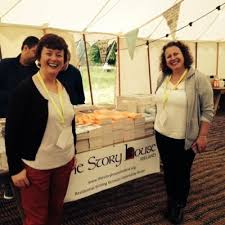
In the wake of International Women’s Day, I can’t help thinking about how many fantastic women there are in literature – not just the writers, but the people who make things happen, especially those who nurture and support other writers. When I was asked to tutor a course at The Story House Ireland, with fellow YA writer E.R. Murray, I was thrilled. I’ve tutored regularly for Arvon, on whose model the Story House is based, and I love the intensity of the five-day residential course. And the Story House was new and exciting.


I hadn’t realised how new. I hadn’t realised how exciting.

As a writer, I meet all sorts of people and am often struck by the energy and devotion of those who work in literature development. Even so, Margaret O’Brien and Nollaig Brennan, who set up and run The Story House, are exceptional. I had gathered from their correspondence that this wasn’t their full-time job and I knew the SH didn’t have a permanent centre, unlike Arvon with its three houses in England, or Moniack Mhor in Scotland or Wales’s Ty Newydd.

Like me, Margaret had gone to Arvon as a student some years ago and been so impressed by its magic that she had conceived a dream to bring something of that back home to Ireland. Arvon believes that everyone has the right to write and its courses provide the balance of nurture and challenge to make that possible. Ireland is full of stories and writers, and there are retreats and writing groups and courses, but there was, until recently, nothing remotely like Arvon. When Nollaig read Margaret’s open letter to President Higgins 
(http://www.thestoryhouseireland.org/single-post/2017/01/21/An-Open-Letter-to-President-Higgins) she contacted her, and together they made the Story House happen. I won’t try to tell the story – the Story House is all about letting people tell their own – but do have a read of it here. http://www.thestoryhouseireland.org/single-post/2015/01/17/I-Am-Afraid-of-What-I-Might-Write-So-Begins-a-Story-by-Margaret-OBrien.

Margaret and Nollaig 

I’ve been to Arvon many times and I have, like many people, a deep affection for all three of its houses. There is a wonderful sense, when you arrive at Totleigh Barton, or Lumb Bank or the Hurst, of both history and the future. These houses have been there for centuries; they have welcomed thousands of writers, and will continue to welcome thousands more. When you know them well, you notice the small changes and improvements – new mugs here, new curtains there – in the way you do when visiting a good friend, but essentially they are comfortingly the same.


But it’s not just about bricks and mortar. My week at the Story House taught me that. Writing For Young People took place in a beautiful old house in County Carlow, which, if anything, was slightly grander than an Arvon house, being a popular wedding venvue. Margaret and Nollaig had leased the house for the week, as they have to do for every course. 
I was impressed, all week, by how brilliantly they worked to create the Arvon atmosphere. It helped that the house was delightful, comfortable and spacious, and the participants lively and enthusiastic. 


Lisnavagh House, Co. Carlow
It helped that both Elizabeth and I, and mid-week guest Patricia Forde, had all had our own writing transformed at Arvon. But the real credit must go to Margaret and Nollaig: but even so, it takes real skill to make such a week run smoothly. Skill, vision, and determination. I was amazed at how these two women, both with their own busy lives, could create and sustain this magic.

I’m so proud to have been invited into the Story House family, and look forward to seeing it go from strength to strength. One day, I hope in the not-too-distant future, there will be a permanent Story House in Ireland, and then those of us who have been involved at this pop-up stage will be able to get together and say, Ah yes, we remember back in the early days…


posh workshop space!


Thursday, 13 November 2014

Back to the Classroom -- NOT about school visits


It was 2011. I was a full-time teacher with one novel published and prize-winning, and another due the following year. I had just signed up for an Arvon YA course with Celia Rees and Linda Newbery, and I was so excited that I shared the information with an acquaintance who was an aspiring writer. ‘Oh,’ she said, ‘I wouldn’t like that, being told what to do. I would never go to something like that.’ She remains unpublished. (And by the way, the course was amazing, and many of us are still friends, with several now published or well on the way.)
all will be revealed...

This isn’t a contribution to the Can Writing be Taught debate: it’s my experience as both learner and teacher that talent can’t be influenced by a teacher or mentor or contact with others, but that many elements of craft and language-awareness can.

I love learning. I was a swot at school and I worked and played hard at university (four degrees at two universities). When writing became a big part of my life, it was natural to me to seek out places where I could learn about that too.

Back in 2001, I signed up for a course called Novel Writing at the local FE college. I had, then, a very rough unfinished first draft of an unpublishable novel, whose progress was erratic because back in those days I used to write ‘when I felt like it’ or ‘when I was inspired’. (Shrieks of silent mirth.) The very first thing the tutor gave us was an exercise in the correct use of the semi-colon. I had a PhD in English and to be honest, I was a bit offended. Surely, I thought, people on a novel writing course don’t need basic punctuation lessons? (OK, more shrieks of silent mirth: I was young and naïve.)

Despite the bad beginning, the course was useful, if for no other reason than that it gave me an incentive to make weekly progress, and introduced me to the importance of giving and receiving feedback. Now, when I meet and mentor aspiring writers I always encourage them to seek out something similar, and I often feel annoyed at their (not infrequent) reluctance. Don’t they know how lucky they are, I fume, to have access to so many courses? I give them Arvon brochures and tell them honestly how my first Arvon course taught me more about writing than a subsequent M.A. in Creative Writing.

Recently I was interviewed as part of an initiative of the NI Arts Council to identify areas of need for arts professionals, and the main thing I could think of was the need for professional development for published writers. There are plenty of courses and mentoring opportunities for aspiring and emerging writers, but anything beyond that tends to be generated by writers themselves, often informally. Of course there must be writers who feel they don’t need professional development, and good luck to them, but I’m sure there are many like me, with a few successful books under our books but no idea how things will work out in the future, who would love to be able to keep on learning. After all, professional ballet dancers take daily classes; athletes train. Yes, of course I learn on my own. Every book I read – and write –  teaches me something. But there is something magical about being in a class, with a wise guide, and other learners to share experiences with.

Books are wonderful, but sometimes you need people. I’m teaching myself the guitar: I’ve always sung but this is my first attempt at learning to accompany myself. I have a reasonable ear, so I wince and try again when it sounds horrible, and I have made progress. After six weeks, when I could play a song all the way through at normal speed without embarrassing gaps while I fumbled for the next chord, I let my stepfather (a brilliant guitarist) hear me. My chord changes were grand, he assured me – but my strumming was wrong. I had been so focussed on the more difficult thing that I hadn’t realised how badly I was doing something equally important. If he hadn’t shown me, I would never have known – even with a lifetime of watching other people play. Even with a good Teach Yourself Guitar book. Sometimes you need people.
sometimes you need people 

That’s why I was so thrilled when, last week, Arvon announced a course especially for its own tutors. I signed up immediately and, given that it’s in January, I’m just praying not to be snowed in, so that I can go and be a student again.