Showing posts with label children's non-fiction. Show all posts

Thursday, 13 November 2025

Pliosaurs vs. AI (Anne Rooney)


Do you like my pliosaur? 

I've posted several times here about AI and how it is making work as a children's author increasingly difficult. I also have a book on AI and its social impact coming out this month. The book was written a year ago — that's publishing lead times for you — so I was not particularly impacted by the relentless flood of AI slop at that point. But now I am. It's harder to find reliable information and, particularly, reliable images to gives to illustrators. The bits of consultancy I do for publishers on other authors' books are getting harder because I can't assume authors have used sound sources. This is all aside from the threat of wannabe writers submitted AI-generated trash to publishers, the pillaging of our corpus by AI developers, and the slow decay of once-nurtured and cherished resources such as the websites of NASA and USGS, now eroding under US policy. 


Is it time to get out? Possibly. Maybe it will all settle down and there will be good ways of producing books in five years' time, or maybe this is the start of something terminal for well-researched and illustrated children's non-fiction.


I can write in ways AI can't and won't for a long time, if ever. It's about seeing connections that will speak to young readers, and knowing what will be funny or fascinating not because it's been done before but because I am human and they are human. 


But it's not just the writing. If the research and picture sourcing become harder, the work takes longer and becomes less and less viable. Publishers aren't about to start paying writers more. So maybe it's time to move on, after 25 or so good years making a living from this thing that I love. Or at least time to diversify further.


That's where the pliosaur comes in. I want to do something that brings together different parts of my life and interests and that can't be taken over by AI. I think I've found it. So — stained glass made using medieval methods (I was a medievalist before I was a children's writer) and depicting the extinct animals and other scientific things I have been writing about for the last couple of decades. If I can't trust children to read, or be able to read, at least — like the stained glass workers of the Middle Ages — I can show them with pictures some of the wonders of the world. 


Maybe I'll never make it work as a job, but I'll have fun trying. 


Anne Rooney

Out this month: The Essential Book of AI, Arcturus, 2025


Friday, 9 September 2022

Writing in a climate of fear

It seems that nearly every book I write at the moment has to end with a spread about the desperate state of the world and humanity and the uncertain future that lies ahead of us. I write (mostly) children’s non-fiction with a focus on science. That means climate change, loss of biodiversity, pollution, extinction and all the other self-inflicted ills of the world are on my agenda. As we reach, and probably pass, tipping points that mean our current way of life is doomed, it’s hard to know how to present this gloomy prospect to young readers.

I can’t ignore them. You can’t write a whole book about the history of life on Earth and fail to mention that we’re heading into a major extinction event of our making. You can’t write about how Earth works as a planet and ignore the rapid climate change that will be catastrophic for many species, almost certainly including ourselves. To ignore this is dishonest and leaves the books incomplete. To acknowledge it and disarm the fear it raises is increasingly difficult, now near-impossible.

Ten years ago, I could write about all this with some hope that we might step back from the brink, do some sensible things that would at least limit the damage. Just before the pandemic I published a book which, by the time it came out, I thought already dishonest in its optimism. (Editorially imposed optimism, I would add.) Luckily, it being published the week of lockdown meant it disappeared without trace.

Book cover: Little People Big Dreams, Greta Thunberg

Hint: making bird feeders out of plastic bottles and putting on a jumper when you’re cold won’t save the planet. It might save some money, in the latest crisis to beset us. But the action we need is political and large scale, and it’s not going to come in time. If at all. The consensus is that you can’t say this to young children. But I’m beginning to wonder why not. I grew up in the Cold War, certain I’d be killed by nuclear war (still possible). My father grew up in the Second World War, certain he'd leave school to be conscripted and killed (it was over before he did). Only the people who grew up in the 90s and 00s have not done so in a climate of gloom. (That is, all the editors…) Young children know all about Greta Thunberg and climate change. She is held up to them as a hero. You can’t see someone as a hero if you don’t know what they’re being heroic about.
 
But it still leaves the problem. What to say in a book that is not specifically about the current situation, but to be complete must mention it. There is not space to go into it and its likely/possible outcomes in depth. Too much information isn’t appropriate either, as we don’t know whether the child reading the book will have someone supportive and knowledgeable to talk to.

humpback whale with calf


I’m not particularly optimistic about our prospects any more, and no longer want to pretend to be optimistic. I’ve noticed editors are no longer doing the knee-jerk ‘can we put a hopeful spin on this?’ We now recognise the ‘hopeful spin’ is just lying. The furthest I’ll go is to say humankind must do a lot of hard and urgent work, make a lot of big changes, to avert the worst outcomes. I don’t think the prospects for the planet as a whole are all that bad, unless on our way down we have a nuclear war. We’ve seen how quickly species recover once we stop killing them. Even huge whales recover quite quickly, despite having long reproductive cycles. The humpback whale population had fallen to 1000 before the moratorium on whaling, and now it’s round 25,000. Quite a bounce-back for just 40 years. Life has flourished at much higher temperatures and higher levels of carbon dioxide than we are threatening to bring. The difference is that the change is happening too quickly for things to adapt. Eventually new species will emerge to populate the hotter world. But, as in previous mass extinctions, there will likely be a few million years of desolation in which only disaster taxa like cockroaches, rats, pigeons and maybe at first a few left-over humans scavenge the detritus of civilisation. That’s not encouraging if you’re eight and want to grow up and have a fulfilling life. There’s no way of putting a positive spin on it. Perhaps the ‘we need to act fast’ line will see me through another five years before even that becomes clearly a lie. Even five years feels optimistic. As I write, a third of Pakistan is under water and California is burning. More and more young readers can see what’s happening because it’s on their doorsteps. We can’t hide it; we need to know how to talk about it.

Anne Rooney

Out now from OUP (no mention of climate change!)


Monday, 20 June 2022

Non-fiction - A Dance or a Poem? by Joan Lennon

A while back, I posted a blog here on how writing non-fiction is a bit like a dance. But lately, as I get further on in my non-fiction writing career*, I've started to think it's maybe more like a poem. In a poem every word has to work hard. You have to pare everything down and say what you're trying to say in as tight, concise and vivid a way as you possibly can. There are boundaries. Constraints.

Wordsworth wrote a lot - there's no arguing about that - and not everything he wrote was perfection on a stick. But in amongst the pearls and the not-so-pearls is a poem about the constraints of writing a sonnet, which begins 'Nuns fret not':

Nuns fret not at their convent’s narrow room;
And hermits are contented with their cells;
And students with their pensive citadels;
Maids at the wheel, the weaver at his loom,
Sit blithe and happy; bees that soar for bloom,
High as the highest Peak of Furness-fells,
Will murmur by the hour in foxglove bells:
In truth the prison, into which we doom
Ourselves, no prison is: and hence for me,
In sundry moods, ’twas pastime to be bound
Within the Sonnet’s scanty plot of ground;
Pleased if some Souls (for such there needs must be)
Who have felt the weight of too much liberty,
Should find brief solace there, as I have found.


Ever since I first read that poem many, many decades ago, I have OFTEN muttered the words 'Nuns fret not' followed by 'I bet they bleep bleep bleep do!' I have never been a nun but, sonnets or not, writers ALWAYS work within constraints. Fret as much as you like, it's still going to be the case. Fiction, poetry, non-fiction - if my experience is anything to go on, we're unlikely to suffer from too much liberty. 

And I'm sure that's a good thing. 

Right?


Talking History: 150 Years of Speakers and Speeches written by Joan Haig and Joan Lennon, illustrated by Andre Ducci.


Or, if you prefer your non-fiction in Spanish, Hablemos de Historia: Discursos Que Cambiaron el Mundo, translated by Victoria Porro.


*The book I'm working on now is only the second children's non-fiction I've ever been involved with - does that count as a career? Am I speaking with admirable self-affirming positivity, or just jinxing myself? Time will tell ...

Joan Lennon website
Joan Lennon Instagram

Thursday, 9 June 2022

Writing for growing toes and growing minds (Anne Rooney)


 Next month I'm teaching a course on writing children's non-fiction (cnf), which is what I write about half of the time. There aren't many courses on this in the UK, though more in the US where cnf has always had a higher profile — largely because schools pay more attention to non-fiction there than they do in the UK. The profile of cnf has risen in the UK over the last ten years or so with lots of really beautifully produced books. One result is that more people are attracted to writing it. On the whole, creative writing courses haven't kept up and still focus on writing fiction, sometimes with a minor component on non-fiction thrown in. Yet children's non-fiction takes a large market share: the books sell, and children like them.

Putting the course together has been fine. But it's been a struggle  finding the extra resources — the books, articles, blog posts, videos and so on to point participants towards for extra advice and info. I've been looking through my stash of books on writing and most assume the reader wants to write fiction, and particularly novels. There are some more academic books on the structure, pedagogy, politics and so on of children's non-fiction but those aren't really appropriate for this introductory course. Most books about writing for children focus on plot, character, world-building, and so on. You could use these in narrative non-fiction, but the course doesn't cover that — precisely because all those things are important to that but not to other types of cnf, so it's a cop-out.


The challenges in writing children's non-fiction are rather different from those in writing fiction. Yes, you still need to hold the reader's interest. But the ways of doing that are often different from how you would do it in a story. The main aim of much non-fiction is not to impart information (which is what people assume it is) but to excite interest and wonder. It's to make the reader want to find out more, do something — or to enrich what they already known with understanding, with putting it into a bigger picture. It seeks to create 'aaaah' moments and 'wow' moments, to show children that knowing things is exciting, empowering, opens doors and will give them satisfaction and pleasure. How you do this is through selecting the right material, structuring  the material, pacing, choice of language and style, integration with images and — counterintuitively — what you leave out. What you leave out in terms of which content you skip (as there is far more to say than you have space to say), but even more importantly in where you leave space for the reader to jump ahead, make connections, use their intuition and imagination. Space to empower the reader. Space for them to grow. Think of the book as like a shoe. You don't want it fitting snugly to their toes or it will only be comfortable for a very short time. You need wiggle room, growing room, space to mould it to their particular shape. I don't know of a writing book that explains this and how to do it. Perhaps I'll have to write one.  But for now, if you know any resources that will help my students with children's non-fiction, please post them in the comments! I've got some, but more will help them.

Anne Rooney

Out now: The Story of Planet Earth, Arcturus, 2022


Wednesday, 20 April 2022

Bluebells and Bats - Joan Lennon

I read Lu Hersey's post about spring and bluebell woods with a bit of a pang. I'm missing spring this year. I was lucky enough to finally make it to Jakarta and am at present immersed in the life of a 3 month old grandson, his parents, their extended family, Ramadhan, a new language (Oh, they say, Bahasa Indonesia is easy. Great, I say. So how do I say hello? Oh, they say, that depends ...), a different culture, and social structures fraught with nuances to get wrong. (I've ended with the tricky bits there, but go back to the beginning of that sentence and you will find the worth-all-of-it-and-anything-else-you-care-to-add bit.)

And I'm currently writing non-fiction for 9-12 year olds about 17th century Ethiopia. I tell my grandson about my research and the fascinating things I have learned, and he listens patiently, as long as I occasionally intersperse gecko imitations. (I am very good at gecko imitations.)

Here, bat bathing (like tree bathing, only with bats) is my 'bluebell immersion time'. I go out on the balcony at dusk and watch them swoop and high-speed flutter against a tropical sky of piled up clouds that harbour lightning, or a round red sun, or trees that become black silhouettes against the street lights.

Scotland, Ethiopia, Jakarta - worlds apart, all in one house.


Joan Lennon website.

Joan Lennon Instagram.

Visit 26 Trees for my poem Day's End and the Banana Tree.


Tuesday, 10 March 2020

Catching the glitches. Non-fiction authors have checking duties right up to the wire - Moira Butterfield


I’ve spent some days the last week working on a non-fiction book that I finished writing nearly a year ago, for the 8+ age group. There’s careful pre-press checking to be done, and it’s a very vital stage of illustrated non-fiction writing.

I've been pre-flight checking my book this week. 

 The book I’m talking about has spread headings, captions and labels that work closely alongside the illustrations, like an orchestra of musicians playing different instruments to create one piece of music. There’s a glossary, credits section and contents spread, too.

An illustrated non-fiction book for the 8+ age range has a lot of different features that work together. 


It’s up to the non-fiction writer to be available at the right time for checking duties leading up to press date. That means consulting with your editor so you are aware when you are likely to be needed, and not disappearing off the grid without warning.

Er...Where did that writer go? 

 I usually get a slightly panicky feeling at this point. Will I miss something? Will I let a big mistake go through that will ruin my book? It’s unlikely, because I won’t be the only eagle eye on the case, but the fear of letting something slip through does concentrate the mind on doing a thorough job.

As a young inexperienced editor I once made a big pre-press mistake. I was given loads of colouring books to organize, featuring characters owned by different Licensors such as Disney and Hanna Barbera. Each book had to have the right copyright notices on the back, but I got some of the Licensors mixed up. This would have been a big deal and would have led to the pulping of the books and consequent costs if anyone had noticed. Luckily I was getting friendly with the young man in the sales department who was responsible for sending out approval copies to the Licensors. He…ahem…omitted to send the colouring books, so nobody ever noticed. I was saved and yes, reader, I married him.But that was definitely a one-time only bacon-saving strategy!

"OK, I won't tell!" 

 In case you also find yourself checking a complicated visual project, here are the most common things that I have found I am likely to spot:

A last-minute art error appearing - Has the artist illustrated something that contradicts the text? I will have checked art roughs and, hopefully, caught anything untoward, but small details could have been added since. For instance, on the space spread I’ve just been checking some of the people are weightless but some appear not to be. Children will definitely notice that, so some judicious seatbelt-type straps will need to be added to figures casually sitting down.

Has some of the text been put in the wrong place? This is a common issue as non-fiction book text can comprise lots of small sections and often, with the amount of work involved the pressure is on and the deadline looms uncomfortably. It’s easy for a section of text to be accidentally placed wrongly at the last minute.

Are the labels near enough to the pictures to make sense? It’s relatively common for them to be misplaced because they’re small and fiddly, and there are sometimes lots of them.

Have I written consistently? In position, text issues can sometimes become suddenly clear. For instance, have I used the same terms throughout? The glossary inevitably gets written much later than the rest of the text and that’s where terms can sometimes accidentally change. Did I say nanobot in that glossary when I’ve been saying nanorobot everywhere else?

Are all the extras correct? It’s perfectly possible for everyone in a team to miss mistakes in the extra material – Headings, contents lists and folios. The author should always take a moment to check them because they’re all too easy to forget.

 My name – I don’t know why but it’s often spelt wrong. I make a point to check the spine, where a weird version of it may well have slipped through.  

How hard is this name? It's surprising! 


It’s a very good idea to do this checking process in a calm state without kids running around or people wandering in demanding your time.

This will never work!


Finally, remember this - All will be well and, even if something small did slip through, so what? It can be changed on a reprint and, really, will anyone even notice or mind?

The book will be born and it will be marvellous. Fingers crossed.


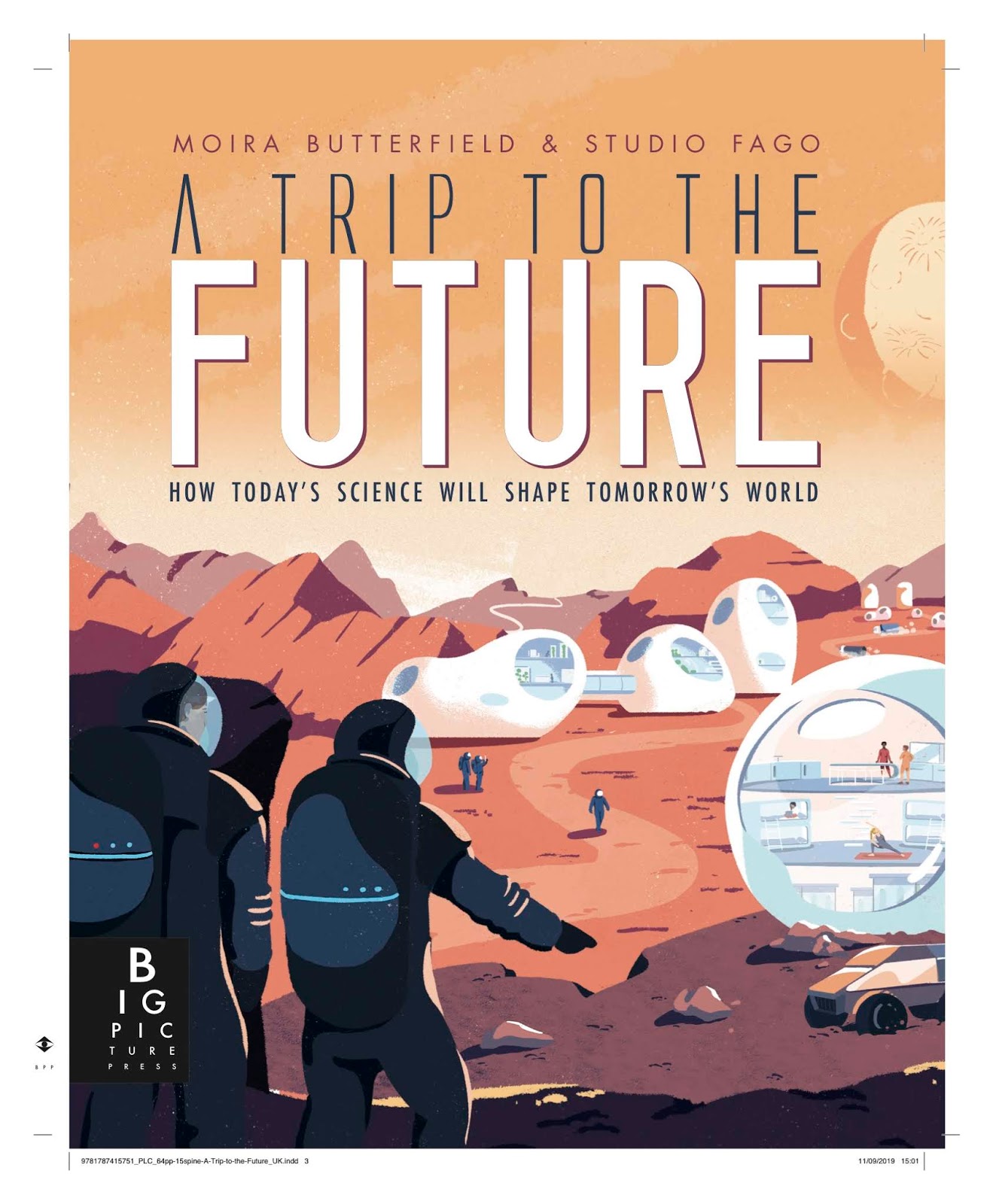
I have been ‘preflight checking’ A TRIP TO THE FUTURE, published by Big Picture Press in July. It’s my shot at inspiring the scientists and inventors of the future.

See you in July! 


Moira Butterfield
Twitter @moiraworld
Instagram @moirabutterfieldauthor 


Sunday, 10 November 2019

Writing non-fiction? Have a meeting with your editor and designer. Moira Butterfield

If you are writing a non-fiction book and you have sold the idea, I’d strongly recommend meeting up in person with your editor and designer. If you can’t – and many of us will be too far away to get to London - I’d try to organize a Facetime session.

I went up to London this week (where inevitably the publishers are based). It cost me a wheelbarrow full of gold but it’s worth every penny to do it if possible (I try to make the trip more cost-effective by planning in an exhibition to see on the same day, if I can – In this case the highly recommended Living on Mars at the Design Museum).

The current cost of a train ticket from Bath to London 


I am about to write a non-fiction book in a pressurized timeframe. I wanted to be sure that the team I’m working with are all on the same wavelength as me.

We discussed the content of the book– already planned but not yet in visual form. I went with specific questions for the designer. How did he think we should approach introductory sections? What kind of features should I build in to the text? In this case we agreed we’d add some cutaway illustrations, which means me providing labels. We agreed on some big images and some much smaller ones, to make for a lively magazine-style layout. I’ll need to be keeping this in mind when I write.

I won’t want to be giving the designer far too much text. That’d be difficult to work with, but equally too little text won’t be ideal either. We’ll need to get it ‘just right’, which means working together on a section ASAP to fix some word counts and features such as chapter headings and sub-headings.

We looked at some artist choices, and our discussions about the way the book would look led us to a choice we all loved – Someone who can do people, landscapes and machines equally, and who won’t be phased by a highly-planned spread. It’s also someone who doesn’t look too retro, because our book subject is very current. Fingers crossed our choice says yes but we have some back-ups, too, thanks to our meeting.

We also chatted about general non-fiction sales feedback the editorial team had been given. That was very interesting and helpful, and not something I would have heard about otherwise.

Finally – and most importantly - we went over the reasons why we are doing the book. They are deeply felt and shared by everyone round the table. We believe in the concept of the book.

I came home feeling that we were a strong team and I hope they did, too. I felt ready for the challenge and excited that they were excited.

Ready, team? Ready! 


Now it’s up to me to write, but I know I have a strong foundation on which to build.

Moira’s non-fiction book Welcome To Our World (Nosy Crow) has been chosen in The Sun and the Mirror as a top gift book for 4+.  Her book on homes around the world has become a bestseller in the US this year– Home Sweet Home (Egmont in the UK. Kane Miller in the USA).

Moira Butterfield
www.moirabutterfield.com
Twitter @moiraworld

Instagram @moirabutterfieldauthor 

Saturday, 10 August 2019

Why Terry Deary is wrong about authors Moira Butterfield

Horrible Histories author Terry Deary has been slagging off books and authors again, suggesting to the BBC that all other authors (but him) are privileged idiots. The BBC printed it all without question, so I’d like to refute a few of his pronouncements here.

"The problem with non-fiction books is they're written by experts who wouldn't know a child if it jumped up and bit them on the kneecap," he says.

In fact children’s non-fiction authors are professional writers. Their careers are based on being skilled at writing for an age-group.  Many have teaching experience. Many have kids. Some visit schools. Many also write novels and short stories. I know this because I belong to a large discussion group of children’s non-fiction authors from around the country (Nibweb). Mr Deary doesn’t. 

In fact non-fiction is having a bit of a golden moment, with amazing artists being put together with imaginative authors. (I don’t think he’s noticed).

"In the publishing industry, I'm a fish out of water," he says. "I don't do literary festivals. And I don't mix with the literati."

Who is this literati? Do we have one in children’s books? It seems to me we’re all pretty inclusive and supportive, and we can contact each other easily. I've found so, anyway. 

"I only know one northern children's writer now," he says - singling out Skellig author David Almond.

Lots of authors I know come from the north/live in the north. Does he mean ‘write with a northern voice’? He doesn’t seem to do that himself.

"There are 100 southern middle-class women [writing books]. And it's business. Southern middle class girls read books. So the publishers publish books for them. Northern working class lads don't read books, so why bother publishing books for them?"

I know there are kid's authors who travel round northern schools and get a great reception. He's really stereotyping northern kids here, isn't he. 

By the way, about half of the Nibweb non-fiction writing members are male. There are also single parents and carers, and we’re not dilettante posh folk. There are all kinds of people, in all kinds of situations, doing their best to write fiction, too. There are men doing it, despite what he says. 

Many of us non-fiction writers have been fighting for years to get non-fiction valued in schools and in bookshops because we knew that some children love it (yes, some boys, in particular). We’ve carried on in the face of low payments and tough income choices. Bring a non-fiction author is most definitely not a cushy number financially. It’s pretty tough, to be honest. I’m certainly not driving a new car…. Given the overall author income figures we have recently seen writing is not a 'middle class' choice as a career, I don't think. Wouldn't it be great if we got some support from Terry Deary? 

I’d say that overall in kid's publishing people have been working really hard to try to get books out there for the ‘non-readers’ he mentions. People have also been working really hard to get diversity into books of all kinds. And I know from reading the blogs that authors are deeply engaged in trying to open up school visits to every kind of school, and generally in the politics of education. Children's authors are also very engaged in supporting each other. So, although the children's book world is by no means perfect, I find it a vibrant forward-looking place. 

But Mr Deary says he doesn't mix with authors and he doesn't read books, so I guess there's quite a lot he doesn't know about - and a heck of a lot he's missing. That's a shame because he gets publicity and he's in a position to help. 

Moira Butterfield
www.moirabutterfield.com
Twitter @moiraworld
Instagram @moirabutterfieldauthor