Showing posts with label author visits. Show all posts

Saturday, 13 May 2023

My Awfully Big Book Club Adventures by Sheena Wilkinson

Book club fiction. I’ve heard the phrase used with a sneer, usually by people, by which I suppose I mean men, who seem to think it denotes women’s, and therefore, in their eyes inferior books. 
                                                              

The first time I heard it used was by my agent, a few years ago, when I first told her I wanted to write adult novels. What sort of novels? she very reasonably asked. I struggled to explain. I knew it wouldn’t be a romance, or a psychological thriller, or a police procedural or any of those handy genres. 


Sort of intelligent, I said. But not pretentious. Thought-provoking. But not experimental. Accessible. Just a – you know – a novel novel. A good story. Well-written. The sort of thing I like to read. 


Ah, she said wisely. You mean a book club book.


That’s exactly it! I said. 


But I struggled to write one: for five years, and two full-length manuscripts, amounting to perhaps twenty drafts between them. These novels were not bad. I would go so far as to say they were quite good. But nobody wanted to publish them. Editors used words like stylish. (But quiet.Elegant. (But quiet.) Beautifully-written.(But quiet.) 


Could you make it more like book club fiction? they suggested helpfully. We know what to do with that. 


Clearly I did not. Maybe it was because I’d never successfully stayed in a book club for more than three books’ worth? Much as I love reading, I’d floundered every time I tried to stick with a group, because if I don’t like a book I never persevere with it. It becomes too much like work, when there are so many books I want to read. Yet I hated being the one who hadn’t read the book. Perhaps if someone started a specific book group – the Mid-Twentieth Century Middlebrow Domestic Novel Book Group, perhaps. Or the Novels Set in Schools Book Group. Or the We Promise There Won’t Be Any Fantasy or Magic Realism Ever Book Group. Then I could commit. 


But when I came to write Mrs Hart’s Marriage Bureau I had an instinct that this book – at last! – might prove popular with book clubs. Its feelgood feminist tone, its blend of wit and grit, above all its sense of community and championing of strong female characters might finally hit the sweet spot? I suggested to my publicist at HarperCollins Ireland that we should run an online competition where one book club could win copies of the book and a visit from me – real or virtual depending on location. I felt rather odd, offering myself as a prize, but as they say in Yorkshire, where the novel is set, Shy bairns get nowt. And as long as one book group entered, it wouldn’t be too embarrassing.


Well, lots of groups entered – phew! The winning group was the Belfast-based St Dominic’s Book Group, which has been going for twenty years. Weirdly, I knew one of the members, the poet and memoir writer Maureen Boyle. As we made arrangements for my visit, I decided to contact the other nearby group who had entered to offer a visit to them too. They hadn’t won the free books, but decided they’d be happy to buy the book and have me visit. Some friends in book groups said they might do it, and would I be able to come? The book group in my old village invited me back for old time’s sake. Another group won a voucher for a visit at my book launch. A former colleague organised an event with three of her local groups. A schoolfriend’s sister contacted me: If you’re ever in Worthing… A London friend, whom I’m going to stay with in the summer when I attend the Romantic Novelists' Association conference, said her local group would read Mrs Hart and have me as a guest if I was prepared to be paid in wine and crisps. I’m being paid, I reassured her, by the fact that some people who wouldn’t otherwise have heard of me are going to buy and read my book. 


Somehow I ended up with nine invitations. So far I have been to meetings in houses and halls, in a yacht club, a book shop and a pub. I have been given flowers and notebooks, travelling expenses once, a tote bag, and a lot of tea and cake.
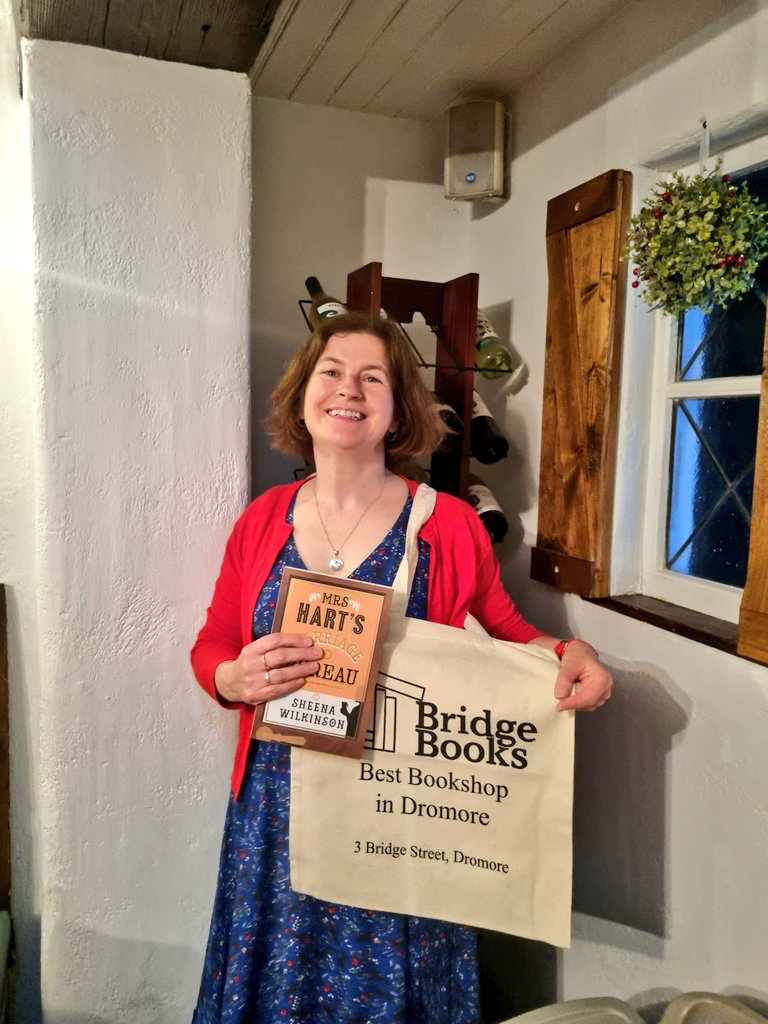

I have met many women readers from 20 to 80-something, and one man. And before anyone says I shouldn't be doing this more-or-less pro bono, let me say: This is not the same as a fee-charging festival paying writers in ‘exposure’: this is a mutually beneficial, informal arrangement between readers and writer. Like the novel, it’s about community and connection. I know perfectly well that people are buying and reading the book who might otherwise not have, and in return, I hope, they are getting the novelty of having the writer to tea. 

Of course, there is always the risk that they hate the book… So far that hasn’t happened, but it's been fascinating to listen to people's discussions: I totally saw that coming. Oh, no, I didn't! I didn't feel I got to know Martha. Really? I felt I knew her very well. And so on. 


In the next few weeks I'm going to be in two Belfast book clubs, one in Worthing and one in London. Who knows where else? 


Wednesday, 28 October 2020

Zooming into the (near) Future! A few tips for online school visits by Saviour Pirotta


Like many authors up and down the country, I rely on school visits and festivals for a good chunk of my income. Lockdown started almost at the end of my event bonanza surrounding National Book Week back in March. My last appearance was at the fabulous Pink Pig Farm in Brig. I spent a very happy and productive weekend with fellow authors and Mel and Nick, the wonderful owners of the Rabbit Hole bookshop.  We told stories, read from our work, signed books and tucked more than we should have into Pink Pig's state-ot-the-art cooked breakfasts.

    Fast forward a week and my inbox was flooded with emails cancelling bookings in the summer term. Luckily, I was about to sign a new four-book deal with independent publishers Maverick so I knew I could keep my head above water for an extended period of time. Schools were soon asking if I would do online sessions, though, and the agencies I work through started looking into the possibility of supplying them. I was hesitant at first. I hate the sound of my voice and don't really like how I look on screen or in photographs. In actual visits, I forget about these trivialities like this once I get into the pace of things but, on zoom or whatever, there is no way of escaping the vision of my gurning face. 

    As the summer wore on and it looked like actual school visits would not be happening till 2021, I forced myself to 'snap out of it' as Cher said in Moonlight. I've actually done quite a few visits, culminating in six sessions with a school in Shanghai last week and two events of the East Riding Festival of Words. I can't claim to be an expert on the subject, but here's a few tips I picked up which might prove useful to other members of the SAS.


1.   THERE'S MORE THAN ONE PLATFORM

In the media you read and hear mostly about zoom but there are alternatives. The education authorities in the East Riding of Yorkshire, for example, prefer to use Microsoft Teams. It's something to do with privacy issues. I've also done events on Google Hangout Meets and Skype. They're all more or less the same but do check with the schools what platform they are using so you'll have plenty of time install on your computer and get familiar with it.


2. TO RECORD OR NOT TO RECORD.

Some schools insist that you do not record the session and some ask if they can. I always refuse to let the session be recorded, partly because of privacy issues but mostly because I want the repeat business. I treat my sessions as actual in the flesh visits, except that I'm looking at the kids through the window of my mac. Recording the sessions destroys that unique 'in the moment' experience.


3. WILL YOU HOST?

Most of the schools organise and schedule the event themselves but a few asked that I set it up myself. If they go for the second options, it is very easy to set up. You just schedule a meeting and the platform gives you an event id which you send to the school. Come the hour and the moment, the school logs in and you just click on the accept the invite button. Easy peasy.


4 IS THAT THE TIME?

If you are doing an international event, make sure you check what time you need to log in. My Shanghai events were schedulted for 12.15 their time. Which meant I had to get up at the crack of dawn to be ready for 6.15am our time. Checking everything was set up at 5.30am I realised I might disturb my elderly neighbour whose bedroom shares a party wall with my office. I hastily decamped to the kitchen where I could howl, crack jokes and generally create a rumpus without waking up the neighbours.  


5 CHECK THE BACKGROUND

My hasty retreat to the kitchen necessitated a quick tidy up. Make sure you check the background before going live. This is the perfect opportunity to display artefacts relevant to your subject and show off your new books. I do this using the photobooth app on my laptop but obviously, you can use any camera that will show you what the audience is going to see.


6 IT TAKES TIME...

...as in, this is new territory for most of us so it will take a while to find out what works for you. I love doing writing workshops in actual visits but I couldn't get them to work online.  Ditto with storytelling. I need to be in the same room with the audience for the latter to work as I pick up on the kids's vibes to help steer my delivery. This is nigh on impossible if the kids are just a fuzzy image on a screen. I now read a couple of chapters from the book I'm promoting, talk about the background to the story and how and why I wrote it, and finish off with time for a Q&A.

7 SEEING IS BELIEVING

Larger festivals often host a prep session before the event. Most of the authors participating join in with these and they're a good way to find out how others approach their events. One or two organisers said the audience would not be visible during the entire session and that any questions would be put forward through the chat function on the app. I found not seeing the audience hard going but answering questions that appear in the chat box quite easy. Make sure that you discuss your preferences with the event organiser so that you can relax and concentrate on giving your best performance.


I hope I haven't been teaching my grandmother to suck eggs, as the saying goes. Good luck with your online sessions. Although I just can't wait to start visiting schools again, I plan to keep online sessions to reach places I can't access otherwise. It's a brave new world out there. Let's meet it with confidence.

Saviour's latest Early Reader, Samira's Wish, is out now with WackyBee books. His third instalment in the Wolfsong Series, The Mysterious Island will be published on the 21st January 2021.  Follow Saviour on twitter @spirotta and on Instagram @saviour2858.


Saturday, 17 February 2018

My Manic Schedule during WBD by Chitra Soundar

Every year schools across the world celebrate World Book Day, which this year falls on 1st March 2018.

Most schools (not all) decide to celebrate books and reading during this time of the year and on the day itself, children and often teachers dress up as book characters too.

For writers like me who go into schools to talk about writing and reading for pleasure, this is the busiest period of our annual schedule. I wrap up all my writing the week before the World Book Day and I cannot get back to my desk for almost a month.


It is amazing to visit schools, to meet with children and introduce my stories to them. It is heartening to see how schools practice reading for pleasure and incorporate books into their daily lives. Often the teacher or librarian (if the school still has one) who organises these events is doing this over and above their day job.

However many writers like me do wonder if there are alternatives to this adrenalin charged 2-3 week period of WBD tour most of us embark on. So if you’re a teacher or a librarian who organises events for schools, maybe some of these other ideas might appeal:

a)    A Day a Term – perhaps it would give a lot of focus and help with planning if there was one day in every term focussed on books and reading for pleasure where the school can come together. Or this could be a week.

b)    Alternate Days to WBD – As a writer from Asian background, I pulled together a list of dates where it would be lovely to bring in authors and books from different perspectives. Click here to download. 


c)     Virtual visits – some of us visit schools via Skype too. But it is tough to do virtual visits during the same week as WBD celebrations. Planning ahead will help you get both paid and free events with a multitude of authors into your schools. Check out Virtual Authors here.

d)    Patron of Reading – as Patrons of Reading, we visit our schools 3-4 times a year and use a whole day to connect with children about stories they love. Find out more here.

As a children’s writer, one of the biggest rewards of the job is to be able to go into schools and meet with children. It is a way to connect with our audience and also share the love of stories and reading. It is fabulous when we can inspire new writers and storytellers.

But it would be good that we can do this all through the year and not just during late February to early March. We do love to get away from our desks, washing-up and filing other times of the year too. So ring me right after Easter and we can get plan a school visit.


Are you a writer or a librarian or a teacher who has a different idea? Do you already do something amazing in your school that involves author visits but on different parts of the year? Tell us about it in the comments below.

Friday, 28 April 2017

What degrees do you need to have to be a writer? - Clémentine Beauvais

That's one question I often get asked by French teenagers. It's not entirely surprising: the French education system, French society in general, and the French middle-class in particular, is absolutely obsessed with diplomas, qualifications, school rankings and fine distinctions between different types of degrees that determine your worth in the eye of the rest of your social sphere.

the complete mindf*** of the French higher education system (source) - graph already far outdated as it changes roughly every Tuesday
I generally reply that you don't need any degrees at all, that many authors don't have a baccalauréat (A-Level equivalent), that many haven't been to university, that plenty have seemingly entirely unconnected degrees - business, physics, geography, sports science - and that the Most Important Thing is that you enjoy writing and probably that you encounter stories in many different media, including through books.

Except, of course, high school students are not stupid, and they can see very well that the vast majority of children's authors they encounter have another, 'main' job which is very likely to just so happen to be one of the following:

- teacher
- librarian
- school librarian
- university lecturer
- book seller
- kindergarten teacher
- some other teaching thing
- more library-related stuff
- special needs educator
- some education-related stuff to do with books
- some book-related thing that has something to do with education

etc. Some, to be fair, are editors, freelance editors, publicists, or journalists...

I'm exaggerating, of course, but the situation is indeed comical: at book fairs, 'we' writers mostly talk about our books and our... students. Put two writers together and they'll doubtlessly talk about their teaching. 

So I like to rephrase that question. You don't need any degrees to be a writer, but most writers you meet are very likely to have very similar degrees and indeed quite similar professions. 

And then we think about it together. Why might it be that writers are so attracted to teaching? Or is it that teachers become attracted to writing? Or are both correlated with something else? What might that be? Does doing literary studies help you become a better writer? Or do you do literary studies because you're already interested in all things literary? Are all teachers frustrated writers? Are all librarians frustrated writers? Are all writers frustrated librarians?

Is your teacher secretly a writer?

(All gazes turn to the teacher, who generally vehemently rejects the accusation.)

Turns out diplomas don't matter, but you can still sneak in a lot of interesting sociological reflection. Including, if you want to push it as far as that with a dynamic group, why those 'other jobs' that writers do are so often, well, extremely middle-class (it's particularly striking in the French children's literature landscape, I think, though the term 'middle-class' has no easy equivalent in French). Cue reflection on what the writer-teacher-librarian association might, well, teach us about the social and cultural politics of writing and publishing today.

Then the question is answered by more questions being raised.

So I feel like I've done my teaching duty, and put my degrees to good use.

Tuesday, 28 March 2017

School visits here and there - Clémentine Beauvais

I took part last week in a semi-academic, semi-professional conference, organised by the University of Lyon, on author visits in schools, and I thought I'd sum up my paper here.

The school visit by children's authors has never really been (as far as I know) theorised, even though there are plenty of practical texts on the matter, as well as many testimonies by authors, children and practitioners. One interesting thing about school visits from a theoretical perspective is what the norms and expectations surrounding the 'usual' author visit can tell us about perceptions of reading, book-consumption, the status of the author, or the space of the school in a given context.

My talk was about the 'typical' British school visit - a very weird format from a French perspective, just as the French format is very weird from a British perspective.

Here are the main differences between school visits normally in Britain and in France (I insist on 'normally': there are, of course, many exceptions in both countries, but there are norms in both countries, and they more or less coherently construct and frame the 'genre' of the school visit). So, normally:


I'm sure you can already see what each configuration tells us about the radically different ways in which author, reader, book and school are positioned in those two national and cultural contexts.

The author in Britain is placed in the position of an actor and a promoter: s/he generates most of the content of the visit and is in the centre of a spectacular situation in the etymological sense of the word:


Meanwhile, the author is France is very much in the position of an authority, whose secret knowledge has to be 'unlocked', for the whole hour, by the children's questions:


The reader is placed in a different situation, too, in each context.

In the British context, the reader is always also addressed as a consumer, or potential consumer, of the book, which is ready in the room somewhere to be bought; spatially as well as temporally, the school visit is oriented at least to some degree towards the book sale.

In France, conversely, the reader is always also addressed as a student of the book. Since selling anything in the school, or doing any kind of advertising is strictly forbidden in France, there is no space or time for the act of buying the book during the visit. Instead, the child reader must show that they have read and studied the book well, and the teachers' preparation in this respect is crucial.

This means, too, very different implications as to why the book is good, or what it is good for. The British school visit sets up the book as a product to be acquired for the pleasure of the child, should the child's choice be to acquire it after being convinced by the author visit.

In France, there's no such emphasis on either the child's choice, or indeed pleasure; it's the teacher whose choice it is to make the class study this book rather than another, with pedagogical considerations at stake (which doesn't mean that it's not pleasurable).

While this may seem a 'good' thing for the British school visit - and indeed, reading for pleasure is hugely valued in Britain in a way that it isn't in France - it also means that in Britain the book is very much positioned by the event of the school visit as a commercial product. And the pressure to buy it is strong for parents, which isn't unproblematic from a sociological perspective.

Finally, the space of the school is invested differently by the two types of author visit. In the British context, the author visit can be understood as partaking in the use of the school space as, on the one hand, a place of discovery, pleasure, fulfillment, creativity - values much more developed on this side of the Channel than in France. But, on the other hand, the author visit also partakes in the use of the school as a place where the values of consumerism are transmitted, in a more or less tangible manner, and cultural goods are treated as products almost like any others.

In France, the author visit is inscribed within the rather unitary use of the school as a space for learning, pedagogy and the glorification of a certain type of culture, chosen by established wardens of that culture: teachers.

I'll stop here (I'll probably write it up as an academic paper soon). It's worth mentioning that there are yet other models of school visits in the world; as another paper by French academic and author Bernard Friot showed, the German author visit generally consists of a long reading, followed by a Q&A, for instance - not a norm for either the Brits or the French.