Showing posts with label attics. Show all posts

Sunday, 18 February 2018

The Haunted Attic by Lu Hersey

Moving is traumatic. I know, because I moved this week. For me, the trauma wasn’t so much about the upheaval or change of neighbourhood –  it was dealing with the bodies in the attic.

Not my attic - way too interesting...

Somehow the loft had accumulated a number of dead relatives, and I had to clear everyone out. There weren’t any actual bodies of course (sorry to disappoint) - I’m talking about family history. Sentimental attachment. Guilt. More guilt. People’s entire lives in a few boxes.

I hate dark, spidery loft spaces, and have a fear of death by falling from a loft – so over the last 20 years, I’d been shoving things up there just to get them out of sight, thinking I’d deal with them later.


Bad idea. The day comes when you have to confront them all, and that time is when you move house. The loft had to be totally emptied, so I was forced to clear out the ghosts. All those things you get landed with when people die, the detritus left from other people’s lives.

Years ago, I had to translate a chunk of the Anglo-Saxon Chronicle from the reign of Alfred the Great (an interesting man, who didn’t just burn cakes) as part of my English degree. It was about a visitor to Alfred’s court from somewhere in Scandinavia, telling them about the customs of his people.

King Alfred

When someone died in his community, all the dead person’s possessions were piled up in a big heap in the middle of the village. Then everyone raced to take what they wanted before the rest was burned. Alfred probably recorded this to make a point to his courtiers - that inheritance isn’t a foregone conclusion.

However, since King Alfred chose not to introduce this custom over here, we still end up dealing with our dead relatives’ possessions. If we’re lucky, these will include useful things, like treasure and property. Sadly, not in my attic. 

My grandmother was up there, confined to a box of photos of her family, a moth-eaten patchwork quilt, a horseshoe from her wedding cake, a few sad letters relating to the death of one of her children, and more on the death of my grandfather. My grandfather was divided between the photo box, and a collection of watercolours in varying degrees of awful.

An unknown dead relative from the attic, and his horse

 My mother took up a lot more attic space. After my father remarried, I got landed with all the photos ever taken of her, her books, all her dreadful paintings, and a collection of letters (which I’ve never read) between her and my father when he was away on National Service.  And all the letters she wrote to me when she knew she was dying. 

My mother with me, a long time ago...

So what we’re talking about is a lot of things you can hardly bear to look through, and leave you feeling like an emotional wreck when you do, but you feel obliged to keep. It’s all that is left of them. And that makes it very hard to get rid of.

Worse, my dead relatives were just the tip of the loftberg. There were all the paintings my children did at school. Four children can do a lot of paintings over the years. And they get a lot of school reports and bring home a mountain of school work. Two very large boxes and a trunk’s worth to be precise. Fortunately, my two youngest showed up to laugh at their old stuff and share the best of it with their friends online, and we managed to more than halve the quantity after some harsh quality control.


Lastly, there were the ghosts of my own past. Photos of people I’d forgotten existed, letters from old boyfriends, and piles of folders of ‘ideas’ (mostly pieces from magazines and old journals, all yellowing around the edges, and frankly the easiest thing in the loft to bin.) There were old computers I thought might still hold info I needed, old tvs that ‘might come in useful’, and tins of paint. Enough to paint entire mansions in a range of out-of-date colours.

My stuff was the easiest to deal with. I junked it all, entirely guilt free because it was mine to junk. My relatives were the real problem. In the end, I squeezed them into a few boxes, and the charity shop benefitted from the rest. Maybe other people will like the some of the terrible paintings. I thought about burning all my parents’ letters, but my youngest daughter persuaded me to keep them. So now they’re in a box marked ‘archive’ – and they’ll become her problem one day.  

But part of me is still tempted to dump all of it. Along with all the guilt and the sadness. As it is, I’ve spent much of the last year writing a book about people in a Mesolithic type environment who aren’t overloaded with stuff. In fact they own nothing.

It’s been very therapeutic...


Lu Hersey

Tuesday, 12 January 2016

Books in the Attic - Ruth Hatfield


Someone very kindly bought me four pony books recently. They were set in a riding stables where nobody went anywhere or did anything except prepare for various riding school shows. Closed in. Safe. Supervised. The writing was pedestrian. The stories were pedestrian. It was terribly depressing. 

Yet I know that there are some fantastic modern pony books, exciting and well-written (many by Sassies, indeed…). And I also know that as a child, I read my way through a vast swathe of pony books, indiscriminately enthusiastic about most of them, not caring about how they were written as long as they had horses in them. I did ride, but in a riding school, so pony books supplied me with all the experiences I couldn’t actually have – riding off on my own, leaping five-bar gates, going on desperate rescue missions where I could gallop over the countryside and not be told off for trespassing. They let me spend huge amounts of time just looking at horses, which I wanted more of in the world. I’m guessing pretty much the same sort of thing applies for the children who read them today.

This got me thinking – if I revisited my old pony book collection, would I find that most were also just the horsy equivalents of Enid Blyton? (I’m not being snotty about Enid Blyton – I loved her books as a kid, but as an adult I do find them a little bit tedious…). My dad disinterred a box from his attic, and I got stuck in.

It felt as though I was shovelling soil out from a shallow grave of dreams. A ghostly choir sang the Black Beauty theme tune. The familiar cover of each deeply-loved book sparked flames inside me. These weren’t just books – they were the places I’d lived in my childhood – the golden fields of the Pullein-Thompson’s Home Counties, the moors of Vian Smith, Ruby Ferguson’s Chatton, the wild praries of the Silver Brumby, the streets of Siena before the Palio. The Highlands of Scotland, with Jinny Manders and her Arab mare, Shantih.


In some ways my fears were realised. It was an interesting experience to read a range of books that I’d loved as a child, and to realise that some of them were pretty mundane (anyone remember the Jackie series? Or the ones by Pat Smythe in which she is one of the characters?), some were well-written and completely horsy (Pullein-Thompsons, Ruby Ferguson etc.) and some were so absolutely brilliant that I almost wished they weren’t about ponies, because they deserve to reach a much wider audience.


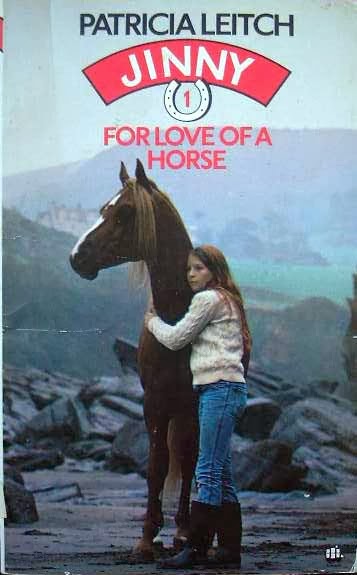
When I opened up the first ‘Jinny’ book, For Love of a Horse by Patricia Leitch, I couldn’t believe that these books had sat in the attic, unread for years. They aren’t just fuel for the pony dreams of teenage girls, although there are elements of that in the boundless moors and the classic partnership of headstrong girl and wild horse. They are beautifully written – much more engaging to me than the classic Alan Garner stories which I read recently – I struggled to picture Alderley Edge, but after a single re-read of a Jinny book, Finmory and the purple heather of the dark moors lay clear in my mind’s eye. 


The Wikipedia entry for Patricia Leitch compares the Jinny books to the Dark is Rising sequence by Susan Cooper, and I’d say this is a fair comparison – they do have fantasy elements, occasionally. In the fourth book, Night of the Red Horse, Jinny encounters archaeologists searching for an ancient figurine, but the mural of a red horse in her bedroom has other plans for it. But they are also grounded in reality. Jinny frequently does terrible things as a result of her obsession with Shantih – (spoilers alert) in the early books, she overjumps the horse and lames her, and she betrays the presence of an osprey nest to an egg-collector, because she wants help from them to train Shantih. Other characters are by no means easy to place as heroes or villains – Brenda who wilfully neglects the horses in her riding school, but who used to be as full of dreams as Jinny, Miss Tuke who runs the trekking centre and who is unromantic and insensitive, but nevertheless sensible and practical. 


I read them and marvelled – so often in these books, nothing is simple and the reader is encouraged to form their own view about what’s going on. Relationships between humans and animals are described in romantic and unromantic, partial and impartial ways. Jinny is entranced by the wildness that the horse represents, but in the way of most humans, her love becomes an obsessive desire to capture, possess and essentially subdue that wildness. It’s not a rosy picture, and it’s an uneasy truth that children’s books, particularly pony books, rarely confront: when people form relationships with animals, the animals are usually subservient, no matter how deeply they are loved and understood.

These are clever books. They’re pony books. I wish they weren’t, because the mere fact of them having a horse as one of the central characters might, in a genre-bound book world, serve to turn some readers away from them. Even if horses really aren’t your thing, the Jinny series might well be. Beautiful writing, wild fantasy, sodden reality and a cast of opinionated, strong-willed characters all trying to carve out the lives they wish to have. What more could anyone want from a book?

I’m about half way through the box of pony books now, and I haven’t even begun on the Black Stallion series by Walter Farley, or the Silver Brumby books by Elyne Mitchell, both of which I remember absolutely adoring a couple of decades ago. And in among the pony books I found a whole chunk of Joyce Stranger’s animal stories. I’m going to carry on with this quest (probably interspersing every other book with a quick fix of Pullein-Thompson Pony Clubbing) – it’s getting to be an exhilarating ride!