

A reappraisal of Faerie Tale, by Raymond Feist
You know how it is? At a certain point in your life you read a book that later, you vaguely remember might have been an influence on your life and creativity? And so you choose to go back to it to see what all the fuss was about. Quite often, of course, it proves to be a damp squib, a shadow of what you remembered.
But there are those times when the sheer thrill of the first read comes back to you all over again. Not only is it all there as you remembered, but there's so much more - so much so that you want to tell everyone about it.
So here goes!
Imagine the dark woods. Imagine the creepy
house with a history of bargains and secret cults. Imagine the company of the
fey waiting at the top of Erl King Hill, and imagine that they are soon to
leave, as their season once more comes to an end. The fair folk make rare
appearances nowadays, maybe once or twice in a hundred years.
But there is a treasure buried on the land, one
of gold coins so valuable that a few of them alone are worth a small fortune. How
did they come here?
Deep within the cellars of the house is a secret room, which, when opened, reveals a safe full of seemingly
indecipherable documents, some in languages so ancient they have almost been
forgotten.
Despite the presence of two rival courts of
faerie and the traditional opposition of the good queen and the evil king, all
might have been well if the secret room had been left untouched by the new
owners of the house.
--or
if they had not destroyed an old pledge by digging up the hidden treasure.
But there is a spirit out in the forest who
wants the treasure to be dug up, and who wants the old pact to be broken. To do that, he makes sure that the hidden key to the locked room – is found.

So far, so trope, you might say, and turn to something you like the sound of more. But then you’d be missing out on two things; an astoundingly good book - which just keeps on surprising and manipulating the form - and the fact that it is written by a hugely respected writer of fantasy fiction. This book, then, is a one-off, in more ways than one.
The simplicity of the title, Faerie Tale, belies the book’s depth
and complexity, let alone the fact that it was written by renowned fantasy writer Raymond E. Feist,
author of the classic ‘Rift War’ saga and much more besides. Feist wrote it in
1987 and he has never written anything else remotely like it since.
Sometimes writers take a leap into the dark and experiment
with something new. Quite often, depending on how satisfying they might find
the experience, or how well it might be received, they may never choose to leap
in the same direction again!
But, for me at least, if you decided to write a one-off
novel about faerie, you’d be pretty hard-pressed to better this. Here are a few
reasons why.
 |
| A few nice gold doubloons |
*Faerie Tale is a genuinely scary novel, which treats its
subject with great respect. It has believable characters caught in impossibly
deadly situations, having no idea at first why this has happened and how it can
be resolved.
*The location, especially the house, Erl King Hill itself, and the Troll Bridge, under which the terrifying ‘Bad Thing’ lurks, are powerful, eerie and evocative and in the case of the bridge, make you want to hurry your steps over it as possible.
*’Faerie Tale’ is based on already powerful old tales, which include the warring faeries of Shakespeare’s A Midsummer Night’s Dream’, the chilling tale of the Erl King himself, the border ballad of Thomas the Rhymer and the Norse tale of Wayland Smith. At no point does the author show any sign that he doesn’t know this material absolutely and has full control of it.
 |
| Arthur Rackham's 'Titania Asleep', (but it's the fact that Puck is lurking in the background with the 'Love in Idleness' juice that really matters!) |
*Of the many similar books that I have read, Faerie Tale carries an almost constant creeping dread entirely in keeping with its subject and plot - a combination of foreboding, but also foreshadowing. The sense of foreboding initially grows over it like a shadow, one which which eats gradually at the characters, their grasp and understanding of what is reality. The second acts more like a future ghost haunting the reader with what might be to come.
*Faerie Tale is always asking questions of us as
readers, as well as its characters. It is a novel which encourages questions,
but especially on those subjects about which we know next to nothing - the
morality and amorality of the faeries and their different factions, the
reawakening of ancient enmities, the legacy of betrayals and corruption so old
they are only just within the memory.
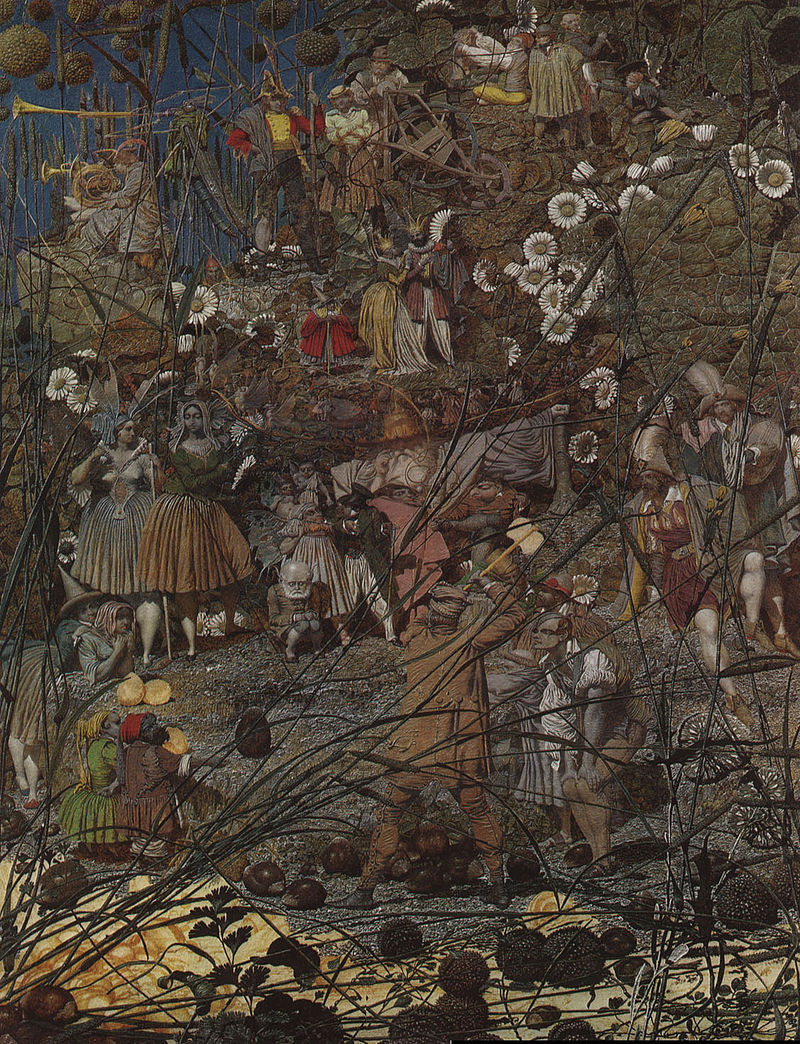 |
| Richard Dadd - Fairy Feller's Masterstroke - Public Domain |
*It also understands the world of faerie. I can’t pretend
to have ever been there, although I’ve written about it plenty of times, but Raymond
Feist does two rather incredible things in this book. First of all, he
manages to bring together the once popular discredited flower faerie version of
faerie, as seen most memorably in Arthur Rackham’s illustrations for A
Midsummer Night’s Dream, and combine it with something far more Brian
Froud and Alan Lee, or – should you have had the chance of reading- Terry Pratchett’s
wonderful Lords and Ladies. One minute it’s as if you’re diving full
pelt into the famous mad English artist Richard Dadd’s Fairy Fellow’s
Masterstroke, which – part English pastoral and part Hieronymous Bosch -
has a very disturbing feel if you look at it for long. The next you’re deep in
the gloom of the forest from which the great European fairy tale collections of
Jacob and Wilhelm Grimm originated. The fact that Raymond Feist manages to
marry the two and make it work so well is a true testament to both his craft
and knowledge, and makes you wonder how he did so, so well.
*But it’s the final extended sequence, when Phil’s two
eight-year-old twins Sean and Patrick are the pivotal figures in a race against
time as the more timid Sean attempts to save his brother Patrick from a fate
worse than death, that Feist is truly able to unleash the wonders of faerie.
The depictions of the contrasting Fairy courts of Queen and King are portrayed
in a quite masterly fashion.
 |
| villagephotography wordpress.com |
*Finally, there are the characters of Sean and Patrick
themselves. There is an unwritten law in Middle Grade Fiction that the main
actions must be both led and performed by the young characters. In contrast, in
Young Adult fiction, the hero or heroine often acts more like a pseudo adult,
than a middle grader on whom adult situations are suddenly forced.
For me, Sean and Patrick are both the best and the
best-drawn characters in the book. Because they are twins, they feel things
together, like when one is in danger etc. Without giving away any spoilers,
it’s the twins who perform the pivotal actions that enable things to be
resolved to some degree at least, and it’s clear the author is with them all
the way, as he trusts them with a good chunk of the narrative, steering us
regularly away from the complicated, often strident world of adults in peril,
to the quieter, but often far more immediately horrific closed-in world of the
boys, who know that things are wrong from the start.
It’s the boys and their journey which make the novel tick,
but uniquely, this is done without us ever feeling as if we’ve been robbed of
the adults, their feelings and problems, their burgeoning sexuality, rows and
insecurities. If I was to take one thing from the novel that is different from
the usual fare, it would be the characters of the boys, our twin narrators to
the inconceivable. For all the worries which accumulate around the adults, and
Gloria and Phil Hastings’ daughter Gabby in particular, it is the boys, and
Sean, in particular, who lead us on this incredible journey into darkness and
back out again.
So, as I've made abundantly clear, 'Faerie Tale' - should dark horror/fantasy be your thing, (and I have to say that nowadays it's very rarely mine), is not only well worth rediscovering thirty years later, but infinitely worth the read at any time.
Faerie Tale by Raymond E. Feist is published by HarperVoyager, (now with a brand new cover) and is also available on Kindle, You'll find copies in all the usual places. Enjoy.


