Showing posts with label Terry Pratchett. Show all posts

Wednesday, 6 December 2023

Lost for Words by Paul May


I've read more than 60 Carnegie Medal winning books now, and I've found none of them more difficult to write about than Beverley Naidoo's The Other Side of Truth. It belongs to a loose category of winners that appear to originate in an author's desire to educate their readers. Social realism I suppose. I'd include Berlie Doherty's books here, and probably Melvin Burgess's Junk. It's not surprising that adults writing for children should be interested in the effect their writing has on those readers. Here's Beverley Naidoo on why she writes:

"I am frequently asked, 'Have you a message in what you write?' My reply is that writing fiction is quite different from declaiming from a soapbox or through a microphone. I do not write to deliver a 'message'. Yet I believe passionately in the importance of literature that engages with life and our moral human universe."

The Other Side of Truth shines a light on the abuses of the military dictatorship in Nigeria in the late twentieth century and on the plight of refugees and asylum seekers arriving in the UK. It does this through the experiences of two young children, Sade and Femi, whose mother is shot dead as they prepare for school in the morning, and who are then smuggled onto a flight to London, where they are abandoned and robbed before being helped by police, social workers and foster parents.

This book was written before the days of the 'hostile environment' or the government plans to send asylum seekers to Rwanda. And, by the way, I saw a survey the other day that indicated most Tory voters thought that the plan was for asylum seekers to be sent to Rwanda for processing before successful applicants were returned to this country. That is not the plan. Successful applicants for asylum would be resettled in Rwanda and unsuccessful ones returned to their country of origin.

Back in 2000, in this book, the police were kind, the social workers seemed to have time to be gentle and patient with the traumatised children, and an item on Channel 4 News was enough to save the family from deportation. Things have definitely not improved since then.

There's no doubt that books like this do a great job. They are incredibly useful in schools to provide a focus for discussion of the many issues they raise and the Internet is full of essays written by young people about this book. Most of those address the central dilemma of the book—should I tell the truth? Or, should I always tell the truth? Or, is telling the truth always the right thing to do? I have to admit that by the end I was suffering from dilemma fatigue.

I admire this book and I think it's very well written, pitched just right for the ages it's aimed at. It has a straightforward style and the characters are vivid. You can hear the 'but' coming, can't you? There are two buts. The first is the one I've just mentioned—a little too much hammering away at the truth dilemma. The second is that I would really have liked to have seen some exploration of the attitudes of the other children in Sade's class at school, and especially of the two bullies, Marcia and Donna. They are a bit too much like cartoon baddies. These are minor things, yet for me they reduced my engagement with the text and I suppose that's why I've found it so hard to think about and write about. And it's why, although I think it's a worthy Carnegie winner, it won't end up in my top ten. Unlike the 2001 winner, which leaps straight into my top five.


The Amazing Maurice and his Educated Rodents by Terry Pratchett is, quite simply, one of the best children's books I've ever read. I can't do better than to quote some of the reviews of the book :

Powerful, passionate, mordantly funny and, at one point, unbearably sad—Daily Telegraph

An astonishing novel . . . I marvelled at the ferociousness of the humour, and the willingness to go to dark places—Financial Times

Despite being mainly about talking cats and rats 'it engages with life and our moral human universe.' to use Beverley Naidoo's words. You might think it odd that I could be moved to tears by the plight of a talking, thinking cat and a bunch of talking, thinking rats when the plight of two vulnerable, grief-stricken children lost on the streets of London didn't affect me in the same way, but that's what truly great writing can do.

This book has everything—dark places indeed, and very smelly ones too; it has metafiction in Malicia, a girl who has read so many stories that she is sure that, for example, any locked room will have a secret passage to escape by; it has heroes and villains, all remarkably realised; and above all it has humour—humour with an edge to it. It also has one remarkable insight which should be noted by peace negotiators everywhere, even though it comes from a talking cat:

'That's it?' (says Maurice) 'That's your plan?'

'You don't think it'll work?' said Keith. 'Malicia says he'll be so embarrassed he'll leave.'

'You don't know anything about people, do you?' sighed Maurice.

'What? I'm a person!' said Malicia.

'So? Cats know about people. We have to. No one else can open cupboards. Look, even the rat king has a better plan than that. A good plan isn't one where someone wins, it's where nobody thinks they've lost. Understand?'

This, you will probably be surprised to learn, is the first Terry Pratchett book I have read. I did start another one once, a long time ago, and it didn't grab me. I regret that now, but on the other hand I now have more than forty of his books still to read. And I guess I'm predisposed to like stories about talking rats as Mrs Frisby and the Rats of Nimh by Robert C. O'Brien has long been a favourite of mine.

Both Beverley Naidoo and Sir Terry Pratchett have excellent websites.


Sunday, 1 October 2023

'THE SHEPHERD'S CROWN' - and what I learned from it. By Penny Dolan

It’s October, when the publishing world ups its publicity game, enthusiastically sweeping everything and everyone into the Big Bookselling Season. Or that’s what all the media/social media/shop-displays/party-pix/awardings and more suggest. This is all brilliant for all the authors & illustrators whose titles are appearing on the shelves around now, so a big cheer for everyone involved! 

However, a wistful autum mist has gathered around all the spring and summer titles. They slip, slowly, beyond publicity’s bright beam. As do the titles from the year before, or the year before that and so on. With so many books are published annually, that’s how the process has to work although if you are an author, it’s hard when you feel the moment is moving on. 

 As for everyone with work-in-progress, or with work in an agent’s custody? Seems to me that the arrival of the shiny-bright season can feel discouraging indeed. But why so, when we are all sensible, rational grown-ups? 

Why, no matter how glad I was for those ‘new’ people or that I had bought and read some of their books, did I still felt an irrationally angry reaction to all the publishing razzamatazz. So you’re off to a party? Bully for you! So you have a giant cake decorated with you own book cover? Fantastic! Hey ho . .

Why, I wondered, feeling despicable, does Big Bookselling in its en-masse form feel so diminishing? Even if only to me? It did not make sense, though I could not get hold of what “it” was. 

Then, one insomniac night or three ago, I came across something that felt like an explanation, something to grasp on to tightly whenever any Big Book Season is upon us, one single word that makes sense. Illogically so, but still sense - and here’s where I found it: in Terry Pratchetts’ last Discworld novel, The Shepherd’s Crown.

                            The Shepherd's Crown by Terry Pratchett - Penguin Books Australia

The book opens with Granny Weatherwax, an admirably strong-minded witch, cleaning every corner of her home ready for Death to come visiting, as happens before long. Then, among other story-threads, the book develops into the story of the young witch, Tiffany Aching, as she grows into her own role as one of the Discworlds respected ‘hags’. 

 Part of the way through The Shepherds Crown, Tiffany takes in Nightshade, the Elf Queen and cares for her and her injuries. Although elves are nasty, mischievous, amoral creatures – as other characters point out - Tiffany decides to teach Nightshade about kindness and better ways. Meanwhile, the usurping Elf King - Lord Lankin - is preparing the elves to attack and invade the ‘human’ world. 

 Tiffany realises that she needs to teach all the other witches about the elves most dangerous power: the trick of “glamour” or as it is sometimes known, “glamourie”. She gathers them all together – old and young, skilled or newly chosen – and here’s how the scene is written:  

“Ladies, are you all ready?” There were some nods and yeses, so Tiffany said “Nightshade, please show us your glamour.” And she grasped the shepherd’s crown* in her pocket – this was a moment when she would need to keep a strong hold on her sense of herself. Yan tan tethera, she chanted softly. Yan tan tethera. 

Nightshade began slowly, her foxy little dairymaid’s face filling with a shining light, with beauty, with style, and then suddenly she was the most wonderful thing in the hall. 

Fantastic. 

Marvellous. 

Enchanting. 

 Terrific. 

The air was thick with glamour and Tiffany could almost hear the other witches fighting it. The inexperienced ones – Annagramma, Petulia and Leticia, Dimmity and Harietta - suddenly seemed flaccid, their faces like dolls. 

Petulia - like many of the other witches - felt a beguiling feeling that the world was all hers, all of it and everything that was in it. And then, her dream – as did theirs – unravelled. Who did she think she was? No one liked her, no one wanted her. She wasn’t worthy of anything. No one wanted her. Everyone knew she didn’t have any skills. It would be so much better if she was dead. Maybe it would be better if she simply let the pigs stamp her down into the mire, and even that wouldn’t be bad enough. She screamed. 

Tiffany moved towards Nightshade, and almost like a bubble bursting, the elf let go, and her glamour was all gone. 

But everyone in the hall looked shaken. . .

"And that, Ladies, was just one elf. Imagine what it will be like when we are facing a whole horde of them,” said Tiffany. 

Point made, lesson striking home - and nor, in the end, do the Elves triumph. 

Having read many folk and fairy tales, I found Pratchett’s depiction of ‘glamour’ sharply perceptive. In this scene, he shows the reader both the glimpse of beauty, success and inclusion, and then that heart-breaking sense of rejection as the bright light fades or moves on and away. 

Suddenly I thought that is it! That’s the word that helps, the concept I was after. 

Glamour! 

A word for an unreal, conjured-up illusion, a phenomenon that feels real but not one to truly believe in. A time when you need to keep a watch over how you and your heart and your hopes respond. 

Keep away from all the ‘Elves’! Beware their Glamourie!

 And so, next time, when I feel inclined to grumble or feel too much dispirited by the Big Bookselling, I’ll shrug and say to myself “It’s those Elves again.”

 And, like Tiffany or Granny Weatherwax, keep a strong hold on my sense of myself and simply carry on with my ordinary, everyday work. That’s what I’ll be telling myself. Beware the Glamourie! 

Thank you, Terry Pratchett

Penny Dolan

@pennydolan1 

* Tiffany’s ‘shepherd’s crown” is a fossilised sea urchin. which grounds her in the chalk of her homeland and in the practical work of being a shepherdess. 

ps. Terry Pratchett had always intended The Shepherd’s Crown, with its theme of the old order giving way to new, to be his last Discworld novel. He had planned much of it in advance, writing the beginning, the middle, the end and other pivotal scenes during the years when he was well enough to do so. Poignantly, the novel was completed by Rob Wilkins, who had worked alongside Terry for much of the time during his long illness. RIP Terry Pratchett.

Friday, 15 March 2019

Apostrophes. Dontcha just love ’em? By Rowena House

Having spent every spare minute this week glued to Twitter - enthralled and appalled by the Brexit mayhem - I’ve been reminded just how many people seem to think the plural of MP is MP’s.

Now it might be that technology bears its share of the blame. Certainly, my phone has taken to autocorrecting “its” into “it’s” every time.

Particularly irksome is a short, sneaky delay before Samsung’s gremlin imposes its will on my punctuation. The error slips past, and my social media feed is forever befouled. The solution: proof read every tweet, post & comment.

Which brings me to a story.

The story of The Wizards’ Rabbits’ Apostrophes.

First off, let me acknowledge unconditionally and absolutely that this story was inspired by proof-reading expert, Catriona Tippin, whose advice on every aspect of this topic in SCBWI’s Words and Pictures has been invaluable for years. In particular, I relied on her superb article, here:

https://www.wordsandpics.org/2015/09/proofreading-tips-apostrophes.html

Catriona, thank you very much.

I also acknowledge the late, great Sir Terry Pratchett as my inspiration for the setting and style of the wizards’ rabbits’ tale - and hope that in law such fan fiction/blatant plagiarism is OK given it’s done purely for educational purposes.

You see, I wrote the story for colleagues faced with the daunting prospect of umpteen thousand words of academic assignments to proof read.

It’s meant to be a fun way to make the point that every apostrophe in every assignment ought to be double checked because they’re devious little devils, slithering either side of an “s”, running away for “its” and hiding in contractions like “it’s” which aren’t allowed in academic writing.

I’ll do the correction exercise alongside them to test myself, and also to demonstrate that even though I’ve been a professional wordsmith for decades, and set the bloomin’ task, Murphy’s Law suggests that I’m bound to misplace at least one or two of the buggers.

[Typing this post, several “apostrophe’s” have appeared as if by magic, and I’m starting to wonder if my tech is Hubris, given a past tendency to sneer about other people’s errors: ‘Oh, look who got that wrong. Tut, tut.’ Hopefully, that’s a thing of the past now; life is way too stressful the sweat the small stuff.]

Anyhow, here is the story - with all the apostrophes removed. It’s not a sparking story. It’s not meant for kids, either. But if anyone fancies having a go at correcting it, I’ll post what I think is the right version in the comments section in a couple of days.

Please let me know if I make mistakes. Like I say, Murphy’s Law and all that…


THE WIZARDS RABBITS APOSTROPHES

Tuesday last, the wizards of Untold University held an open day to which their young male relatives were invited, females being banned from its hallowed precincts. Among the exhibits were rabbits, kept by the wizards in lieu of lawnmowers, but which the denizens of Lank-Moorpuck endlessly asked to see being magicked out of the wizards hats whenever one of them was spotted sidling along The Lashup in search of refreshment in its seedier establishments.

Knowing that these performances were demanded to annoy the wizards, rather than from any fondness for magic, Untold Universitys finest had determined to distribute their rabbits among their nephews in order to prevent any further interruptions to the serious business of drinking.

On the appointed day the Master of Impossible Feats, Silas Graves, wasted no time. The moment his nephew, Nigel, stepped over the threshold, Silas thrust two white rabbits into the boys reluctant hands, and then scuttled out of the building. The two bemused creatures were now the magicians nephews pets.

Seeing Silas striding towards The Goblin Arms, with a bag of dwarfs gold dangling from his belt, identical twin wizards Cornelius and Corinthian Trump stuffed their shared rabbit into the trouser pocket of their sisters son, Humphry, then hurried after Silas. The wizards nephews rabbit looked nervous.

On the far side of the quad, Obadiah Ringworm was livid: the Trump brothers reputation for boozing was legendary, and Lashup Old Peculiar in dangerously short supply due to the brewerys draymens strike. Obadiah grabbed both his nephews by their ears, forced them under threat of being turned into skunks into selecting a rabbit each, then he snatched up his hat and staff and ran full pelt into town. Ringworms nephews rabbits looked at each other - and winked.

Now, over the years, the wizards, being careless, had spilt a great many spells in the universitys halls, and in the quad and on its lawns. The wizards nephews rabbits had, in consequence, dined on magical grass since birth, growing both in intelligence and guile. They had no intention whatsoever of being handed over willy-nilly to a bunch of spotty-faced, indolent, catapult-wielding urchins, thereby forfeiting the pleasures of The Lashup, whose byways and back gardens housed far fairer fluffy tails than the booze-sodden wizards could ever have imagined in their misogynistic lives. To a rabbit, they bared their teeth, bit the nephews down to the bone and legged it.

@HouseRowena on Twitter

Website: rowenahouse.com


Saturday, 25 November 2017

Terry Pratchett: HisWorld - by Sue Purkiss

A few days ago, I went to see the Terry Pratchett exhibition at Salisbury Museum. (Apologies to my companions, OH and two friends from Salisbury, none of whom have ever read a Terry Pratchett book - and thanks to them for their patience, as I wandered round chortling and sometimes a little misty-eyed, while they were simply mystified. And thanks too to the two guides, who clearly shared my enthusiasm. One of them was also called Susan, and we bonded over the picture of Death's granddaughter, Susan, and Terry's explanation of why he gave her the name. I didn't make a note of it, but it was something to the effect that he felt sorry for Susans, who tend to be the sort of people who make the sandwiches - nice but rather dull - so he decided to give them a boost by calling this very special character Susan. Thanks, Terry.)

The exhibition was largely structured round the illustrations of Josh Kirby and Paul Kidby, though there were other exhibits too - notably a mock-up of Terry's study, with its six computer screens, wall of book shelves, and various memorabilia - such as this lifesize model of The Luggage. (If you're a fan, you'll know what I'm talking about, and if you're not, then there really isn't much point in trying to explain. You just need to read the books. And keep out of the way if you see it heading towards you.)


And there were costumes you could try on. No idea who this manic-looking peron in a pointy hat is. It's in black and white because, trust me, the colour version was far too scary for a family blog.


The labels, or captions, were mostly in Terry's own words. Here he talks about how it all began - incorporating a useful tip for parents trying to help their children to learn to read: 'I didn't enjoy primary school, Mr Tame, my headmaster, thought he could tell how successful we would be in later life by how well we could read or write at the age of six. He told me I would never amount to anything... My mum wasn't having any of that. She taught me to read, with love, care and affection. When that didn't work, bribery, at a penny a page when I read perfectly.' (I noticed, as we went round, that this is how Terry's humour often works: he writes a few apparently serious sentences, and then undercuts them with something sharp, unexpected, and funny.)

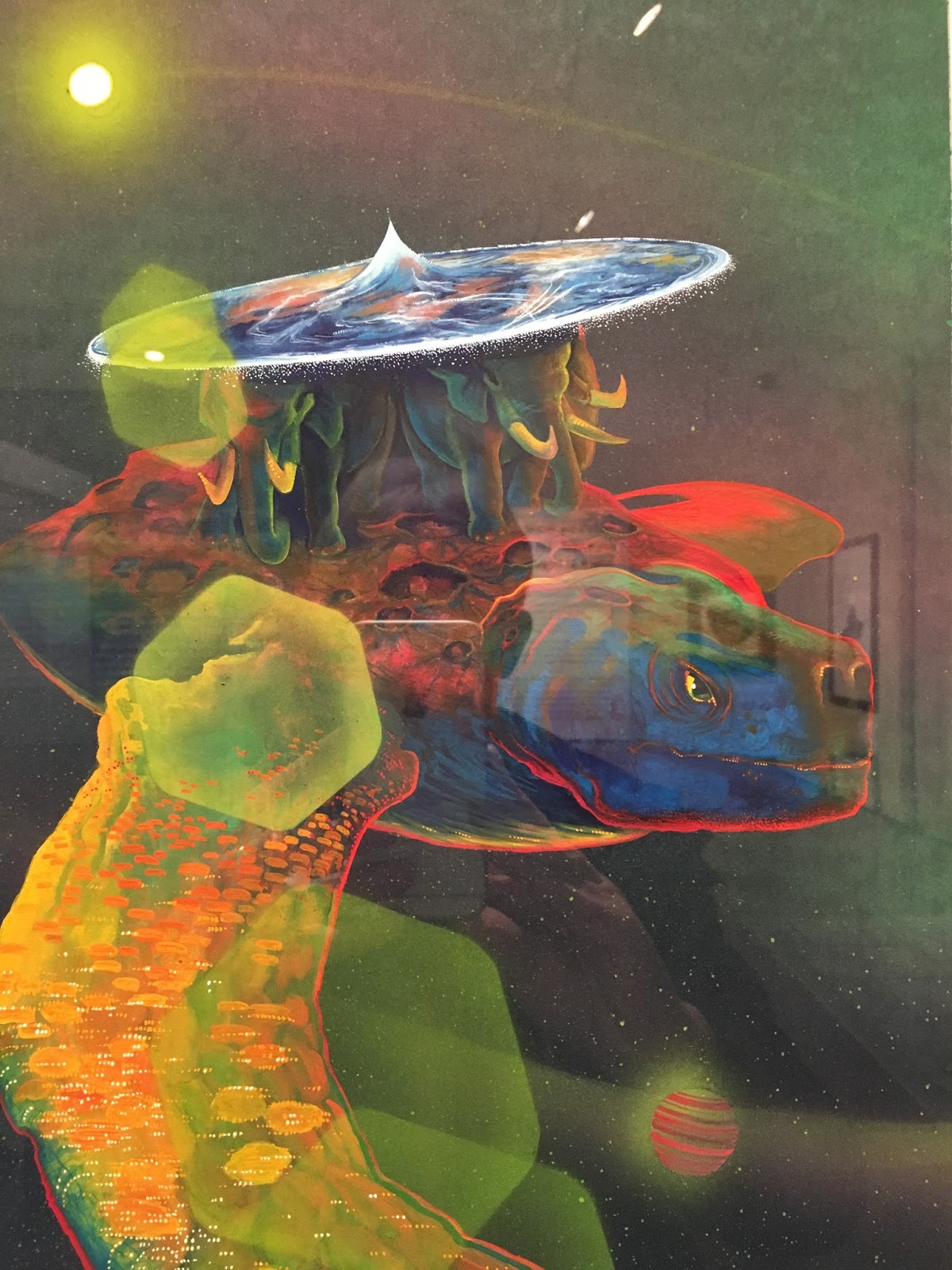
Here's a picture of the Discworld by Alan Smith. As many of you will know, it floats through space on the back of a giant turtle. (Sorry about the reflections.) I was intrigued by this from Terry: 'I write about people who live on the Discworld. They worry about the sort of thing we worry about, like death, taxes and not falling off. There are no magic swords or mighty quests. There are just people like us, give or take the odd pointy hat, trying to make sense of it all. Just like us.'


Here's the cover art for Reaper Man, by Josh Kirby. It features Death, one of my favourite characters. Terry gives full credit to the artists who worked with him: 'I didn't know what Discworld trolls actually looked like until Josh drew them. The artwork for the covers are masterpieces, especially Reaper Man. It's a shame they have to be spoiled with the title.'


Here's Susan. Not a bad namesake to have. I may begin to wear black.


I had just re-read Wyrd Sisters, so was intrigued to see this picture of Granny Weatherwax's home in Lancre. (That's not a sun, it's a reflection from my phone camera.) Charming, don't you think?


I've always thought of the Discworld novels as fantasy. So this was interesting. 'I've seen a 16th-century woodcut of something like the Discworld. The idea that the world goes through space on the back of an enormous turtle is something that's common to a large number of this planet's cultures, past and present. I don't know why. It's not an obvious beast to carry the world through space; I mean they go underwater quite a lot. I needed a ridiculous world... I wanted to write, in effect, an antidote to fantasy. I thought let's take a ridiculously, self-evidently foolish world, put the people on it, and make them as real as possible.'

I'll leave you with this ensemble picture of the cast of Discworld characters. The exhibition continues at Salisbury Museum till Sunday, January 14th, 2018.


Wednesday, 5 July 2017

Who, What or Where Influenced your Writing?

Wycombe Library as I knew it

Books have always been a source of inspiration for me. Great literature is like soul food for the imagination. It can take you anywhere at any time, no journey too long, no obstacle too great, no limits, no boundaries. Can I imagine a world where there are no books? NO is the simple answer. When I was a kid, my family couldn’t afford to buy books, (don’t worry, I’ve made up for that big time!), so the library was where I got my weekly fix. My town library during my teenage years was a place of huge inspiration. It was full of books by writers I had heard of and many I had not. 


Wycombe Library now

I made my way round the whole library, reading good fiction, exceptional fiction, high-brow to low-brow, from JRR Tolkien, CS Lewis, John Wyndham, Agatha Christie, Jane Austen, Tolstoy, Zola, the Brontes, Edgar Allan Poe, Maupassant, Stephen King, Dickens, Erle Stanley Gardner, John Creasey, Denis Wheately (I told you I read everything!), to John Fowles. I had wide and varied tastes – I still do! Although I never dreamt of being a writer then, I soaked up words like they were going out of fashion.

Penn Bookshop
Some of the thousands of books in Penn Bookshop


When I was about sixteen, my dad and I discovered The Cottage Bookshop in Penn – a second-hand bookshop stuffed full of shelves, nooks and crannies, bursting at the seams with books upon books upon books. I practically moved in, losing hours in that place. I didn’t know then that Terry Pratchett had also spent hours and hours lost in the book alleys of this very bookshop when he was a kid. The Cottage Bookshop was the inspiration for L-space (library space) in Discworld. Pratchett often returned to the shop during his career, and launched his Johnny and the Bomb there in 1996.
Ian Fleming


Stephen King was inspired by writers such as Richard Matheson, Shirley Jackson, H P Lovecraft, and Bram Stoker. Arthur Conan Doyle was inspired by Edgar Allen Poe. Ian Fleming's James Bond was apparently inspired by Dennis Wheatley's Gregory Sallust series.


Tolkien was a huge inspiration for me – he led me into the endless worlds and possibilities of a genre I came to love.

So, it’s no surprise then that the first thing I ever wrote was a fantasy epic – complete with its own world, full of many lands, populated by a diverse range of people and creatures. There were several maps, drawn to scale. And hundreds of thousands of words: the trilogy had to be divided up into six parts. The manuscripts have been filed away. Every few years they get dusted off and reread before going back in the drawer. I may do something with them one day... I can’t say that my recent works have been inspired by one writer or a few writers in particular. That’s one I’ll have to mull over.
              
So what, who or where has inspired you to write?


Savita's Website


Wednesday, 23 September 2015

Terry and the Bad Fairies, by Steve Gladwin


It's lovely to be invited to write a regular blog here. I hope to share with you a few intriguing ideas and obsessions. So dear reader - let us begin.

Elves are wonderful. They provoke wonder.

You can’t really say what a faerie looks like. It appears only as it desires to. All you see is that illusion, that glamour. Whatever appearance the faerie chooses, gives you your sole reference point. A fairy has you believe what it wants you to believe. Should you fail to understand that lesson ----


Elves are marvellous. They cause marvels.

Many prefer to think of fairies as tiny, delicate wisps, like the Cottingley fairies who danced so prettily around the girls in their starched Victorian white. Or perhaps rosy cheeked mischief makers like Arthur Rackham’s cherubic Puck. In another Rackham picture however, there is a sinister lurking presence in the background of Titania’s bower. This too is Puck. He is no longer so sweet, (if he ever was), but the gleeful servant of his dark master. (My mistress with a monster is in love!)

I learnt to tell the difference early on when I was lucky enough to be given a dream trio of books to study for GCE English. Not only A Midsummer Night’s Dream, but Cider with Rosie and To Kill A Mocking Bird by Harper Lee were gifted to me. In one fell swoop I was taught about magic and illusion, introduced to sex and cider behind a hay cart, and learnt the importance of combatting intolerance and bigotry. I also learnt that faeries could be bad.

Elves are fantastic. They create fantasies

In twenty years of being a pagan druid, I’ve met many people who claim to have seen faeries. Many of these are people whose judgement I trust. I’ve spent many happy performance hours playing and directing versions of Oberon and I still know all his speeches. I was even hand fasted to a Midsummer Night’s Dream theme. I love faeries at their baddest and have little patience with the Victorian flower fairy version. If Oberon and the rest were to begin behaving reasonably, I’d feel let down.

Elves are glamorous. They project glamour.

At the moment I’m writing a book about the composer Ralph Vaughan Williams and faerie. It’s fiction of course, but I was amazed to learn recently that his last unfinished work was to be an opera based on the stories of both Thomas the Rhymer and Tam Lin. It seems to make an eerie sort of sense of my own wild fictional imaginings, but it also unites two of the most well known of the stories of English faerie. Each, however similar, seem to carry an opposite message. On the one hand we have true Thomas of Erceldoune, choosing to follow the Queen of faerie to Elfland, (Childe Ballad 37) but allowed to leave when his own life is forfeit because of the ‘tithe' that must be paid to hell’. On the other there is Tam Lin, the kidnapped Lord of Roxburgh (Childe ballad no 39) made captive in his youth by (maybe even the same) faerie queen. Fair Janet battles for his very soul, as her lover's form switches between lion, serpent and a fierce hot brand.


Elves are enchanting. They weave enchantment.

So are these examples of good and bad faeries?  Or are they just the same faery in different moods? How do we know which version we’re going to meet? Will it be the faeries of the seelie court, -- supposedly the goodies, or those of the unseelie court, who can be as nasty as they come? In my favourite modern fantasy trilogy, The Fionavar Tapestry, Guy Gavriel Kay uses a similar idea by dividing his elves into the Unseelie svart alfar, _ (a name also used by Alan Garner in The Weirdstone of Brisingamen,  and the Seelie like, lios alfar. As he spent a year preparing The Silmarillion with Christopher Tolkein, he was surely in a good place to recognise that there might be more than one side of faerie. 

Elves are terrific. They beget terror.

It’s very clear in which court the 'gentleman with the thistledown hair', belongs in Susanna Clarke's Jonathan Strange and Mr Norrell. He seems to exist solely to tease and manipulate and destroy. He feasts on exotic and extinct fauna, has a castle surrounded by dead men’s bones and takes great relish in the hunting and destruction of a whole pack of wolves. However his sustained and, more often than not, unwelcome acts of kindness to Stephen Black, show him more quixotic in this instance at least. He is by a long way the villain of the piece. However neither by the end of the book can we be wholly sure of the true nature of the John Uskglass, the Raven King, whose shadowy presence grows throughout the book.  His role is left deliberately ambiguous, with only clues to what he might be when he - Lord Voldemort like, returns in his full power!

Terry Pratchett understood bad faeries better than most. Lords and Ladies has a chill undercurrent throughout, for all the jokes about dwarf Casanovas with step ladders, royal falconers called Hodges aargh and anything done by the magnificently bawdy Nanny Ogg. His faery lords and presiding Lady cannot understand the idea of cruelty because it does not form part of their moral compass. Poking someone harder when they are already being tortured, just seems like a good idea to them. It takes the reader a while to realise that lurking in the background of Lords and Ladies is the faerie plot of A Midsummer Night’s Dream.

Thus in order to prevent ‘Titania’ from allowing her anger at the royal estrangement to wreck things any further for the human world, ("We are their parents and original'), Nanny Ogg and her dwarf paramour venture underground to have it out with ‘Oberon’. Essentially they request him to have a word with the Mrs. 

Nanny succeeds in the sort of task few would dare try, because, despite all the jokes, she’s a very powerful witch herself. In the end however it is her friend Esme who discovers the only way to beat the queen. Maybe Granny Weatherwax doesn’t understand the concept of defeat. She probably wouldn’t accept it even if she did.


No-one ever said elves are nice

In the last few years of his writing life, Terry Pratchett returned to both the witches and the world of faerie in his Tiffany Aching books. The final book in the series, The Shepherd’s Crown, is the last book of his to be released. I like the idea that like Vaughan Williams, almost the last thing he set down was about faeries.

 There are of course many other characters in literature who have discovered to their cost that a faerie is none of those things it either appears to be, or others have had us believe. Maybe they just needed an Esmerelda Weatherwax in their corner. She could tell a bad faery from a good faery. Elves were all the same as far as she was concerned.


Elves are bad.


Quotations from Lords and Ladies by Terry and Lyn Pratchett 1992

A Midsummer Night's Dream by William Shakespeare


Steve Gladwin


Author of The Seven published by Pont Books 2013
Shortlisted for Tir na n-Og prize 2014

'I really like its rigour, its pace, its wit and the way you step so 'lightly and fiercely through the window between the worlds.'

Kevin Crossley Holland

Find out more about The Seven here.

gwernseven.wordpress.com

https://www.facebook.com/gwernseven