Showing posts with label Terry Prachett. Show all posts

Saturday, 30 June 2012

The Cottage Bookshop.... Savita Kalhan


The Cottage Bookshop


To celebrate Independent Booksellers week (30th June to 7th July) I’m going to tell you about a little bookshop I used to go to when I was a teenager. It was a second-hand bookshop, which was perfect for me as I couldn’t afford to buy new books. The library was my second home, but this particular bookshop wasn’t far behind it. My dad used to take me there – I don’t know how he found it, because it was set off the beaten track, and if you drove too fast along the main road, you’d miss it. I spent hours in there – you would too if you’re lucky enough to come across it. It is packed from floor to rafters with books, fiction, non-fiction, old, ancient, contemporary, soft-backed, hard-backed, and so many gems it’ll take your breath away. It always did mine.


After I left home to go to Uni, I never went back. That was exactly thirty years ago. Recently I googled the bookshop, hoping against hope that it had survived the last thirty years, and imagine my sheer delight when I found it. Of course I had to go and visit it for old times' sake. I had no idea whether it was actually the same bookshop, but the location seemed to be right – I remembered it was near Penn, in Buckinghamshire, and very close to High Wycombe where I grew up.


I found it tucked away in the lovely village of Penn, tucked in amongst the cottages, off the beaten track, and it was the same bookshop. Not only was it still there, it was exactly the same. Books overflowing from floor to rafters, little nooks and niches full of books, up the old staircase to another floor of more books. 65,000 books are crammed in at any given time.


I spoke to Liz, who runs the bookshop for the family, and she told me a little bit about its history. It was opened in 1951 by Fred Baddeley, who owned the general store next door. He wanted to run a bookshop where people could come in and find books they could afford to buy. He wanted to stock as many different titles on as many different subjects as possible. When he died, his daughter Wendy took over and kept the shop in the same tradition. When Wendy passed away, her husband took it over. The bookshop still remains in the family, and it is with the same commitment to the customer.


Midsomer Murders was filmed there twice - A Tale of Two Hamlets, and more recently, A Rare Bird. It also featured on kids’ programme, Chucklevision, Bookshop Chuckles. Blue Peter featured the bookshop twice: once with Enid Blyton’s daughter, Gillian Baverstock, and once with Terry Pratchett. Terry Pratchett lived just up the road from the shop when he was growing up and often went there as a child. Apparently he said that The Cottage Bookshop was the “origin of L-Space”. He launched his Johnny and the Bomb in the shop.


But I think The Cottage Bookshop’s main claim to fame lies in the fact that it has been open for business as a bookshop for sixty-one years. It is still thriving and it is still full of book-lovers, adults and kids alike.


One of the best things I’ve heard all year came from Paula, the very helpful shop assistant, who said, “People keep saying kids don’t read. Well, they should come in here on a Saturday and during school holidays – it’s full of kids!” That was music to my ears!
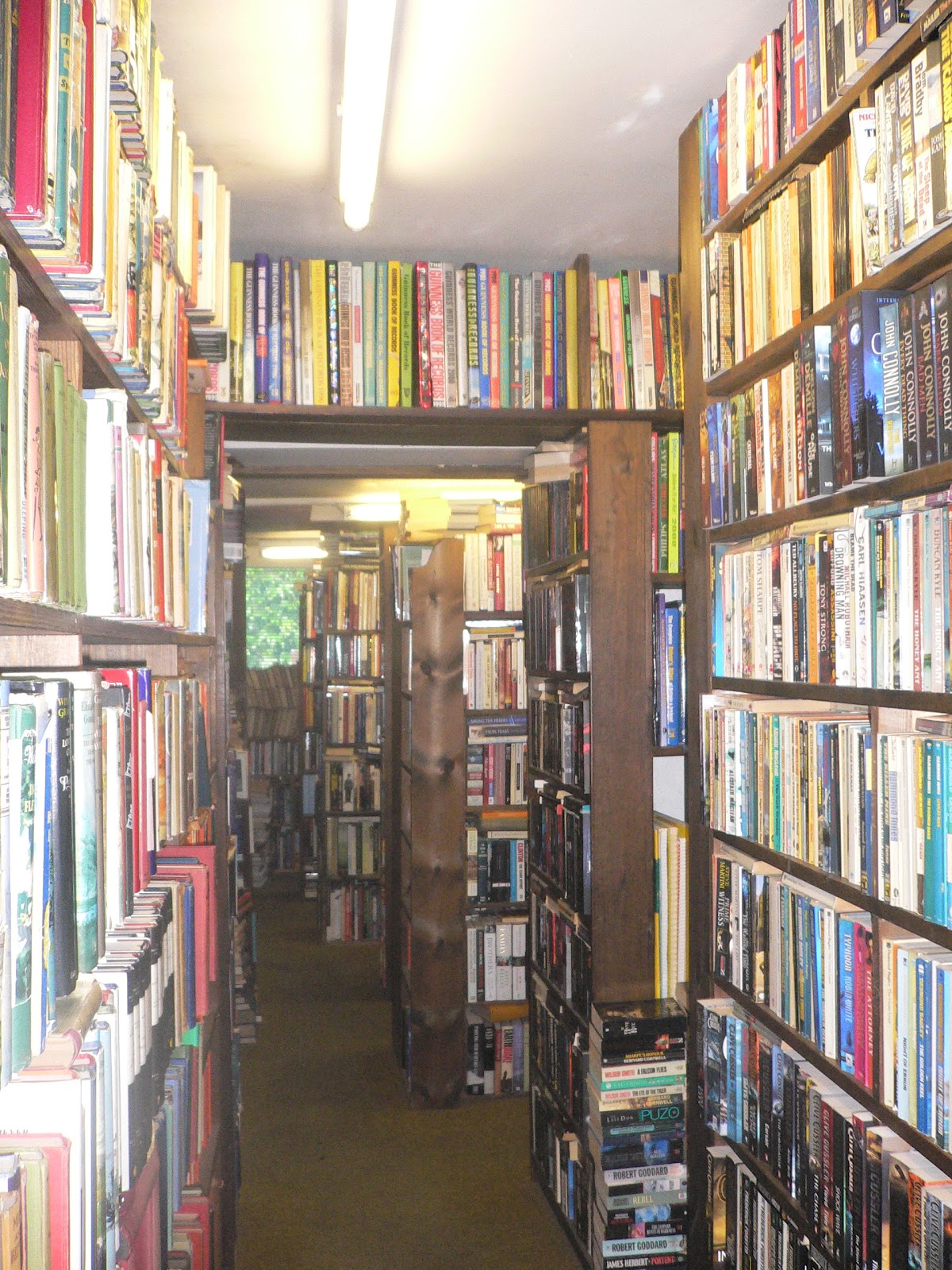
I hope The Cottage Bookshop thrives for many more generations, so that booklovers of all ages continue to enjoy it. It is a treasure trove, one that I hope everyone gets to stumble across.

http://www.cottagebookshop.co.uk/


Wednesday, 30 November 2011

Initial Response: on gender and writing - Ellen Renner

A few days ago, Keren David wrote an excellent ABBA post querying why women writers sometimes choose to use their initials rather than full names. She felt that women need to stand up and be counted. It's a subject I've considered for a while without coming to a conclusion. My thoughts on reading her post were too long and complicated to fit in the comments section, so I’m returning to the topic here.

I'll start with a confession: I wanted to be published as E. L. Renner, but my then agent convinced me to use my first name. I'm still uncertain that was the right decision.

Why? Partly because initials are more anonymous. My books are about my characters, not me. I want my stories and characters to stand alone, with as little 'author-as-brand' hype as possible. As a child and teen reader I didn't want to know anything about the author of books I loved except when their next book was coming out. I wanted to experience the magic of transformation into another person, another world, another experience. Author photos were a definite turn-off: I wanted magic performed by some unknown alchemist, not a real person. Terry Prachett has the wisdom to wear a magician’s hat for his publicity stills.

Then there’s the delicate question of the critical glass ceiling. It's a perennial topic in adult fiction and it would be naive to believe that children’s books are exempt. It would also take a large dollop of willful obtuseness not to notice that male authors attract more critical attention per capita than their female counterparts. It's not a conspiracy; critics don't exercise their bias consciously any more than did the editors of the publications who recently voted for Sports Personality of the Year and neglected to put a single woman on the list.

I believe that almost all of us, however pro-female we believe ourselves to be, are so conditioned by the constant bombardment of overt and subtle messages in every aspect of our society about the relative value of the male versus the female that we subconsciously take a story written by a man more seriously than we would the same story written by a woman.

I don't think J.K. Rowling's books would have been as successful had she published them as Joanne. I doubt George Eliot would have garnered such a strong place in the canon if she had written as Mary Ann Evans. If Sylvia Townsend Warner, one of the greatest stylists and most original writers of the twentieth century, had been a man, I am convinced that her books would be much better known today. Arguably, Virginia Woolf made it into the public eye not because she had a room of her own, but because she had a publishing house of her own.

Is it, therefore, a cop-out for a woman to write under her initials, in an attempt, however feeble, to combat the anti-female bias that pervades every aspect of our culture? Possibly. It’s a difficult question and one I’ll continue to ask myself. But I also know I'll use whatever tools I can fashion to give my books and my characters, both male and female, every chance I can.

Because the larger point is that, although gender shouldn't matter in life, it does. And the only way I can see to address this issue as a writer is to attempt to be as genderless as possible – a writing androgyne. I enjoy writing both male and female characters. I don't set out to write about a girl or a boy; I choose the gender which seems to fit the story best. And the reason I write at all is because I want imaginative experience. While it's true that I can’t experience what it’s like to be a boy or man in real life, I can imagine it as a writer, and I have never felt closer to any character than I did when writing Tobias Petch in City of Thieves.

‘Only connect.’ E. M. Forster knew that books teach empathy. Between the pages of a book a reader can become another person. Boys can become girls, and girls boys. Men can see the world, however briefly, through the eyes and emotions of a woman. And understanding may result. And then, perhaps, the word ‘girly’ will no longer be a term of disdain. When that happens, this entire discussion will be irrelevant.

Earlier this year I attended a conference where a speaker advised writers to ensure their main characters were boys, trotting forth that insidious mantra of marketing, ‘boys won’t read about girl characters’.

Please don’t tell that to the countless boys who read Roald Dahl’s Matilda, The BFG and The Magic Finger. Or the boys, like my son, who devour Prachett’s Tiffany Aching books (which gently poke fun at gender stereotypes through the dealings between Tiffany and the Wee Free Men). Don't tell the generations of boys who have loved Charlotte's Web and The Borrowers or those who, like my husband, read E. (!) Nesbit’s The Railway Children and fell in love with Roberta.

If boys hear the message that a book is good, they'll read it whether or not it has a girl as a main character. Who gives them that message? We do. Parents, teachers, librarians, publishers, marketing and sales departments with gender specific covers. If boys are refusing to read books where the main character is a girl, it’s because we’re telling them that they shouldn’t. We give them permission to exclude girls from their imaginative world, and that view of the female as 'other' will simply carry on into adulthood. That’s where writers need to draw the battle lines: not how gender specific an author’s name is, but the banishing of girls from the centre stage of life itself. It’s an appalling message to give to children of either sex: that girls cannot be heroes, cannot be the main characters in story or in life.

I happen to be female. That accident of genetics has shaped and coloured who I am, but it is not my primary definition as a person or as a writer. Despite my qualms that Keren may be right, and that I’m somehow betraying my ideals by using my initials, I am considering publishing my next book as E. L. Renner. It’s an older, darker book and I want to distinguish it from my younger fiction. That’s the obvious reason for switching to initials, but I know the issues I listed above will inevitably influence my decision.