

Cor, I wasn’t half chuffed to be included in this year’s recent Read for Empathy Collection 2022 from Empathy Lab. It’s an organisation that does incredible work developing empathy skills with children and young people through the power of reading.
And – empathy
and power – it got me thinking about stories that have ignited deeper feelings
and connections within me as a young person. Amongst the many, there’s one my
mind spot-lit in a heartbeat. A Kestrel for a Knave by Barry Hines.
It was a
class book we read together in Year 8 (or 2nd year to me). A story about a boy who 'hates and is hated', yet finds hope and trust in his relationship with a kestrel; ultimately doomed. It was
something completely different from the books I was feverishly borrowing from
the library at this time (every Judy Blume, a little Agatha Christie, and,
ahem, possibly a few too many Sweet Dreams). Up to this point, stories had
mostly been a route to escape, tonic for a bad mood, fodder for my imagination,
and, more latterly, a welcome reflection of my own experiences and feelings.
And then
came . . . A Kestrel for a Knave. (Accompanied soon after by Ken Loach's film Kes.)
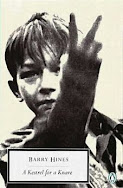
Only connect . . .
It wasn’t a
story I’d have chosen for myself – and what a loss that would have been. It did
something to me so visceral, so powerful, that I can still feel its effects in
the pit of my stomach today. Beyond escapism and storytelling; more than a
reflection of my own emotions; I walked in the shoes of Billy Casper, a boy
whose harrowing experiences were alien to me – and I made a connection. A
connection that definitely helped shape and deepen my understanding for the
other young people around me.
We were a
Catholic comprehensive in Sheffield; its inner-city location meant the intake
came from all parts of town – from leafy suburbs to tower blocks to our Traveller community. The setting of A Kestrel for a Knave, in Barnsley, was physically close to
us, as were many of its issues. Ours was Sheffield in the mid-80s: a
diminishing steel industry, rising unemployment and miners’ strikes. Arthur Scargill
was our local hero (along with Human League, ABC and Heaven 17).
Times were especially
hard for some students in my class, not least, with an increasing number of parents
on the dole. But we were close-knit, we looked out for one another and began confiding
in each other more too; and some confessions were tough ones. I can still remember
not knowing quite how to process these, especially distressing topics like domestic violence. I recall feeling real sympathy, yet, at
the same time, also feeling confused – of not being able to make sense of such unfamiliar,
upsetting experiences.
The power of books
Reading Kestrel – it really helped. By getting inside the bleak and bullied life of lonely Billy Casper – with his violent brother and his detached mother and his troubled school life – I started to walk in his well-worn shoes, to live and learn from his gritty experiences. And then, by sharing his love for the hawk he rears, trains and cares for, I found myself making an unlikely connection with Billy. And an enlightening discovery, through the inevitable tragedy he faced, that in our differences, we weren’t that dissimilar.

Walking in the shoes of a troubled boy who no one seemed to care about, I suppose it showed me – my class too
– that the first step with empathy can simply be to care . . . to really, really care.
If you’ve not read it, I can’t recommend it enough . . . A Kestrel for a Knave by Barry Hines
Alex Cotter’s middle-grade novel THE HOUSE ON THE EDGE came out in July 2021 with Nosy Crow. Find her at www.alexcotter.co.uk or on Twitter: @AlexFCotter


