Showing posts with label children as writers. Show all posts

Thursday, 30 March 2017

The Power of 'I Don’t Know' – Lari Don

I think I’ve worked out where stories live.

I was touring Northern Ireland last month, with the Scottish Book Trust’s Scottish Friendly Book Tour, chatting about my new Spellchasers trilogy. I met almost 1,500 fabulous friendly imaginative primary children, I shared my stories with them, and I encouraged them to come up with story ideas of their own.

In a school towards the end of the tour, one wee boy was imagining an exciting story about shapeshifters chasing each other, and I was asking open questions to prompt him. But suddenly his chase scene ground to a halt.

“I don’t know,” he said. “I don’t know what happens next.”

His face fell, and I could see his confidence draining away.

“But ‘I don’t know’ is brilliant,” I said. “’I don’t know’ is how I write stories.”

He frowned at me.

I pulled out the half dozen notebooks I keep in my briefcase. “These are filled with questions I don’t know the answer to, and all my scribbled attempts to find the answer,” I said. “All my novels are answers to questions that I didn’t know the answer to when I started.

“‘I don’t know’ means that you have to find out. ‘I don’t know’ means that you have to imagine, invent, discover what happens next. And that’s what writing is!”

The wee boy started to perk up.

“’I don’t know’ is a good thing. It means you aren’t writing something obvious or predictable! ‘I don’t know’ means you’re writing something new and exciting. You might have to stop and think and play with ideas and come up with an answer to the question, but ‘I don’t know’ means you have a story worth playing with.”

The wee boy grinned, and started to think about all the possible answers to fill in his ‘I don’t know’.

And I realised that I hadn’t just been saying something positive to give confidence back to a wee boy and his shapeshifters. I had discovered a truth about my own writing. When I first discuss a novel idea with an editor, I can almost always describe the main character, their big problem, the baddie, and the first few scenes. But fairly soon after that, there’s a point where I say quite cheerfully: ‘...and I don’t know what happens next. I don’t know how they solve the problem and defeat the baddie, but I’m sure I’ll find out while I write.’ And, so far, I always have...

Those are the stories that excite me, the ones with great big ‘I don’t know’s in the middle and at the end, because I want to write them to find out.

That’s where stories live, for me, and I hope for that wee boy. Stories live inside ‘I don’t know’, and the fun is in finding them!


Lari Don is the award-winning author of more than 20 books for all ages, including fantasy novels for 8 – 12s, picture books, retellings of traditional tales, a teen thriller and novellas for reluctant readers.


Monday, 17 August 2015

How To Judge Children's Writing? - by Emma Barnes


Earlier this year I was asked to be Judge of the Hope/Findel Writing Competition for children. Schools across the UK submitted stories by their pupils, in three age categories, with the chance to win prizes of books for the school, cinema tickets, and signed copies of my book Wild Thing. My job was to pick the overall winners from the shortlisted entries.

Being a Judge was enormous fun – and also a complete nightmare. Enormous fun because there was so much talent in the shortlisted stories. They were truly a pleasure to read. A complete nightmare because reading and enjoying the stories was one thing, but picking out a winner – and a second and third place – in each category was another thing entirely. I wanted to be like the Dodo in Alice in Wonderland who declares: "Everybody has won, and all must have prizes."

The Dodo as Judge by Tenniel (Image: British Library.  Public Domain)

Now the results are out, and here I am reading out the winning entries on film. Well done, you brilliant young writers.

But how do you judge children's writing? (How do you judge any piece of creative writing?)

With great difficulty.  There's the quality of the prose, which could be marvellously rich and poetic (or crisp and concise).  There's also the structure - a story needs a beginning, a middle and an end (or usually it does).  A story needs pace.  And then what if the story is genuinely funny and surprising, but the ending lets it down? What if the story is highly polished and well-structured but somehow predictable? What if there's a brilliant idea, but it's not quite carried through? What if an entry is brilliant but over the word count?

Even trickier, how do you judge realism against humour against a thriller against a piece of dystopian sci-fi against a story with talking animals?

Having drawn up various lists, and devised elaborate points systems, none of which worked, in the end I followed my instincts.  I chose the stories that most surprised and delighted me. But I had terrible pangs about the wonderful stories I couldn't choose. And I now have a huge sympathy for teachers – the people who day in, day out have the job of assessing children's writing.

It did make me think about the way we teach children to write. Writer CJ Busby has spearheaded a campaign (started on this blog) to address some of the ways writing is taught in primary school.  Reading the stories I did find that simplicity could be a breath of fresh air, and there was an occasional story where the phantom of the National Curriculum, standing at the writer's elbow and whispering "squeeze in just one more metaphor...how about another complex sentence?" was not helpful.  A good story is not a checklist, and maybe we need to remind ourselves of that.

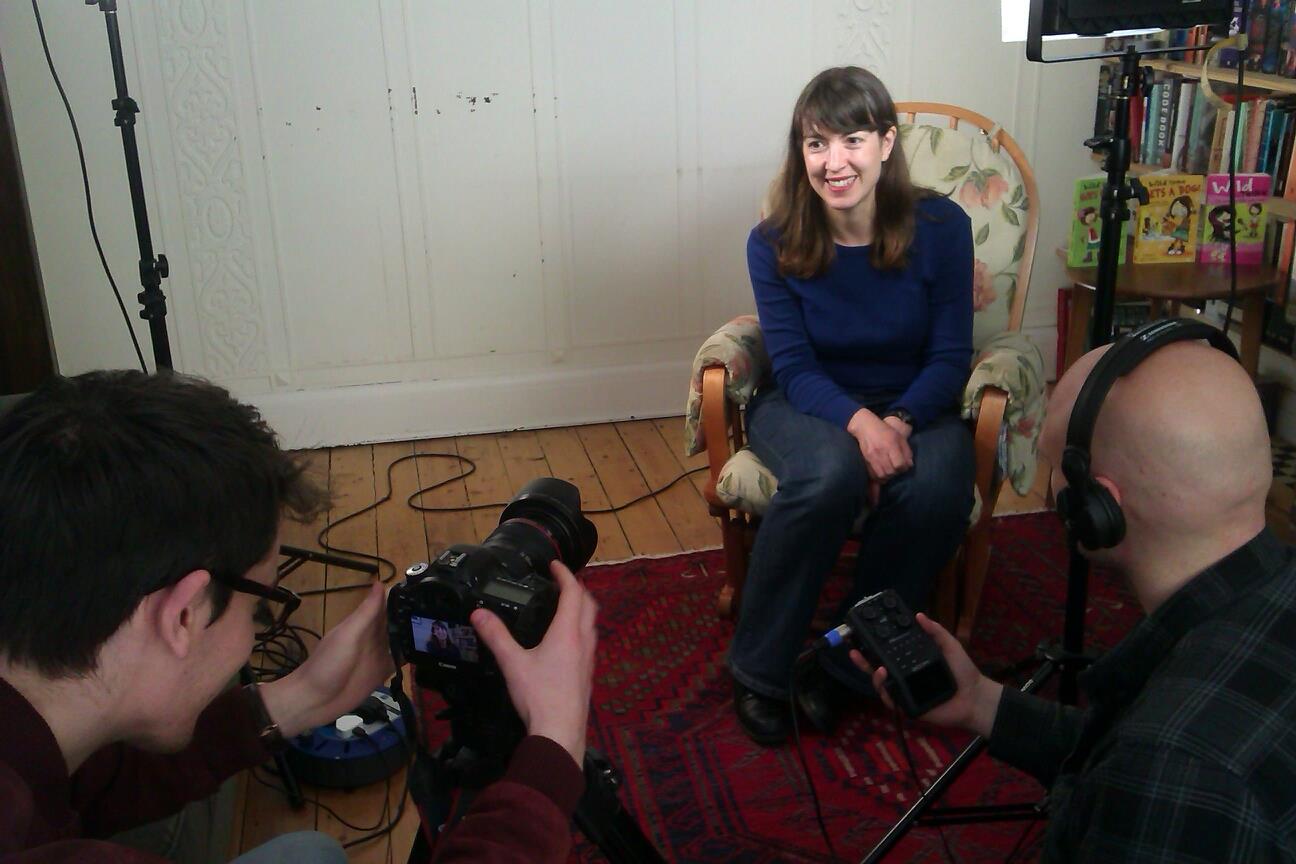
Meanwhile I got to be media star for a day. In my writing career, this is the first time I've had a film crew in my house. Many thanks to Findel designer Gary Hadfield (top left), and the guys from the EGL video (left to right) Andrew Birtwell, Simon Ashton and Luke Margetts who cheerfully set up their gear in my livingroom, braved my crazy dog, and didn't worry too much about the building noises from next door.


Getting ready to read


The team from Findel/EGL

Many congratulations, not only to the winners but to all the young writers who took part - I hope you all enjoyed it as much as I did.

--------------------------------------------------------------------------------------------------------------------------

Emma's Wild Thing series for 8+ about the naughtiest little sister ever. (Cover - Jamie Littler)
"Hilarious and heart-warming" The Scotsman

 Wolfie is a story of wolves, magic and snowy woods...
(Cover: Emma Chichester Clark)
"Funny, clever and satisfying..." Books for Keeps

Emma's Website
Emma’s Facebook Fanpage
Emma on Twitter - @EmmaBarnesWrite