Showing posts with label Tove Jansson. Show all posts

Tuesday, 25 July 2017

A Tove Jansson exhibition - by Sue Purkiss

I somehow missed the Moomins as a child. I think after that I was vaguely aware that they existed (cue existential debate!), but the first Tove Jansson book I read was one for adults, The Summer Book. I came across it in a bookshop, and just liked the look of it; it's very blue, which is my favourite colour, and it shows a small island floating between sea and sky.


It's about a summer in the lives of a child, Sophie, and her grandmother, on a tiny island off the Finnish coast. Sophie's mother is dead; her father's there some of the time, but he's very much a background presence. It's about the small things that happen each day: the things you have to be careful of when you live on a very small island which is vulnerable to fierce storms, like tying your boat up securely; the flowers and shells you find; the talks you have; the people who occasionally visit. It's suffused with the calmness of the sea, but also the underlying threat of storms. Tove Jansson's prose is clear as a rock pool, as elegant and beautifully shaped as a sea-washed pebble.

I went on from there to read most of her other adult books, but The Summer Book remains my favourite. I've also now read a couple of the children's books, which share the same precise prose, apparently grave but with laughter underlying it. She's incredibly inventive. As you travel with the Moomins through their world, its landscape and inhabitants unfold perfectly naturally, as if they've existed forever.


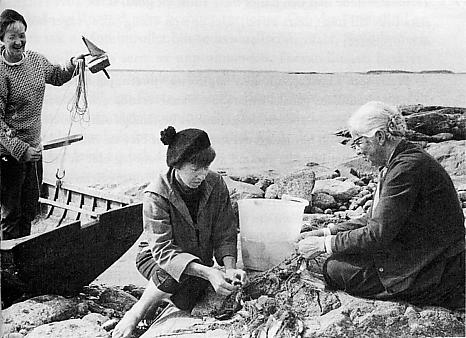
A few years ago, I watched a documentary about her life, and saw the island and the house which feature in The Summer Book, and the footage of Tove taken by her partner, Tuulikki - of Tove dancing beside the sea with flowers in her hair. So a few weeks ago, when we were on holiday in Copenhagen and saw that an exhibition about her was to begin while we were there, it was too good a chance to miss.


It was fascinating. It showed how talented she was in so many ways. She started as an artist - and very much wanted to succeed as a painter, not only as an illustrator. So here are many of her paintings, as well as satirical illustrations from the war years (Finland was invaded by Russia in 1939) in a magazine called Garm, and illustrations she did for other books besides her own.

Alice in Wonderland

The exhibition was first put on in Helsinki, in 2014, 100 years after her birth, and now it's touring Europe. I'm not certain, but I think it may be the one that's going to be at the Dulwich Art Gallery from 25th October this year. It certainly has some of the same works. (I hope it also has the wonderful room for children which was at the top of the building in Copenhagen: a sort of enchanted forest with crayons dangling from white columns, where you are invited to make your own notes and sketches - see below.)


I thought the self-portraits were particularly interesting. Very honest - almost brutally so. She saw so very clearly.


Friday, 12 September 2014

In praise of Tove Jansson

Just over a month ago, it was the centenary of Tove Jansson's birth.  There were public celebrations in her home land of Finland, and an exhibition at the Finnish National Gallery dedicated to the paintings, illustrations, and writing of this extraordinary figure.

I believe this exhibition also included the original miniature Moomin house on loan from its home at the Moomin Museum Tampere.  This is a blue, five storey building which Jansson built with her  partner Tuulikki Pietilä in the 1970's.  It's about three metres high,

http://moominmania.co.uk/wp-content/uploads/2012/02/house-tampere-art-gallery.jpg
Moomin House, Tampere (Adele Pennington)


I haven't been to see it, but my cousin and fellow Moomin-fan Ann  - who lives in Norway - has. She describes how "Tove and Tuulikki built the house using materials they found washed up on the beach. The roof tiles, by the way, were made from cedar bark they found and cut into shape using nail scissors. Fish-scale pattern. And Moominpappa stands in his room which is  equipped with maritime clutter, looking out of his window through his telescope. The small shy people are in tiny rooms in the basement."

But Tove didn't build this wonderful house to put in a museum. She didn't build it to market her books, or as a wonderful photo opportunity for social media. This house is a labour of love, a work of art, an act of pure creation by someone who felt compelled to write, draw and make from an early age, and for whom imagined universes arrived so fully realised in her head, they could literally be translated into bricks and mortar.

That house, along with so much else - like the sculptures and montages of scenes from the books they made together and put in glass cases - is for me a beautiful representation of why in some ways, Tove Jansson was the ultimate children's writer.

She wasn't just a children's writer, of course, not by a long stretch - but she was one of the greatest artists to write children's books.

In a famous 1961 essay, “The Deceitful Writer of Children’s Books”, Jansson writes that she writes for children not because she is particularly interested in them, or because she wants to entertain or educate them, but much more because she needs to satisfy "the childishness in herself".

This is not emotional immaturity or arrested development, of course - but rather a profound connection as an adult with the intuitive world of childish make believe and play, and a sad awareness at its passing.

Born into a somewhat madcap household of artists, from an early age Jansson was drawing, writing and making, at a dizzyingly prolific rate. It was like a compulsion, and I think any writer would - at certain times - envy that inexhaustible drive to produce and create. She developed her craft in all disciplines over many years, but in the 1970's, was able to sit down and build a toy house for her Moomins just as she might have done as a child at the beginning of the century.

Moominland is the world through the eyes of a child, captured with the skill of an adult, a synthesis of pure-make believe and acute, uninhibited natural observation, a perfect marriage of pictures and words. And it is a world of mystery tinged with an ineluctable sadness.

"It was the end of August — the time when owls hoot at night and flurries of bats swoop noiselessly over the garden. Moomin Wood was full of glow-worms, and the sea was disturbed. There was expectation and a certain sadness in the air, and the harvest moon came up huge and yellow. Moomintroll had always liked those last weeks of summer most, but he didn’t really know why.” (Finn Family Moomintroll)


The Moomins are popular worldwide, very accessible stories with pictures for readers young and old, with a warm and human cast of family characters, but the Moominvalley with its Hattifatteners and the Groke is also a strange, and occasionally frightening place - just like growing up. The mysteries of the wild country beyond are never far away:

“The very last house stood all by itself under a dark green wall of fir-trees, and here the wild country really began. Snufkin walked faster and faster straight into the forest. Then the door of the last house opened a chink and a very old voice cried: ‘Where are you off to?’

‘I don’t know,’ Snufkin replied.


The door shut again and Snufkin entered his forest, with a hundred miles of silence ahead of him.”


The genius of Jansson is her ability to take children so simply and so naturally on exciting night journeys down mysterious paths, never to deny the human impulse to grow and to wander - even if gallons of milk, berries and buns will always be waiting in a warm Moominhouse on your return.

The elegant drawings and poetic prose of the Moomins tread the finest of paths between an enticing retreat of warmth, family eccentricity and humour - that we know cannot endure forever - and the mysterious unknowable forest beyond. It's a path every child must take one day, and who better to guide you down that road than a Moomin? Which other cast of creatures so gracefully demonstrate the wonder, mystery and sadness of growing up?

If it is childish to memorialise childhood with such imagination and feeling, whether through a miniature blue house or the pages of a book, then let's always try and write for the childishness in ourselves.

Most endings are also beginnings.


Piers Torday
@PiersTorday
www.pierstorday.co.uk


Wednesday, 30 January 2013

Moominland: by Sue Purkiss


A couple of months ago, I went into my local bookshop looking for books for my six year old grandson. One of the assistants said, “How about the Moomins? Has he read those?” 

Well, no, I thought. And neither have I. There’s too much text for my grandson, but not for me.

I picked up Comet in Moominland and took it to the counter. “Ah,” said another of the assistants, nodding wisely. “The Moomins.” “Are you a fan?” I asked. “Oh yes. Any book would be better for having a Moomin in it.” (Now there’s interesting. War and Peace, with Moomins? Oliver Twist and the Moomins? I'm not sure it would work, but it shows how much the Moomin books mean to him.)

I read my first Tove Jansson book about four years ago. It was called The Summer Book, and it was on the adult shelves. It was the cover that attracted me first. It’s a paperback, but it has flaps, so you can easily mark where you stop reading. I like that. And I’ve no idea why, but the cover is nice to the touch – soft and smooth, but substantial. It shows a deep blue sky (Aquamarine? Ultramarine?) with just a couple of light cloud trails, and in the bottom quarter of the page is a small wooded island, edged with a pale stony beach, set in a dark blue sea.
On the real island

It’s about an elderly artist and her six year old grand-daughter and a summer they spend on the island. Nothing huge happens. When the southwest wind was blowing, the days seem to follow one another without any kind of change or occurrence… It was just the same long summer, always, and everything lived and grew at its own pace. It’s a small world, with only a few characters, and Tove Jansson simply takes you right into it, so that you come to know the place and the people very well, in all their apparent simplicity. You enter deeply into the way they experience life. And that isn’t an easy thing to do, either as a writer or as a human being.

I’ve read her other adult books too, though I think The Summer Book is my favourite. But the Moomins are what she’s famous for, and until now they have completely passed me by. I had vaguely thought I might have seen a television series, but then realised I was confusing it with something else – was it called The Clangers? About triangular shaped characters who lived on the moon and made funny squeaky noises?

Tove and a Moomin
Anyway, the Moomins are not at all like that. They are small creatures which look a little like smoothed-out hippos, or possibly – given that they’re Scandinavian – tiny trolls. They go on epic journeys and have great adventures away from the safety of home, but all in a slightly Winnie-the Pooh sort of way; I don’t mean it’s like Winnie-the-Pooh, but the characters have that quite grave way of thinking and speaking. And after the adventures, they come back home again. This is the last paragraph of The Moomins and the Great Flood:

And then she (his mother) took Moomintroll by the hand and went into the sky-blue room. And there in the valley they spent the whole of their lives, apart from a few times when they left it and travelled for a change.

It’s the same voice as it is in the adult books: cool, clear, utterly unpretentious and essentially rather serious. I love it, and though I’ve come a bit late to the Moomins, I intend to make up for it and read my way through the rest of them. Are there any other fans out there? And if so, can you explain what it is that you like about them?


www.suepurkiss.com


Saturday, 14 April 2012

When in Doubt, Rave About the Moomins


I think it's quite a good piece of guidance for life in general, but it's certainly useful for those times when you suddenly notice that you're supposed to be writing a blog post for Saturday and you forgot to start thinking of possible topics in plenty of time.

So I will rave about the Moomins. Just in case you don't know them, they are a family of cuddly and intriguing trolls, created by the Finnish author Tove Jansson back in the 1940s and still delighting children and adults all over the world (including me) today.

Many of the books I loved as a child disappoint me when I go back to read them now. That's not necessarily a fault of the books; it can simply be a matter of intended audience. It always surprises and delights me when books do stand the test of time; especially the test of growing up. 

I often tell myself I read for entertainment and escapism, to alleviate boredom, supply companionship and enjoy language. All those things are true. But I think the main reason I read (and always did) is to discover the magic formula for living. I still haven't found it, I know that much. It's what some people call an instruction manual, a kind of Hitchhiker's Guide to Life, but it's far more than that. Or it would be, should it exist. It would assure me of my place in things. Not too big a place - crushed by responsibility - but not too small, either. The bed and the bowl of porridge that are 'just right'.

So at times when I'm despairing of ever finding a way to accept myself, or when I doubt that the mush I call myself is even worth accepting, it's very important to have the right book - or series - to hand. The Moomins fit that bill. There's a central family: Moominpappa, Moominmamma and their son Moomintroll. They are smooth and round and covered in white, velvety fur. On a bad-weight day, that's exactly how I'd like to look. Tummies are fine in Moomin Valley. In fact, any size or shape or colour or hair/fur-type or personality is fine. You can disappear for months on end like Moomintroll's pal Snufkin, and turn up on the first day of spring to a wondrously warm welcome. You can hibernate all winter, presumably missing Christmas (hurray!) You can be brash and noisy like the Hemulen, a thoughtful philospher or a mischievous child  like Little My.


Life can be dangerous in Moomin Valley and beyond: this is not happy-ever-after land. There are always threats lurking - earthquakes, comets, tidal waves, floods, volcanoes and avalanches. The Hattifatteners, despite their name, are seriously scary electrically-charged beasties thtat grow from the ground in thunderstorms. There's a most unpleasant Groke, who sits on everyone and everything to try to warm herself, squashing the life out of you in the process.

Tove Jansson's love of nature, the sea, boats, landfalls and the offshore islands of her native land permeate these books. That's one of the reasons they work for grown-ups, too. But the main reason they work for me, I think, is that I just know that if I were to turn up in Moomin Valley one sunny April day, Moominmamma would put another leaf-plate on the table and tell me to sit down. I could find my own place in that extended family, which might include spending whole days or weeks alone but knowing there'd be a big velvety cuddle waiting for me when I needed it.

That's my definition of heaven, I think...

These books are inspired and if you, you children and your grand-children haven't discovered them yet, then you have a lifetime of treats in store, so dive in.

View on Amazon.co.uk

What are your favourite comfort books? Have any of them stood the test of your growing up?

Best wishes
Ros

Author of Coping with Chloe (age 11+)
Newly available as an eBook: Charity's Child (age 14+)
Blogging at Rosalie Reviews
My Facebook Author Page
Twitter: @Ros_Warren