Showing posts with label Literary Festivals. Show all posts

Tuesday, 11 August 2020

Of tough decisions and online literary festivals - Kelly McCaughrain

My latest highly scientific lockdown Twitter poll was: Online Literary Festivals can have bigger audiences, cheaper tickets, are easier to attend, and are more environmentally friendly. But they employ fewer people, don't sell the author's books, have no social aspect etc. Would you like more festivals to be online post-lockdown?

The results were:

Yes – More eco-friendly 0%
Yes – easier to attend 22.2%
No – just not as fun 38.9%
No – job cuts, book sales 38.9%

Personally, I’m a big old yes, mainly because I possess a degree of introversion that is genuinely staggering, and any methods of reducing human interaction get the automatic thumbs up from me. 
But I was also swayed by the eco argument and I was kind of surprised that this got no votes at all.

Literary festivals are great. They provide a much needed income for writers, they sell books, they allow likeminded people to socialise and get excited about reading, they create jobs and promote the arts. I’ve been very grateful for the ones I’ve been asked to speak at and I think they’re important for writers and readers. But I’m also quite happy for them to be virtual.

Partly because they do have a carbon footprint, in the shape of writers having to fly all over the world, as well as readers flying or driving to attend. Most people who go are probably locals but some will have come a long way and that’s always kind of bothered me. Big name writers take dozens of flights a year to attend these things. Probably living in Northern Ireland makes me more aware of that because we have to fly to go anywhere, but having to take two flights just for a one hour event makes me feel really guilty. I’ve done it, and I'm sure I'll do it again, because I feel a responsibility to my book, my publisher, my agent, myself and my mortgage to do it, but I did feel bad and I kept thinking, how long are we going to get away with this shizz? Surely it's ridiculously wasteful.
I’ve always been kind of disgusted that my husband occasionally has to do long-haul flights just to go to meetings for his work. Surely if we’re taking the climate emergency seriously the first thing that has to go is long-haul travel to do things that could be done via the internet? I think a lot of companies were just used to doing things a certain way and assumed they couldn’t be done any other way. But since lockdown we’re discovering that a lot of things we thought were impossible, are actually complete possible, and environmentalists are claiming lockdown is proof that we can live differently. My husband hasn’t flown anywhere this year and his company has not collapsed for the lack of face to face meetings. Should we be saving the air miles for jobs where it's essential? 
On the other hand, his company did their annual conference online this year and my husband said it was pretty rubbish and he missed talking to people in person. Is it something we just need to get used to, or does it just not work at all?  

Literary festivals have not been stopped by lockdown. Some have been cancelled but a lot have moved online and if lockdown had continued for another year I imagine the rest would have followed suit.

And while there are cons to that, there are also pros. If you don’t happen to live in a big city, going to festivals can be really expensive. Even when I can afford it, I probably couldn’t be bothered going all the way to Edinburgh or Hay just for the two or three events I really want to see. But if they were online, I could go.

And a lot of festivals are run on a shoestring. There’s so little funding, and there’s going to be even less when the economic fallout of this year hits us. But an online festival event can cram in a lot more attendees than your tiny local library, and it’s easier for people to attend, so theoretically they could be selling a lot more tickets. Maybe even cheaper tickets.

And no one has to fly anywhere! 
 
But would people actually attend? It’s probably not ideal. Even I like the festival bookstalls, I like heading to the pub with a friend after an event, I’m sure it feels much more natural to talk to an audience you can see, I’d much rather do a school visit in person than online, and I kind of loathe Zoom calls. So yeah, we're talking actual sacrifices here. But that's kind of the point. 

We all complain because the idiots in power have been so slow to address the climate emergency that it might actually be too late. But do we really mean it? Are we willing to make changes in our own lives? Actual sacrifices that actually hurt. Surely (whisper it) literary festivals (that you can attend online anyway) aren’t anywhere near the top of the list of essentials.

So anyway, I was just a bit surprised that no one seemed to consider that a factor. What do you think? If everyone had to limit their air travel to two flights a year, would you be willing to see literary festivals move online to help us do that? Or would you stop attending if they weren’t IRL? How do you think the literary world can/should contribute to reversing climate change?

In the absence of real changes from the government to tackle climate change, I’m genuinely interested to know what people would be prepared to do without. I’m not saying it would be ideal, and I’d pretty much club a baby seal to death* to attend the Iceland Writers Retreat. 

(*not really)

But since I’ll never be able to afford the Iceland Writers Retreat, I can afford to be sanctimonious. 

I'm kidding. I love Greta.


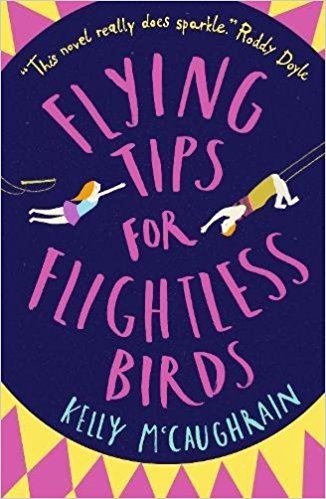
Kelly McCaughrain is the author of the Children's Books Ireland Book of the Year,

Flying Tips for Flightless Birds

She is the Children's Writing Fellow for Northern Ireland #CWFNI

She also blogs at The Blank Page

@KMcCaughrain


Monday, 29 February 2016

Boycott or not? - John Dougherty

Hanging out in one of the hotel bars
Some of you may have read about the Think Twice campaign, asking authors to boycott the Emirates Airline Festival of Literature in Dubai, which starts this week. The campaign's objections are to the festival sponsor, Emirates Airline, which is owned by the government of the UAE, a government with a less than enviable record on human rights.

Now, before weighing into the debate, I guess I should declare an interest of sorts. I went to the festival last year, and had a great time.   The organisers treated us tremendously well; the other authors were fantastic company; and all in all, it was as good as a holiday. So - as per the photographic illustrations to this piece - I have some very good memories of and feelings about the festival which may well compromise my objectivity.

Meeting a hawk in the desert
I should also say that I've got no objection to a decent boycott. I haven't knowingly bought a Nestlé product in years, probably decades.

Young Bond author Steve Cole on a camel
 But my feelings about Think Twice's proposed boycott sway between undecided and uneasy, and I'm not entirely sure why. In part, at least, I think it's the idea of targeting a festival solely on the grounds of its sponsorship that troubles me.

Leaping about in the desert with Steve
& photographer Lou Abercrombie
(there with her husband,
 YA author Joe)
The thing is, there are a number of festivals whose sponsors I have serious issues with. There's the Times & Sunday Times Cheltenham Literature Festival, a festival I'm proud to have spoken at more than once, but whose main sponsor is owned by Rupert Murdoch, a man who I believe has done immense damage to political discourse in this country and who holds disproportionate influence in the corridors of power. Or the Hay Festival, sponsored by the Telegraph, whose owners are allegedly no friends of democracy.

Now, if Murdoch or the Barclays tried to censor the festivals which which they're respectively associated, I think that would almost certainly be grounds for a boycott. As far as I know, they haven't. But as far as I know, there is no reason to believe that either Emirates Airline or the government of the UAE have tried to influence festival policy, let alone impose censorship.

Lunching with Steve & illustrator
extraordinaire David Tazzymen
I really don't want to downgrade the importance of the human rights argument. But Think Twice isn't calling for a boycott of every festival held in a territory with a poor human rights record; only this one. So I suppose my question is this: should the nature of their chief sponsor mean that Emirates Airline Festival of Literature should be held responsible for the UAE government's human rights record? 

I'm not sure it should. The organisers are not connected with the government; they're simply book enthusiasts who have worked hard to get a literature festival off the ground, and who have sought sponsorship from a local company with a lot of money. And I'm not sure it seems fair to try to close down their festival as a way of protesting against the sponsor. If the boycott is successful, the Emirates Airline Festival of Literature will be no more. Emirates Airline, and the UAE government, will continue exactly as before.

What do you think?


__________________________________________________________________________________________________________


John's Stinkbomb & Ketchup-Face series, illustrated by David Tazzyman, is published by OUP.


His new books in 2016 will include the next two Stinkbomb & Ketchup-Face titles, his first poetry collection - Dinosaurs & Dinner-Ladies, illustrated by Tom Morgan-Jones and published by Otter-Barry Books  - and several readers for schools.


Sunday, 23 February 2014

the Magic of the Hay Cartagena Festival - Maeve Friel


Cartagena de Indias is a walled city on the Caribbean coast of Colombia, founded by Spanish conquistadors in 1533. I was thrilled to visit it recently to attend the Hay Cartagena Literary Festival. It is a magical and enchanting city, steeped in romance and brimming with literary and historical references.  It is also beautiful. Once squalid and rundown while a new high-rise city grew up further along the coast, old Cartagena has undergone a renaissance and is full of old colonial houses, secret courtyards,  leafy squares and cobbled streets of vibrantly painted houses with bougainvillea spilling from their wooden balconies.


It is the unnamed but clearly identifiable city where Gabriel Garcia Marquez set Love in the Time of Cholera.  In late 19th century, Cartagena was gripped by cholera and the bourgeoisie tried to avoid being infected by cholera by enclosing themselves in the walled city.
You can sit on a park bench under the almond trees in the Plaza Fernández de Madrid and imagine the lovelorn Florentino Ariza sitting beside you reading poetry and hoping to catch a glimpse of Fermina Daza emerging from the handsome house opposite, the one with the overhanging balcony and the parrot door knocker beside the Alliance Francaise. (I missed the parrot door but saw many other distinctive ones. I´ve a bit of a thing about door furniture.)


Or you can stroll under the arches where Fiorentino and Fermina first met and where the hawkers still sell sweets to passersby. 


1.    The gorgeous Hotel Santa Clara (where the visiting Hay writers all stay), inspired another magical novel by Garcia Marquez Of Love and Other Demons. Once a convent, this is where Garcia Marquez, then an aspiring journalist, first heard about the discovery of a skeleton of a girl with over twenty metres of hair. 
Nowadays, rather than captive virgins and demure nuns,  there is a large Botero nude in the lush hotel gardens and a resident toucan flitting about.  

On the first evening of the festival, I had arranged to meet John Boyne for a drink in the hotel bar - he had earlier given a fabulous talk with Peter Florence. director of Hay,  about his new WW1 novel The Absolutist. The slightly surreal atmosphere of the place was enhanced when we heard plain chanting and a pair of incense bearing cowled monks appeared, a nightly ritual in honour of the hotel´s former existence as a monastery.

2.      
Everything about the city was an inspiration but add in the Hay Festival participants and you have a heady mix.

 
Irvine Welsh talked about Skagboys, a return twenty years later to his characters in Trainspotting (the most shoplifted book in the UK, apparently). He spoke about heroin addiction, Scottish independence, the breakdown of consensus in modern Britain and  his love of music. He told us that he creates a playlist for every character: he needs to know "where they stay, who they lay and what they play".
   
There were so many highlights: the Mexican actor Gael Garcia Bernal (Motorcycle Diaries, Y tu mama también) introducing his documentary about illegal immigrants to the USA); a thoughtful Joe Sacco, self-described cartoonist, with his new fold-out frieze about WW1 and getting some hostile questions about his book on Palestine and its "lack of balance"; Yoani Sanchez, the Cuban blogger; David Rieff, the journalist, talking to Colombian writer Hector Abad about remembrance in the context of war and conflict,  how memory is not sacred, is often faulty, and controversially declaring that there is no such thing as collective memory. Remembering is not a moral act - under some circumstances, it is better to forget. 
I loved  Rosie Boycott´s interview with the engaging Tom Hart Dyke, orchid fanatic, who spent eight horrendous months as a hostage of the FARC guerrillas in the Darién rainforest in Panamá. 

Strolling from venue to venue, there were many bookshops and cafes - Abaco,  my favourite,  was both  bookshop and café.


4    Leaving Abaco one night, I was delighted to meet Martin Murillo who has been wheeling his carreta literaria, his literary cart, through the streets of Cartagena for years, lending books for free. 

     
An early school leaver, Martin  used to sell bottled water but was sponsored to fulfil his dream and set up his literary cart by the organiser of a beauty contest and a journalist who were his water customers.(Doesn´t that sound like something Garcia Marquez would make up?) From the original two hundred volumes, his library now has thousands of books, all donated by publishers and individuals - every day he makes a new selection to include children´s books, novels, technical manuals, poetry, philosophy. Loans are free and without strings attached. He assumes people will be honest and return their books, even if it takes them years.  He now travels around Colombia visiting schools and libraries encouraging the love of reading. 


Another morning, we saw two men sitting on upturned paint tins, playing draughts on a painted square of wood with red and white bottle tops as pieces.

Day and night, there were colourful palenqueras, the descendants of slaves from Palenque, selling fruit from the trays they balanced on their head. This lady told me she started aged ten.


There were vultures on the roof tops, horse-drawn carriages and literary celebrities strolling on the sea wall in their new Panamá hats. 

There were children in a courtyard drawing armadillos and spider monkeys and, in a school that I visited, a flock of peacocks in the grounds to keep the snakes away.
 You couldn´t make it up.

Maeve Friel
I am currently living in Panamá. Please come and visit my website www.maevefriel.com or subscribe to my blog www.maevefriel.com/blog where I am mostly writing about my time in Panamá and about Latin American children´s literature. Or follow me on twitter @MaeveFriel or on Facebook.


Thursday, 25 April 2013

Festivalitis - Tamsyn Murray

My name is Tamsyn and I have an affliction. It's one you might identify with, especially if you've spent much time at literary festivals in your professional capacity as a writer. At the time of writing, there's no known cure. I'm talking, of course, about Festivalitis and I have it bad.

It starts gradually, the symptoms so slight that you don't notice them. You might have had to travel to get to your festival - maybe someone gave you a travel itinery to follow. They probably booked your train tickets for you. You could be met at the station by a nice PR person from your publisher, who plies you with tea and cake and ensures you get to where you need to be.

A typical Green Room view - in the case,
Chipping Norton Lit Fest getting it just right.
At the festival, you might be staying overnight, or even for a few days. You'll stay somewhere nice and be provided with food and drink. Your friendly PR person will make sure you are fed and watered at all times and will strive to ensure you have everything you need at your fingertips - you want buttered unicorn eyeballs? No problem! And the green room will be full of other writers, some of whom know you, all of whom understand you. There will be some mutual preening and a lot of laughter.

Photographers and journalists are fascinated by you. If you're lucky, lots of fans will attend your event and there will be a long signing queue afterwards. Your PR pal will tell you how marvellous you were. And they'll supply you with more tea/wine/cake, then ensure you get on the right train home.

That's when Festivalitis really kicks in. It's been wrapping you in its sticky web without you even realising it and now you're ensnared. The first inkling you'll have is when you look around for a cup of tea and realise you're going to have to get it yourself.

Oh, the horror! It gets worse when you arrive home - your family don't know that you're suffering and can look askance at your request for a glass of something chilled and the menu. For me, I knew I was infected when I got off the train after a few days at Hay, approached the car and stared in confusion at the door handle, wondering why my husband hadn't jumped out to open it for me. I had to put my own suitcase in the boot too, which was another shock. And then it dawned on me that I'd contracted Festivalitis, an affliction which strips away your ability to function properly in the real world. It might go into remission once you've spent a bit of time in the real world but a relapse is only ever an invitation away.

My name is Tamsyn and I have Festivalitis. It has been four days since my last lit fest. I really miss the cake.