Showing posts with label Kitty Barne. Show all posts

Monday, 6 July 2020

A Book by its Cover by Paul May

I’m not sure whether ‘You can’t judge a book by its cover’ is a proverb or a metaphor or a piece of advice. If it’s a piece of advice, I’ve always ignored it. And if it’s true than I wonder why publishers spend so much time trying to get the cover right and why it caused such a kerfuffle when Waterstone’s recently turned all the books round to show the blurb on the back.

My kind of cover. This was published in 1944,
not long after Visitors from London.

Last month I wrote about the book which won the Carnegie in 1940, and Penny Dolan wondered ‘how the book worked with the readership rather than the library judging panel’. That’s a question that’s hard to answer after all this time, but it made me think about how I chose books when I was a child, and about the books I read and enjoyed myself. 

It's a book with children in it. I expect they're visiting
 from London. I would not have taken this off the
 library shelf, which is a shame because I might have enjoyed it.

My period of peak children’s book reading came between 1960 and 1966. I read a lot of books in that time, but I never owned any of them. They all came from the library. I don’t know if I’m unique, but in my family, back in the 1950s and early 1960s we all read a lot but we didn’t own or buy books. Penny mentioned that most children’s books these days are bought by parents and grandparents. I’m sure this was true back then of those children who owned books, the ones who had the latest Arthur Ransome or Noel Streatfeild delivered to the end of their bed each Christmas. But my reading was completely unmediated by my parents, or by any adult other than the children’s librarian at my local library who chose which books to buy, if such a person existed. 

Same colour but a world of difference.


And so I had two main ways to choose a book. The first was to look for anything by Enid Blyton and the second, deployed when I couldn’t find a Blyton I hadn’t read, was to look for something with a cover that looked equally exciting. If it was good, I’d then read everything by that author. Once I’d exhausted those possibilities (and there wasn’t an unlimited supply of my kind of book) I’d select books almost at random and read a bit. If the first page was good, I’d read the rest. I’ve never been a reader of blurbs.
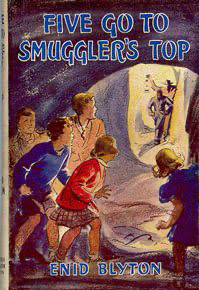
The promise of excitement


Even more excitement


My lockdown reading of Carnegie winners has now taken me as far as 1950. Based on their covers there is only one of those winners that I would definitely have read back then, and it’s the only one I did read—Pigeon Post. The Arthur Ransome covers are an inspired piece of branding that makes them stand out, even today, from everything else around them. I might have read The Circus is Coming too, but it would have been in the third category, a browsed book where the first page hooked me in.

No chance. Even a bit scary!


 I would definitely not even have opened The Radium Woman or Visitors from London. Sea Change by Richard Armstrong looks like the sort of book they’d give you to read at school and Agnes Allen’s The Story of Your Home is a book I would have been terribly disappointed to receive for Christmas, even though, as I’ve said already, books were not given at Christmas, or any other time, in my family. I wouldn’t have been interested in gnomes, either, or ponies, and the opening pages of We Couldn’t leave Dinah are way too ponyish for me, or rather, for the boy I was then.

A pony and a stable? I don't think so.
Why no evil Nazis on the cover?

Back in the early sixties most, if not all of those early Carnegie winners would have still been on the library shelves for me to take home. I’m sitting here trying to figure out what I would have made of them back then if I had been made to read them, or if they had been read to me. (As far as I can remember we never had a daily story time at my primary school, and I didn’t have bedtime stories at home after the age of about five, but I had three younger sisters so you can see why!) 

The main problem with many of these books for the me-back-then is that there is too much in them about adults. That would have stopped me for sure, so Eve Garnett, Eleanor Doorly, Kitty Barne and Eric Linklater all fail that test. It would have put me off the Noel Streatfeild too, but there’s enough fun and action to have made it work for me. The gnomes in The Little Grey Men are very old and the whole thing is a bit weird and Walter de la Mare is very weird and there are adults there too. Elizabeth Goudge’s The Little White Horse is a special case because it is very much, or would have seemed to me then, a girls’ book, not so much because it’s about a girl as because it goes on about loveliness most of the time, and even when people aren’t lovely you just know it’s going to turn out fine in the end. It’s a terrific book which I’ll write more about later, but ten-year-old me would never have read it. A girl and a unicorn on the cover! No way! (Oh, and quite a spoiler that as well.)


Anyway, by the time I was eleven or twelve the covers of the thrillers and detective stories my mother brought home from the library were more enticing than anything I could find in the children’s section and that was me done with children’s books pretty much for the next ten years. I don’t think I was so very different from many other children, then or now. I read what I wanted to read, and mostly the books I read were by writers who never won the Carnegie Medal—Enid Blyton, John Pudney, M Pardoe, Richmal Crompton, Laura Lee Hope (yes, I read The Bobbsey Twins)!

More modern readers, too, like to go their own way. Roald Dahl, Jaqueline Wilson, JK Rowling, none has won the Carnegie Medal, which I think tells you that if you really want to know about the history and pattern of children’s reading over the past 80 years, the list of winners of the Carnegie is probably not the best, and certainly not the only place to look.

Now that's what I call a cover!


And finally I have to admit that, although my taste has broadened a little since I was ten years old, if I want a book I can't put down I turn to the likes of Michael Connelly, Robert Crais, John Harvey, Ian Rankin, Sara Paretsky or, lately, Adrian McKinty. First the name, then the cover. And I love Dick Francis from his golden period in the 1960s and 1970s—another find from my mother's piles of library books.

If I'm browsing in the library or bookshop I still choose books the same way. First by the author, then by the cover. If it looks like my kind of thing I read a few paragraphs and that's enough for me to tell if I'll want to finish it. So, best keep those covers turned to the front, Waterstone's, at least as far as I'm concerned.

Saturday, 6 June 2020

Kitty Barne's Visitors from London by Paul May


Here are a couple of quotes from Kitty Barne’s 1940 Carnegie Medal winning book Visitors from London.  The four Farrar children have arrived in the Sussex countryside to spend their school holidays on a farm with a youthful aunt named Myra. 'Steadings' is a nearby farmhouse, rented by a writer friend of theirs, that has been empty for a couple of years. This writer friend has lent it to be used by evacuees.  

“. . . it was to be used for the overflow of London children if there was a war . . . They were all to be moved out of London, the children, millions of them, in three days . . . How many did they think they could take?
‘What aged children?’ inquired Myra . . . ‘What age and what sex?’
But that, it seemed, was more than Miss Williams or anyone else could tell her. The idea was that the children came to the London stations, and if a train was there, drawn up at a platform, they got in it and went. Any children, any platform, any train, to any place. As for their age, schoolchildren were between five and fourteen. How many could they take?”

The government have apparently promised to provide everything, but luckily Myra is practical and realistic. “Beds, blankets, mattresses—they’ve been promised, but that doesn’t mean they’ll come.”

It’s impossible not to hear the echoes of today’s government’s panic and muddle. Nothing changes!


This is the last of my wartime Carnegie reads and it's slightly dizzying to realise that it was published 80 years ago. I approached it with some trepidation when I finally managed to track down a copy. Four middle-class children on holiday from their boarding schools encounter four evacuated working-class families from London. It could be what a friend of mine once called ‘a minefield of naffdom’. Only it isn’t that at all. It turns out to be an outstanding piece of observational writing. I can’t remember ever reading such brilliantly observed very young children anywhere else outside of picture books—I’m talking about 2, 3 and four-year-olds—and it’s not just the small children either. This book is overflowing with economically drawn, fully-realised characters. Without looking back at the book I can count up twenty that I can summon up clearly—quite distinct from each other, each with their own, memorable personality. 

Frontispiece by Ruth Gervis

At times, especially at the beginning, the language used is a little dated, especially so in the internal monologues of young Jimmy Farrar. To a child in 1940 I’m sure this would have sounded fresh and contemporary, but it raises an interesting question for today’s children’s authors about how far it’s worth sacrificing longevity for the sake of that modern feel. Here’s Jimmy:

“. . . it was queer, it really was, the way David and Gerda remained dead nuts on horses though they hardly ever saw one. There was no money for extras like riding in their family. Came of having ridden in India, he supposed, when he and Sally were too small to do so. Now a car was worth looking at. Every blessed one of them different . . .’

I don’t mind this at all myself. I’m sure it’s how Jimmy and his contemporaries talked, but I suspect it may be one reason why this particular Carnegie winner is out of print, hard to find, and undeservedly forgotten. Not a huge amount happens, but everyone is changed by their experiences. Here are some examples of those young children I was talking about. In this first extract the families from London have just arrived after an exhausting journey.

“Hardly had they gone through the gate when they ran into a small boy. He had on a coat far too big for him, and his head with its large grey cap stuck out from the collar in a bewildered tortoise-like way.
            ‘Please, wot’s the way out of the park?’ he asked them in a wavering voice.
‘Way out of the park? But this isn’t a park,’ said Sally.
‘I got to get fish and chips for mum. I got a shillin’, but I can’t find no way out to the streets. I bin all round. No cops to ask either, there aren’t.’
            It was Ernest. His big grey eyes, ringed with fatigue, were swimming with tears. The moment Mrs Huggett had gone his mother had fancied fish and chips for a bit of supper, and sent him out to get some. He’d promised dad to take care of mum but he couldn’t find no shop . .  . If this wasn’t a park he didn’t know what it was.”

And here are some children playing on their own. This scene could come from any Nursery or Reception class (complete with well-meaning adult asking stupid questions, or well-meaning ten-year-old in this case):

“It was a hot day and no one was wearing very much. Cyril was driving Ireen, harnessed with a piece of rope. Sydney, in a pair of bathing drawers, was playing a game of his own up and down the steps where once poor Mr Bloss’s parents had climbed to mount their horses. He travelled up them, gave three stamps, and came down again; that was the whole game, but he’d made it up himself so he was happy playing it. Benjy was sitting in Syd’s bed of earth, digging with Syd’s spoon, busy planting his three wooly balls. Syd had lost interest in these possessions.
            Feeling interested, but rather out of it, Sally decided to tackle Benjy.
        ‘What are you doing, Benjy?’ she inquired.
‘Plantin,’ said Benjy.
‘What, potatoes?’
‘Yus. Potatoes and gravy.’ He hadn’t thought it out, but that would do.” 

A trip to the beach

Visitors from London was based on Kitty Barne’s own experience as a house mother looking after evacuees. She was married to Noel Streatfeild’s cousin, Eric, and it was at Streatfeild’s suggestion that Barne had turned to writing children’s books. After her promising career as a musician had been cut short by a botched operation which left her deaf in one ear, Barne had made a name for herself writing, producing and directing amateur theatrical performances for the Girl Guide Association, as well as serving as their music and drama adviser. By 1936 she was worn out by the work and found herself in hospital with a breakdown. Streatfeild, fresh from her triumph with Ballet Shoes, urged her to write a story about a musical child. This was She Shall Have Music, a book which lost out in the 1938 Carnegie Medal competition to Streatfeild’s own The Circus is Coming

Kitty Barne

Visitors from London is illustrated by Noel Streatfeild's older sister, Ruth Gervis, and the process of illustration was a truly collaborative one. Gervis describes it: 'After I had read over the MS, we would meet and then, her good ear towards me, her eyes shining, her face alive with interest, she would discuss her characters. I used to make dozens of quick sketches of every single character until I had got them as she pictured them.'

It's hardly surprising that Visitors from London reflects to some degree the conventional views of the time about the roles of men and women, but there are plenty of strong female characters in this book, not least 12-year-old Lily who acts as a mother to her two younger siblings. ‘I’m twelve I am. Two years I’ve bin looking after them. Mum she went to hospital and she said Lily, if I don’t come back you mind them.’ Lily is incredibly competent and practical, and she even travels with a tin-opener!  Then there’s Daphne, a volunteer who’s going to be a land girl and wears slacks. Here’s her first appearance: ‘She strolled on long slim legs over to the byre, and they saw her in the shadow leaning against the door, and talking to the cowman.’ Economical, elegant prose.

But Kitty Barne waits right till the end, when the husbands turn up, to show us why Mrs Thompson, with her two children and new-born baby, is so timid and miserable. ‘Mr Thompson had come down, as he told his wife at once, with the intention of taking her back to London. He had had enough of being by himself, enough of boiling the kettle and making himself tea when what he wanted was something hot and something ready when he got back from work.’

And then we see Mrs Thompson in the back of the van as they are about to leave: ‘Roly peered in and saw Mrs Thompson, a jelly of tears, sitting in a dark corner of the van, Myra Jinny (the baby) in her arms. ‘Been so kind . . . don’t want to go,’ she sobbed.’

This really is a very good book by a very good writer. She wrote many more books and I’m looking forward to reading them.

Visitors from London is out of print.