Showing posts with label Jacqueline Wilson. Show all posts

Tuesday, 17 April 2018

A Report from The Golden Anniversary of the FCBG Conference by Chitra Soundar


This year the Federation of Children’s Book Groups are celebrating a big anniversary and I was honoured to be invited to be on a panel with Lantana Publishing who are publishing my next two titles You’re Safe With Me and You’re Snug With Me, both illustrated by the very talented PoonamMistry.


The conference itself runs for three days, each year a different regional group organising it in conjunction with the national committee. I was invited for a panel event on the second day and I was a bit intimidated that we were going to follow James Mayhew and we will be the warm-up act for Jacqueline Wilson, the super-woman of children’s literature, especially writing stories that represent misfits and unique kids, like I was.

So I was proud to collect my badge which said speaker. And then I realised I knew quite a lot of people there, either because I’ve met them before at various school events or friends on Twitter or Facebook. 


We setup our presentation with the help of Stewart Jordan, the amazing theatre manager.


Our panel was made up of three women – Alice Curry, founder and publisher at Lantana Publishing, Mehrdokht Amini illustrator of two beautiful books with Lantana Publishing and yours truly, writer of You’re Safe With Me.


We discussed how books can span from local to global and the other way round and what does that mean to Mehrdokht and me as creators. We discussed how sometimes tensions will arise between commercial appeal in the western markets vs. the authenticity of the content. We also discussed how Alice makes choices for her list – which story, which culture and the creators.

The audience was made up of librarians, teachers and people who love books and they not only listened to us tell our stories, they laughed in the right places too.

They also had a hall full of publishers showcasing their books and I was proud to be on three tables – OtterBarry Books, MMS Publishing and Bounce representing all my books. There was also Brenda’s Bookshop and I got to sign advance copies of You’re Safe With Me. The illustrations by Poonam Mistry were a big hit and everyone could see how excited I was about the book.

It was my first FCBG conference and it was fun to be there on their Golden Anniversary. I got to listen to Dame Jacqueline Wilson speak and it was wonderful listening to the master. I got to meet so many other authors, friends from twitter and wonderful people of the book world. And yes there was cake!

Find out more about FCBG here: http://www.fcbg.org.uk/ and find out about their conference here - http://www.fcbg.org.uk/conference/


Chitra Soundar is the author of over 30 books for children. Find out more about You’re Safe With Me and all her new books at www.chitrasoundar.com and follow her on twitter @csoundar

Sunday, 17 January 2016

Getting Rid of Mum: Books With Single Parent Dads in Children's Fiction - Emma Barnes


I wasn't sure why I created a family without a mother when I wrote Wild Thing. I've nothing against mothers. I've a very nice one of my own. Many of my best friends are mothers. Not to put too fine a point on it, I AM a mother. It wasn't something I thought about at the time. Kate and Wild Thing just didn't happen to have a mum. They had a dad looking after them instead.
interior from Wild Thing Gets A Dog - copyright Jamie Littler


I think a lot of the reasons writers choose something are unconscious. Afterwards, bringing a more deliberate analysis to bear, the reasons become clearer. So now I've no doubt that the reason I got rid of Kate and Wild Thing's mother was because I wanted as much mayhem as possible. I planned these to be funny, chaotic books. Although I hate to admit it, I suspect that's easier without Mum.

Single Parent Families featuring Dad have a lot of advantages to a writer. Somehow, it seems entirely natural for dad to be fun and quirky, to be a lousy cook, and to forget about things like the start of term, or a child's need for new socks. Of course, mothers are quite capable of forgetting these things too. (Well, I am.) But it strains the credulity of a reader more. (Or it's just harder as a writer to break that “responsible, boring Mum,” stereotype.) So maybe writing about a Single Dad is the best way of writing about the chaos and mishaps which are, if truth be told, absolutely normal in all families everywhere.

Here are some children's books featuring single dads.

Danny the Champion of the World by Roald Dahl


Danny adores his dad, and together they have crazy adventures – would a fictional mother have been allowed to be so irresponsible, and yet so loveable?

The Summer House Loon by Anne Fine


Ione's dad Professor Muffett is an absent-minded academic, preoccupied with his research into “Early Sardinian trade routes”. He is also blind. An entirely sympathetic character, it is not surprising that a certain amount of chaos flourishes in their household in this witty, sophisticated book. A really fun read for a certain kind of teenager – the kind that doesn't want angst, but some comedy instead.

The Penderwicks  by Jeanne Birdsall


Another absent-minded professor, Mr Penderwick is left to bring up his four daughters when his wife dies, in a book which is a bit like a more modern version of Little Women, but with a dad replacing “Marmee”.

Rooftoppers by Katharine Randell


This prize-winning book features...another academic single dad. (Hmm, beginning to detect a bit of a trend.)   Charles is the foster father to Sophie, who is an orphan from a shipwreck. He is absent-minded and eccentric and he and Sophie eat off books rather than plates, their bizarre house-keeping getting them into trouble with social services. It's rather whimsical but also very appealing.

The Longest Whale Song by Jacqueline Wilson


And finally...you can rely on Jacqueline Wilson to be a bit more down-to-earth, and although she's written several books with single dads, I don't think any of them are absent-minded academics. What is especially nice about this one, is that it features the relationship between a girl and her stepfather, forced to work as a team when the mother enters a dangerous coma after her baby's birth. Ella's stepfather is far kinder and more responsible than her biological father, and once again Wilson shows that a successful family can come in all shapes and sizes.

Please tell me your favourite single dad stories...with or without absent-minded professors.


------------------------------------------------------------------------------------------------------

Emma's Website
Emma’s Facebook Fanpage
Emma on Twitter - @EmmaBarnesWrite

Emma's Wild Thing series for 8+ about the naughtiest little sister ever. (Illustrated by Jamie Littler)
"Hilarious and heart-warming" The Scotsman

 Wolfie is a story of wolves, magic and snowy woods...
(Illustrated by Emma Chichester Clark)
"Funny, clever and satisfying..." Books for Keeps

Thursday, 3 December 2015

Losing Your Daemon - Sharon Tregenza

Recently my dog died and it hurts a lot. He had been a constant companion, padding beside me upstairs and down and in and out of every room. While I worked, he waited patiently in his basket next to my desk. He was the truest friend, and the inspiration behind Tia the beleaguered Yorkie in The Shiver Stone. So forgive the indulgence - today, as a small tribute, I give you 'writers and their dogs'...

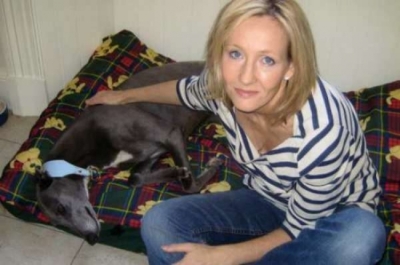
First up - staff at a small Scottish dog rescue centre were surprised when a certain J K Rowling showed up with her family, including their Jack Russell terrier, Butch. The entire clan fell in love with, and adopted, a four year old greyhound named Sapphire.


Roald Dahl was another dog fan. He’s seen here with Cookie and Amber. They also figured in his work. There’s a gorgeous poem he wrote called 'Puppy and Me'.


Dr Seuss created many mythical creatures and in real life was a true dog lover. He also  
championed many dog-related charities.


Dr. Seuss (1904-1991) Theodor Seuss Geisel — seen here with his Irish setter Cluny beside his pool in La Jolla, California

Paws and Whiskers is a special anthology of the very best stories about cats and dogs from the world of children’s literature, chosen by Battersea Cats and Dogs Home patron Jacqueline Wilson.


It’s a collection to enjoy and share for many years. For every copy sold, a significant donation will be made to Battersea Cats and Dogs Home.

Francesca Simon says:  This book is very special to me because it includes a piece about Shanti, my 
wonderful Tibetan spaniel, who very sadly died last autumn. That’s Shanti on the cover, in the 
bottom right hand corner!


It seems as though pets attach themselves to writers; most authors I know have a dog or a cat. Maybe it’s the attraction of a constant, non-critical, listener to bounce ideas off.  Whatever the reason, dogs and authors have a long and loving tradition.


R.I.P.
Reilly


The world is a sadder, darker place without my daemon.


Sharon Tregenza: www.sharontregenza.com
                              sharontregenza@gmail.com
                              facebook.com/sharontregenzabooks
                              @SharonTregenza


Tuesday, 13 May 2014

Past Perfect Sheena Wilkinson

I have a secret other career.

Though I’m most known – insofar as I’m known at all – as a writer of contemporary YA, I have since 2006 (four years before my first novel was published) been writing, and publishing, short stories for adults, mostly historical, almost all about World War One or its aftermath. 

Now I’m having the chance to combine my two great writing passions – realistic YA and historical fiction – as I have a story included in Walker’s forthcoming anthology The Great War (pub. 3 July 2014). All the stories are inspired by actual artefacts, and my story, ‘Each Slow Dusk’, is inspired by a collection of 1914-19 school magazines, from the school where I taught for nineteen years. I curated an exhibition based on these magazines in 2004, so in a way this story has been ten years in the making.
school magazines from WW1 

 I fictionalised details of the school’s war effort, foregrounding the experience (often overlooked in war literature) of a schoolgirl, sixteen-year-old Edith, whose dreams of higher education are shattered when she has to leave school to care for her older brother, invalided out of the army with rheumatism. It’s very like the rest of my World War 1 stories, apart from the fact that the main character and the intended readership are younger.

Historical fiction always produces tension between wanting to evoke the period so that it comes alive for the reader, but not recreating it so systematically that it lapses into pastiche. The story must work as modern fiction, so it has to feel fresh, especially to a teen reader, who is likely to baulk at anything that feels worthy or schooly. This was a big challenge for me: there are no battles, no gore; the story takes place in a single day in a Belfast suburb. How could I make duty and quiet desperation interesting to a modern teenager?
music from the period

Unlike the intended readership, who are likely to have a prolonged period of young adulthood, the teenage characters in ‘Each Slow Dusk’ are children at school one minute and adults the next – not only leading men into battle, but, in Edith’s case, taking an adult caring role. Notions of duty are much more pronounced than they would be today, and Edith seems both older and younger than a modern sixteen year old.  How could I make her voice and choices accessible to a modern teen reader without compromising the sensibilities of the 1917 narrator?

In trying to evoke the Zeitgeist of 1917 I was scrupulous, but not heavy-handed, about period detail, and about ensuring these details are used only when it is natural to do so – when it would be equally natural to mention them in a story set in modern times, rather than have them come blazing signs shouting Period Detail. Being a geek, getting every detail exactly right matters to me, but accuracy isn’t always enough. In ‘Each Slow Dusk’ Edith and her friend Maud pass notes in class, and in one note they use the @ symbol – Meet you @ break. I spent some time checking that this sign was in common usage in 1917, and was pleased to find that it was. I liked the fact that it looks so modern, and hoped it would be one of the many small details to help bring 1917 alive for my reader. My editor agreed – but in the end the @ sign had to go. Why? Because, although I and my editor knew it was correct, it was flagged up at the copy-editing and proofing stages as looking anachronistic. And it only takes one little detail to break the reader’s trust in you. On the night before we went to print, @ was replaced by at.

I once started to read a novel set in the thirties, where the characters’ sexual attitudes were anachronistically modern. When they gathered round a television to watch the coronation of George VI, I flung the book away in disgust, saying ‘Wrong coronation! Can’t even get that right!’ Later I discovered that it was technically possible, if highly unusual, to have watched the 1937 coronation on television, but by getting the tone wrong in other areas, the writer had compromised my trust. Once that compact between writer and reader is broken, all the accurate period detail in the world will not restore it.

the first in Wilson's excellent Victorian series 
I’ve been thinking a lot about historical fiction recently. I’ve just finished Bring Up the Bodies, where Mantel established that trust so confidently that she could have told me anything about the 1530s and I’d have believed her. Last month I blogged about temporarily abandoning an academic paper in favour of a week’s uninterrupted first-draft scribbling: that paper was a chapter about Jacqueline Wilson’s Victorian novels for a forthcoming Casebook study of Wilson. It’s now finished and submitted, and the whole process was invaluable to me, even though it kept me away from my real work for weeks on end. I loved the Hetty Feather books, and thought Wilson dealt deftly with all the tensions I’ve noted above. This week I’m coming back to the present, for a big edit of my next novel. Set in 2014. I hope I get the details right.


Wednesday, 10 October 2012

Bipolar Characters in Children's and YA Fiction


It's World Mental Health Day today - so what better time to address the subject of mental health in children's and YA books? I'm going to focus on bipolar disorder, because it's a particular interest of mine. But much of what I say can be applied to depression and other mental health conditions.

First of all, let me announce that I'm a sufferer myself from chronic/recurrent depression. Although I've never been diagnosed as bipolar, I do have mood swings and have some idea, at least, of what the highs as well as the lows can be like (the highs in my case may possibly be the result of not getting the levels of medication right - who knows?)

I now believe that my depression started when I was in my teens, though I had no idea what to call it at the time. It was all put down to PMT, though I'm not sure that the term had been invented in the late sixties. The fact that I suffered from it at other times of the month - well, that's easily got around - there's always another period on the horizon somewhere!

Or perhaps it began even earlier, when I was five and my dad disappeared off to Singapore with the RAF and I was terrified for months afterwards that my mum would vanish too. I'm sure my parents did their best, but knowing me, a book would probably have helped, and there weren't books for kids about that sort of thing in those days.

Perhaps I became depressed when bullied at my new school at seven, when I was ostracised because of my 'posh accent'. The memory still brings tears to my eyes and the teachers didn't help.

My depressive episodes, never diagnosed or treated, recurred at intervals of a few years until eventually, in my late twenties and living in Edinburgh with two small children, I took myself off to the GP with stomachache and she had the sense to see that there was something more going on. I was prescribed anti-depressants (which I refused to take on that first occasion) and told to get a part-time job. The part-time job helped. But the depression came back after a couple of years. This time it was worse and I took the medication. I also had counselling and the combination of the two brought joy and colour into my life that I'd forgotten could exist. Just waking up in the morning feeling at peace with myself... free from the self-condemnation, guilt, shame, worry, and all those other horrible things depressed people suffer.

Since then, I've had further episodes, often but not always associated with times of difficulty and stress in my life. I still fear my depression and try to make sure I don't get too busy or stressed out - but it hits me from time to time. I'm adept these days at recognising the early warning symptoms. I have medication on hand and don't delay in visiting my GP. In fact my depression these days is like my bad back in some ways - I know that if I'm sensible I have less of a chance of setting it off - but there's always the possibility that something (or nothing) will trigger it. And I have to accept that I'll have down times when I can't do very much.

I'm very lucky in one respect, though. I have never been too depressed to read. I have several favourite books I turn to when I feel bad. William Styron's memoir Darkness Visible is one of them - where the great American author describes his own experience of depression. I'm not sure why it helps me, but it does. Perhaps it's just the putting into words of some of my own dreadful thoughts. The 'I'm not the only one' feeling. Whatever it is, I am so grateful to William Styron for writing it.


Anyway - children's books. I decided a few days ago to compile a list of characters in fiction who have bipolar disorder. Of course, it's difficult to be sure, if you go back very far, because the condition wasn't sufficiently understood. I asked for suggestions from various friends, contacts and writers' groups, as well as trying to come up with some of my own. I was partly interested in which books came to people's minds - i.e. the ones that had made a lasting impression. Thanks to all who contributed, I now have a list - and for the purposes of this blog I will restrict it to novels for children and YA.

This is my list, in no particular order (further suggestions most welcome).


The Illustrated Mum by Jacqueline Wilson
A Note of Madness by Tabitha Suzuma
A Voice in the Distance by Tabitha Suzuma
My Mum's from Planet Pluto by Gwyneth Rees.
Red Shift by Alan Garner 
Boneland by Alan Garner (though I'm told this is not strictly a children's/YA book)
***Mental by Sherry Ashworth
Girl, Aloud by Emily Gale

*** Mental is actually about schizophrenia, I realise now I've read it, but I'm leaving it on the list as it's a very good book.


Remember, these are for children/YA and I've restricted the condition to bipolar (except for Sherry Ashworth's Mental - see above). And I certainly don't claim that the list is complete. Nor have I read them all (yet). I'm currently enjoying Gwyneth Rees's My Mum's from Planet Pluto, which I'd strongly recommend. But I can't help noticing how few titles there are...

It concerns me that there aren't more. I said earlier that it would have helped me, as a child, if I'd been able to read about someone like me. I'm pleased to say that books for children featuring other kinds of conditions and disabilities are growing in number (though we still need more). We need, in my opinion, both issue-tackling books and books that treat the condition as a background thing - not the focus of the book but something one of the characters just happens to have.

It's the same with mental health. We need children's/YA books that delve deep into the condition (in a way appropriate for the target age-group, of course). But we need characters in books who just happen to have bipolar disorder (or depression or schizophrenia, etc) too. We need books that treat these conditions with gentle humour - combined, of course, with respect. I can laugh at my depression, at least some of the time. Often humour is part of the way we come to terms with things. We need books with 'heroic' endings (character overcomes all the challenges) and ones that are more true to life, while always offering hope. And in order to get this variety - we need LOTS MORE BOOKS. Sorry to shout, but we do.

So come on, children's authors... and publishers. By the time World Mental Health Day comes round next year, let's see a lot more books for children, YA (and adults) on the subject of bipolar disorder and, more generally, on mental health.

I believe there's a role for many of us in helping to remove the stigma attached to mental health conditions that, almost unbelievably, is still present in our society today.

We all have minds, after all, just as we all have backs.

Happy reading
Ros

Note: My own contribution to the bipolar list has just come out. It's for adults and it's called Alexa's Song. You can see it on Amazon UK and download it for Amazon Kindle for £2.54.

My blog, Rosalie Reviews
My Facebook Author Page
Follow me on Twitter @Ros_Warren
I'm a regular contributor to Do Authors Dream of Electric Books?