

Today is Holocaust Memorial Day, and this year’s theme is ‘One Day’. The theme resonates strongly for me as it was literally one day that changed the course of my family’s life for ever. One day, and one extraordinary act of kindness.
This is my family’s story.
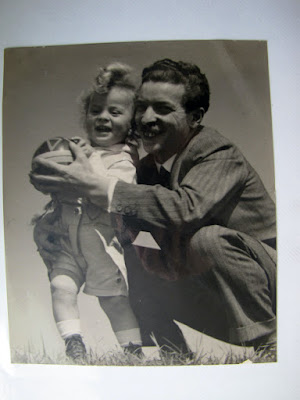 |
| My dad with his father |
My dad was born to a Jewish family in 1930 in Austria.
One day in 1934 my dad, then four years old, was recovering from a bout of whooping cough and, as a treat, his father took him for a trip on a Danube Steamer.
Excited to watch the world going by from the water, my dad knelt on his seat looking out of the window. He didn’t notice the woman on the seat beside him and his father warned him to be careful that his feet didn’t scuff the woman’s dress.
She replied in halting German that it was fine, and my grandfather asked where she was from. It turned out that she was English and she was with her husband, who was a dentist. They were attending a dental conference in Vienna and had joined a tour on the Danube Steamer. She called her husband over and the two of them got so involved in their conversation with my grandfather that they ended up missing the stop where the rest of their party had disembarked.
My grandfather said he would help get the couple back to the hotel where they were staying, but first he invited them to come home with him, to meet his wife and taste her home-made Sachertorte – the famous Viennese cake. He also offered to meet the following day and give them a tour of Vienna. Mr and Mrs Jones happily accepted both offers.
Some time after their return to England, Gladys Jones wrote a thank you letter to my grandparents. Roughly translated, it read, ‘My Dear Mr Kessler, We have nothing forgotten. I cannot the German well write but I think often out of you and that so lovely son.’ The letter, signed Gladys Jones, was headed from her husband’s dental practice in Chester.
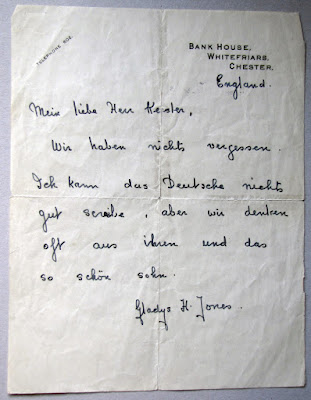 |
| The letter from Gladys Jones to my grandfather |
Over the next few years, between 1934 and 1938, things became increasingly hard for my family. As Hitler gained more and more influence, life became more and more frightening for Jews in Central Europe. Finally, in 1938, when the Anschluss took place and Austria became annexed to Germany, my family knew that they had to leave Vienna.
The only place they were allowed to go was to Czechoslovakia as my grandfather had a Czech passport. And so, with their passports marked with a big red ‘J,’ for 'Jew', they moved to relative safety in a small town called Brno, 75 miles away.
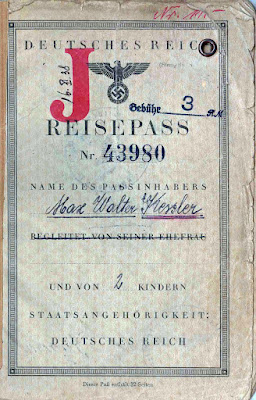 |
| Another family member's passport from that time |
When Hitler’s army took Czechoslovakia less than a year later, it seemed my family’s luck had run out. By now it was 1939 and they were banned from parks, restaurants, swimming pools. They weren’t entitled to any benefits. They could not own electrical items, bicycles, typewriters or records. They were forbidden to go to theatres or cinemas. Their basic human rights were being eroded at an alarming pace and the window of opportunity for them to leave was growing smaller by the day. The hurdles they had to surmount in order to do so made it almost an impossible task.
Nevertheless, my grandparents persisted in their attempts to get their family out of the country. Day after day my grandmother would queue for hours at one office after another following a bureaucratic paper chase until, finally, they had everything they needed – except for one last item: an affidavit from someone in the country to which they hoped to go, taking full financial responsibility for them as they would have to leave all their assets and possessions behind.
Unfortunately, my family knew no one who might do such a thing – until my grandfather looked through his papers and found the letter from Gladys Jones from five years earlier. He wrote to the Joneses, telling them his family’s circumstances and asking if there might be any chance of them providing him and his family with the affidavit they so desperately needed.
The Joneses did something that changed the course of my family’s lives forever. They said yes.
And so, in May 1939, my now eight-year-old father and his parents arrived in England with one box of personal possessions, thirty shillings in English money, no knowledge of the language and a huge debt of gratitude to the Joneses with whom they were to live for the next six months in a small village in Cheshire.
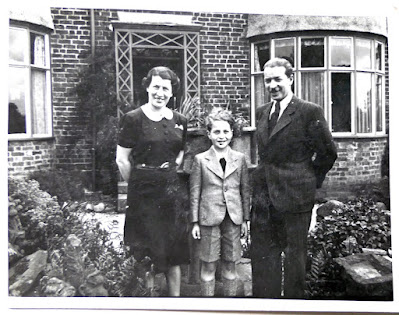 |
| My dad with his parents outside the Jones's house in 1939 |
When I think about these events, it blows my mind. It doesn’t take much imagination or more than a cursory knowledge of historical events to know what might have happened if my father had not knelt on his seat on a boat in 1934, his feet near to the woman beside him. They would almost certainly have ended up in concentration camps. Indeed, many of the rest of my family did.
It is almost certainly because of the Joneses that, as an author, I have often been inspired by the idea of the small moments that our lives turn on. But the book I always wanted to write was the book that was inspired by my father’s story. And last year I finally did that.
When The World Was Ours tells the intertwined stories of three friends, starting in Vienna in 1936 and taking them in different directions over the following decade. The question I have always pondered is: what if that moment had never happened?
In my book, Leo’s life closely resembles what happened to my father. Elsa does not have his moment of good fortune and her story answers the question I had so often asked myself. Max, the third friend, finds himself emulating his high-ranking Nazi father, joining the Hitler Youth and finally ending up face to face with Elsa in a heart-breaking confrontation at Auschwitz.
This book of my heart is out in paperback this week. The responses to the book from teachers and librarians over the last year have been heartwarming and wonderful, and every time I hear of an adult wanting to share the story with young people I feel proud and honoured.
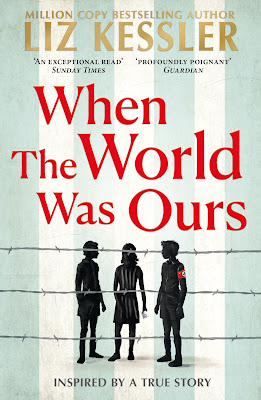 |
| My book with its fresh new paperback jacket! |
I hope that my book – and the facts of my dad’s life – will inspire young people to dig deep into the facts of the Holocaust and draw parallels with today that might help inform their own actions and thoughts. But above all, I hope that it will stand as a testament to, and a celebration of, the kindness of people like the Joneses, without whom I would not be here today.
You can buy When The World Was Ours here
Liz's website is here
Follow Liz on Twitter here
Or on Instagram here


