Showing posts with label Booktrust. Show all posts

Friday, 4 February 2022

Stopping to Smell the Flowers - by Ciaran Murtagh

One of the things about being a freelancer is the constant pressure to provide. You're never 100% sure where the next cheque is coming from so you say yes to everything. 


For me, this started young. I had my first child while I was at school and so my entire working life I've always had to have one eye on the bank balance. 


It's all well and good choosing to live a precarious freelance existence - certainly in the creative industries -  but it's quite another to bring a baby along for the ride. It meant I said yes to just about everything, regardless of whether it was a good career move or something I necessarily wanted to do. If it paid, I did it. 


That baby is now approaching 27, but my approach to work hasn't mellowed much. 

When the pandemic struck I felt the fear just about everyone in the country felt. However, for the freelancer it was tinged with the regular worry of - what if I never work again? I threw myself into work, saying yes to just about anything, and I am only now coming out of that frantic period. 


Last year I head wrote, with my writing partner, five new series of television. That's about 200 episodes - I was responsible for delivering and writing. I also wrote on other people's shows. Totting it all up Andrew and I wrote or were responsible for about 225 episodes of TV. One a day. 


I also had three books out last month and another one out next, so I was doing that too. 

This month things have calmed down a bit, after the year or two I've had, it feels like I've gone from 90 miles an hour to a more sedate 45. I can take time to smell the flowers. 

However, it doesn't stop me feeling like I should be working harder. It's hard to adjust to a new pace like that. It feels like someone has literally pulled the handbrake. Now the logical part of me is telling me it's healthy, you can't work at that rate forever, you'll burn out.  But that nagging irrational bit of my brain is worrying again - what if the phone never rings, what if this is it, better get hustling Ciaran. 


For now I'm doing my best to ignore it, and to be honest that voice can be a useful thing, it stops me sitting on my arse for extended periods, but the truth is it'd be nice to turn it off completely every once in a while. I'd like to enjoy a guilt free holiday without wondering what I'm missing, I'd like to sit and look out the window without beating myself up over the book I'm not writing or the idea I'm not developing. 

I'm not sure that's ever going to happen, I'm the wrong sort of person in the wrong type of industry to allow that to happen, but strategies to dampen it down would be useful. 


So come on creative freelancers -  how do you deal with the guilt of not creating every moment of the day and stopping to smell the flowers?

In other news, I am taking part in Book Jive Live this month - it's a great opportunity to hear new voices and also ask me any questions you may have about any of the creative industries I participate in. Even better - all profits go to the Booktrust. Get your tickets here:

https://www.wegottickets.com/event/532457


Wednesday, 13 July 2016

My Top Ten

Northern Ireland isn’t a big place and I’m articulate/ opinionated/gobby, so I’m often wheeled out when they want someone to talk about children’s books/reading/libraries on the radio.

This time it was to comment on a poll commissioned by the BBC Love To Read campaign, which asked 1,000 parents which books children should read. The list has courted some controversy, with Booktrust suggesting that it’s too focused on classics. (http://www.telegraph.co.uk/news/2016/07/10/bbc-childrens-book-list-too-focused-on-daunting-classics-booktru/ ) 

What children’s books had meant most to me growing up? the producer asked during our briefing. I mentioned a few. Hmm, she said. She obviously hadn’t heard of any of them.

Which is fine. My favourites are my favourites. Your favourites are yours. Of the ‘top ten’ in the BBC poll, none has particular resonance for me. That doesn’t mean they won’t for you. The list includes nothing published this century, and I wouldn’t describe either To Kill A Mockingbird or The Bible as children’s books, but, in the words of Miss Jean Brodie, ‘For those who like that kind of thing, that is the kind of thing they like.’

Just in case you care, here is the list: 
The BBC’s top ten recommended books:
Harry Potter and the Philosopher's Stone by J K Rowling
The BFG by Roald Dahl
To Kill A Mockingbird by Harper Lee 
Alice in Wonderland by Lewis Carroll
The Famous Five by Enid Blyton
The Very Hungry Caterpillar by Eric Carle 
The Wind in the Willows by Kenneth Grahame
The Gruffalo by Julia Donaldson and Axel Scheffler
The Lord of the Rings by J R R Tolkien
The Bible


Last week I was at Charney with 22 other children’s writers, and as an introduction, we all talked about a favourite childhood book. 23 eulogies to 23 different books. Some of them sparked smiles and nostalgia throughout the group; many were met with polite blank stares. Of course. Because such things are totally personal and subjective.

So when I was asked, in the studio this morning, what my childhood favourites had been, I resisted the chance for a nostalgia fest. Nor had I much to say about the BBC list: I stressed that it was much more important that children were given the resources to find their own favourites. I talked about the importance of local and school libraries (of course).

But I do have my own favourites, so just for fun, and in the hope that it might encourage some ABBA readers to think of their own special books, here is my Top Ten from My Childhood.  My rules were: I had to have read them as a child, and I was only allowed one book from each author. Otherwise, Antonia Forest and K.M Peyton would have dominated.


Little Women – Louisa May Alcott


The Chalet School In Exile – Elinor M. Brent-Dyer 


 I Wrote A Pony Book – Joanna Cannan


Harriet The Spy – Louise Fitzhugh


End Of Term – Antonia Forest

The Abbey Girls In Town – Elsie Oxenham

Flambards – K.M. Peyton


The Last Ditch – K.M. Peyton


Ballet Shoes – Noel Streatfeild


Little Town On The Prairie – Laura Ingalls Wilder


Oh, yeah: and I cheated: I couldn’t just have one KMP. Well, it’s my list!

What's on yours? 


Friday, 2 May 2014

LONDON BOOK FAIR 2014 and a tribute to Korean picture books – Dianne Hofmeyr

Pam Dix from the IBBY committee UK with the President of IBBY Korea, Su-Jung Kim and writer Sang-Hee Lee.

I remember my first London Book Fair in 1998... I wandered aimlessly about wondering what on earth I was doing there. Everyone seemed to be rushing with purpose, while I trundled about feeling distinctly insignificant and redundant. It’s odd how the actual creators of books, can feel so inconsequential at a Book Fair. But over the years I've realised that most of the best encounters take place without planning, in the corridors between the stands, or in the numerous seminar sessions – even if it’s just to put a face to an editor you’ve never met, or meet one new person who will be a springboard to other projects, or just one new author or illustrator who has similar interests.

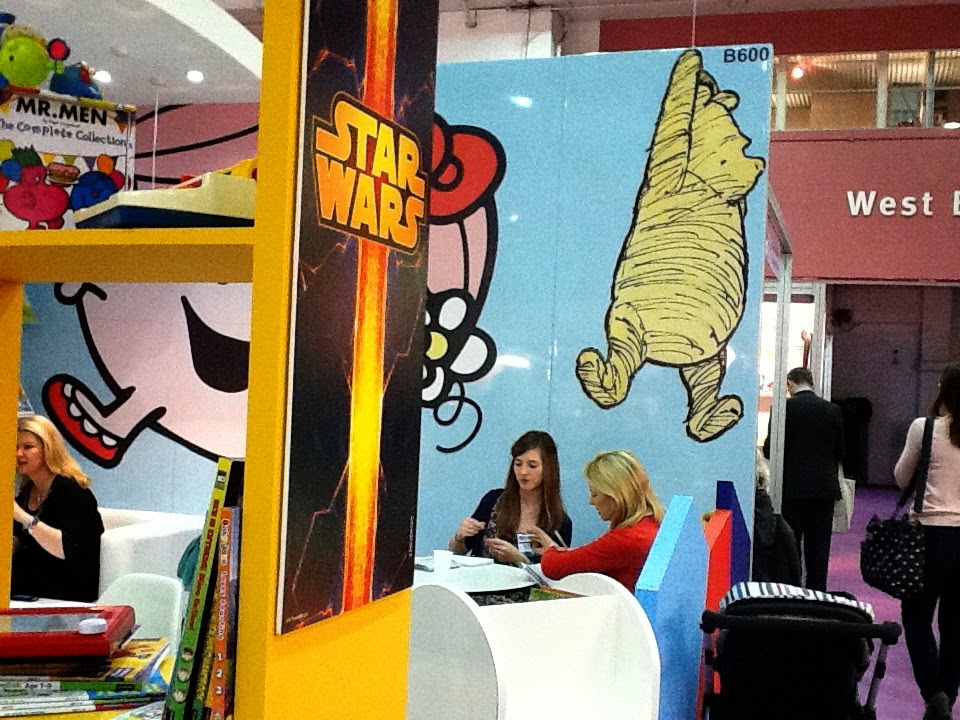
The most striking children’s book stand this year goes to Egmont. Not only did they have the best sweets in their jars and a balloon-floating Pooh bear... but alongside an earnest table discussion, I spotted a pram! So authors with babies do manage to get appointments! 
The Artworks also made a child-friendly statement with open tables and chairs. 
Some of the larger publishing house stands with their 'gate-keepers', protect their editors and rights people as well as the books from anyone who might want to browse a book. A few get around this this with digital posters of new books on their hoarding. Daughters of Time, the History Girls anthology showed up well on one of these massive digital screens. But there are others, where one is hard pressed to know they actually publish a thing called a book. 

The most thought-provoking stand was Book Aid International, where I met Judith Henderson, the project manager. It was a shack built of bits of wood with tin-plate, a hand-painted library sign, empty shelves and a single locked cupboard showing how books are so precious and few in Africa, that they are literally locked up. Figuratively locked away too as so few people have access to books in Africa. Book Aid works in partnership with libraries in Africa providing new books and resources and training. They were the LBF's Charity of the Year and to mark their 60th anniversary they plan 60 new child friendly library spaces. The ABBA blog isn’t about fund-raising but if you are interested in donating visit: www.bookaid.org/LBF.


The seminars and workshops were many and varied with accomplished speakers in their fields – Julia Eccleshare leading the panel on What the judges are looking for, Sophie Hallam from Booktrust and Ben O'Donell speaking on Children’s reading habits, Lynn Taylor from the Reading Agency facilitating a talk on Chatterbox Groups and Mike Jolley, Chris Wormell and Tom Cole on The Spectrum of Experience – from first time picture book to lasting career. The Authors Hub was crowded and noisy and too small.

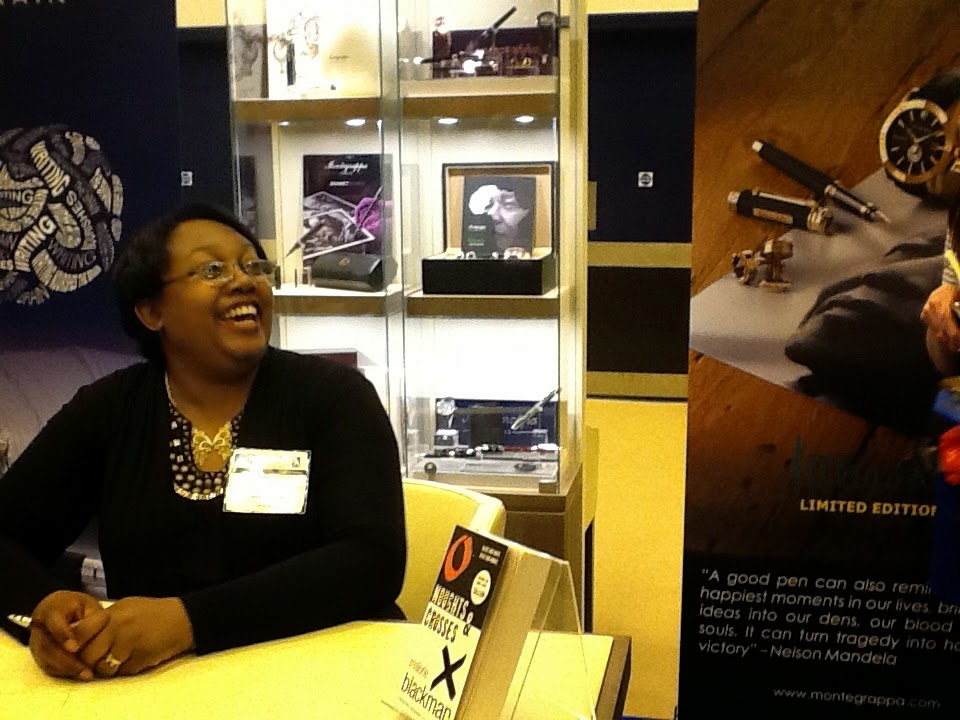
Malorie Blackman with her huge enthusiasm and energy, was Author of the Day on the final day.

Korea was the guest country of this year’s Fair and the Korea IBBY stand had a magnificent display of Award Winning Korean picture books. What struck me is they often dealt with children with difficulties and disabilities but because many were wordless, could easily be enjoyed not just by Korean children but children across all cultures. So here we are... an IBBY UK and KIBBY gathering on the last day of the Fair.
Pam Dix, Ferelith Hordon and me with some members from KBBY including the President, Su-Jung Kim
Many of the Korean books on display had won the Bologna Ragazzi Award, which is given to picture books prominent in technical expression and stories with great creativity, educational values and artistic design. The foreign Bologna Ragazzi books are often picked up by other publishers like the Tate. The Lion in Paris translated from French, being a good example of this.

Here are four picture books with Korean artwork to enjoy:
The images in Last Night by Hyewon Yum which won the 2009 Bologna Raggazi Award, are full of playfulness and beautifully rendered in textured print with bold shapes and a striking way of showing light and shadow. It's a wordless picture book that tells of a grumpy child going out at night with her bedtime bear who has been transformed.

A day at the beach by Kim Su-yeon, is about a blind fisherman who has no one to help him in his advanced years. The text in its entirety only amounts to five lines, but the illustrations show how the old man leads a full life. It was one of the winning entries in the student category of the V&A Illustration Awards 2006.

Readers follow the blind man as he goes fishing with his dog. He is mending his nets when a seagull snatches a line out of his hands and the dog, chasing the seagull, suddenly morphs into the seagull. The dog-seagull returns the line to the old man. In the meantime the old man is reeling in a big white fish. The white fish swims off with the newly returned line and the old man, turning into a black fish, pursues it. The dog-seagull follows him under the sea, and turns into a large boulder when a shark threatens to gobble up the black fish. Then the boulder turns into the old man, and the black fish turns into the dog. Coming back to the surface, the old man and the dog go home with the big fish in their basket. The story finishes with the line, “Tomorrow they will repeat their life of today.” 

A runs across every page of the book suggesting that the old man, even though blind and isolated, is not abandoned by the world but is always connected to something – his dog, seagulls, fish, and by extension to nature itself. Powerful and imaginative. 

The Story of Ppibi by Jin-Heon Song reflects the childhood memories of the author. Ppibi is an autistic child who comes to play in the forest, the neighborhood playground, but is shunned by other children. The narrator befriends Ppibi and the two boys explore the forest together. The forest is shown in fine pointillistic pencil marks, shadowy at times and at other times like a nebula of light dust, giving the sense of a cloud around the characters which suggests perhaps the autism.
Wave by Suzy Lee published in 2009 made the IBBY Silent books Lampedusa Project Honour List.  A little girl visits the beach and overcomes her fear of the ocean. No words, just the sky and the sea, the seagulls and a girl – very fluid and immediate – done in only two colours. One can almost hear the waves and seagulls squawking and smell the sea. Simple and wonderful.


www.diannehofmeyr.com
Zeraffa Giraffa illustrated by Jane Ray, published by Frances Lincoln, was chosen as Book of the Week by Nicolette Jones in the Sunday Times Culture on 20th April and given a 5 star review in Books for Keeps.

My 10 Best Giraffe Books has just gone online in The Guardian: http://www.theguardian.com/childrens-books-site/2014/may/01/top-10-giraffes-in-children-books-dianne-hofmeyr

Saturday, 29 March 2014

TIME TO MAN-UP! – Anna Wilson

A couple of things have happened this week which have made me think about how I promote myself as a writer who also happens to be a woman. I would like to share these things to get your opinions, which I know will be many and varied!

On Wednesday 26th March I went to an event organized by the wonderful Bristol Librarians. It was, as much as anything, to say a fond farewell to Margaret Pemberton and to thank her for her inspirational and tireless work in the Library Services over the years.


It was also a fantastic opportunity for authors to network, as it was advertised as ‘Speed-dating with Librarians and School Teachers’ – every bit as scary as it sounds, but not quite as dubious.

We children’s authors were invited to bring along samples of our work and be prepared to talk about our books and what we can offer for events. Every five minutes or so, a bell would be rung and the teachers and librarians would move on to another author. Clearly the idea was for us to sell ourselves convincingly in a succinct and engaging manner in order that the teachers and librarians would remember us, buy our books for their establishments and hire our services for events.

I was on a table with Che Golden, whose Mulberry pony books are hilarious, action-packed tales about (in her own words) ‘evil’ ponies - definitely ‘not your average pony books’. She has also written a series about ‘homicidal’ fairies, the first title of which The Feral Child, has sold in the US and already has a large fan base. Sitting with us was Rachel Carter: her debut novel for 9-12s, Ethan’s Voice, has been extremely well received. Rachel is a Bath Spa graduate from the MA course, Writing for Young People. She is a talented writer with more stories in the pipeline.

So, of course, the three of us sat there telling the teachers and librarians how marvellous we were, blowing our own trumpets and generally setting out to impress . . .

Did we, hell. (I know Che and Rachel will agree, because we discussed it afterwards!) We were bashful and self-deprecating, we had brought no books to sell and we shared each other’s business cards as we had not thought to bring much in the way of promotional material.

Then there was John Dougherty: he had a stack of books to sell and a pile of beautifully put-together, carefully thought-through leaflets which helpfully and concisely laid out what he does, how much he charges, what a school can hope to get from a day with him and how good he is at doing it. He had added selected quotes from happy readers, teachers and librarians who could testify to how good he was and what benefits his visits had brought to their schools. It was brilliant! And it gave a very professional impression. (I have since showed his leaflet to friends and family who have said, ‘Why don’t you do this?’ Why, indeed?)

Che and I also discussed events and festivals with Wendy Meddour (author of the wildly funny Wendy Quill books). Wendy said at one festival she was on after two well-known, hilarious male authors, and that it made her anxious as it was ‘like following two stand-up artists’.

I went home thinking, ‘Why is it that women writers do not put themselves out there as confidently as men?’

The next morning the headline below featured in the Guardian. It provoked some heated debate on Facebook amongst a few female authors I know:

Discover the Booktrust 2014 Best Books awards shortlist!
David Walliams, Jeff Kinney and Jonathan Green [sic] make the shortlist for the Booktrust's Best Book awards – which children's books do you think should win?


Apart from the glaringly obvious mistake that it is in fact John Green’s name on the list, not the mysterious Jonathan, the thing that riled me and more than a few of my friends was the lack of women’s names in the headline. If you scroll down through the shortlist, you will see many prominent women writers included on the list, some of whom (Lucy Cousins, Joanna Nadin, Sarah McIntyre, for example) are well-known, well-loved writers who have already won or been nominated for prestigious awards, and so are hardly also-rans who deserve to be tacked on after the men.

Both the article in the Guardian and the ‘speed-dating’ event made me wonder about how we women promote ourselves. I know that in an ideal world it would be great if there was an entirely level playing field to start with, and it would also be lovely if publishers did not leave the lion’s share of promotion to us authors who really only want to get on and write rather than be cajoled into the role of performing monkeys . . . But with John Dougherty’s leaflet sitting on my desk and Wendy’s words about men’s events being ‘like stand-up’ ringing in my ears, I did wonder what I could do to change things for myself.  

My husband works in the food industry: I asked him if women were as backwards at coming forwards in business as I felt I was in the book world. His reply:

‘Oh yes, the women I work with admit that if they have only 20% knowledge on a certain subject, they will hold back until they feel they know about 80% before they voice an opinion, whereas I would say that men are happy to chip in confidently with their views when they know only 20% of what they are talking about.’

This would certainly back up what teachers have said to me about the differences in male and female behaviour in the classroom, too. Girls will tend to sit quietly and wait until they are sure they know the answer, whereas boys will have a go even if they are not 100% (or even 80%) confident.

So, I have made a decision. If I want people to take my writing seriously, pay me what I charge for events and (maybe one day) put my name in a newspaper headline, I shall have to take a leaf out of the men’s book and talk myself up a bit.

As Caitlin Moran says in her marvellous book, How to Be A Woman:

The boys are not being told they have to be a certain way, they are just getting on with stuff.

Now, where is that excellent leaflet of John Dougherty’s? I feel a copy-cat session coming on . . .

Find me on the web at http://annawilson.co.uk