Showing posts with label Festivals. Show all posts

Sunday, 2 June 2019

Making Hay, by Sophia Bennett


Last week I had the wonderful experience of being invited to speak at Hay. It's my third visit, and each one is special in its own way. 

This time, the specialness started as we pulled up at our B&B, where we were met by the curious chickens. They came to check us out every time. Not sure we passed the first inspection. 


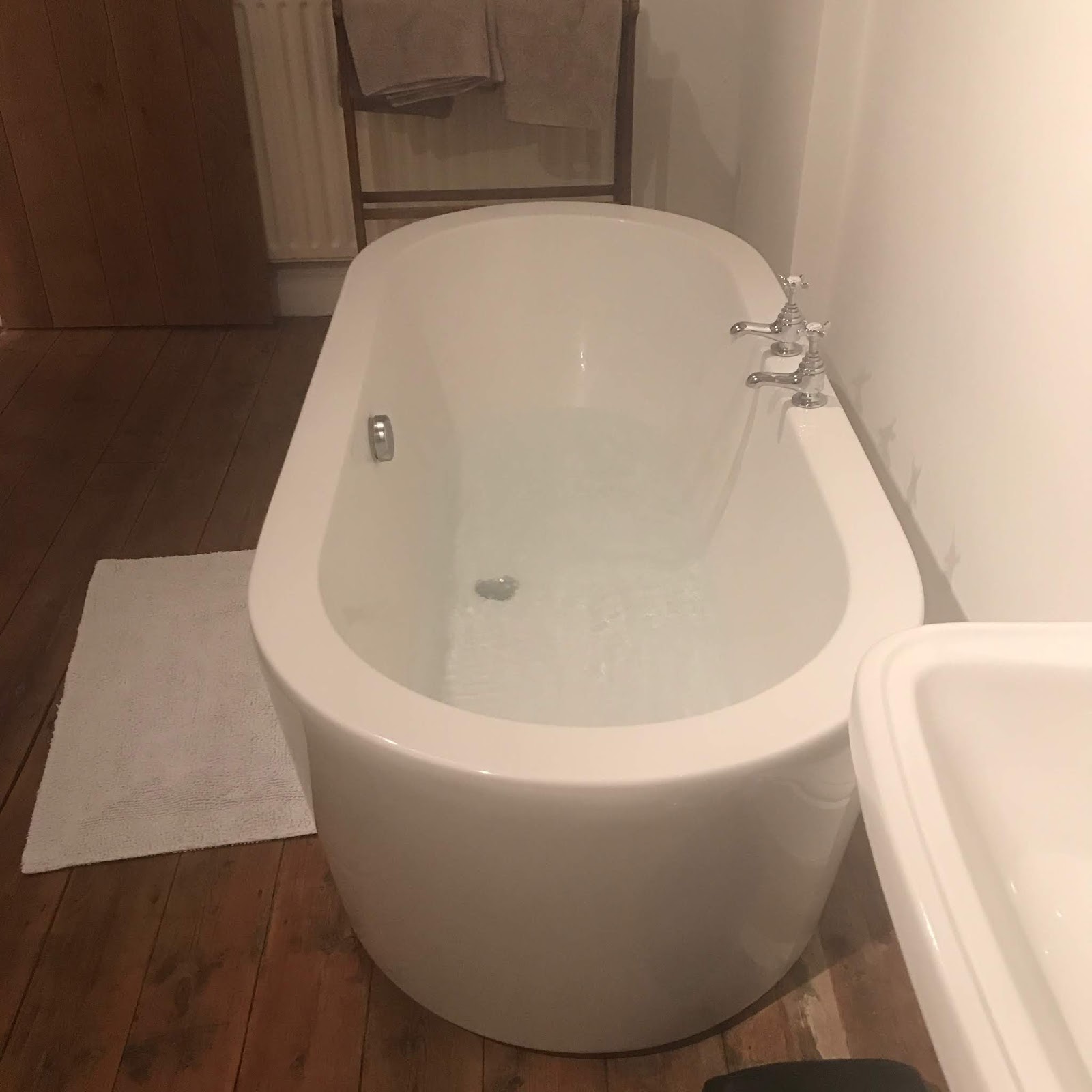
 This, I kid you not, was our bath.


But it wasn't just about the creature comforts. There were also books to be discussed, in a big tent (actually lots of big tents), in a field (probably lots of fields - but hard to tell, under the tents) in a village on the border between England and Wales, and most definitely heaven. 


Talking of which, the first talk I went to was by Ben Lewis, talking to Kirsty Lang, and was all about Jesus. Or rather, Leonardo da Vinci's painting of him in the Salvator Mundi. Or WAS it Da Vinci? That's what Ben's book is about. By the end we all agreed that nobody really knows, but it's probably about 20% da Vinci. Great hand, though. A hand by the hand of the master, probably. Great talk.


And the following day (after we'd tried out the bath), we were back in a big tent with Kirsty again, who was talking to Horatio Clare this time about a walk he did in Germany, in the footsteps of JS Bach. If you ever get the chance to listen to Horatio, do. (He's on Radio 3, so not hard to find.) He has a voice for broadcasting, a beautiful turn of phrase, innate hope about the natural world, and always something interesting to say. As an audience, we were gripped. Afterwards, Horatio signed for nearly two hours. (I bought 2 copies of 'Something of His Art'. Check out the gorgeous cover on the link.)


And then there was the Artists' Room, where we were treated like royalty. I didn't spot any actual royalty (although it's been known), but did see Michael Gove, Jeanette Winterson, Robert Macfarlane and Jackie Morris (who kindly signed my copy of 'The Lost Words' for me and let me fangirl) and many other Famous Faces. My husband and I had a lovely long chat with Candy Gourlay, who's produced all sorts of content from Hay this year - so if you want to know the full story, follow her on Twitter, her website and wherever else you can find her!


And then it was time to watch Frank Cottrell-Boyce in conversation with Lauren Child. I love to hear about writers and illustrators' artistic process. Lauren said that often a book will take her years to write, putting it away when she gets stuck and coming back to it later when the ideas flow again. She's lost count of how many she's done, so it's obviously working for her. It was fascinating to hear about the way she does collage too - so painstaking. You'd think perhaps it's all digitised now, but it isn't. A lot of the patterns she uses come from the insides of Australian envelopes. So now you know.


I was going to be speaking in the same tent as Frank and Lauren, and it was big! Lots of people! This was my view from halfway back in the audience. I assumed there would be about 20 people for mine, but actually it was pretty full too. Which shows that 1) Hay audiences have great taste and want to know about women in the art world and 2) the great Hay festival organisers are brilliant at getting people enthused. Hooray! (These are my books in the bookshop by the way.)


The sun shone. Not all the time, but enough. Make Hay and all that ...


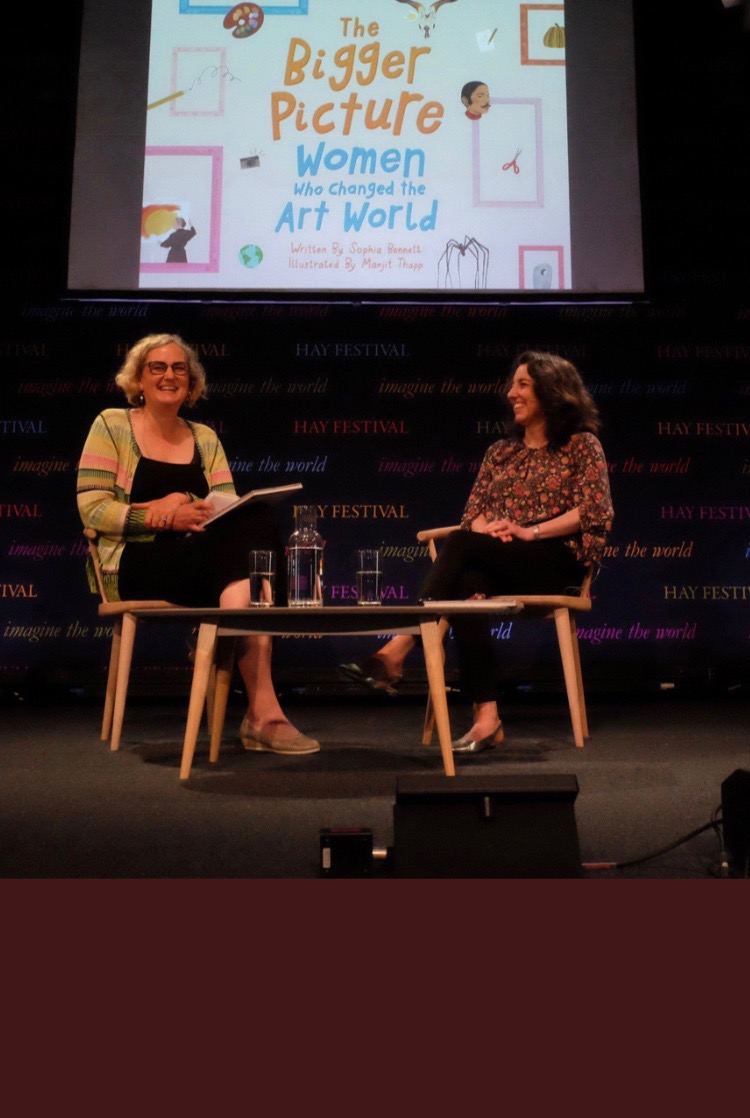
And then it was time for my event with Claire Armitstead from the Guardian. She was a brilliant, gentle, thoughtful, (prepared!), funny chair. She let me do my thing, talking about some of my favourite artists from 'The Bigger Picture: Women Who Changed the Art World' and what I find fascinating about their lives and work. Claire ended with the quiz from the back of the book - asking the audience some hand-picked questions, which they could now cheerfully answer! Candy was in the audience and took these pictures. Thanks Candy! (My husband was there too but he was too busy cheering - very loudly and embarrassingly - to take a photo.) 


Here he is afterwards. Still cheery. 


And then it was party time. Again, no pictures from husband, so resorting to a selfie to give the general idea.


And this is what it looked like when we got there. I say 'we' - I was sharing the B&B with Jessie Burton, as you do, and we went together. She was LOVELY, and obligingly signed my copy of 'The Restless Girls' after breakfast the next day. If you want a feminist fairytale for older girls, with magnificent illustrations by Angela Barrett, then this is the one. It is odd but nice to share toast and marmalade with your literary heroes. At Hay, that's the sort of thing that happens.


 Home time. Such a beautiful view from the Second Severn Crossing. And a memento: the very last 2017 30th anniversary Hay mug, by Emma Bridgewater, with a fantastic image of Hay by her husband, Matthew Rice. Guess what I'm drinking my tea out of as I write ... 


Tuesday, 13 February 2018

Gladstone's Library -- A Magical Place

One of the greatest joys of being a writer is the access it gives you to magical places. Places like Gladstone’s Library, which I was fortunate enough to visit last weekend for the first, but hopefully not the last time.

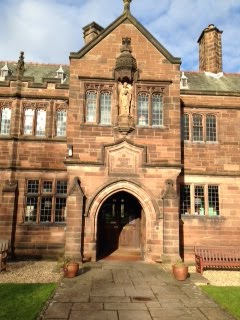
The entrance to Gladstone's Library

Like many writers I spend idle moments Googling things like ‘retreats’ and ‘writer opportunities’, and that’s how I found out about Gladstone’s Library. It is such a ‘me’ place that I can’t believe I haven’t known about it all my life.

Gladstone’s Library describes itself as a ‘residential library and meeting place …dedicated to dialogue, debate and learning for open-minded individuals and groups, who are looking to explore pressing questions and to pursue study and research in an age of distraction and easy solutions.’

As the name suggests, it was founded by the statesman William Gladstone himself, and part of his own extensive library forms the core of its magnificent collection. It’s the most wonderful memorial to his life, work and liberal values.  Gladstone wanted to ensure that anyone who needed to use the library should be able to do so, so access to the library itself is free, and there are many bursaries and scholarships to help those who need to stay. 

And there is the most fantastic Writer in Residence scheme. https://www.gladstoneslibrary.org/events/writers-in-residence


This year, feeling that my recent publications Name Upon Name and Star By Star qualified as ‘engaging with liberal values’, I decided to apply. I was thrilled to be shortlisted, and the disappointment of not making the final four was greatly assuaged by the invitation to read and talk at Hearth, their winter ‘micro-festival’, held in November and February. 


This was one of the best events I have ever attended. It’s deliberately small – four writers and about thirty participants, many of whom choose to make a weekend of it in the comfortable accommodation. Each writer gave a talk, and there was a panel event on the Saturday evening. I’d never met my fellow writers – Annabel Abbs, Jenny Lewis and Dipika Mukherjee – but we had a great panel event, thanks not only to our own brilliance but to the expert chairing by Peter Francis, Gladstone's Library's Warden and Louisa Yates, Director of Collections and Research,  and to the intelligent questions of a hugely engaged audience.

I was slightly nervous about turnout for my Sunday morning talk, Soldiers, Solidarity and Suffrage. Though the blurb made it clear that my novels, though marketed for teens, are enjoyed by adults, I was worried that the snobbery which sometimes dogs the children’s writer might prevail. I knew that it was the first time the Library had invited a children’s author, and I didn't want to let them down! I should not have worried. The room was full and Star By Star sold out in the festival bookshop. I don’t think I’ve ever had such a long signing queue or responded to such in-depth questions.

This is where the festival takes place -- yes, literally round the hearth!


As well as attending my fellow writers’ talks, and much chatting, eating, drinking and walking, I was also able to use the library itself to work in. It’s the most wonderful space – silent and spacious and yet with such a full, rich atmosphere. In my little nook, surrounded by nineteenth century books on theology and art, I felt hugely grateful to be part, for one weekend, of this benevolent and civilised place. I managed to do a week’s worth of editing in under three days, and I’m already planning my return.

a wonderful place to work
On my last morning, though I'm not really a religious person, I decided to start the day by attending the short Eucharist with which every weekday morning at the library starts. My fellow writers had had the same idea. It felt like a fitting end to a wonderful experience. 

I’ve taken  away with me some new friends, some wonderful books by my fellow Hearth writers, and a special new place on my mental map of wonderful places to write. I’ve also taken the confidence to keep on applying for new opportunities. I think Gladstone would have approved. 


Sunday, 24 January 2016

It’s Not About the Price Tag…Or Is It? - Liz Kessler

If you are tuned into the world of the UK writing community, you’ll probably know there has been a lot of talk about money recently.

The thorny issue of authors being paid to do events at literary festivals was put firmly in the limelight by Philip Pullman when he resigned from the Oxford Literary Festival in protest against their policy of not paying authors.

There has also been talk amongst bloggers about whether they should be paid for the work they do to help promote books for authors and publishers.

I don’t want to get into the ins and outs of those arguments. There are many places where you can read about them, including fantastic blogs by Lucy Coats and Lucy Powrie amongst others. Do take a look.

The thing that has occupied my mind in all of this is the issue of the blurry lines between our passions and hobbies and our jobs and financial standing, and how, somewhere amongst all of this, we find the hooks on which we hang a lot of our sense of identity and status.

About fifteen years ago, I left a permanent job in order to free up enough time to commit myself to writing a novel. I spent the next couple of years working in a part-time capacity as a teacher and editorial advisor, whilst attending an MA in Creative Writing. During that time, I wrote a YA novel which would take fifteen years to get published, and the first book in a series which would go on to sell in more than twenty countries across the world. I wasn’t being paid to write. I was being paid to teach, and to work on people’s manuscripts. This meant that when I met someone new and they asked the question that we so often ask, ‘What do you do?’ I felt stuck. I wanted to say I was a writer, but that felt fraudulent. How could I say this was what I ‘was’ when no one was paying me to do it? So instead, I would describe myself in terms of the thing I did to pay my way, rather than the thing that fuelled my passion, filled my thoughts and occupied every life goal I had.

My home town is full of people who make their living in the tourist industry, managing bars, waiting on tables, cleaning holiday homes. Many of these people also paint beautiful pictures, create gorgeous jewellery, take stunning photographs. If you ask them, ‘What do you do?’ many will find it hard to answer, ‘I make necklaces,’ or ‘I paint sunsets’, instead falling back on, ‘Oh, I just work in a café.’

Beautiful St Ives, where many talented artists 'just work in a café' 

And I’m wondering if this is OK. If this is right. If this is how it should be. And I think the answers are no, no and no.

For some of us, we are lucky enough that our passion and our jobs overlap. I think that seeking this overlap is partly what is behind the recent campaigns in the book world. Authors are generally delighted to be asked to take part in festivals, and perhaps many of us see it as such a pleasure and an honour that it makes it easy for those running them to get away with not offering a fee. Book bloggers generally get into doing what they do because of their passion for reading – but does this mean that we should expect them to devote hours of their time to promoting people’s books without any financial acknowledgement of their work and their time?

I think there’s a tipping point. There is a moment when, ‘I do this because I love it, and will fit it into my life in any way I can’ becomes, ‘I do this because I love it, and I wonder if there’s some way of making money doing it, so I can afford to put even more time into it,’ which eventually merges into, ‘I do this because I love it, but it is taking up so much of my time, and people are now making demands of me, and it’s about time I was properly acknowledged and paid for my time.’

Of course we all need a roof over our head and bread on the table, but I believe that the aspiration to be paid for our time is also about a natural desire that we have for acknowledgement, for status, for a recognition of who we are, what we are doing, the difference we might be making in the world. Money is society’s way of saying, ‘You are appreciated for this.’

Earlier this week, I received a letter that filled my heart, from a girl who had just read my YA novel about a girl coming out. Read Me Like A Book was published last year, after a very long road to publication. I have always said that my biggest hope with this book would be that someone might read it who really needed it, and that it would help them to feel they weren’t alone in what they were going through. This letter was that person.

The lines that stopped me in my tracks and brought tears to my eyes were these: “I felt that I could relate to a lot of Ash’s experiences in the book and that’s really helped me to feel a lot more, for want of a much better word, normal and happier and more accepting of myself. Thank you, thank you, thank you again and again and again!”

This letter tells me that what I am doing has value. That I have a place in the world, that the thing I put my time and my passion into is worthwhile. This letter says, ‘You are appreciated for this.’ Putting aside the need to eat, have shelter, be warm – this letter, frankly, is why I am a writer.

And yes, the fact that writing books is my job does mean it’s easier for me to say ‘I’m a writer’. But my argument is that we should be able to say that regardless.

My other passion is photography. I spend almost as much time on this as writing – but I have never made any money from it. Even so, when people ask what I do, I often want to mention it. My Twitter profile, for example, now includes ‘Keen photographer,’ and it feels important to me that I do this – that we do this.

The kind of thing that gets me up and out of the house early in the mornings
Just to be clear, I’m not arguing that we should all be happy to know that we’re doing something creative and not try to get paid for it. Not at all. I am fully behind all attempts to receive financial reward for the things we put our time and efforts into – whatever they are and however we feel about them. What I am saying is that we, as a society, should rate people’s passions and dreams as highly as we rate their method of paying the bills.

So, try it. Next time someone asks ‘What do you do?’ try saying, ‘I review books,’ ‘I crochet mermaids,’ ‘I take disabled people horse riding,’ ‘I help save lives out at sea,’ ‘I write, take photographs and surf.’

Perhaps if we all do it, then as a society we might one day come to value the contribution that people make to their communities and to the lives of those around them as much as we value the hunk of metal they drive to their day job and the size of the building they live in.

Have a look at Liz's Photos
Follow Liz on Twitter
Join Liz's Facebook page
Check out Liz's Website


Friday, 20 February 2015

Problems of Presentation - Joan Lennon

A while back I tackled the ticklish problem of how we present ourselves at readings, festivals, author visits - any time we are obliged to get out of our pjs and face the public.  That post focused on women writers and their clothes dilemmas.  With men writers, there are fewer versions of shirt/trousers, sweater/trousers, jacket/trousers to get wrong.  But there is one thing - one vital decision - that I would like to address today - and that is ...


Nobody said being a writer was going to be easy - here's wishing you luck in your decision.


P.S. Apropos of nothing writerly, I'm a big fan of this video too - Yo Mama.


Joan Lennon's website.
Joan Lennon's blog.

Wednesday, 13 June 2012

Stand up Tammy Bunting! by Cindy Jefferies

Little did the developers of estamet, a sort of light, worsted cloth made in England from as early as 1594 know what they were doing. This fabric was made in Norfolk, and one day someone had the idea of pressing it with a hot iron. The result was to put a shine on the fabric. I wonder if it was done by mistake or on purpose? I certainly remembering using too hot an iron on my young son's school trousers some years ago. The result then was a very unwelcome shine but the cloth manufacturers in Norfolk took a mistake, if mistake it was, and turned it into a great success.

The cloth was bought by ribbon makers. This shiny, home produced cloth was probably cheaper than imported silk, and maybe more available too. It wasn't long before the navy saw the possibilities of the fabric. This estamet, tammet, tammy (the name evolved over the years) began to be used to make flags, particularly signalling flags. No one seems to know when or why the name for this fabric became bunt, but for a long time signalling officers in the navy have been known as bunts.

Did that first person who shone the cloth and began the process of creating bunting lose his job or get a rise? Mistake or happy experiment? Probably we will never know, but this summer that unknown person's handiwork is in evidence all over the place, as Britain celebrates the Jubilee, the Olympics and numerous fetes, festivals and parties.

Today, if you go into a shop and ask for bunting you're likely to be offered a string of gaily coloured plastic or paper triangles. For more durable decorations there is also cotton bunting, which, found in various craft shops has become popular as an interior decoration for children's rooms or second, seaside homes. For those who are getting tired of seeing it everywhere at the moment I'm not including any photographs. You all know what it's like!

We don't know who first coined the word bunting, or who made the first shiny cloth, or who decided to take the navy's signalling flags and use a version of them as decoration. As a gift to the world perhaps bunting is hardly significant and yet, how dark and sober our lives would be if we never thought to put out the flags. Royalist or republican, sports fanatic or not, at its simple, non partisan best bunting celebrates what it is to be human and optimistic in spite of everything that life throws at us. That gets my vote.


Monday, 2 January 2012

Books and Roses Savita Kalhan

This summer I went to Barcelona for the first time. It’s an incredibly vibrant city, full of cafes, museums, stunning architecture and art, and the food is pretty good too. There is so much to see and do, not least is a stroll up and down the buzzing La Rambla.

La Rambla is characterised by its wide central walkway teeming with touristic stalls, painters and sketchers, dancers and diners. But every year on the 23rd of April there is a completely different type of buzz – a celebration of roses and books which stems from a tradition steeped in history, originating from the myths and lores of bygone centuries, of Sant Jordi, or St. George, the dragon-slayer and patron saint of love and culture. April 23rd was also the day two of the world’s most renowned writers, Cervantes and Shakespeare died. These, combined with the historic symbolism of the rose, representing love and respect, transforms La Rambla into a rose-and-book-lined promenade, with many bookshops and cafes across the city hosting readings by authors. There is even a 24 hour marathon reading of Cervantes’ Don Quixote! It has become a popular date to launch a book as well as to swap a book for a rose. But what a way of encouraging people to read!

Some four million roses have been sold by the end of the day, and eight hundred thousand books have been sold too. That’s a lot of roses, and quite a lot of books too.

In 1995 the UNESCO general convention adopted April 23rd as World Book and Copyright Day.

In the UK, so that schools can be involved, World Book Day will be celebrated on the 1st March 2012 this year. Thousands of events are being planned in schools, bookshops, libraries and other venues across the country. The Quick Reads are being written, and World Book Day £1 Book Tokens will be given out to every schoolchild. World Book Night, however, is on 23rd April 2012 this year. The first World Book Night was held last year in the UK, when a million books were given away all over the UK. This year a planned half a million books will be given away. They are both great events for writers and readers.

But while books are being given away in the UK, at the Books and Roses Festival the focus is on selling books. I wonder how much work it would take for something like the La Rambla festival to happen here and to take off in the way that it has in Barcelona? Covent Garden would be a great venue... Hundreds of writers and books and readers converging in one place for the day – who wouldn’t want to go to an annual event like that?

Perhaps I need to make another trip to Barcelona around the 23rd April, and make notes on how the experts do it...


Thursday, 27 October 2011

Collaborating or flying solo? - Linda Strachan

Writing is normally a solitary occupation and I rather like that about it.

Tuscany- my shed
There is that feeling of living with and in your characters' heads, so beautifully expressed in Ellen Renner's ABBA post a couple of days ago Visitors From the World Called Imagination    

I like to slope off to Tuscany (my shed), to disappear into another place or time, and live in my head for a while.


I am not sure I know where the ideas and characters come from but I find that nothing will kill off my enthusiasm for a story idea more than  plotting it all out before I begin to write.

I prefer to discover the plot alongside my characters and feel all their uncertainty and excitement.

Without this I lose that tingle in my spine and the sense of wonder and endless possibilities that make writing such a delight and pleasure.  I have to admit that sometimes it can also become incredibly hard if I lose my way, and I imagine that those who plot carefully before they begin at least have signposts to keep them on track.  Unfortunately each time I try to plot a story out chapter by chapter beforehand, it all too soon begins to feel a bit flat.


Some writers have written successful collaborations but I've always wondered how they did it.  What was the mechanism? Were they working together bouncing ideas off each other, throwing around phrases or dialogue while one wrote it all down or working separately, each adding different segments of the story?

I once wrote part of a novel with another writer in the form of letters between two characters who knew nothing of each other to start with. Each of us took one character and replied to the previous letter as suited the character and their temperament. It was a lot of fun being really stroppy and fascinating to see how the characters developed and changed as the story progressed and they drew nearer to meeting each other.  It was never finished as other writing commitments got in the way, but it might be interesting to come back to it one day.

from  Hamish McHaggis

  Working closely with an illustrator - as I have for some years with Sally J. Collins on the Hamish McHaggis books -  is again a different way of working.

It is a collaboration but, although I have written the storyline before Sally begins her pictures, writing a picture book is quite different than writing a novel and I find myself looking forward to seeing her ideas for the pictures
Linda Strachan - working on Hamish McHaggis
We find that the books grow much more organically as we work together, with images and text evolving and progressing in tandem.

 It's been a couple of years since the last one, but our latest book Hamish McHaggis and the Great Glasgow Treasure Hunt is the 10th book in the series and it's good to be back working with Sally again.  The new book is currently being completed and will be published in the spring of 2012.


In the last month or two I have also been involved in a couple of other collaborative stories that have been just a bit of fun but I find that writing short pieces sparked off by other writers, is a great way to keep my 'imagination' muscles working!

The Bath Kidlitfest Big Blog Story was a collaboration of writers and bloggers, 20 in all, and worked a bit like the game you may have played as a child called 'Consequences '.

The ABBA contribution was written by four of us, Joan Lennon, Dianne Hofmeyr, Lucy Coats and myself  and we all added our own bit to the story, each writing about 250 words to make up the 14th chapter.  With a new chapter of the story being posted every couple of days it was a bit of a scramble to read the previous entries and find time to write our own part within the specified time.

It was interesting to follow the story and try to see where it might go next. It turned out to be a very strange tale indeed, and nothing was quite what you expected.  On the last day it was cleverly rounded off by Jeremy Strong who wrote the final chapter. You can find all the links for the entire story here http://bathkidslitfest.wordpress.com if you scroll down to the end of the final chapter. Do have a look, it's all about the day the moon fell into the sea....


 The Society of Authors' short story tweetathon was another collaboration to highlight the BBC short story cuts campaign which protested against the BBC Radio 4 short story cuts.

Ian Rankin
There were 5 different stories composed of only 5 lines.
Starting with Ian Rankin, each Wednesday of the month one of five writers  - Ian Rankin, Sarah Waters, Simon Brett, Joanne Harris and Neil Gaiman - were invited to provide an opening line and this was posted on twitter with the hash tag followed by soatale.  All followers of the #soatale were invited to contribute the next line.  It was open to anyone who wanted to try and all manner of ideas and weird possibilities turned up.
The only criteria was that it had to be only as long as a tweet and include #soatale.
The curator for each story chose the winning line every hour until all five lines had been completed.  The final stories have  been recorded by actors Bill Nighy, Brenda Blethyn and Hugh Bonneville.

It was a great displacement activity, waiting to see what the next line would be and then trying to think where the story might go from there. It was good to see just how inventive people can be, in so few words!
You can find all six twitter tales here  www.societyofauthors.org/soa-short-story-tweetathon-soatale

Despite all these collaborations I have to admit that for most of the time writing is something that I want to disappear into - all on my own. I do like to have my characters to myself until I reach the end of their story when I can release them to find their own way in the world.

Are you a plotter or do you run with the story?

Do you want to work alone or enjoy collaboration?


Linda Strachan is the  author of the Hamish McHaggis series, YA novels Spider and Dead Boy Talking and writing handbook Writing for Children
Website wwwlindastrachan.com
Blog Bookwords

.............

Wednesday, 31 August 2011

The Empty Chair - Celia Rees

Every day, authors appearing at the Edinburgh International Book Festival give their time to stand in solidarity with persecuted writers by reading aloud from their work. The readings are organised by Scottish PEN, in conjunction with Amnesty International. Pride of place at these events is given to an empty chair. The chair represents those writers who cannot be there, who have to have their words read by others because they live in repressive regimes that seek to silence them by censoring their work; subjecting them to imprisonment, torture, or worse, for daring to express their views and for demanding that their voices be heard.


All the writers taking part in this event must feel, as I did, honoured and humbled to be reading from the work of fellow writers who have suffered, and are suffering, for the right to do something which we take so very much for granted. We are free to write what we like, read what we like, say what we like.


I sat in the tent, listening to my fellow writers reading the words of our brother and sister authors, famous and anonymous, imprisoned or in hiding, in China, in Cuba, in Burma and in Bagdad. All around us events were going on, audiences queuing up, readings being given, while back in the yurt, a fair few egos were on display. I thought about how lightly we hold our freedom to take part in this sharing of words and writing and I found myself looking at that empty chair and wondering: would I be prepared to take the risk? Would any of us? As I did so, words came into my head. Words from the hymn, As I Survey The Wondrous Cross:


my richest gain I count but loss,
and pour contempt on all my pride.

If you are attending trhe Book Festival, go along to show your support and solidarity. These events are free and happen at 5:30 every day.

Friday, 26 August 2011

Of Yurts, mud and wellies - Nicola Morgan

I'm cheating a bit with this blog post, I'm afraid. Many of you know some of the things that are busifying me at the moment and I'm really struggling to keep up so I hope you won't mind my bringing you a link to a post I wrote recently for the Guardian books blog during the Edinburgh International Book Festival, which the Guardian now sponsors.

Even that post was a teeny bit cheaty, as I've blogged on ABBA about the gloriousness of the Yurt once before. But the Yurt is magically glorious and magical gloriousness deserves an audience.

However, not everything about the EIBF is magically glorious. But they give us due warning.


Which is very necessary when you see this:


But, in no way does this spoil anyone's enjoyment. In the very same minute that I took the mud picture, I took this, just a few feet away:


And besides, what do I care? I haz these:


Saturday, 13 August 2011

Of Yurts and Spiegeltents: Book Festival-ing in Edinburgh - Linda Strachan


Where can you find a Yurt and a Spiegeltent, comedy, politics, cuddly creatures, crime and all kinds of great writing?
Well, if you are in Edinburgh in the next two weeks or so there is one place you should not miss.
By the time you read this the 28th Edinburgh International Book Festival will have kicked off.  Billed as the 'largest and most dynamic festival of its kind in the world'
 Now that is a huge claim to fame but for those of us who live in the vicinity - and the some 220,000 visitors it attracts- it is easy to see why.
Edinburgh at festival time is a completely different place than it is during rest of the year. It feels looks and even smells different!

Playing host to the The Book festival, the International Festival, the Edinburgh Fringe, the Jazz Festival and several other festivals all at the same time, the city is converted into one huge venue, where even the streets become the stage and performers attract audiences in the most unlikely places.

In all this exciting cultural mayhem the Book festival is an oasis of calm.  You enter Charlotte Square (which for the rest of the year is a leafy private garden) and immediately the bustle of the city is converted into an excited hush, a tranquil setting resounding with gentle roars when the audience in one of the tents begins to applaud.


Of course the Edinburgh weather can affect the Book festival as much as anywhere else and there have been a few years when the rain left delightful little ponds around the square- delightful for the little yellow plastic ducks that suddenly appeared! Their equally sudden disappearance gave rise to discussions about the possibility of a plastic crocodile..... ?

But each year they have added more solid walkways, then covered walkways to and from the event tents and the bookshop tents and finally even to the author's green room - the yurt.

There was one particular year when there was much comedy to be had watching the staff wielding large umbrellas to shelter celebrity authors in the dash across what seemed to be the only uncovered walkway- the first 2 metres as they stepped out of the yurt on their way to their events.  Thankfully that was sorted the following year.


But when the sun shines the grassy centre of the book festival fills with people. They sit about chatting and reading in the sunshine, eating ice cream and sipping coffee. People of all ages, families with tinies and octogenarians, and from all walks of life, they have one thing in common, they love books and discussion.


creating the Spiegeltent

In the signing tent or walking around the book festival you might spot a first time author or a megastar, a politician or an actor. The Book festival also has a Spiegeltent where in the evening Unbound is free and brimming with music and performances.


As you can see I am a huge fan and look forward to the last two weeks of August each year.

It is a chance to spend time listening to wide variety of fascinating authors, to meet up with old friends and new and to discover books and authors I might never have found otherwise.


Preparing to chair an event with Nicola Morgan


The Authors' Yurt is a particular delight.

The 'green room' for authors appearing at the festival, it is a lovely space and even has a separate area for quiet preparation before an event.


Hamish McHaggis  & friends


Hamish McHaggis decided to pay a visit to the yurt a couple of years ago and the staff were keen to pose with him!  I am not sure if Hamish is going to make an appearance during my event this year - it will depend if he has recovered from his recent trip to the USA!


I will be spending quite a bit of time at the book festival again this year and aside from my own events I hope to catch up with quite a few SAS authors and ABBA contributors who are appearing there this year, such as,  Celia Rees, Liz Kessler, Nicola Morgan, Gillian Philip, Cathy MacPhail and many more. 
www.edbookfest.co.uk

Here are details of my events below and in the comments perhaps those of you who are also appearing in Edinburgh will add your names and the details of your events, too.

If you are coming to Edinburgh don't miss the Book Festival or put it in your diary for next year!


Linda Strachan is appearing at the Edinburgh Book Festival on-

On Thursday 18th August 2011 - 5.30pm 
Amnesty International Imprisoned writers series
On Friday 19th August 2011 - 5.00pm For teens and Adults -
Exploring the research involved in writing her teen novels Spider and Dead Boy Talking 
On 25th August 2011 
- writing workshop (THIS EVENT IS SOLD OUT)
On Schools Gala Day  - 30th August 2011
 Hamish McHaggis and friends

Website www.lindastrachan.com
Blog http://writingthebookwords.blogspot.com