Showing posts with label Holly Race. Show all posts

Thursday, 25 November 2021

An addiction - by Holly Race

I have an addictive personality. It's something I realised quite early on, and as a result I chose to side-step the experimental phase some people go through in their teens and twenties, fearing that I wouldn't be able to regulate myself.

So it's been something of a shock to realise that I've inadvertently become addicted to something despite my best efforts... I've become addicted to writing groups.

It all started seven years ago, when an acquaintance offered to arrange a coffee between me and an agent friend of his. At that point, I had never shared my writing efforts with anyone, pressing them close to my chest, promising myself that by the time I showed them to someone else, they would be perfect. The agent read my work, and said, 'You can write, but for god's sake, join a feedback group. You'll improve so much faster.'

I took her words to heart, and applied to Faber Academy's Writing a Novel course. My first 'PP' (six years on and none of us can now remember what this stands for - personal project? peer presentation?) was terrifying. Fifteen near-strangers had read the opening 5000 words of my book, and were now discussing it around a table. Did I get criticism? Absolutely. Did I also get a confidence boost? Also absolutely. Where I learnt most of my craft, though, was in giving feedback, not receiving it. It's much easier to spot problems - and solutions - to someone else's book baby than it is your own, but once you've spotted them in someone else's work, it's easier to find and fix the same issues in your own. After the Faber course finished, many of us continued to meet on a monthly basis to read and discuss each other's writing. We took a few years off, but have recently started again on Zoom. My work in progress has been given a new direction and new energy as a result of my peers' constructive criticism.

As for my addiction? Well, my Faber peers aren't the only group I now belong to. There's also a 6am writers' Zoom, running every weekday for my fellow early birds. We gather in our pyjamas, tea in hand and bleary-eyed, chat for five minutes, write for fifty and then chat for another five. I've written and edited many thousands of words as a result, all before the sun is up. There's a group for screenwriters and actors, meeting monthly to read scripts out loud. And my fourth writing group is in person: a little gathering of Cambridge-based authors who meet up for coffee, gossip and the occasional writing sprint.

Each one is priceless in different ways. Each one provides companionship that can so often be lacking from the writing process, and a group of excellent minds to bounce ideas off. As addictions go, it could be worse.

Now, whenever aspiring writers ask me for advice, I parrot the words of that agent, without which I absolutely wouldn't be a published author today: 'Get thee to a writing group'.

Monday, 25 October 2021

Your invitation to a Halloween festival - by Holly Race

The last eighteen months has given us precious little enjoyment: stuck in our homes, worrying about shortages and vaccines. One of the few things that I have treasured is the greater accessibility of events as everything moved online. For anyone outside the London bubble or with access needs, this has always been a problem, and it's a real shame that it's taken a pandemic to force the wider publishing world to address this.

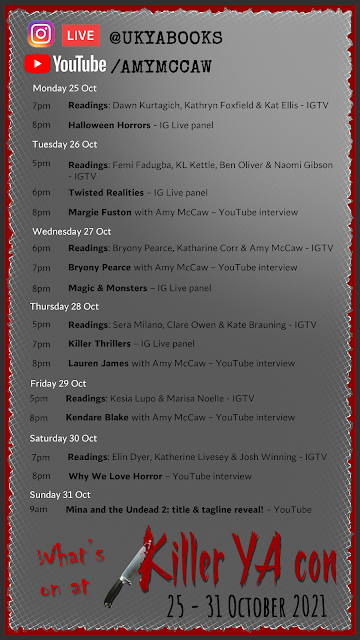
So as we slowly begin to return to 'in-person' events I really hope that we don't lose sight of how inclusive online events can be, and how important it is to retain that if we want to foster a diverse industry. As one of the founders of a growing community of UK and Ireland-based YA authors, we are hoping to help contribute to this, starting with Killer YA Con, which starts today and ends on Halloween.

Organised largely by horror authors Kat Ellis and Amy McCaw and contemporary author Naomi Gibson, Killer YA Con is a week-long festival of panels, readings and giveaways around spooky or Halloween-related YA novels. Do have a look at the schedule and join us, if you'd like to share our love of YA with a bite!


---


Holly Race worked for many years as a script editor in film and television, before becoming a writer.

Her YA urban fantasies, Midnight's Twins and A Gathering Midnight, are published by Hot Key Books.

Saturday, 25 September 2021

To social media or not to social media? by Holly Race

Anyone who has stepped foot in Twitter, Facebook, Instagram or TikTok will know that they can be perilous places. It's so easy to get sucked in, either arguing with someone whose mind you're never going to change, or comparing your own success (or lack of) with others who are on the same path. It's a drain: of time, of mental energy, of emotion.

But I can't pull myself away! I love being able to keep in contact with my readers and with other authors, to keep abreast of what's happening in the book world and to applaud my peers' successes.

I've been wishing for a while that I could find a better balance with my social media use: being smarter, spending more time engaging with others instead of firing off every random thought that comes to me when I've inevitably had too much coffee and too little sleep. Thus I found myself on Neema Shah's incisive and practical 'Marketing for Writers' online course. I won't share exactly what she taught me, but her guidance has led me to both realisations and a much more fun and fulfilling social media experience.

Here are a few insights I got into my own personal online experience:

  • Facebook is going to remain a platform I use to connect with other writers rather than readers. My audience - mostly teenagers and people in their 20s - don't really use Facebook anymore.
  • Twitter doesn't enjoy me talking directly about my books - in a month when I had a lot of events lined up, I actually lost followers! It's a much better site for getting and giving recommendations of all kinds.
  • Instagram, conversely, much prefers me to post pretty pictures of my own books to anyone else's! I love sharing photos of my latest book haul so I can't see myself changing my posting habits, but it was interesting to note the difference with Twitter nonetheless.
  • TikTok. Ah, TikTok. I'd avoided doing anything more than scrolling through this newest platform until recently, because it makes me feel very old and uncool. However, I dipped my toes in last week and had a surprisingly pleasant experience. I had more fun on social media than I've had in a long time. TikTok seems to love a bit of sass, and with an endless stream of prompts, it's not as creatively draining as I'd feared it might be. The Bookseller recently reported a 61% uptick in sales of YA books, largely thanks to TikTok. I don't know whether it's a coincidence or correlation, but my own book leapt up the Amazon rankings a day after I posted my first video...

I'll be interested to see what else comes out of my new, hopefully more streamlined, way of thinking about how to use social media. I never want to chase followers, but given my work is largely solitary, I'd love to be able to reach more like-minded readers and writers across the globe in a meaningful way!

---


Holly Race worked for many years as a script editor in film and television, before becoming a writer.

Her YA urban fantasies, Midnight's Twins and A Gathering Midnight, are published by Hot Key Books.

Wednesday, 25 August 2021

'The end of all things' - finishing a trilogy, by Holly Race

It's been a week since I typed the words 'The End' for the first time on a story that has been tumbling through my head for over a decade. The first draft of the third book of my urban fantasy trilogy, A Midnight Dark and Golden, has been sent to my editor. While I will be working through several further drafts over the next six months or so, it feels very much like the beginning of the end. I cried for a full hour after hitting 'send' on the manuscript (admittedly this may have had something to do with it being 5am at the time and the fact that I had only slept for three hours in the previous two days, but still...).

There have been so many lessons learned in the process of writing these three books, but in many ways I've taken the most interesting ones from writing the final book. Here are a few of the things I wish I'd known before embarking on the trilogy journey:

The fatigue is real

About a third of the way through the draft of the third book, I vowed to never, ever write a trilogy again. You know that point during the drafting process, around 30,000 words in, where you've got past the flush of the 'shiny new story' but haven't yet reached the 'home stretch' and the middle acts feel like the steepest mountain ever? That point felt triply worse for me on this third novel, because it was really 230,000 words in, and I couldn't see my way to get those final 70,000 down on paper. As the final chapters drew closer, the inner editor screamed louder and louder - 'This is your last chance to get it perfect! Only perfection will suffice!' The temptation to watch Love Island instead was very strong indeed.


By the end, though, it's addictive

I may have spent a large portion of writing A Midnight Dark and Golden pledging that this would be my one and only trilogy, but by the end I did a 180 degree turn. There's something intensely satisfying about drawing out multiple character arcs over three books, or 1000 pages. You get the chance to expand smaller characters in ways you hadn't anticipated; you can forge unlikely connections in a way you would be hard pressed to do in a single, 400 page novel. At a certain point, the cast begins to generate their own stories, which is a delightful frustration when you've spent many years attempting to map their journeys in detail across multiple volumes.

You can retcon more than you think

I'm sure there are fantasy authors out there who have the ability to work out every single detail of their world, character arcs and magic system before writing a single word. I'm sure there are fantasy authors out there who not only work these things out, but stick to them as well. I am not one of them. 90 per cent of the best parts of my books came from a sudden realisation that the story would actually be much more exciting if I used a throwaway detail from an earlier novel or chapter and turned it into a world-building or magic-y twist. That, of course, meant throwing away or revising a lot of what I had planned in future chapters, but it was absolutely worth it. And making it fit with previous books is much easier than I thought it would be - who knew that when you're the one making the magic system, you get to invent new rules?

Which leads me on to...

Now you know your characters, trust them

That bit I wrote earlier, about characters generating story? It's absolutely true. After two novels and ten years, you end up knowing your characters pretty well. Would it be weird to say that they know their author pretty well too? By the early chapters of A Midnight Dark and Golden, I could almost hear some of my characters telling me, 'Oi, that trajectory you planned for me eight years ago? That doesn't really fit with the story you're now telling, does it?' Thus two crucial characters who had been on separate, tragic journeys, told me that they would quite like to team up, please and thank you, and one of them would like a happier ending if it wasn't too much bother. It was quite a bother, to be honest, because I'd been writing the conclusions to their arcs in my head for years. However, I heard them out and emailed my editor. She came back to me, as I knew she would, to confirm that the new ending was much more emotional and powerful than my original plan. 'Fine,' I said to my characters, 'You win.' But they were right, and the new ending to their arcs is one of the scenes I am most proud of in the whole trilogy.

Beware nostalgia

Like a back-to-back binge-watch of Ever After, Clueless and Ten Things I Hate About You for a Millennial, my third book was a full-on nostalgia fest. I found myself adding callback after callback to moments in the first two books. I know already that there are too many. I couldn't help myself, and have already briefed my editor to tell me where and when to reign it in. But in the moment, while writing that first draft of the last book, those callbacks were a necessary for me. A way to say goodbye to the characters who have lived in my head for so long, and who are so soon - too soon - going to be flying the nest.


---

Holly Race worked for many years as a script editor in film and television, before becoming a writer.

Her YA urban fantasies, Midnight's Twins and A Gathering Midnight, are published by Hot Key Books.


Sunday, 25 July 2021

Writing filmically, by Holly Race

When I'm not slaving over first drafts or edits, I can usually be found either watching TV or films, or reading scripts. About ten years ago I started working in film and TV development. Development encompasses a variety of jobs, but it’s essentially about finding new ideas and new writers, and working with writers from the inception of an idea right through pitching it to broadcasters or investors, then being a sounding board and editor when they’re writing the script.

In this other life as a script editor, I spend a lot of time thinking about how much crossover there is between the skills of writing novels and writing scripts (if I externalised my scream anytime someone says 'Oh, writing scripts is just about writing dialogue', I would have lost my voice by now).

One of the elements I think we can learn from as novel-writers is the way in which directors and cinematographers use camera angles. Here are a handful of angles commonly used on screen:

Close up!

- Close up & extreme close up – these give us a level of detail into a scene or a character’s expression.

- Montage – this is a sequence of shots that are usually made cohesive by music or a voiceover, and they can be used to give an impression of time passing or to show us what's happening at the same time in multiple settings.


Quick cuts
- Quick cuts – I've popped a shot from Mad Max: Fury Road here because that’s one film where the director uses lots of very fast cuts both to disorientate the audience and to create a frenetic pace. You can equally use the opposite – very long scenes or slow fades between shots to slow the pace and create a smoother storytelling experience.

Zooming in

- Zoom in/ out – This is the smooth transition from a longer shot to a close-up or vice versa. Depending on how quickly you do it, you can create different effects. In this classic shot from Jaws, we get a very fast zoom, which visualises the character’s sudden panic and realisation.

- Long shot (below) is fairly self-explanatory – it gives you an impression of a vast landscape and is used a lot in fantasy.


Long shot

From below
- Shots seen from above and below have very different effects. When the camera is placed above, it can be used to make the characters it looks down on appear small and vulnerable, or it can work in the same way that an omniscient narrator works in prose. When the camera is below, looking up, it makes the audience feel small or threatened.

- Point of view shot is where the audience sees ‘through’ a character’s eyes. It’s the most literal equivalent to a first-person present voice.

- Pan across/ up/ down – this is a great shot for injecting a feeling of movement and momentum. It can be used as a transition – sometimes you pan the camera up to the sky and when you pan it down the scenery has changed a little to denote the passing of time, for example. Sometimes it’s simply used to follow someone as they move.

As novelists, we have complete control of what we can show to our readers, and there can be a temptation to get a bit lost in describing everything that we see in our head. If you’ve spent a lot of time working out exactly where your characters are standing, exactly what movements they’re making at any given moment or the full layout of the room they’re in, it’s easy to want to convey all of that to your reader in minute detail. But it’s not necessarily serving the story.

Watch any scene from your favourite film or TV show, and note how sparing and deliberate the camera angles are in most of them. Can you imagine how those scenes would come across if the director panned right the way around the space, picking out absolutely every object the art department had put in there? If they had done close-up shots of every character’s blink or cough or hand movement? What do you think that would do to the momentum and pace? Would it make the story clearer? Would it give us any more insight into the characters? I think we can all agree that the answer is: no! It would be confusing and disorientating.

We can apply similar methods to our prose writing. Think very carefully about what you need to convey for the purposes of your story. To have a level of detail in your head about how a scene looks is great, but you don’t need to put all of that down on the page. As writers, we are the camera, and where we place it can make all the difference to the readers' enjoyment and comprehension of our stories.

---

Holly Race worked for many years as a script editor in film and television, before becoming a writer.

Her YA urban fantasies, Midnight's Twins and A Gathering Midnight, are published by Hot Key Books.


Friday, 25 June 2021

Q&A with Julia Tuffs, author of brilliant, witchy YA debut 'Hexed'

I'm thrilled to be talking to YA author Julia Tuffs this month about her fabulous debut novel Hexed.


Thank you for joining me Julia and congratulations on your imminent publication! Can you give us an introduction to Jessie and Hexed?

Thanks so much for having me! 

Hexed is about Jessie Jones; new girl, witch and accidental activist. Jessie’s life is turned upside down when her mum suddenly moves the family back to her home town on the Isle of Wight. All Jessie wants to do is fade into the background, coast and avoid the attention of school douchebag Callum Henderson and his toxic cronies, but when strange and uncontrollable magical powers start to manifest during her period, flying under the radar becomes impossible. Hexed is about finding your place and your power and learning to love your differences.

You address some quite dark moments of sexism and bullying in the book, but the overall tone is energetic and witty - do you think it’s important to have this balance between subject matter and tone in stories of this nature? Do you have any tips on how to achieve that balance without undermining the serious message of the novel?

I don’t think it’s necessary to have that balance of subject matter and tone – I think there are lots of books that address issues like this in a much more solemn way, and it’s really important that those books exist – but it was definitely a conscious choice for me. I wanted to tackle the everyday sexism and toxic masculinity that we all have to live with in a way that was relatable and enjoyable and to have a bit of fun with it. And the starting point for the book – a girl who gets magical powers while on her period – is so ridiculous that you have to have fun with it really! The boys’ noses growing when they lie and nipples lactating when they commented on girls’ boobs – that was all a LOT of fun to write! In terms of tips on how to achieve a good balance… it’s hard. Quite often I found I’d leaned too far into the serious and had to go back in and lighten it up a bit – often by just adding small one-liners, or Dave – she’s always good for some comic relief. I think the key for me was also to make sure Jessie never took herself too seriously. And again, often other characters are good for this if something is written in first person – so Nonna will often put Jessie in her place (lovingly) or come out with a mild swear. Little additions like that help to lighten the overall tone.

I loved the tone, you struck the balance so brilliantly. Hexed joins a luminous tradition of stories about teenage women coming into magical powers - many of which are referenced in the story! These shows are brilliant metaphors for the teenage experience, and Hexed keys into that in the same way. How much did you draw from shows like Buffy and Sabrina, and how did you engineer your magic system to be familiar yet distinctive?

I grew up watching Sabrina and Buffy and absolutely adore them but I actually avoided re-watching them when I was writing Hexed. I wanted the magic to be specific to Jessie’s world and I was worried that if I re-watched shows, I’d end up accidentally including ideas and aspects of magic from other places. Deciding what I wanted the magic system to be was actually one of the hardest parts of the book – there was lots of internal conflict over how her powers would manifest and asking myself questions like ‘do I want Jessie to be able to turn people into frogs?’ and ‘if she can magic her homework to be done, why wouldn’t she?’ I tried to mostly centre the magic in nature and the natural world and lean towards that aspect of it.

There are some incredible moments in the book where Jessie and others note how far we still have to go to achieve gender equality - do you think that the pressures on young women are greater than they were when you and I were teenagers?

Oh God, YES! I think social media has been a game changer and I honestly feel so sorry for all the added pressure that’s heaped on young women now. You have to look for the positives though, and I do think that young women are a lot more savvy about things now and there’s definitely a momentum towards not putting up with as much – it’s great seeing some of the good that social media can do too and that at its best it does bring people together. We really have to lean into that to alleviate the bad I think.

Without wanting to give too much away, there’s one male character who faces some difficulties too. Do you think that young men face similar pressures?

Absolutely, but in different ways. I see it with my own boys, who are still young – they’re made to feel like they shouldn’t express emotion, like they always have to be tough, like they shouldn’t wear certain colours – the list goes on! The patriarchy doesn’t do anyone any favours – let’s take it down!

Hear hear!

The story is set on the Isle of Wight, which has a link to Jessie’s magic, and Jessie seems to have a bit of a love/hate relationship with the island. Can you tell us why you decided to set Hexed there?

My husband is from the Isle of Wight – I’ve been visiting the Island for twenty-five years now and we lived there for a few years too and over that time I’ve come to really appreciate what an interesting and unique place it is. There’s something very particular about being surrounded by water and not being able to just jump in your car and drive for as far or as long as you want. I think growing up on the Island is a really different experience from growing up on the ‘mainland’ – the pace of life, the mentality, the sea, the fact that the population doubles over summer - I really wanted to capture some of that and I wanted to show Jessie gradually falling in love with it, as I did - though for me it was more instant!

It's a wonderful setting - almost a character in and of itself! I also particularly loved the difficult dynamic between Jessie and her older sister Bella. That sibling dynamic is a foundation of my own books too. Do you have any tips on how to make sure that the reader is emotionally invested in those tricky relationships, despite the arguments and misunderstandings?

Ah, sibling relationships! I think the thing that’s fascinating about sibling relationships is that, at their heart, siblings do love each other, no matter how much that’s shrouded in temporary hatred and annoyance. That’s possibly me being very naïve, but even if it’s very low key and mainly from having some form of shared experience, I think there’s always some kind of love and connection there, deep down. The other important thing that makes those relationships different from friendships is that you can’t walk away from them and I think that fact alone instantly makes readers invest in them. They’re also very relatable as a lot of people have siblings and as such will understand the push and pull and love and hate of a sibling relationship. Ultimately, I think it’s about making sure the interactions between the siblings are peppered with strong emotions – whether that’s love, like, sadness, regret or just plain familiarity.

You worked as a primary school teacher - were you ever tempted to write for Middle Grade, or was it always going to be Young Adult?

Sometimes I’ve wished I could write Middle Grade – it can be easier to market and sell and get into readers’ hands than Young Adult, but my heart has always been with YA. That time in life is everything to me – it’s when your whole world view is shifting, when you’re working out who you are and when everything – music, friendships, love – are all so intense and passionate. I love it! Also, I find it hard not to swear so that kind of rules out Middle Grade for me!

True! Your biography says that you aim to write the kind of books that shaped and inspired you as a teenager - can you give us some recommendations for those books?

Well, as a lot of teenagers did before YA became an acknowledged category, I went straight from books like Judy Blume (the whole back catalogue) to much more adult things like Jilly Cooper, Danielle Steel and the Flowers In The Attic series by Virginia Andrews. I was OBSESSED with that series – I re-read the first one recently, worried that it may not have stood the test of time and I loved it all over again. 

It felt as though the ending left us open for a potential sequel - are there plans to revisit Jessie?

Oh yes. The next Hexed installment is coming next year and all I’ll say about it is that it gets darker…

Oh my goodness I cannot wait! That sounds fantastic! Finally, if Hexed were adapted for screen, who would be your dream casting for Jessie and Nonna?

Oooh this is a hard one. I think I’d go with Billie Eilish for Jessie and Miriam Margolyes for Nonna – she’s got some serious Nonna energy – and a potty mouth like Nonna!

Most excellent choices! Thank you so much for joining us, Julia. If this has piqued your interest in Hexed, do look out for it in bookshops when it is published on 8th July!


Holly Race worked for many years as a script editor in film and television, before becoming a writer.

Her YA urban fantasies, Midnight's Twins and A Gathering Midnight, are published by Hot Key Books. She also selectively undertakes freelance script editing and story consultant work.


Tuesday, 25 May 2021

One trilogy, three plotting techniques - by Holly Race

I'm living across three books at the moment, albeit all ones in the same series. My first novel, Midnight's Twins, has just been published in Spanish as Ciudad de Pesadillas, reminding me of all the things I loved (and all the aspects I wish I could redraft, now I'm a more experienced writer) about the story. My second book, A Gathering Midnight, is due to be published in the UK in two weeks time: advance copies are in the post, my author copies are sitting on my bookshelves, and a brilliant actress is recording the audiobook as I type. And I'm currently in the middle of drafting the third and final book in the trilogy.


Despite the fact that all three books belong to the same overarching story, I went through very different processes in plotting each of them. Midnight's Twins took me almost a decade to plan and plot - I have notebooks filled with world-building and folders of documents plotting what would happen in each scene. Of course, everything changed when my editor came on board. I may as well have started from scratch.

With A Gathering Midnight, which was largely written during the first UK lockdown, I was forced to pants my first draft entirely. When you've only got an hour to write before you have to either do other work or take over childcare, you don't have the luxury of plotting. You certainly don't have the luxury of spending more than a few months writing a first draft. It was something of a culture shock compared to the first novel.

What I did with both books, at different stages in the process, was break out some techniques I learned when I was a theatre director (an age ago!) and from my script editing toolkit. I used these more as troubleshooting methods, to test what I already had in place in my first or second drafts.


Balancing plots and subplots

With any story that has multiple subplots, it can be difficult to make sure that the focus doesn't stray too far from the central plot for long periods of time. I break my story down into 'beats', then colour-code each one to account for a different plot or subplot (investigation, romance, family etc). This makes it far easier to see where the main plot is missing from the story for long periods of time. Conversely, it is also useful to see where certain subplots bunch together and might need to be separated to create a more even sprinkle through the novel.


Peaks and troughs


In any story, we look for the main character/s to undergo a series of 'highs and lows' as they get closer or further away from their goals. If the pacing is right, these highs and lows are sequential and get bigger as the story progresses and the stakes rise. The easiest way I've found to chart this is to plot the main story out on a graph. Sometimes this will throw up the fact that I have two very big highs right at the start of the plot, for example, leaving the story nowhere to go in the final climax, where the biggest high 'should' take place. Breaking the story down in this way makes the task of structural edits feel less overwhelming: I'm not dealing with 100,000 words; I'm dealing with a simple graph.


For my third book, I'm trying to incorporate these methods into what I hope will be a more orderly an
d streamlined plotting process! I've been using Julie Cohen's brilliant Plotting with Post It Notes course to brainstorm my story before I begin writing. Using different coloured post its for each story strand helps me to balance my subplots and main plot, and I have even placed the post its on a 'graph' on my wall in order to make sure I've got the right sequence of highs and lows. So far, I haven't deviated far from my post it plan, stuck to the wall behind me. That's never happened before, although time will tell on whether my editor has other ideas!


Sunday, 25 April 2021

UKYA Spotlight: Clare Owen, author of Zed and the Cormorants - Q&A with Holly Race

Clare Owen's debut novel, Zed and the Cormorants, is released on 29th April - just four days' time! It's a gorgeously evocative story set in Cornwall, full of loving but messed up families, ghosts and warm bread rolls. Clare kindly agreed to chat to me about her inspiration, her thoughts about YA as a genre and what she's working on next...

Please also enjoy some of the stunning illustrations by Sally Atkins, which can be seen in the book.


Hi Clare! To start us off, could you tell us a bit about the story of Zed and the Cormorants?

Zed moves from London to Cornwall with her family. Her dad is convinced that a fresh start and a simpler lifestyle will improve their mother’s mental health and stop her sister Amy going off the rails, but Zed is riddled with anxiety about starting a new school and really misses the friends she’s left behind, particularly her best friend for whom she has quite confusing feelings.

Their new home is very isolated and the few neighbours they do have, won’t go near the boathouse down on the river. Then one night during a storm, Zed is attacked by a flock of cormorants and soon after things start to go very wrong for her family and the local community.  She begins to piece together a local story of love, loss and revenge but can she find a way to appease her tormentors? And in the process face her biggest fears?

It’s a book that defies genre - part ghost story, part contemporary drama that delves into some pretty dark issues, and partly an environmental fairytale. What inspired you to bring those different elements together?
Illustration by Sally Atkins


I didn’t set out to defy any genres, I just wanted to write a compelling story with a nuanced young woman at the heart of it.  Most of us have to deal with ‘dark issues’ at some time or another and I don’t think Zed is particularly unusual in having a family all struggle in different ways and therefore aren’t always able to give her the support that she needs. The more gothic elements of the story took me a little by surprise if I’m honest, because I’m much more drawn to contemporary dramas in my own reading, but I did grow up reading novels like Jane Eyre and Wuthering Heights which are full of emotionally wrought characters in isolating circumstances and often have some kind of ‘haunting’ in the background! 

The Cornish landscape is a huge part of the novel: is that part of the country very close to your heart?

Yes, I live in on a river estuary in Cornwall and my daily dog walk is where the story began to take shape. I haven’t always lived here though, and I think growing up in a city allowed me to really appreciate the beauty of the place and understand the value of the ‘headspace’ that living somewhere rural can offer you. That might not be welcome if your head is filled with anxiety, confusion and fear but if – as Zed does - you can find a way to live in harmony with the natural world; to respect it and stop trying to destroy it, I think it can help you find a bit of peace and positivity too. 

Illustration by Sally Atkins

Do you have any tips to writers who are unsure about how far you can go in YA when exploring those darker issues?

Well, the first question here is what is YA? Is it an age group or is it a genre?  And even if we go with an age group there is a big difference between a 13-year-old at one end of the teenage spectrum and a 19-year-old at the other!  Generally, I don’t think anything is out of bounds as long as it is dealt with sensitively and its primary purpose is to serve the narrative. If it’s just there to shock for its own sake, then I’m less interested.  And if there is even a whiff of you trying to work through your own demons, then write by all means – I’m a huge believer in writing as therapy – but maybe it’s better, for the time being, to keep that separate from your fiction.

What are you working on at the moment? Will we be seeing Zed again?

Last year I wrote lots of short stories and I’m actually working on a novel for adults at the moment, mostly from the point of view of an eighty-year-old man, so there’s not a hint of teenage angst! As for a follow up to this book, I’ve found myself thinking a lot about Suki, why she left Cornwall and what coming home might mean for her, Denzil and Tamsin. Zed would definitely have a part to play in that story.

Illustration by Sally Atkins

I would love to read more about Suki! She's such a great character.

What are you reading at the moment? Any recent recommendations?

I think everyone should read Liz Kessler’s When the World Was Ours which came out last year. It doesn’t at any point shy away from the horror of what went on at the hands of the Nazis but the compassion and friendship at the heart of the book is such a strong force, it balances out the brutality and loss.  And it’s so relevant to young people today: the rise of extreme right-wing views and refugees needing a safe haven are very much contemporary issues playing out all over the world. I haven’t cried like that for ages, but they were tears of joy, not despair.


Illustration by Sally Atkins
Duly added to my TBR list! Finally, which actors would you love to play Zed, Amy and Mum and Dad in a screen adaptation of the book?

I actually think it lends itself to a stylised animation – along the lines of Studio Ghibli (especially since cormorants are very familiar birds in Japanese culture and mythology) but if I had to cast a film I’d have Tom Hollander for Dad, Gina McKee as Mum and maybe someone like Brooke Norbury for Zed and Raffiella Chapman - with a super straight blue/black wig - for Amy.

You're so right, an animated adaptation would be perfect! Clare, thank you so much. Very best of luck for the launch of Zed and the Cormorants. You can find out more about Clare here and order Zed here.


Holly worked for many years as a script editor in film and television, before becoming a writer.

Her debut novel, Midnight's Twins, is published by Hot Key Books. Its sequel, A Gathering Midnight, will be released in June 2021. She also selectively undertakes freelance script editing and story consultant work.

Thursday, 25 March 2021

UKYA Spotlight: Bex Hogan, author of Viper, Venom and Vulture - Q&A with Holly Race

Bex Hogan is the author of the rip-roaring, heart-pounding The Isles of Storm and Sorrow trilogy. My sole pitch when telling friends to read it is 'lady pirates!' which usually sees them scampering straightaway to the (online) bookshops. In reality, this trilogy is far more than that - it hooks you with a brilliant, bad-ass female pirate heroine, and keeps you with politics, magic, and a world to you'd give your writing arm to swim in (have I made enough sea-based puns yet?)

Bex kindly answered questions about her world-building, her fantasy casting, and what's in store for her and her heroine Marianne. Be warned that there are a few spoilers for Venom and (very lightly) for Vulture.


- Hi Bex! Can you start us off by introducing the world of Viper?

I would love to! The Isles of Storm and Sorrow series is set on the Twelve Isles – six eastern and six western. The two used to be allied, but have long been divided by war. Viper is set primarily in the Eastern Isles, the six without magic, and the six which the Viper ‘defends’. The Viper is the most feared man in all the Isles, supposedly working for the King to protect the people, but in actuality is terrorising the lands, stealing and murdering as he wishes. Marianne is his daughter and his heir, but despite being raised on a ship of assassins, she’s not so keen on killing. She’d rather be a healer, but that would mean standing up to her father, something no one’s done and lived to tell the tale.
 
- Marianne goes on some incredible journeys - both physical and emotional - during the course of the first two books. Can you give us some idea of where she ends up at the end of book two, Venom?

Oh poor Marianne! By the end of Venom she is in a bad, bad place. It’s fair to say she’s made some mistakes – because who doesn’t? – and she’s put her trust in the wrong people. One of the things I like about Marianne is that she really is torn between wanting to do the best for others and putting her own desires first and she doesn’t always get the balance right. During Venom it’s the first time we see her living outside of the very large, oppressive shadow of Captain Adler, and she’s still very much figuring out the kind of woman she wants to be, while having a lot to prove. She’s young and impulsive, often a bit reckless, though her heart is always in the right place. But the events of Venom leave her utterly betrayed and that’s going to have an impact on her.


- Can you give us any hints as to what we can expect from Vulture?

Vulture picks up directly where we left off in Venom, and we’re straight back into the action. I don’t think it’s too much of a spoiler to say Marianne is alive (it says so in the blurb!) but she’s not doing so well after the events of Venom. And things only go from bad to worse! I describe Viper as quite a piratey book, lots of action on the water, whereas Venom is more land-based, and maybe more political. Vulture is a combination of the two – there are sea battles and land battles, so it’s a good balance to conclude the series.

- You've created a vast world with the Twelve Isles. Did you have any inspiration for the islands, and (this feels like a bit of a silly question, because why wouldn't you want to write about pirates, but...) what made you want to write about pirates?

The whole idea for the series stemmed from a dream I had, a very vivid scene from Viper. So I knew from the beginning that it was set on at least one island. When I started envisaging the world, it made sense for me to draw a huge amount of inspiration both from the Cornish coastlines where I’m from, and the Isles of Scilly which I visited a lot growing up. And if you’re going to have a world with ships and islands, why wouldn’t you make your sailors pirates?! Especially when they’re a particularly cruel lot! 
 

- Well quite, why wouldn't you?! I love that the story came to you in a dream! 
The magic system that Marianne learns in Venom is beautifully drawn and so grounded in the geography of the Isles - can you talk a bit about how you came up with it?

Ooh, I love this question! So, about seven years ago, we bought our first house and with it, our first garden. I had never been particularly interested in gardening before that, and although I’d always been a lover of nature, it was only when I started getting my hands in the earth that I realised quite how magical it was. How grounding. I take an enormous amount of comfort from the natural world, whether it’s the resilience of plants, the warmth of the soil, or the beam of the moon, and knew that the magic in the Twelve Isles would be entirely based around its own natural world.
 
- That love of the natural world is so evident in Marianne's story. Each book - and the trilogy as a whole - are so intricately planned. Do you have any plotting tips for writers who are currently struggling to map multi-book, epic fantasies?

Firstly, be kind to yourself! These things take time and so be prepared for lots of brainstorming hours, some of which will be productive, others not so much! But no time is ever wasted. Find a way that works for you – for me, I like to make chaotic notes in my trusty notebook, but I know some people prefer a more orderly approach! There really is no right way. And don’t expect it to all happen at once. It’s very much a layering process, I think. Start with the big, essential basic – so for me that was Marianne’s arc. I knew very early on the main beats of all three books, and then built around them, finding the right path to connect them.

- This is your first series - how are you feeling about coming to the end of the trilogy, and what are you doing to distract yourself?!
 
Honestly, I’m trying not to think about it too much! Having two-thirds of your trilogy come out during lockdown is far from ideal, and I haven’t been able to celebrate either Venom or Vulture the way I would have liked. I’ve distracted myself by working on other projects, investing in new characters and their journeys, but honestly, it’s going to be very hard saying goodbye to Marianne and her crew. They’ll always hold a special place in my heart.

- Are you able to tell us a little about what you're working on next?

I’ve been working on a couple of adult projects, one epic fantasy which is going to take me some time to complete, and another one that’s quite a different beast. But there’s a couple of YA fantasies I’m busy with too. Plus something else that’s neither adult or YA! I like to keep myself busy to breaking point!
 
- There's busy and then there's... that. How are you finding the time?! Which may make my next question a bit redundant but... what are you reading at the moment? Any recent recommendations?

I wasn’t going to answer this question at first, because I’ve honestly barely managed to read anything this year. But actually, I think it’s important to admit stuff like this. With everything going on in the world, and finding myself homeschooling along with trying to do my own writing, something had to give. I really struggle with this, because I truly believe reading is essential for writing, but there are only so many hours in the day! So instead of focusing on what I haven’t done, I’m going to look forward and share the things in my TBR pile I’m most excited to get to – The City of Tears by Kate Mosse, The Gilded Ones by Namina Forna, Death and the Maiden by Ariana Franklin and Samantha Norman – and later in the year I’m looking forward to The Theft of Sunlight by Intisar Khanani, Monstrous Designs by Kat Dunn, and A Gathering Midnight by you! (Holly Race, be professional, Bex!)
 
- You are too kind, thank you! That's a fantastic list of books to have on one's TBR, no matter when you get around to reading them. Finally, which actors would you want to play Marianne, Bronn and Torin in a screen adaptation of the books?

Two of these are so easy, I don’t even have to think! Zendaya is my dream Marianne, and Colin Morgan my perfect Torin. But when it comes to Bronn? I honestly have spent years trying to head-cast him, and still can’t think of the right person. He’ll have to be a newcomer who can capture that mysterious, tortured soul!

And we'll be swooning over him when he does appear, I'm sure! Thank you so much, Bex, I can't wait for everyone to lose their minds over Vulture, which is published on 8th April 2021. You can find out more about Bex at her website, here.

You can buy Viper here, Venom here and pre-order Vulture here - I'd urge you to get all three because I made the mistake of only getting one and then had to wait a full TWO DAYS for Venom to arrive, which was unacceptable.


Holly worked for many years as a script editor in film and television, before becoming a writer.

Her debut novel, Midnight's Twins, is published by Hot Key Books. Its sequel, A Gathering Midnight, will be released in June 2021. She also selectively undertakes freelance script editing and story consultant work.

Thursday, 25 February 2021

UKYA Spotlight: A Crown of Talons by Katharine and Elizabeth Corr - Q&A with Holly Race

Katharine and Elizabeth Corr are sisters and co-writers of The Witch's Kiss trilogy and A Throne of Swans. The second novel in the Swans duology, A Crown of Talons, was published in January by hot Key Books. Katharine and Elizabeth very kindly answered some questions about how they approach series of different lengths, how to build fantasy worlds and creating suspense.


- Hello! Thank you for chatting to me. To start off with, can you introduce the world of A Throne of Swans, for anyone who hasn't yet read it?

The main kingdom of A Throne Of Swans is Solanum. It's part of a world ruled by the minority - the nobles - who can shapeshift into huge, people-sized birds that represent their family line. In Solanum the ruling family are swans. Everything is organised for the convenience of the nobles. For example, the roads are bad because the nobles don't use them, and the architecture reflects the fact that they arrive at places by flight (so there are landing platforms built into their dwellings). The majority of people are flightless, but they have few rights and little representation and are kept down (mostly) because the shapeshifting power of the nobles allows them to burn flightless with the slightest touch. Solanum is ruled by a monarchy, advised by a royal council and a larger body that represents the nobles, mostly following ancient laws known as Decrees. It's divided into six dominions, each of which is controlled by a Protector. 

- Aderyn's our way into the world of Solanum - a noblewoman who is drawn into Solanum's politics in A Throne of Swans. Can you talk a bit about where we find Aderyn at the start of A Crown of Talons?


[Spoiler alert!] A Crown Of Talons picks up about three months after the events at the end of A Throne Of Swans, when Aderyn decided to enter into a political marriage with her cousin, Aron, in order to save her lover, Lucien, and stop the country falling into civil war. She is now queen, and is trying to steer the country towards reform (particularly with regard to the treatment of the flightless) at the same time as searching for the villains (no names because spoilers!) who fled at the end of Swans. She's also dealing with the emotional trauma of trying to be happy in her marriage while still being in love with Lucien. Into this mix is thrown another problem: the flightless of Celonia, a neighbouring country, have risen up and driven out the nobles. Aderyn tries to steer a line between giving sanctuary to the Celonians and stopping Solanum being drawn into a war, or ending up embroiled in its own revolution. There are plots everywhere!

- There are! I love it! It’s such a brilliant idea to retell Swan Lake. I remember seeing the ballet once as a child and reading A Throne of Swans gave me exactly the same feeling of poetry and romance and graceful, magical danger. What inspired you when you first came up with the idea?

We've both always enjoyed watching ballet, and Kate and one of her daughters takes ballet lessons too. It was her daughter who first suggested Swan Lake as a source of inspiration. But we decided straight away we didn't want to do a retelling that stuck too closely to the original, particularly since we were more interested in the villains: what caused Rothbart (the evil wizard) to turn Odette into a swan, and why did his daughter Odile go along with it? Aderyn was called Odile in our original draft, and eagle eyed readers will spot from the family tree that Aderyn's father is indeed named Rothbart.

- A Crown of Talons has, from the outset, an incredible sense of menace and claustrophobia. We don’t know who Aderyn can trust, even amongst the characters we’ve come to know and love. Do you have any tips on how to create that atmosphere and feeling of paranoia, for any writers reading this who are crafting stories with political or thriller elements?

There is a lot of politics in Talons, and we found that writing in the first person helped with developing that sense of menace - as a reader you're really up close with Aderyn's thoughts and plans, and her sense of anxiety - and sometimes panic - comes through. It's also helpful to thread hints through the story. For example, we included a scene in Swans where Aderyn overhears Lucien dictating a letter in the middle of the night. It's not until about a third of the way through Talons that particular bird comes home to roost, so to speak! We were constantly sowing little seeds of doubt as we went along, trying to keep the reader on the edge of their seat!

- You succeeded! The world of Solanum is so rich and detailed, and we see a lot more of it in A Crown of Talons. How much of the world building - the Pyre Flames, the litanies, the other islands (which I won’t talk about in detail in case of spoilers!) etc - did you work out before writing A Throne of Swans and how much did you invent as you drafted?

We worked out most of it as we were drafting. We knew up front that we wanted the setting to have the feel of the English eighteenth century. So for example they have telescopes and clocks but they don't know what fossils are. We also had in our head the sort of things that we'd need to think about to build a convincing world: social structure, religion, geography, history and so on. But we didn't have all the details pinned down in advance; the world almost revealed itself to us as we were writing it, if that makes sense.


- Your first series - The Witch's Kiss - was a trilogy. How different is it to plot a duology as opposed to a trilogy?

With The Witch's Kiss we knew we wanted to take the classic trilogy approach of having the second book end up in a dark place; book two ends on a cliff hanger with no certainty that either of the two main characters are going to survive. With the duology, we decided that we needed the first book to have an ending that wasn't a cliff hanger as such but that did leave very obvious questions to be answered.

- I understand that as a writing duo, Katharine is the one responsible for character deaths and Liz is the one trying to save them? I love that! Has your writing dynamic changed at all over the years that you’ve been writing together?

It's remained remarkably constant, especially re the killing / saving aspect! If anything, it's become a little smoother. We both know what our strengths are now so we have no difficulty dividing up the work in a way that best reflects that.

- Are you able to tell us a little about what you’re working on next?

We would love to but it's still under wraps right now! Hopefully later this year we'll be able to spill the beans... 

- I can't wait! Right, finally, which actors would you want to play Aderyn, Aron and Lucien in a screen adaptation of the books?

That's a tough one! We're not great at picking actors, but here goes: -

Aderyn - Florence Pugh

Lucien - Xolo Maridueña

Aron - Luke Newton (though he'd have to dye his hair!)

I love love love these choices! Thanks so much, Kate and Liz - it's been a total pleasure.

Thank you so much for having us on the blog, Holly!

You can buy A Throne of Swans here, A Crown of Talons here and The Witch's Kiss here. They are beautiful, evocative YA fantasies with hauntingly dark edges.

---

Holly worked for many years as a script editor in film and television, before becoming a writer.

Her debut novel, Midnight's Twins, is published by Hot Key Books. Its sequel, A Gathering Midnight, will be released in June 2021. She also selectively undertakes freelance script editing and story consultant work.