Showing posts with label Wolfie. Show all posts

Tuesday, 17 March 2015

Is There More Science in Fantasy than Real Life? Thinking About Science in Children's Books - by Emma Barnes

This week is British Science Week, when events up and down the country will be celebrating maths, science, technology and engineering. Many of these events will be directed at children and happening in schools. It's one of only many initiatives aimed at interesting children and teenagers in science. But while there may be plenty of workshops and demonstrations, what about the role of children's fiction?

Fiction, after all, is where children see themselves reflected.  It is also where they explore possibilities.  When I longed to be a ballet dancer, if was because I had read Ballet Shoes.  If I thought about becoming a vet it was because I was neck deep in James Herriot.  When I decided to study history, my interest had first been fired by Jean Plaidy's Young Elizabeth and Barbara Willard's Mantlemass books.

Where are the stories that excite children about science?

As I said in this post, scientists, when they do appear in children's books at all, are often of a type – bad, mad and dangerous to know. If you are trying to interest a young person in science, or maybe find fiction books that a science-mad kid might adore, you're likely to have a tough time.  Children's books in which science plays any role in the plot, or is portrayed realistically, are few and far between.

(This is true of adult fiction, too.  In fact this site, Lablit, is an attempt to address the problem.)

Even where science seems to be to the forefront, it often isn't.  In the classic A Wrinkle In Time, heroine Meg's parents are scientists.  But it is the power of love that enables Meg to save her brother, not scientific discovery.  It's really a spiritual message that L'Engle is interested in, more than the scientific principles of time travel.  In another classic, Mrs Frisby and the Rats of Nimh, the scientists have created the immensely intelligent rats, but are too stupid to understand their own creation, while the rats' task is to escape and try and create a better way of life.  

In fact the theme of both books - scientists messing up, and more humane types dealing with the consequences - is probably a perennial in children's books.

Even the recent emergence of geek cool, epitomised by those nerdy, scientific genii of the Big Bang Theory, while making it easier for any kid that likes to hang out in a physic lab, or spend his or her time coding, hasn't done much to alter the content of children's fiction.  At least, not on the shelves of the bookshops I know.

I have no science background, but twice I have used science in my books, and in a positive way.  Even more unusually, I've done so within the form of funny, middle grade fiction.  In Jessica Haggerthwaite, Witch Dispatcher Jessica (who wants to be a Famous Scientist one day) designs her own experiment to test and evaluate the results of her mother's magical potions on the tomato plants. The result is surprising for everyone – but as a good scientist Jessica soon works out all the implications. It is actually the only piece of children's fiction I know in which a child conducts a serious scientific experiment.

In Wolfie, the heroine, Lucie, is given a pet dog – which just happens to be a talking wolf. At the climax of the story it becomes very important indeed whether Wolfie is a dog or a wolf, and luckily it so happens that Lucie's neighbour is a distinguished Professor of Zoology and expert on Canid and Lupine Studies. (I say luckily - in fact, this is something that Lucie has to uncover with some difficulty.) The Professor's judgement is rigorously scientific – but there's a twist...

These are the only two of my books with a scientific element, and the interesting thing is that they both feature a strong magical element. Jessica Haggerthwaite is not actually a fantasy, but her mother, Mrs Haggerthwaite, is of the firm opinion that she is a professional witch and acts accordingly. Wolfie – complete with wolves that talk and fly – is definitely fantasy.  And yet, science and fantasy are opposites - aren't they?

Or perhaps not.  If science rarely crops up among "real life" children's books, then maybe there is a reason.  For science is an activity sealed off from the everyday lives of children - and indeed, of most non-scientists. Amateur scientists rarely ascend the rooftops these days to observe the stars through their telescopes, or gather fossils for museums to display.  Science goes on in dedicated laboratories barred to children, and wrapped around with Health and Safety regulations.  Its practitioners are almost always paid, professional experts.

So perhaps the practice of science, the devising of theorems, the following of formula, the investigations of nature and the attempts to understand and control it, are better represented in fantasy, than everyday life? Professor Snape with his Potions laboratory, and Professor Sprout with her careful Herbology experiments at Hogwarts may be the best representations of a scientific laboratory (minus the Health and Safety regulations) available to children. Diana Wynne Jones's Ogre Downstairs, with the chemistry set that goes drastically wrong, or her  Charmed Life with the dangerous, illicit dragonsblood, conveys the perilous nature of certain substances better than any real life scenario. (Charmed Life also features linked worlds – an idea taken from modern physics.)  And then there is Philip Pullman's Northern Lights with its mysterious Dust...

A recent report into What Kids Are Reading suggests that children's choices of books tends to be evenly divided between funny real-life stories, and fantasy. Is it actually in the fantasy section of their bookshelves that children get the greatest chance to think about what is such an important part of real life -  science?

 ------------------------------------------------------------------------------------------------------------
Emma's series for 8+ Wild Thing about the naughtiest little sister ever is published by Scholastic. 
"Hilarious and heart-warming" The Scotsman

 Wolfie is published by Strident.  It is a story of wolves, magic and snowy woods...
"A real cracker of a book" Armadillo 
"Funny, clever and satisfying...thoroughly recommended" Books for Keeps

Emma's Website
Emma’s Facebook Fanpage
Emma on Twitter - @EmmaBarnesWrite

Tuesday, 17 June 2014

School Library Services – and why we need them – by Emma Barnes

Something rather nice happened a few weeks ago. I hacking away at the coal face, trying to complete the edits for the third book in my Wild Thing series, when the publisher of my previous book, Wolfie, called to tell me that it had just won a prize – a Fantastic Book Award.

Writing is a funny kind of profession. It’s lonely, insecure, there’s no pension, and you never know if the next book will be taken on – but, being so unpredictable, it does produce its golden moments.

It was a real treat, winning the award. I got a certificate, a fountain pen, letters from the child judges. Best of all, I was invited to the presentation ceremony to meet some of the participating children. I heard what they thought about Wolfie, read their reviews, was stunned by their wonderful Wolfie board games and illustrations, signed their books and led a workshop brainstorming magic animal stories. (I’m tempted to steal some of their brilliant ideas!)


Celebrating the award!

I also got to meet the lovely folks at Lancashire School Library Services (Lancs SLS) who  actually run the award.

So, at this point, you’re probably wondering what this all has to do with the title – Emma supports School Library Services because they gave her a nice day out?

No, no, and no. Encouraging authors, nice though it is, is only a side effect of what School Library Services (SLSs) do. First of all, the point of regional book awards, like the Fantastic Book Award (FBA), is not really about the prize. It’s about the process. And that means the children reading, discussing – enjoying – the books. It’s all about bringing books and children together.  And that is what every School Libraries Service aims to do.

My winning book!
To which some might say – why can’t schools do this without a School Library Service? Just consider the following facts:

 - most primary schools don’t have a librarian
 - most primary schools have limited space for a library, and limited stock
- most primary school teachers are not experts in children’s literature, and so primary schools rarely have someone who can choose stock and advise children on which book to read.

 I know these things because I regularly visit primary schools, and have encountered many “libraries” that consist of little more than a handful of Roald Dahls and Dick King Smiths. I do meet teachers and teaching assistant who are passionate about children’s books and reading – but it is through their own personal interest. Wide knowledge of children’s books does not seem to be considered a key part of the job or its training. (I don’t blame hard-pressed teachers – I do blame an education system which has given so little priority to encouraging children’s reading.)

It’s the children that suffer. Here are some of the things that I have witnessed first hand, the result of primary schools without librarians:
  
 - a Year 3 child struggling and failing to read an ancient copy of Thackeray’s The Rose and The Ring from the school library. Nobody was aware that this was not in fact a young child’s read.
-  a boy giving up on a non-fiction book in disgust because its classifications of dinosaurs was decades out of date. 
- a school library that was revamped by parent volunteers, but where there was no library time, and no chance for children to borrow books, because there was no staff member to oversee this. 
- a school which was over 60% non-white, but where none of the books on the shelves had characters of the same ethnicity/religion as these pupils. 

Here, by contrast, are some of the things I’ve seen with a designated school librarian:

 - children’s reading being guided in a good way – e.g. if you like this, then perhaps you’ll like that: if you like The Rainbow Fairies, maybe you’ll like these books by Emily Rodda (also about fairies but more challenging).
- children able to say “I’m interested in Monet/dinosaurs/space/Greek Myths” and immediately being given something age appropriate that reflects their interest.
- regular library times, for quiet reading, but also finding out what library does and how to use it. 
- a wide range of stock which does not rely completely on just a few well established authors, and which reflects all ages, abilities and interests.

 It’s hard for individual schools to tackle these issues alone. The Society of Authors has been campaigning for every school to have a librarian, a campaign I HUGELY support, but the truth is it’s not going to happen any time soon.

Meanwhile School Library Services (SLSs) provide back up. They are the infrastructure on which individual schools can rely.

What does that mean in practice? Well, the first thing I saw when I visited my local SLS in Leeds was a huge warehouse full of books. There were shelves and shelves in all kinds of categories – and all of these books are available to, and regularly sent out by the box load, to the schools that subscribe to the service.

(A bad back must be an occupational hazard in a SLS!)

A school could phone up and say, “we’re doing a project on transport for Year 4” or “we’re struggling to find books for reluctant readers” or “we need books with Muslim characters” and the SLS would help. SLS staff know the stock. They can advise schools on how to access it, how to create a better school library, and how to create a reading culture in schools. They also organize author visits – so that children can meet authors face to face, and teachers can hear about new books too.

They also organize regional book prizes – like the Fantastic Book Award (FBA). For the schools and children involved, the FBA meant a chance to:

- meet in a weekly group to read and chat about the shortlisted books (chosen to reflect a range of abilities and interests)
- read purely for pleasure and to do other fun things, like post reviews online
- spread the word about the books in school
- let teachers know which new books are out there, and which their pupils enjoy
-  engage in activities like drawing the characters in the books, designing board games and eating chocolate muffins at lunch time! All these things help make reading “cool”.
- correspond with authors and meet them in person.

After the event, I was sent feedback from the children. Here’s a couple of quotes:

This morning was brilliant. Especially when we made the story with Emma Barnes, it was fantastic!

I think today was probably the best day in my life because I saw a real life author!


Unfortunately, School Library Services are closing.  Schools have to subscribe to their services – if they don’t subscribe, the service closes. Many parents don’t know what an SLS is or does, so won't protest – which must make them a soft target for cuts. In my own area, Bradford SLS closed in 2012, and  North Yorkshire SLS is to close next year. Who will step into the gap? Public libraries? They may try (I recently did a wonderful schools’ event organized by Oldham Libraries) but public libraries are also subject to deep cuts.

At a time when the value of reading for pleasure is being recognized and acknowledged – the research evidence for its benefits keeps mounting – it's bitterly ironic that the services needed to support it are being reduced.  I just hope that the politicians and public see what's happening before it's too late.

---------------------------------------------------------------------------------

Emma's new series for 8+ Wild Thing about the naughtiest little sister ever (and her bottom-biting ways) is out now from Scholastic. The second in the series, Wild Thing Gets A Dog is out in July.
"Hilarious and heart-warming" The Scotsman

 Wolfie is published by Strident.   Sometimes a Girl’s Best Friend is…a Wolf. 
"A real cracker of a book" Armadillo 
"Funny, clever and satisfying...thoroughly recommended" Books for Keeps


Emma's Website
Emma’s Facebook Fanpage
Emma on Twitter - @EmmaBarnesWrite

Saturday, 17 May 2014

Writing and Place: How Santa Barbara Sunshine Led To a Tale of Wolves and Snowy Woods – by Emma Barnes


I’ve just come back from a visit to Santa Barbara.  It was wonderful to revisit old haunts – the Daily Grind coffee shop, Chaucer Books – and to spend time watching the dolphins and pelicans from Arroyo Burro beach, smell the roses near the Mission, and most of all, bask in California sunshine after a long, cold, Yorkshire winter. 

It also made me think about the relationship between writing and place.

It was while I was in Santa Barbara I got a message saying that my book Wolfie had won a Fantastic Book Award (voted for by children across Lancashire).  This seemed fitting, as it was actually while I was staying in Santa Barbara, five years ago, that I wrote Wolfie.  And that made me think how odd it was that a book about wolves and deep winter woods (so atmospherically brought to life in Emma Chichester Clark’s illustrations) should have been created in such a completely different environment.

cover: Emma Chichester Clark
I remember the process well.  I’d walk my daughter to preschool – passing rows of jacaranda trees, an open air swimming pool and banks of creeping rosemary.  Then I’d go home and open my laptop and plunge into a world where a wolf appears in an ordinary British neighbourhood, and takes the heroine into a snow-filled world of adventure.  Maybe it was the contrast itself that got my imagination going?  I was certainly driven: tapping away intently, working against the clock until pick-up time.  

illustration: Emma Chichester Clark
 Of course many writers are inspired by their particular environment and its familiarity.  But I wonder how often writers are inspired to write about a setting precisely because it isn’t there?  Quite often, I suspect.  In some cases, this might be tinged with homesickness, or nostalgia for a place and time lost.

Certainly, one of the most evocative children’s books that I know, in terms of creating a setting, is Susan Cooper’s Dark Is Rising – part of the famous fantasy series of the same title.  This book is set in rural Berkshire near Windsor, and Will’s house, the village, the manor and the surrounding landscape are brilliantly portrayed: so real, so immediate, but also echoing with the years of history that lie behind.  When Will sets out into the woods he may meet a Smith from centuries past, or a tramp who has travelled through time, or the mythical Herne the Hunter: somehow the place can contain them all.  This capturing of landscape is also a feature of Cooper’s other books – the mountains of Wales in The Grey King, and a Cornish village in Greenwitch.

These books capture perfectly a British place and time (and I say time because I suspect the “present day” Berkshire that Cooper portrays has probably now been lost as totally as her Medieval or Dark Age versions, under the pressures of modern development).  Yet they were written when Cooper was far from her original home, living on the East Coast of the US.  In interviews, she has described how she was cross country skiing (a thoroughly un-British activity) when the idea of The Dark Is Rising came to her.

I’m certainly grateful for my time in California.  Towards the end of my stay I also went to the Santa Barbara Writer’s Conference, which was stimulating in a different way.  And I enjoyed happy hours running on the beach.  But mainly those months were a warm, calm, interlude: a bubble in which I managed to write a book.

Maybe one cold, winteryYorkshire morning I will sit down and find myself writing a tale of sunshine, sand and dolphins…
---------------------------------------------------------------------------------

Emma's new book, Wild Thing,  about the naughtiest little sister ever (and her bottom-biting ways), is out now from Scholastic. It is the first of a series for readers 8+.
"Hilarious and heart-warming" The Scotsman
"Charming modern version of My Naughty Little Sister" Armadillo Mag

 Wolfie is published by Strident.   Sometimes a Girl’s Best Friend is…a Wolf. 
Winner of 2014 Fantastic Book Award
"A real cracker of a book" Armadillo 
"Funny, clever and satisfying...thoroughly recommended" Books for Keeps
"This delightful story is an ideal mix of love and loyalty, stirred together with a little magic and fantasy" Carousel 

Emma's Website
Emma’s Facebook Fanpage
Emma on Twitter - @EmmaBarnesWrite

Tuesday, 29 January 2013

TO LAUNCH OR NOT TO LAUNCH? by Emma Barnes

HOW TO HOLD A CHILDREN’S BOOK LAUNCH

You’re publishing a book so you are bound to have a book launch? Right? Wrong. Of the many children’s books published each year, few are “launched” – at least, not in the traditional manner with nibbles and champagne. There may be a flurry of activity on Facebook. Or it may just be that the author buys herself a celebratory cappuccino that morning, or even, sitting at her desk, suddenly thinks “wait a minute, wasn’t my new book out today?”

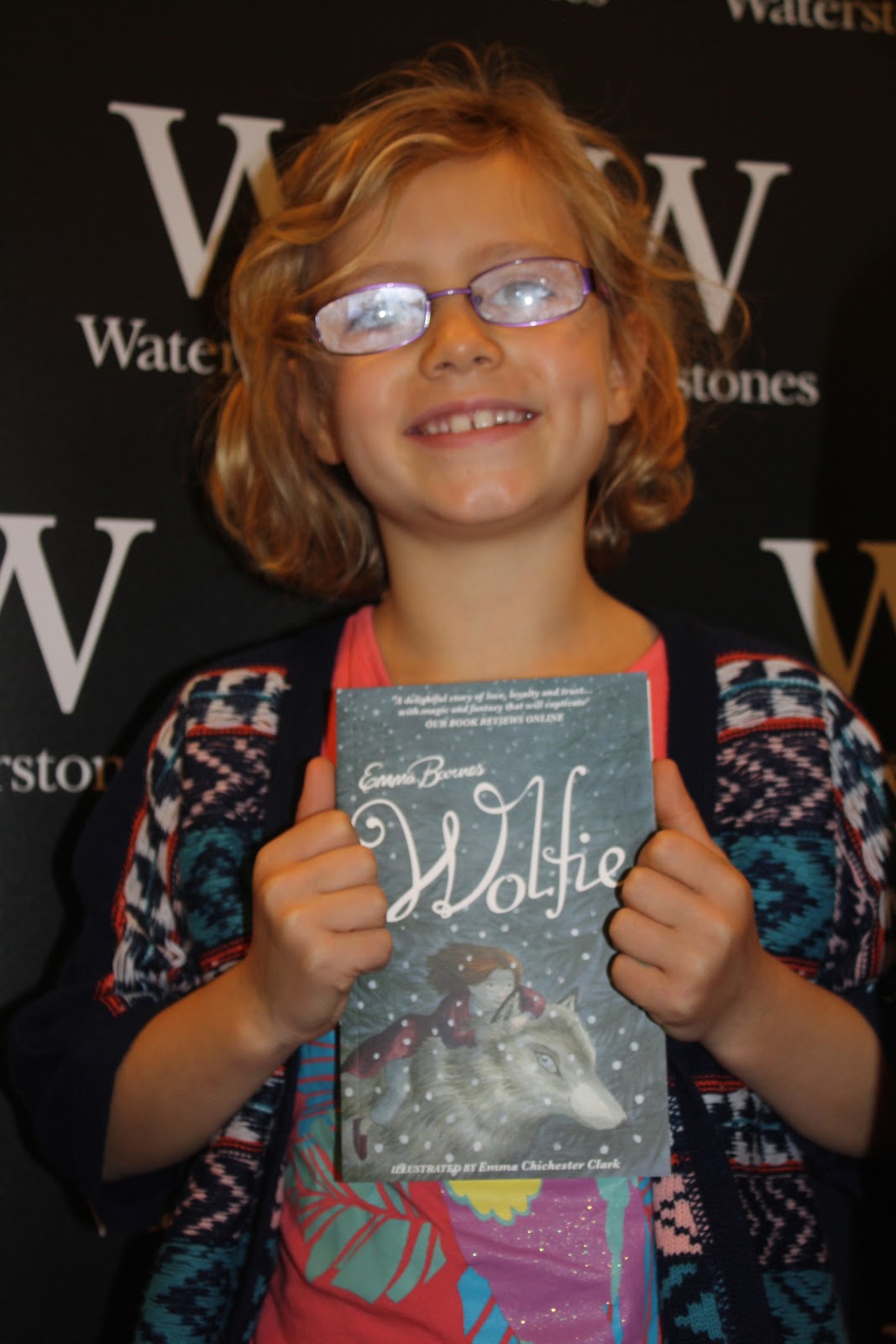
I’d never had a book launch. But for my 2011 book How Not To Make Bad Children Good, I did have a book signing at Waterstones in Leeds. As it turned out, lots of people came along, the store sold out of the book, and there was a real “buzz” in store. So when Wolfie came out, I decided to take the next step and have an official launch party.

Waterstones very kindly offered me a Friday evening after the store was closed, glasses for drinks, and staff to hand them out. Other than that (my publisher could only support me from a distance) I knew the organisation was mainly down to me.

Was it a wise decision? A few hours before, with my voice a mere croak from a bad cold, no idea of how many people were turning up, no posters in store, no idea where to park (without taking out a second mortgage), and my nearest and dearest stuck on trains across the country, it felt like a very bad idea indeed.

But then... my sister designed a poster and the local print shop printed it in minutes. My baking pal produced lovely eats – and she knew where to park, too. Suddenly there were crowds of little wolves running about the aisles, their parents were happily quaffing, my voice held out...just about...as I did my reading. People were queuing to buy the books and get them signed. I met some fans of my previous books. It was actually fun!

So should you have a book launch for your book? Maybe. Here are some things to consider.

PROS

1) It’s a great way to tell people about your book. You can invite not only friends and family, but also schools where you have visited, librarians, reading groups, book festival organisers, bookshop owners, journalists and so forth. Whether or not they come, you are still reminding them about you and your book. And when children turn up because they have loved your previous books, that is very special.

2) Media Coverage. A launch event is more interesting to journalists than simply “local author writes book”. I got coverage in the local newspaper, on various blogs, and local radio.

3) Social Media. Again, a launch is something to shout about on Facebook and Twitter, and is especially good for FB as you can post lots of photos. (So make sure there are photos!)

4) Book sales – I suppose this is the big question. Does it have an impact? All I can say is that Waterstones were delighted with sales on the day, and the Amazon rating was right up in the following weeks.


5) Above all, though, it’s FUN, and celebrates the fact that your book is finally, after so much hard work, in print!

CONS

1) It’s a LOT of work. Unless you are in the cushy position of having an event organiser, then you are going to be sending invites (and personal ones are best), writing press releases, organising food, liaising with the bookshop etc. It’s time that could be spent writing.

2) Don’t even think about it unless you know lots of people to invite. Remember, many you invite won’t be able to come. Few people will walk in off the street – unless you are a “name”. And if it’s a kids’ book, then you need to know people in the right age group. If you don’t, it may be better to do a school or other group-based event instead.

TOP TIPS

1) For a children’s event, you need children, and they like to have things to do. My book is about a wolf, so I had wolf-themed Word Searches, Colouring Sheets, Quizzes and Dressing-Up and a competition to Guess How Many Hamburgers A Wolf Can Eat in One Setting (its ninety, amazingly). For a kids’ event (probably any event) keep readings – and any speeches – SHORT.
2) Photos. Press tend to have quite strict requirements for photos. They like faces, looking straight at camera, and closely cropped. Tell your photographer in advance. If using your own camera, make sure the BATTERY IS CHARGED. Ask children’s parents if they are happy for their children’s images to be used.

3) Exploit your friends! You may not be able to make wonderful refreshments, design great posters, take publishable photos etc, but you probably know people who can. So ask them. And then thank them and pay them, if it is appropriate, or give them a lovely present.

4) Cake. You can now order cakes with your book’s cover from supermarkets or online companies. Easy, inexpensive and delicious!

5) Invite a Group. Library-based book groups, brownies cubs, scouts may all be interested. Schools, though, can be less receptive than you’d think – most teachers are busy, and not looking for extra outings, and head teachers may be reluctant to publicise events that only certain pupils can attend. On the other hand, I invited the Friends group from my local park, where some of my story is set, and although the age-group seemed wrong several came along to buy signed copies for their grandchildren.

6) Think About Stock. If your launch is at a bookshop, bear in mind that they will not want to be left with lots of unsold copies, and will order cautiously. On the other hand, you don’t want people who are keen to buy being unable to do so. So it’s a good idea for you or your publisher to bring along extra stock, which the bookshop can sell (and then replace later) if its own stock runs out.

7) For press coverage you need to get your timing right, and you need to write a snappy press release. Don’t assume that journalists will have time to interview you or write insightful pieces about your work – instead write good copy yourself and provide strong images. Send out press releases in the week before and tweet local media. I found one good tactic was to put the press release on my web-site and tweet the link. Send out photos as soon after the event as possible. And finally:

8) RELAX. You can’t completely control your book launch. So long as you are not collapsing drunkenly in the aisles (this is not the publicity you are looking for) you might as well enjoy it!

Check out Emma Barnes's web-site
Wolfie is available from Amazon and other booksellers


Thursday, 23 August 2012

Wolfie Hits Edinburgh! by Emma Barnes

To my mind, Edinburgh is the acme of Book Festivals. That doesn’t mean I don’t love visiting others too. But because it’s my original home town, Edinburgh will always be special.

 I’ve been going to Edinburgh for years – mostly to the children’s events. It was here, a few years back, that I got to see two of my childhood idols: Anthony Buckeridge, the creator of the hilarious Jennings, and Diana Wynne Jones, who wrote Howl’s Moving Castle.

I’ve been able to prowl around the fabulous book tents, scoff the fabulous ice-cream and even sneak into the authors’ yurt, when invited by my lovely publisher or author friends. So naturally it’s become a burning ambition to do an event at Edinburgh myself.


Last year it almost came true when my book How (Not) To Make Bad Children Good came out at the same time as the Festival, and I signed the first ever copy of the first edition in the Festival bookshop. And this year it finally happened. I was asked to do an event. I was to present my book, Wolfie – hot off the presses – to a tent full of Edinburgh school children.


Yay hay! In triumphant mood I went along to the yurt to collect my author’s pass and complimentary tickets. Complimentary tickets! I gloated over them for a little while. Then I had a quick nose into the yurt itself. It’s a lovely space, but at that moment bursting with scary looking literary types, all deep in conversation. I slunk out and decided to check out the book tent first.

Dismay! I couldn’t find my books. Then I realised they were there – and spread out over two stands.

I had a couple of days before my event and I made good use of them. One session I enjoyed was with sci-fi writer Neal Stephenson, and scientist and novelist Jennifer Rohmer, about the lack of scientists in fiction. I’m well aware of that. My own books, Jessica Haggerthwaite: Witch Dispatcher (and now Wolfie) are two of the few I’ve encountered for children where science is integral to the plot.

I also made a diversion to visit Parliament. The Holyrood one. As part of the Festival of Politics, there was a Carnegie-sponsored panel discussion on children’s reading, with author Theresa Breslin among others, and I was able to go along. 

Back at the Book Festival, I made a discovery. Not only is there the lovely authors’ yurt – with FREE CAKE – but there is even a special authors’ toilet. Who knows who you might bump into? 
And yesterday, my big day arrived. The lovely people in the yurt told me that there were 150 children attending – a bit of a shock, as I was expecting about 50. I was miked up, and I met my wonderful Chair from the Scottish Booktrust, who put me right at ease. 

We were off! 

After that first moment of blinking into the lights, I forgot my nerves. They were a lovely audience (some of them even knew the latin name for wolf!) and it was all great fun. The quiz was just the right side of chaos. But I couldn’t resist bragging about the free cake in the yurt. 

So not a surprise when I bumped into one young member of the audience in there later... 

Wednesday, 18 July 2012

One Girl And Her Dog: Top Dog Stories in Children's Fiction - by Emma Barnes

Some themes crop up over and over in children’s literature. My new book takes lift-off from one of them: the powerful bond that exists between girl (or boy) and their pet dog.

Why are dogs so important to children? Although they plead to have them, in practise most parents know it will be they who do most of the work, while dogs often work out where their walks and sustenance are coming from, and relegate the junior members to mere puppy rank. Yet despite that, from Lassie to Eva Ibbotson’s last novel, there remains something special about the relationship between child and hound.


In my new book, Wolfie, Lucie has always wanted a dog, and her wish is finally granted when her Uncle turns up with a large, toothy, furry “dog”. But is it a dog? Lucie is not sure, although the grown-ups (never good at seeing what is under their noses) mock her claim that the new pet is actually a wolf...

Wolfie is a more dangerous proposition than the average domestic dog. And that’s even before you take into account the fact that she can talk. But in the end, dogs and wolves are both pack animals, and it is the strong attachments they form to their group, and the uncomplicated nature of their affections, that makes them such precious companions, real or imagined, to children.

Some Different Kinds of Books About Dogs 

1) Dog as Friend

For a lonely, often an only, child a dog becomes an essential companion. Perhaps the most famous example (note my pun here!) is George of the Famous Five. A spiky, difficult girl who wants to be a boy, and feels misunderstood by her parents, George is deeply attached to her dog, Timmy. Indeed it is her determination to constantly defend Timmy which sparks off many of her adventures.


My Sam in Sam and the Griswalds is a timid and lacking in confidence – quite unlike George. But acquiring a dog, Biter, is a crucial ingredient in pepping up Sam’s life. And the support of a dog can be important even in adolescence: as in the wonderfully funny but poignant Feeling Sorry for Celia, where Elizabeth has a better relationship with her collie than her own parents.

2) Dog as Ally

Dogs can be equally important to children who, while they have siblings (maybe lots of siblings) are seeking refuge from the rivalry that often brings. Helen Cresswell’s Ordinary Jack has a closer, less demanding relationship with his mongrel dog, Zero, than with his overly talented siblings. OK, so Zero is far from bright, inclined to wee on the floor when nervous and scared of almost everything. But he makes Jack, the only ordinary member of the Bagthorpe tribe, feel tonnes better about himself.


For Peter Hatcher, narrator of Judy Blume’s classic Fudge books, having a dog is offered as compensation for having to put up with endlessly demanding, troublesome younger brother, Fudge.
3) The Dog Weepy 

My primary school reading book was not usually of much interest to me – but then I read Bedgellert. This was the tale of the hound, Gellert, who saved Prince Llewellyn’s baby son from a wolf attack. But his master, returning home, thought that Gellert had killed the baby – and slew the dog, only to realise his mistake when he found the child unharmed.

This story absolutely devastated me. My heartbreak was only matched a few years later with the death of the boy Stephen’s hound, Amile, in Barbara Leonie Picard’s medieval novel, One is One. It’s a wonderful story and still in print – recommended to all with an interest in dogs, monasteries or painting.

Somehow, terrible to say, it’s always worse when an animal dies. Even today, as I watch the (definitely not for children) series Game of Thrones, it’s not the growing pile of human corpses that upsets me: it’s what happens to the dog (ok, it's a dire-wolf - same thing).

4) The Naughty Dog 

Being animals, dogs cannot be blamed for being naughty – and so children can revel in all the things that a bad dog can get up to (and which they might fancy themselves). Dogs run away, dig up flower beds, chase cats, jump fences, trip up the postman, steal food, and generally cause all kinds of enjoyable domestic chaos. I especially like Rose Impey’s Houdini Dog books, where the two sisters remind me of myself and my sister. We badly wanted a dog, and (as in Impey’s book) we decided that a protracted nagging campaign was the best way to get one. When we finally got one - a beautiful, stupid, but very good-natured Samoyed –  like Houdini dog he was given to occasional escapes, and led us a merry dance finding him again.

My favourite naughty dog of all is probably “the dog” (unnamed) in Adrian Mole. He is sick, he eats model ships, he throws up, he jumps on policemen, he runs away to Grandma’s, he licks his stitches, he is scared of alsations, he gets concrete stuck in his paws – he is thoroughly delightful. Who wouldn't fall for a dog like that?

Long may canines rule in children's fiction: may their barks never grow faint!

Check out Emma Barnes's web-site
Wolfie is published in August 2012 and Emma will be talking about it at the Edinburgh International Book Festival.