Showing posts with label The Gruffalo. Show all posts

Tuesday, 9 December 2025

USING COLOUR IN CHILDREN'S BOOKS - ORANGE

 ORANGE


Orange is a bold warm colour. It can make young readers feel excited and ready for adventure. The mix of yellow's cheerfulness and red's excitement creates a perfect combination.

Orange will boost imagination and grab attention in a fun, friendly way.


Here are some examples of illustrators using the colour orange to its best advantage:


The Gruffalo's bright orange eyes are instantly recognisable and create a feeling of warmth and affection for the lovable menace.


This book is fully created around the word and colour orange. It's used perfectly in the storytelling as well as the artwork. 


Who doesn't recognise Judith Kerr's wonderful orange tiger in her famous book "The Tiger who came to Tea"? His bright orange coat dominates the pages and makes him a friendly rather than frightening character. 


www.sharontregenza.com

sharontregenza@gmail.com

Friday, 31 January 2020

FEELING SQUASHED AND SQUEEZED by Penny Dolan

Today is Friday 31st January,. Tomorrow will be Saturday 1st February and tonight we will be "out of Europe." Right now, I can't help feeling hugely sad.

I have been wearing my head out, wondering what to say for this particular start-the-new-month post.  I could pretend all is okay and go on ahead, idly whistling. I could pretend there's a story to write - although I have no confidence in what people want any more. I could pretend to devote myself to words on the page when - right now - I can see only a blank space?  As I suspect do many: these last twelve months have not been a very creative period.

I could even pretend to be poorly - groan, moan,  sob! -  and say I forgot about my ABBA post entirely?  Yet how can I do any of these when I feel as if there's a sort of monster roaming around the land? 

https://lalamanoukyan.files.wordpress.com/2014/03/gruffalo-88314031_166432c.jpg

Then, musing,  I thought of another monster:  an instantly-recognisable, much-loved monster who, despite his anxious look, is probably a highly profitable monster too.

And I looked at some of the story behind this particular monster's story and this is what I found.

Once upon a time . . .
There was a boy who lived in Germany. He loved art and he loved drawing and he decided he wanted to teach other people about art.

Unfortunately, he and his college studies did not get on. For a while, the boy - now a young man - helped mentally ill people in their homes and set his dream aside. Away on holiday, this German man shared his love of art with an English friend. The consquence was that he moved to the UK  and finally studied at Bath Academyof Art in Wiltshire  and went on an exchange to New York.

A Squash and a Squeeze | Teaching Children PhilosophyMoving to London, his freelance work was used in advertising and editorial articles and he also started illustrating children's books.

One book was based on a popular Jewish European folk tale. (As someone interested in folk tales, I'd come across this already where the plot centres on the troubles of a farmer overwhelmed by his complaining wife and many children.)  The version that he  - or the artist Axel Scheffler, as you know by  now - worked on  kept the plot within a simple farmyard setting.

The delightful retelling proved a very popular title  mainly -  I feel - because Axel's simple style fitted so perfectly with the book's setting, and partly because children and grown-ups responded to the words and rhythmic patterns in the text.


Yet it was not, apparently, until after the book was out that Methuen - the publishers - brought the artist and writer together:  "Axel meet Julia, Julia meet Axel"  And so their famous collaboration began.
https://blogger.googleusercontent.com/img/b/R29vZ2xl/AVvXsEixEQI-h9xbF7YQJLQbyh3GUjf06JZUGu_nnuhLvlkEW0cJNlZwjKDTUJgcnJ6fD_8QkS8g0Ac-tS6IhTmiO_tBtMK-sJ2AX8iSq2QnWycl0wlcOvdLzijmRIOu3yb35qLlAEu_-oFHqaHa/s1600/Gruffalo.jpg
But who was this Julia? What was her story? 

Julia grew up in North London. Although her father was a doctor, the whole family and - I assume -  several of their friends were keen amateur musicians and theatrical performers.

Julia and her sister became part of a children's opera group and spent much of their childhood creating their own plays and props and acting out their own stories. Given a weighty anthology, she loved learning and and reciting many of the thousand poems.

By the time Julia was at Bristol University, she was a capable musician and songwriter, well used to singing at folk clubs and in public. During the summer holidays, Julia and two friends went busking in Paris before travelling around France and around Europe. They performed in clubs, on the street and often to groups of children. Julia began making up simple plays and songs in the language of each country where they were perfoming.

Julia was someone who knew three European languages, helped -  or so I feel - by the fact that her parents were both fluent German speakers and her mother a leider-singer. Julia herself had studied French and German at school, learning Italian while working as a children's tutor in Naples. This was also a time when learning one or two European languages was considered an important part of a well-rounded education.

She, like Axel, went to America, travelling round the States on a Greyhound bus and busking in Seattle and San Francisco before returning to London. She then worked as a publisher's secretary and wrote children's plays and songs for BBC Bristol and for the popular children's tv programme Play Away.  After gaining a PGCE, she taught English in school for two years before returning to France for a year,  finally moving up to Glasgow in Scotland. At home with children, she started using the skills she'd learned as a song-writer. sending off manuscripts to children's publishers.

And so,  and so . . .

One day, an editor at Methuen invited her in to discuss a possible picture book, A Squash and A Squeeze. It was to be illustrated by a German artist living in London called Axel Sheffler - and so it began. 

Working together, the pair created The Gruffalo, winning hearts and awards, as well as Julia's Children's Laureate role and film deals and more.  Other collaborations followed, including another great family favourite: Room on the Broom.

The Gruffalo - Room on the Broom 15th Anniversary Edition(Possibly, Broom and Squeeze are both about finding enough room for everyone and appreciating each others strengths, needs and fears Maybe that is the same for The Gruffalo?)

I'm writing this post, thinking about all the European countries that fed, somewhere, into The Gruffalo's success. There is Germany, France,
 Italy, England, Scotland - and maybe others I haven't read about yet.

He could almost be described as a particularly European monster if not a global creation..

 
 Once you start to look, you can find other European authors and illustrators: some as well known and beloved as Judith Kerr, or Goscinny & Uderzo and their translators* ; or Astrid Lingren, plus a host of now-unknown others who are starting as new names within the forest of children's early readers. This without mentioning that there are several artists like Quentin Blake, who live and work some of the year in Europe.

I love the way that the children's book world crosses boundaries and cultures in all sorts of ways, not only in the books themselves, but in real life, in meetings and conversations. There are children's writers and artists right now, counting their pennies and euros to work out whether to travel to the children's publishing festival in Bologna and wallow in all the books and artwork on show there: a trip that is one of my fantasies. One day  . . . one day . . .

Finally, this week's end has brought another book back into my mind. The Christmas before last, I bought copies of this book to give to friends. Initially an exhibition, the book was published as a visual testament, as a way to show how strongly these forty-five illustrators - and many more illustrators and authors -  feel about the  value of our European links. If you peer closely, you'll spot the name of the person who wrote the foreword: Axel Scheffler.

41063426. sx318


Here's to hopes for a friendlier and kinder future than we've lived through this last while. 

More information about these artists can be found at
https://axelscheffler.com/who-is-he

and at

http://www.juliadonaldson.co.uk/about.htm
Written with apologies if any unknown errors have crept into these accounts.

*Fact just found: One "Asterix the Gaul"  translator was Anthea Bell , the editor that Julia Donaldson worked for when first involved in publishing herself.

By Penny Dolan.
@pennydolan1
Written on the 31st January 2020

Tuesday, 12 August 2014

What's the Point of Festivals?


I’ve just returned from Edinburgh on a train packed to the gills with rucksacks, sleeping bags, and the odd piece of bin-bag wrapped set. Yes, it’s festival time and the returning festival-goers include, as they have for the last twenty-two years, me.

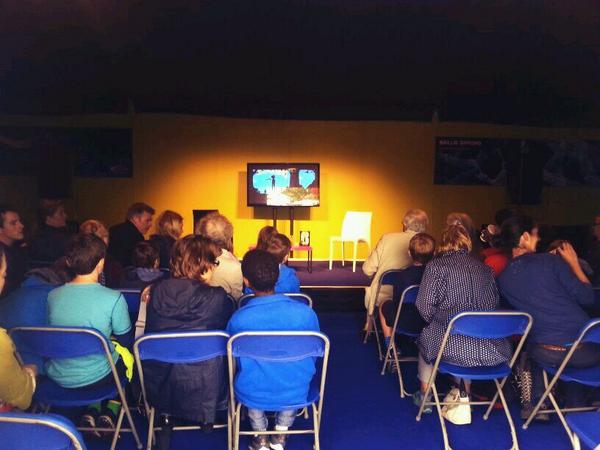
I’ve also been a participant this year – talking at the Edinburgh Book Festival, just one of seven festivals that completely take over the Scottish capital every August. At the same time as I was talking to 80 children about The Dark Wild yesterday, Alex Salmond was discussing the referendum next door, and had you struck out in almost any direction from Charlotte Square in search of alternative fare, I guarantee you could have found some event to suit your palate.
Embedded image permalink
My audience at the Edinburgh Book Festival 2014

 I wasn’t with my partner on this occasion, who was giving a talk on a forgotten Elizabethan play…at another festival, Wilderness, in Oxfordshire. Wilderness is part of a new crop of ‘boutique’ festivals offering  a midsummer’s assortment of revels from hip bands to literary events to Madhatter’s Teaparties. The lakes and Arcadian lawns of Wilderness are a far cry from the cobbles and closes of Edinburgh, although this weekend they shared the same weather.

Earlier this summer we did go to the same festival, to the brand new Curious Arts – a kind of Voewood-on-Sea, in the charming grounds of Pylewell Park, a Regency mansion with a view  from the terrace straight down to the Isle of Wight. You could dance to Ed Harcourt in the evening, listen to Lady Antonia Fraser on the Great Reform Act after breakfast, hunt a Jabberwocky in the Aboretum all afternoon, and finish the day with a gin cocktail leaning over a crumbling balustrade watching ships pass on the Solent.

Pylewell Park, the setting for the Curious Arts Festival


All very charming and civilised. But as I returned for the umpteenth time from the granddaddy of all festivals last night – I found myself meditating on the true attraction of such gatherings. What’s the point of a festival?

Let me first declare an interest in this British summer sport. I began my career programming a large theatre on the Edinburgh Fringe,the Pleasance (of which I am now a Trustee). Each year we have enough shows in enough different rooms to momentarily make us one of the largest arts venues in Europe.

I’ve sat in the sun at Hay and waded through the mud at Latitude. I’ve spoken at a tiny theatre festival that just takes over three floors of one building in Suffolk and a new book festival in Devon which was just a room in a library.  Later this year I’ll be leading a wildlife walk at Bath Festival and then dashing off to sit on a panel at Cheltenham. You can festival it up from Port Elliot  to Adelaide to Dubai, if you want to.

It would seem that we are at peak Festival, with over 700 events taking place this year classified as one,  about 300 of them literary.

 As a writer, you will be told many things about festivals, as I know theatre companies, musicians and comedians are told about theirs. You will be told they are essential for profile, that ‘festivals are the new bookshops’ and a great way for connecting with readers.

I don’t wholly dispute those things. Being in a Festival programme, especially an established one, does lift  perception of you and your titles. Sales wise I’m less sure – I had a sold out talk at Edinburgh yesterday, in a 75 seat room, and probably sold 20 odd books, which is great - but it’s not the sole reason I went.

You certainly don’t go for the money. Some Festivals, like Bath and Edinburgh offer a token fee, and some like Hay, offer a case of wine and a flower. And as someone involved with the running of a festival venue, I can report that the ever increasing rental, accommodation, promotional, regulatory and staff costs associated with mounting one of these temporary gatherings mean profits are only ever normally found behind the bar rather than the box office.

It’s not cheap for audience members either.  Individual events may carry an average ticket price of £8-10 but the travel, accommodation, taxi and food/drink bill means the minimum festival tab comes close to the £100 prices offered by the all inclusive weekend events like Curious Arts, and can be often more - if you visited Edinburgh all week, for example.

Why do we all go and what do we take away?

A dull critic of this pastime might argue that at best audience members take away an empty wallet and often a hangover, and we take away some book sales and inclusion in a programme mailing list.

Of course, all of us are in search of something much more profound.

Festivals may be promoted effectively but I would not place them under the heading of ‘Effective Promotion’ for any artist. There are numerous more sober and less fun ways to do that – just speak to your publisher’s sales and marketing department. But festivals are also fun for them to attend too.

Festivals, especially the summer ones, satisfy a much deeper urge in us to ‘gather.’ Writing, as we all know, can be a damnably lonely business, just you, your ideas and a cold screen all day long. School visits are often hectic and at best your longest conversation with an adult might be five minutes on logistics over a coffee in the staff room.

I think all of us, from writers to actors to comedians to singers to audience members, go to festivals primarily to talk, and to connect. We need our events, sure, we need a reason to gather, our cover story; but the real business of a Festival takes place in the green room, the author’s yurt, the performer’s bar and the pop-up café franchise. 

The classic image of a festival is a big tent, and that is the heart of their appeal. Where else can one talk to Archbishop Emeritus Rowan Williams, the Gruffalo and First Minister Salmond all in one room? Even if I chose not to. They are harvest festivals without the back breaking labour (unless perhaps you’re in an acrobatic troupe), weddings for all, and the very best are always tinged with midsummer madness.
Embedded image permalink
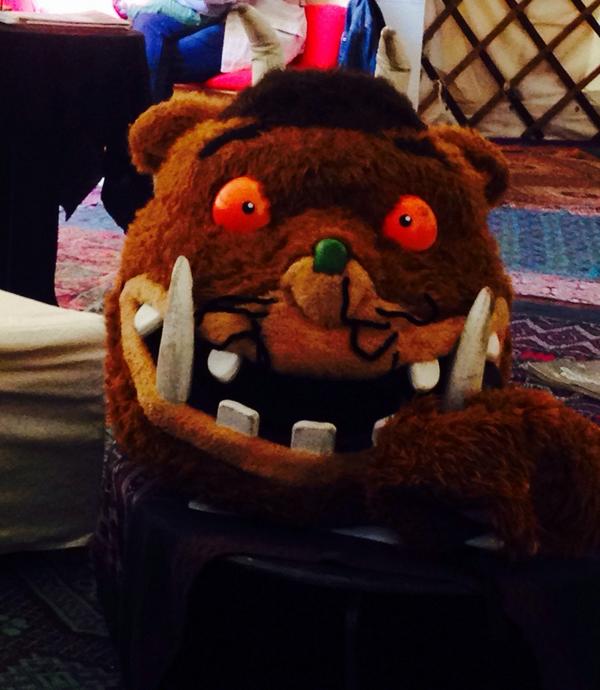
The Gruffalo loses his head at all the excitement in the Edinburgh Author's Yurt

We gather, we discover, share ideas, news, worries and gossip like crazy.  Twitter handles become three dimensional, books expand to reveal the lives behind them, and readers are no longer scary anonymous Amazon commenters.

We might sell the odd book or register with a bookseller who didn’t know us before. All of which is great and worthwhile. But next time your publisher invites you to a festival, don’t worry too much about the fee or whether the sales will be worth it, just gather in the tent  (ideally under a super moon) and enjoy the craic.

Piers Torday
@PiersTorday
www.pierstorday.co.uk

If anyone has any memorable Festival experiences, good or bad, do share them below!