Showing posts with label Edinburgh International Book Festival. Show all posts

Wednesday, 30 August 2017

My local book festival - Lari Don

The Edinburgh International Book Festival is wonderful. Of course, all book festivals are wonderful and everyone’s own local book festival is precious to them. But I am privileged to live in the city with the biggest book festival in the world. For almost 3 weeks every August, Charlotte Square in Edinburgh becomes the heart of the literary world. (Yes, other festivals are available in Edinburgh at the same time, but this one is about BOOKS!)

I used to go to the Edinburgh Book Festival when I was an aspiring writer, before I had any idea what I wanted to write or how to go about it. I used to sit in huge tents listening to authors launching their new books and scribble down every tiny (and contradictory...) writing tip that I heard. I used to attend writing workshops in much smaller tents, and ask earnest and naïve questions. I remember coming out of one ‘how to write for children’ workshop with an idea I was convinced was a bestseller and sitting down on the muddy grass to fill a whole notebook with enthusiasm. (I’ve never written any more of that story. I wonder where the notebook is...)

I still go to the book festival every August, and I still sit at the back of tents with a notebook on my knee (because writers still say interesting things, and I still scribble them down.)

But I also chair events, and ask earnest and possibly naïve questions on stage.

And I also (and this is the bit I sometimes can't quite believe) stand on stage and read my own books to audiences. I talk about my writing process. I share my stories with young readers and answer their (challenging and very pertinent!) questions.

I launched my new book – The Witch’s Guide to Magical Combat - last week at the book festival. The last book in a trilogy I’m sure I wouldn’t have written without all the notes I scribbled and all the earnest questions I asked, many years ago.

I love book festivals. But the book festival which means the most to me, the book festival which reminds me how far I’ve come and how privileged I am, is the book festival which happens just up the road.

The Edinburgh International Book Festival is now over for another year. But I wonder what words and stories and books will be written over the next 11 months by all the aspiring writers, young and old, who were in those audiences...


Lari Don is the award-winning author of more than 20 books for all ages, including fantasy novels for 8 – 12s, picture books, retellings of traditional tales, a teen thriller and novellas for reluctant readers. She has just launched the final book in the #Spellchasers trilogy.

Sunday, 30 August 2015

What you learn in tents - Lari Don


It’s nearly the end of the Edinburgh Book Festival – a wonderful opportunity for booklovers to gather and get rained on in Charlotte Square in Edinburgh.

I live in Edinburgh, so as well as being fortunate enough to do author events at the festival (this year, I did an event on my new book Serpents & Werewolves, and one on the gorgeously illustrated Tale of Tam LinnI also spend a lot of time enjoying other authors’ events.

I learnt a lot about writing from the book festival when I was starting out, both from writers’ workshops and from asking questions at the end of authors’ events.

Do I still learn about writing from the events? Yes of course, though not in the waterfall way I learnt years ago, when I had no sense of who I was as a writer. I still listen and learn, but I no longer scribble frantically the whole way through events.

But writing isn’t the only part of being a writer. Author events, readings, workshops and Q&As are just as much part of my job nowadays as imagining and inventing and editing. So, having learnt how to be a writer by haunting the EIBF 15 years ago, is it now possible for me to learn how to do author events by watching what other authors do?

I mix going to see authors I already love to read and authors I’ve never heard of. I learn a little bit from all of them, from their writing process and their inspiration. But I also learn from watching them do their events. From their readings, dressing up, musical accompaniment, audience participation, powerpoint presentations, debates and discussion with other authors, and all the other things authors do at festivals. And the main thing I learn is - the most successful events are the most honest ones, the ones which genuinely reflect the author’s work. There is no point in trying to do the same event as another author, because the most important thing to do in an event is be honest and open about your writing process and your book.

I may love listening to Patrick Ness or Marina Warner, but I can’t copy the way they present their events any more than I can (or should!) copy their books. Whether talking to 300 kids in a tent in Edinburgh, or 15 kids in a library in Ayrshire, all I can ever do is share with my audience what I do and why I love it. (This is why I very rarely do an event without telling one of myths or legends or folktales that inspire my fiction.)

So, I learnt to write my own way from workshops all those years ago in Charlotte Square, and now I’m learning to talk about writing in my own way too.

But the tents will come down next week. And we’ll all need to stop talking about writing, get our heads down and start writing again!

Lari Don is the award-winning author of 22 books for all ages, including a teen thriller, fantasy novels for 8 – 12s, picture books, retellings of traditional tales and novellas for reluctant readers.
Lari’s website 
Lari’s own blog 
Lari on Twitter 
Lari on Facebook 
Lari on Tumblr

Wednesday, 17 September 2014

A Tale of Two Book Festivals: from Leeds to Edinburgh - by Emma Barnes

After speaking to 350 children at Edinburgh International Book Festival

It’s easy to get depressed in the worlds of children’s books: whether it’s the ongoing closure of public libraries, the fact that writers are earning less and less or the dismal statistic that over 1 in 4 British children don't own a single book.  But, if you haven’t abandoned me already, there ARE bright spots.  One of these positive trends is the amazing growth of literary festivals.

Big festivals are growing.  Small festivals are mushrooming. 

This summer I witnessed both ends of this spectrum, doing events at one of the newest festivals and  one of the most long established. 

Leeds Big Book End - Children's Programme

The Leeds Big Bookend has been set up by a bunch of enthusiastic and dynamic people in the city where I live, Leeds, who felt that with virtually everywhere else around us boasting a festival – Ilkley, Harrogate, Morley, Wakefield (I could go on) Leeds should have one too.  Entirely run by volunteers, it’s obviously been immensely hard work.

The children’s venue was rather tucked away above a health food shop…and yet inside the organizers had built a wonderful story-telling yurt, to which every child in the place immediately gravitated.  It was lovely.  And still small enough and intimate enough that I probably had chat with every child there.

Fellow author Kate Pankhurst in the Leeds yurt: Photo credit - Coronita Coronado


Then, at the end of August, I was off to one of the biggest and most well-established of festivals – the EdinburghInternational Book Festival (EIBF), where I was taking part in the Schools Gala Day.  The EIBF is a major event in the literary world, where probably the highlight of a packed children's programme this year was an appearance by Malala Yousafzai, introduced by JK Rowling.

Edinburgh is my original home town and I’ve been to the book festival there for years.  I remember sitting in small tents, sometimes with a handful of people, listening to the speakers organized by Scottish Book Trust.   Now the programme has grown hugely and the marquees in Charlotte Square are a hub bub of activity, with enormous queues, packed out events, famous faces passing in the crowd and a whole lot of people eating ice cream and sunning themselves on the grass  (well, Edinburgh weather permitting).

Of course, I’ve heard critics say that this growth in festivals only affects a few people – the book-buying public, and the families who encourage their children to read anyway.   In other words, festivals are the past-time of a literary elite.

Not so.  My own first event was for an audience of around 350 children who had traveled to the Festival with their schools – seven different primaries from across Scotland.  And in the afternoon, I did another school event in a local library – part of the Festival’s Outreach Programme, that takes writers and illustrators to meet children who most likely wouldn’t have the chance to come to the Festival.  And this year Edinburgh also ran a Writer in Residence scheme – enabling a writer to go in and work with children in a school over an extended period, creating their own picture books.

Questions prepared by the children at my EIBF outreach event


Edinburgh isn’t alone in this.  Many literary festivals run programmes of school visits, bringing together teachers, children, writers and illustrators.

When I was growing up, I never met an author or illustrator.  I was fascinated by books, but I never thought that writing them was something that living, breathing people did.  (I knew Enid Blyton and Roald Dahl were dead…I reckoned the rest probably were too.)

Now, many children are meeting authors, and that has a lot to do with book festivals.

Did I inspire any of the children I met this year?  I don’t know.  I know they laughed a lot.  I know they had lots of questions.  And I know when a bunch of those 350 children came up onto the stage and acted out their own story about my character, Wild Thing (where she and her sister visited Edinburgh Castle and accidentally set off the One O’clock Gun) they certainly inspired me.


---------------------------------------------------------------------------------

Emma's new series for 8+ Wild Thing about the naughtiest little sister ever (and her bottom-biting ways) is out now from Scholastic. 
"Hilarious and heart-warming" The Scotsman

 Wolfie is published by Strident.   Sometimes a Girl’s Best Friend is…a Wolf. 
"A real cracker of a book" Armadillo 
"Funny, clever and satisfying...thoroughly recommended" Books for Keeps


Emma's Website
Emma’s Facebook Fanpage
Emma on Twitter - @EmmaBarnesWrite

Tuesday, 12 August 2014

What's the Point of Festivals?


I’ve just returned from Edinburgh on a train packed to the gills with rucksacks, sleeping bags, and the odd piece of bin-bag wrapped set. Yes, it’s festival time and the returning festival-goers include, as they have for the last twenty-two years, me.

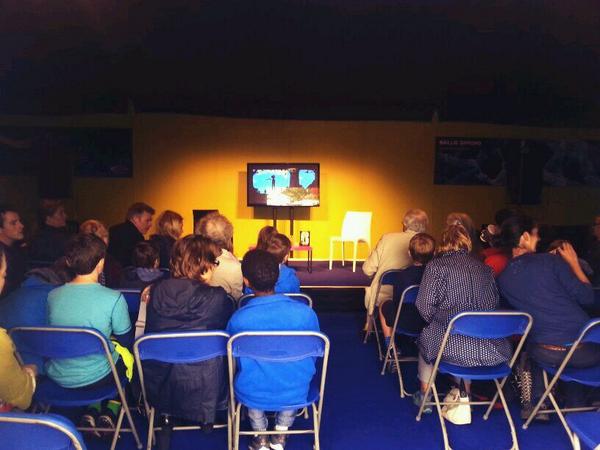
I’ve also been a participant this year – talking at the Edinburgh Book Festival, just one of seven festivals that completely take over the Scottish capital every August. At the same time as I was talking to 80 children about The Dark Wild yesterday, Alex Salmond was discussing the referendum next door, and had you struck out in almost any direction from Charlotte Square in search of alternative fare, I guarantee you could have found some event to suit your palate.
Embedded image permalink
My audience at the Edinburgh Book Festival 2014

 I wasn’t with my partner on this occasion, who was giving a talk on a forgotten Elizabethan play…at another festival, Wilderness, in Oxfordshire. Wilderness is part of a new crop of ‘boutique’ festivals offering  a midsummer’s assortment of revels from hip bands to literary events to Madhatter’s Teaparties. The lakes and Arcadian lawns of Wilderness are a far cry from the cobbles and closes of Edinburgh, although this weekend they shared the same weather.

Earlier this summer we did go to the same festival, to the brand new Curious Arts – a kind of Voewood-on-Sea, in the charming grounds of Pylewell Park, a Regency mansion with a view  from the terrace straight down to the Isle of Wight. You could dance to Ed Harcourt in the evening, listen to Lady Antonia Fraser on the Great Reform Act after breakfast, hunt a Jabberwocky in the Aboretum all afternoon, and finish the day with a gin cocktail leaning over a crumbling balustrade watching ships pass on the Solent.

Pylewell Park, the setting for the Curious Arts Festival


All very charming and civilised. But as I returned for the umpteenth time from the granddaddy of all festivals last night – I found myself meditating on the true attraction of such gatherings. What’s the point of a festival?

Let me first declare an interest in this British summer sport. I began my career programming a large theatre on the Edinburgh Fringe,the Pleasance (of which I am now a Trustee). Each year we have enough shows in enough different rooms to momentarily make us one of the largest arts venues in Europe.

I’ve sat in the sun at Hay and waded through the mud at Latitude. I’ve spoken at a tiny theatre festival that just takes over three floors of one building in Suffolk and a new book festival in Devon which was just a room in a library.  Later this year I’ll be leading a wildlife walk at Bath Festival and then dashing off to sit on a panel at Cheltenham. You can festival it up from Port Elliot  to Adelaide to Dubai, if you want to.

It would seem that we are at peak Festival, with over 700 events taking place this year classified as one,  about 300 of them literary.

 As a writer, you will be told many things about festivals, as I know theatre companies, musicians and comedians are told about theirs. You will be told they are essential for profile, that ‘festivals are the new bookshops’ and a great way for connecting with readers.

I don’t wholly dispute those things. Being in a Festival programme, especially an established one, does lift  perception of you and your titles. Sales wise I’m less sure – I had a sold out talk at Edinburgh yesterday, in a 75 seat room, and probably sold 20 odd books, which is great - but it’s not the sole reason I went.

You certainly don’t go for the money. Some Festivals, like Bath and Edinburgh offer a token fee, and some like Hay, offer a case of wine and a flower. And as someone involved with the running of a festival venue, I can report that the ever increasing rental, accommodation, promotional, regulatory and staff costs associated with mounting one of these temporary gatherings mean profits are only ever normally found behind the bar rather than the box office.

It’s not cheap for audience members either.  Individual events may carry an average ticket price of £8-10 but the travel, accommodation, taxi and food/drink bill means the minimum festival tab comes close to the £100 prices offered by the all inclusive weekend events like Curious Arts, and can be often more - if you visited Edinburgh all week, for example.

Why do we all go and what do we take away?

A dull critic of this pastime might argue that at best audience members take away an empty wallet and often a hangover, and we take away some book sales and inclusion in a programme mailing list.

Of course, all of us are in search of something much more profound.

Festivals may be promoted effectively but I would not place them under the heading of ‘Effective Promotion’ for any artist. There are numerous more sober and less fun ways to do that – just speak to your publisher’s sales and marketing department. But festivals are also fun for them to attend too.

Festivals, especially the summer ones, satisfy a much deeper urge in us to ‘gather.’ Writing, as we all know, can be a damnably lonely business, just you, your ideas and a cold screen all day long. School visits are often hectic and at best your longest conversation with an adult might be five minutes on logistics over a coffee in the staff room.

I think all of us, from writers to actors to comedians to singers to audience members, go to festivals primarily to talk, and to connect. We need our events, sure, we need a reason to gather, our cover story; but the real business of a Festival takes place in the green room, the author’s yurt, the performer’s bar and the pop-up café franchise. 

The classic image of a festival is a big tent, and that is the heart of their appeal. Where else can one talk to Archbishop Emeritus Rowan Williams, the Gruffalo and First Minister Salmond all in one room? Even if I chose not to. They are harvest festivals without the back breaking labour (unless perhaps you’re in an acrobatic troupe), weddings for all, and the very best are always tinged with midsummer madness.
Embedded image permalink
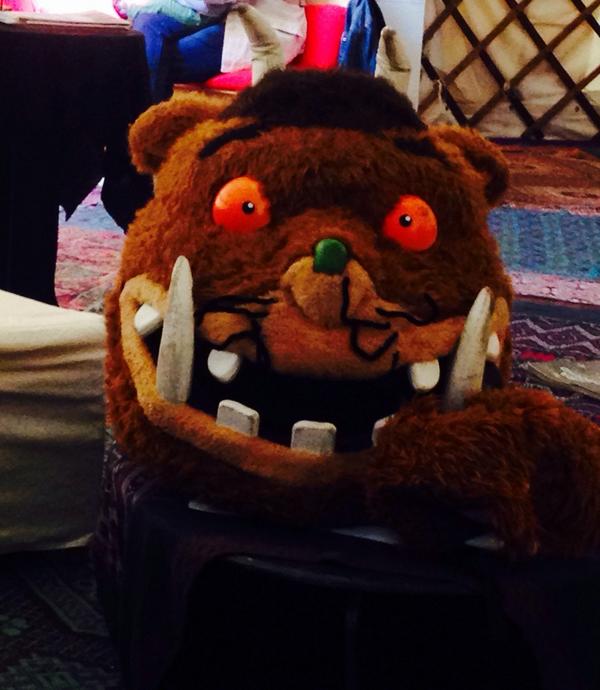
The Gruffalo loses his head at all the excitement in the Edinburgh Author's Yurt

We gather, we discover, share ideas, news, worries and gossip like crazy.  Twitter handles become three dimensional, books expand to reveal the lives behind them, and readers are no longer scary anonymous Amazon commenters.

We might sell the odd book or register with a bookseller who didn’t know us before. All of which is great and worthwhile. But next time your publisher invites you to a festival, don’t worry too much about the fee or whether the sales will be worth it, just gather in the tent  (ideally under a super moon) and enjoy the craic.

Piers Torday
@PiersTorday
www.pierstorday.co.uk

If anyone has any memorable Festival experiences, good or bad, do share them below!


Wednesday, 30 July 2014

Rereading for the wrong reasons? Lari Don

One of the most wonderful but most troubling things about being a writer is that books become work.

Not just writing books, but reading them too.

This can be wonderful, when I tell myself that wasting (spending, investing) a whole day reading a novel that I’m desperate to finish, is in fact legitimate work. But it can also be troubling, when I realise that something I used to love is now something I HAVE TO DO.

This changes my relationship with books. Having to read books, having to think about and talk about books, not because I want to, not because that’s the book I want to spend time with, but because I’ve committed myself to an event or an article or a blog post which makes reading that particular book right now a necessity.

I live in Edinburgh, and I’m doing various events at the Edinburgh International Book Festival next month, mostly in the children’s and schools programme. But I’m also leading a reading workshop on Diana Wynne Jones, a writer whose books inspired me as a child, whose books still inspire me now, whose books I love to read.

But this summer, I have HAD to read them. I have had to reread the ones I am committed to discussing. (Books that, to be fair, I suggested and wanted to discuss, but even so…)

And suddenly I found myself resisting rereading them. I love rereading my favourite books. Mostly because I enjoy them, and am happy to reenter their worlds. And partly because, especially with books by Diana Wynne Jones, Neil Gaiman and others who are inspired by tales of old magic, I recognise more references every time I read them. But that’s when I choose to reread. When a book calls to me and says, come on over here and visit me again…

This summer, there’s been a pile of DWJ books on my study floor, which I knew I had to reread, but which I kept stepping round. Even though The Power of Three is my favourite ever children’s book, and Howl’s Moving Castle is in the top five, and Fire And Hemlock radically changed my relationship with my favourite Scottish fairy tale, and Chrestmanci is the most perfect wizardly wizard ever created… I’ve been resisting. Because I felt that I had to read them, that it was my job, that it was homework.

a small fraction of the DWJ pile!
And this has made me consider how, to some extent, every book I read is work. That everything I read leaves something behind, like a wave on a beach, which changes and inspires and shapes everything I will subsequently write. That I learn from every book, whether I love it or not. That the reader I am creates the writer I am.

But I also know that if I am conscious of what I’m learning from a book, then I haven’t truly lost myself in it. And the books that I just thoroughly enjoy, that I don’t read as a writer, that I just read as a wide-eyed reader, desperate to find out what happens next (and not noticing how the writer is making me care) those are the books I love the most. Probably those are the books that influence me most. And certainly those are the books I happily and enthusiastically reread.

And so. I took a deep breath. I started with Dogsbody, and The Ogre Downstairs, and Howl and those castles. And I have had the most glorious weekend rereading Diana Wynne Jones. To be honest, most of the time, I forgot why I was rereading them (workshop, what workshop?) and just lost myself in the wonderful magical world of her imagination.

Lari Don is the award-winning author of 21 books for all ages, including a teen thriller, fantasy novels for 8 – 12s, picture books, retellings of traditional tales and novellas for reluctant readers. Lari’s website 
Lari’s own blog 
Lari on Twitter 
Lari on Facebook