Showing posts with label writing competitions. Show all posts

Saturday, 18 May 2019

Making wine from sour grapes - by Lu Hersey


If you watch the BAFTAs or the Academy Awards, you notice an interesting thing about actors. They can convey any emotion, from deep sorrow to ecstatic joy, and make us totally believe in their on-screen characters – but they just can’t quite get it right when they don’t win an award. Their fixed smiles at the success of their fellow actors really doesn’t quite cover the gritted teeth and barely suppressed anguish at not grabbing the Oscar for themselves.


The thing is (I’m not up for any book awards right now, so I’m allowed to say this), WRITERS FEEL EXACTLY THE SAME! 

Of course we do. We can recognise the brilliance of another writer and be glad they’ve been acknowledged – but at the same time, we wish we'd won instead. We just want to run away and sulk BIG TIME. What we really DON’T want is to be all over social media telling everyone how delighted we are for the winner and how amazing and deserving they are…but obviously we do it anyway, because usually it's true. We just can't feel it at the time.

In any kind of writing competition, whether you’re looking for an agent, or a publisher, or hoping for an award for your published book, not succeeding doesn’t mean you’re no good – just that someone else won. I’ve read manuscripts by excellent writers, telling fantastic, original stories, who somehow haven’t yet found a publisher - and plenty of published books by amazing writers that weren’t even nominated for any awards. There must be an entire library’s worth of books out there that deserved all the accolades, but didn’t get them. Whatever the reason, it doesn’t mean they’re not great books by brilliant writers.


Years ago (more than I’d like to admit to) the person I believed I was going to marry, married someone else. There was one song that kept going around in my head - Yvonne Fair’s It should Have Been Me. (Turn up the volume - it’s amazing and packed with raw emotion. Forget Celine Dion.) The quantity of sour grapes I swallowed congratulating the happy couple was enough to pack a crate and the champagne toast practically choked me – but years later, I’m glad it worked out the way it did. My life just took a different direction, and truth is, sour grapes can mature into fine wine.


The same goes for writing awards and competitions. Don’t waste your energy wondering if you should give up and if you’re no good – just congratulate the winners. You might win next time…and you’re going to really appreciate others wishing you well.
Meanwhile, maybe we should start a virtual library for all the brilliant books that weren’t best sellers or award winners, but really deserve some love…

Lu Hersey

@LuWrites

Wednesday, 26 October 2016

Wells and Welsh - Eloise Williams


Thrilled, delighted and over the moon that my novel ‘Seaglass’, as yet unpublished (hint, hint), has come in as Runner-up in the Wells Festival of Literature Children’s Novel Competition this year.

Please do a happy dance for me.

Wow! You really do have the moves!


So, I went to Wells – beautiful City of extraordinary eateries and superlative shopping opportunities and shook Camilla’s hand. Yes, the Camilla. As you do.

Hello there, security people. Yes I AM coming into the marquee in the Bishop’s Palace Gardens thank you very much. And so is my mum.


Anyway, a lovely day was had by all and I am so chuffed that my story is so liked.

On that note – a bugbear. Time to get something off my chest.

Writers in Wales are often told not to make their stories too Welsh. Or, to put it another way, make them less Welsh.


Just because our stories are set in Wales and have Welsh characters populating them, it doesn’t mean that they won’t have Universal appeal. *Pulls extremely cross teacher type face*

‘Seaglass’ is a ghost story set on the Pembrokeshire Coast. It uses the local landscape and history as its setting and its main protagonist is a Welsh Gypsy. I specifically chose to write about the place because it is a place that I love with all my heart and is also where I am lucky enough to live. I chose for Scarlett to be a Welsh gypsy because that’s how she was born in my head.  

There are loads of brilliant writers setting their stories in Wales because it is interesting here! Even some writers who weren’t even born in Wales! Shock! Horror! *Picks self up from fainting position.*


I’m not saying that I will never set a story somewhere else – N.B. I probably won’t because there are all those procrastinational jobs to do – but I see absolutely zero reason why I shouldn’t write about the people and land where I live and still be relevant.

Eloise… can you make you make your stories a bit less Welsh?

Erm… No.
 

Will you make your stories a bit less Welsh?

Erm… No.

Perhaps if you could…

I’ll stop you there.
Erm…No.

And so to celebrate the success of ‘Seaglass’, I’m in a cabin in North Wales, overlooking the sea from the Llyn Peninsula, close to the mountains of Snowdonia, learning to siarad Cymraeg badly, discovering my next story and editing Gaslight, which is set in Cardiff and was written with support from Literature Wales.

Of course the Welsh word for Congratulations is Llongyfarchiadau. As you well know.

Llongyfarchiadau Seaglass! Da iawn.  

And just to get rid of the teacher face a spot more happy dancing if you please… I’ll just get put on some Tom of the Jones!


Monday, 17 August 2015

How To Judge Children's Writing? - by Emma Barnes


Earlier this year I was asked to be Judge of the Hope/Findel Writing Competition for children. Schools across the UK submitted stories by their pupils, in three age categories, with the chance to win prizes of books for the school, cinema tickets, and signed copies of my book Wild Thing. My job was to pick the overall winners from the shortlisted entries.

Being a Judge was enormous fun – and also a complete nightmare. Enormous fun because there was so much talent in the shortlisted stories. They were truly a pleasure to read. A complete nightmare because reading and enjoying the stories was one thing, but picking out a winner – and a second and third place – in each category was another thing entirely. I wanted to be like the Dodo in Alice in Wonderland who declares: "Everybody has won, and all must have prizes."

The Dodo as Judge by Tenniel (Image: British Library.  Public Domain)

Now the results are out, and here I am reading out the winning entries on film. Well done, you brilliant young writers.

But how do you judge children's writing? (How do you judge any piece of creative writing?)

With great difficulty.  There's the quality of the prose, which could be marvellously rich and poetic (or crisp and concise).  There's also the structure - a story needs a beginning, a middle and an end (or usually it does).  A story needs pace.  And then what if the story is genuinely funny and surprising, but the ending lets it down? What if the story is highly polished and well-structured but somehow predictable? What if there's a brilliant idea, but it's not quite carried through? What if an entry is brilliant but over the word count?

Even trickier, how do you judge realism against humour against a thriller against a piece of dystopian sci-fi against a story with talking animals?

Having drawn up various lists, and devised elaborate points systems, none of which worked, in the end I followed my instincts.  I chose the stories that most surprised and delighted me. But I had terrible pangs about the wonderful stories I couldn't choose. And I now have a huge sympathy for teachers – the people who day in, day out have the job of assessing children's writing.

It did make me think about the way we teach children to write. Writer CJ Busby has spearheaded a campaign (started on this blog) to address some of the ways writing is taught in primary school.  Reading the stories I did find that simplicity could be a breath of fresh air, and there was an occasional story where the phantom of the National Curriculum, standing at the writer's elbow and whispering "squeeze in just one more metaphor...how about another complex sentence?" was not helpful.  A good story is not a checklist, and maybe we need to remind ourselves of that.

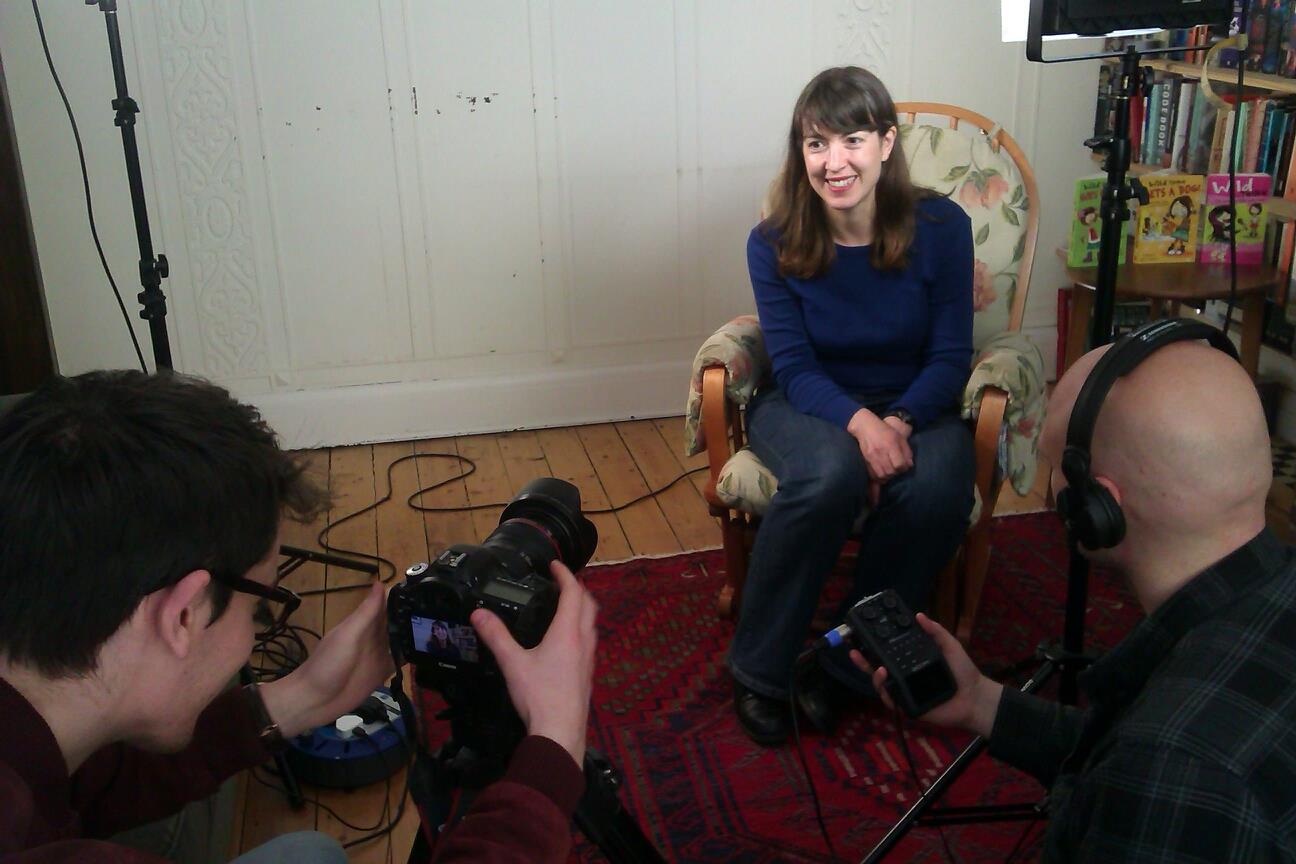
Meanwhile I got to be media star for a day. In my writing career, this is the first time I've had a film crew in my house. Many thanks to Findel designer Gary Hadfield (top left), and the guys from the EGL video (left to right) Andrew Birtwell, Simon Ashton and Luke Margetts who cheerfully set up their gear in my livingroom, braved my crazy dog, and didn't worry too much about the building noises from next door.


Getting ready to read


The team from Findel/EGL

Many congratulations, not only to the winners but to all the young writers who took part - I hope you all enjoyed it as much as I did.

--------------------------------------------------------------------------------------------------------------------------

Emma's Wild Thing series for 8+ about the naughtiest little sister ever. (Cover - Jamie Littler)
"Hilarious and heart-warming" The Scotsman

 Wolfie is a story of wolves, magic and snowy woods...
(Cover: Emma Chichester Clark)
"Funny, clever and satisfying..." Books for Keeps

Emma's Website
Emma’s Facebook Fanpage
Emma on Twitter - @EmmaBarnesWrite

Saturday, 13 September 2014

Once upon a time... the end

In my past life, as a teacher, one of my most disliked tasks was marking. Not because I didn’t like reading my pupils’ work (though I often didn’t), but because having to assess a piece of writing against a set of increasingly arbitrary assessment objectives sometimes made me think it was all about jumping through hoops rather than the actual rules of good writing.

When I sat down a few weeks ago to judge a short story competition, I delighted in the fact that this time I was setting my own objectives, and they were pretty simple. Does this story work? Does it draw me in and keep me hooked? Do I feel confident in this writer’s hands?

I’ve won quite a few short story competitions, and it was flattering to be asked to judge this one. It was a fairly small, but very professionally-run competition, organised by a magazine. The magazine is Ireland-based, as am I, but attracted entries from all over the UK and the Republic of Ireland. The stories had been pre-shortlisted and were judged anonymously. Not knowing anything about a writer really makes you focus on what’s important in the story.


I’ve often read judges’ reports on competitions which say that the winner announced itself in the first few sentences, and I know agents and publishers often say that they can tell almost at once if a book is going to impress. This wasn’t my experience. Instead, though I found it easy to choose the winning story, several stories promised a great deal in the first paragraph, only to disappoint as the story went on. Some writers had put so much emphasis on that all-important hooking of the reader that they forgot to reel her in, and she was left dangling.

Several of the stories contained fantastic writing – really imaginative use of language. Heart-stopping moments. Intense character identification. Yet none of these stories was placed. Why? Because great use of language isn’t enough – a story has a job to do, and if it doesn’t do that, if it doesn’t take a character from A to B, it doesn’t matter how delightful its metaphors are. 


I write young adult fiction, and it’s normally a 70,000 word novel as opposed to a 2,000 word story. Yet I found the experience of assessing these stories really helped me to look dispassionately at my own work. Young adults, like short story judges, are hard to please. They aren’t fooled by metaphor-fur-coat and no story-knickers. They won’t keep going if a story doesn’t live up to early promise.


I enjoyed assessing these stories, and I’m looking forward to meeting the winners at the ceremony in November. But even more, I enjoyed being reminded of the nuts and bolts of good story-telling, and I hope my own readers stand to benefit from that.

Saturday, 20 July 2013

No, MY name is Ozymandias - Joan Lennon

In the (so far nameless) Victorian adventure book I'm writing, my characters have just stumbled across a ruined statue in the Egyptian desert and gone ever so slightly crazy, loudly declaiming the lines of Shelley's famous poem to the empty sands.  In order for them to do so, I had to look up the lines, as I only had snippets in my brain.  Wikipedia came up with the goods, and then some.  It gave me an interesting image of an early rough draft:


It gave me an image of a fair(ish) copy in Shelley's best penmanship:


 And THEN, it gave me ANOTHER poem called Ozymandias: *

IN Egypt's sandy silence, all alone,
      Stands a gigantic Leg, which far off throws
      The only shadow that the Desert knows:—
    "I am great OZYMANDIAS," saith the stone,
      "The King of Kings; this mighty City shows
    "The wonders of my hand."— The City's gone,—
      Nought but the Leg remaining to disclose
    The site of this forgotten Babylon.

    We wonder,—and some Hunter may express
    Wonder like ours, when thro' the wilderness
      Where London stood, holding the Wolf in chace,
    He meets some fragment huge, and stops to guess
      What powerful but unrecorded race
      Once dwelt in that annihilated place.

This one was written by Shelley's friend, Horace Smith.  I didn't know this, but apparently they'd challenged each other to write a sonnet inspired by bits of old statues found lying about the place in Egypt (before being shipped to the British Museum).

And what is my point in transcribing Wikipedia articles about things you lot probably all learned at school any way?  Well, blame my characters.  Without their odd behaviour, brought on by incipient sunstroke, I might have been blogging about something altogether different.  Like Throwaway Lines, maybe, where writers are challenged to write about a bit of old rubbish found lying about the place ...

Be we Shelleys or Smiths, writers do love having a go!


*  He later changed the title to the less punchy "On  A Stupendous Leg of Granite, Discovered Standing by Itself in the Deserts of Egypt, with the Inscription Inserted Below."  They may have paid by the word in those days.

Joan's website.
Joan's blog.
Joan's Throwaway Lines story.


Friday, 21 June 2013

Dog Days - Ruth Symes/Megan Rix


Back in March of this year I blogged about how my golden retriever, Traffy (short for Old Trafford) was going to be a reading therapy dog and would be visiting schools so children could read to her. 

So far this has been far more successful than I’d even imagined it would be.  On our first visit we took assembly for the whole of the Lower School so everyone could meet Traffy. As I read the children a book about her the children started saying 'Miss, Miss' and pointing behind me. When I looked round I saw that Traffy had helped herself to a bag of her favourite chicken donut treats from my bag (which is really her bag as it only has her toys and water bowl and treats and special mat in it) and was throwing the treat bag up in the air in the hope that one would fall out. As I looked back at the children's laughing faces I thought I couldn't have planned a better introduction for them to her. Who could be frightened of a dog who helped herself to her own treats.
                                                   
         ‘Shall I give her one?’
         ‘Yes!’ came the resounding reply.

After that initial assembly our real 'work' began. Each week we go into the school for an hour and the children come one at a time to read to Traffy in the library (the carpeted floor is always a lot furrier by the time we go.) We're helped by one of the Mum's who brings the children to us - which speeds things along. And at the end of each child’s visit they get a special paw-print stamp in their reading record book.
        
I love listening to the children read and Traffy does too; lying next to the reader and often watching as they turn the pages – although occasionally she faces the wrong way and once or twice has had a little doze.


This week 2 of our regular readers were missing so the teacher said she'd pick two extra children who'd finished their books and were starting new ones to come to us instead. We were told some of the fastest reading in history happened as a consequence!
             
As well as her reading job Traffy's also recently been along to 
the East Sussex Children's Book Award Ceremony at the De La Warr Pavillion in Bexhill where my book ‘The Great Escape was runner-up.

She wagged her tail at the 300 or so oohing and aahing children in the audience and would have gone down the steps there and then to meet them if I’d let her. 

Kate Saunders won the beautiful engraved glass first prize for her book ‘The Whizz Pop Chocolate Shop’ and as we answered the children's questions Traffy sat down on the stage and then lay down looking at us and then back out at the children - totally unfazed by it all. Although she'd have preferred it if there were more chicken donuts.


Ruth and Megan are the same person.

Megan Rix's latest book is 'The Victory Dogs' published by Puffin and set during the Blitz in WW2. Her website is www.meganrix.com

Ruth Symes' latest book is 'Witch Camp' published by Piccadilly. Her website is www.ruthsymes.com