Showing posts with label Short stories. Show all posts

Wednesday, 18 March 2020

How to pass the time when self-isolating - by Lu Hersey

Many of us are now stuck at home, either by ourselves or with our families. Self-isolating. Days spent away from our usual work, friends and entertainments. Maybe weeks. Hopefully not months. Self-imposed prison sentences from an unseen enemy, where toilet rolls could be the least of your problems. My son already thinks he might die from sheer boredom.

In the (global pandemic) circumstances, I thought the most helpful thing I could do would be to list some ideas on how to entertain yourselves while you sit it out.

1. Write something different. A change is as good as a rest. Have you tried writing short stories? There are a surprising number of short story writing competitions around, and if you win one, some great prizes. Two of the best still open for entry this year are The Bristol Short Story Prize, with cash prizes for the top 20 stories, which also all get published in an anthology - and The Bridport Prize, where the winner of the short story prize gets £5K (which might help cover loss of usual income).
You could also try writing in a different genre - adult fiction, non fiction, flash fiction, interactive fiction that works with smart phones... a friend even suggested writing dinosaur porn (she was joking, but apparently it's actually a thing. Please don't go there)


2. Yoga. Even if you can't get out much, you still need to stretch and exercise, and yoga could be the answer. There are plenty of yoga sites on YouTube, but probably the most popular, with free instruction and various online classes is Yoga with Adrienne


3. Crochet. If you can't crochet already, again there are plenty of YouTube videos out there to help you learn. No wool? Unravel a jumper or two you don't like much. Which is what they did in the war, apparently. If you don't have a crochet hook, make one out of a coat hanger or something. You can learn almost any skill you don't currently have from YouTube, from putting up shelves to navigating by the stars. Admittedly so far I've only learnt how to clean my wood burner using wood ash, but it's come in very handy.

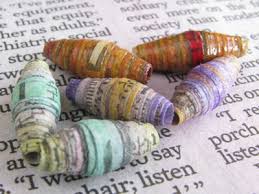
3.Make your own jewellery. This is something else they did in the war, carefully winding strips of foil or magazine paper to make beads. If you stocked up well, you should have toilet paper if nothing else.

4. Make percussion instruments from tin cans and spoons. Try not to kill each other while practising.

5. Learn a language. Duolingo covers most of them. Keeps the brain active and if the isolation goes on long enough, you could learn to get by in several countries, even if you can't actually visit them.

6. Research for the future. One of my daughters spent time watching Vacuum Wars on YouTube. For real. She watched 3 hours of it before deciding on her new vacuum cleaner. (I had no idea she was that nerdy or cared about vacuuming that much.)

7. Masking tape painting. Youngest daughter is becoming a master. You need a canvass (though cardboard will do) masking tape, paintbrush and acrylic paint, so stock up fast if you don't have these things available already.


8. Read. How many books are in your tbr pile? Mine would probably kill me if it toppled. And if you can't stop buying books, many independent bookshops will post to you. So as long as the postal/delivery services are working, you don't need to suffer from a shortage of reading material and you can help independent booksellers at the same time.

9. Final suggestion (except maybe practising mindfulness or meditation - again a multitude of classes are available for free online) is to stay in contact with friends and family via phone or social media. It's horrible to feel isolated, and fortunately there are many ways to keep in contact while avoiding face-to-face contact.

Good luck people. May you survive the apocalypse in good health, and with increased knowledge of many useful things. Even if it's just choosing the right hoover.

Lu Hersey
luhersey.com
https://twitter.com/LuWrites

Sunday, 17 March 2019

The End! by Tracy Darnton


Like many of us, I’ve been talking about writing as part of WBD school visits. One of the tips I gave to students entering the short story competition I’m judging, was not to neglect their ending. We hear so much about the importance of a killer first line, that elusive hook to grab attention. But what readers take away from the ending affects how they feel about the story as a whole. 


What do you like? Neatly-tied up resolution? Ambiguity? A warm glow? Shock? A twist? A perfect or imperfect cadence?

You probably don’t like feeling confused or short-changed that the story promised something it didn’t deliver, or that the story has petered out.


I’ve just re-read The Go-Between by L.P.Hartley which has one of the most famous opening lines of all: 
The past is a foreign country: they do things differently there.

So far so good, but how I go away at the end of the process feeling about The Go-Between is more determined by how L.P.Hartley winds up his story. I’m busy; I’ve invested my time and effort into reading the devilishly small print of the whole book. Does it deliver for me in exploring memory, the boundaries of adulthood and class? Does it leave me still thinking about the characters and themes? Did the hint of some terrible life event in the prologue pay off? Was I satisfied?

A common tip on a short story is to cover the last paragraph or two and see if the story is improved. Finishing a novel is inevitably more complex. Where to end it? If you’re finishing on a big action moment, it’s tough to tie everything up without it seeming contrived and interrupting the pace and tone of a big reveal. A time jump, or epilogue, may provide that resolution - One of Us is Lying by Karen M. McManus or Sunflowers in February by Phyllida Shrimpton are good examples.

Epilogues certainly seem to be enjoying a revival though I confess sometimes I’d rather leave the characters exactly where we left them and not know what came to pass. Another balancing act for the author to navigate – and something I had mixed feelings about in The Go-Between. (Spoiler alert – did I really want to see Marion as an old lady and know the fate of every character?)

And if you can tie up your story beautifully, and have a killer last line too, then you really have nailed it. The Great Gatsby provides a masterclass in both concluding with

“So we beat on, boats against the current, borne back ceaselessly into the past.”

Consider books you’ve read recently. Did they end at the right place? Did they have a killer last line?

Or did they just fi

The End


Tracy Darnton is the author of The Truth About Lies, shortlisted for The Waterstones Children’s Book Prize 2019. She has an MA in Writing for Young People. You can follow her on Twitter @TracyDarnton


Friday, 5 August 2016

About 'Stories From The Edge' by Savita Kalhan


The first books I read as a child were collections and treasuries of fairy stories, folk tales, myths and legends from across the world. They were short stories, perfectly formed, each very different and enthralling, and I loved them. Somewhere along the line, I began reading chapter books, and then quickly moved onto novels. I think the same is true for lots of kids, but not all. 


There are lots of teenagers who only read what they have to read for English at school. They often don't have the time or the inclination to read novels for pleasure. I am aware of a few schools where kids are not allowed to bring in their own books to read in school. The school prescribes what they can read for pleasure - in one particular school books are pre-loaded onto kindles and those are the only books the kids are allowed to read. They don't have a choice. Part of the pleasure in reading is surely in being able to have some say over what you read for pleasure - even for kids!

I read lots of short stories - and I enjoy writing them too. Short stories are similar to novels in some ways, but they have their own identity. Edgar Allan Poe, in his essay "The Philosophy of Composition," said that a short story should be read in one sitting, anywhere from a half hour to two hours. Short stories developed from the traditional art of oral story-telling from fables and anecdotes, which are present in every culture, so by definition they have to be short. Modern short stories often focus on a pivotal moment or emotion or mood, whereas in the past they were more rooted in parables and ethics with the stories having a beginning, middle and end, but both usually focus on one main character with one central theme. There is also more experimentation in the prose and style of a short story, which may not work in a novel.

I have always read short stories, and I have wondered why there were so few anthologies for teenagers. Well, I have been involved in a project that brings a new anthology into schools.

Apart from being a member of the amazing Scattered Authors Society, I also belong to a small collective of teen writers. There are eight of us: me, Sara Grant, Dave Cousins, Miriam Halahmy, Keren David, Katie Dale, Paula Rawsthorne and Bryony Pearce, and we all write edgy fiction for teens and young adults. We call ourselves The Edge. We blog together, and often do school and library events together, and last year we decided to write an anthology together.

It has been an interesting process. Our only remits were that the stories should be up to five thousand words and be suitable for teens and young adults. Because we all write edgy fiction, we knew the stories would all have an edge to them - and they do. They range from stories about doping in sport, online grooming, racism, gender, terrorism, grief and loss, love and life, to name some of the themes in the stories.

What we're hoping for is that the stories inspire reading and discussion and debate amongst teens and young adults. To aid teachers and school librarians, we've also written discussion guides with suggested topics for discussion and creative writing exercises.

My short story for the anthology is called Aladdin's Lamp. It's a story about a sixteen year old Indian girl called Priti who doesn't want her best friend to leave India and doesn't want to be married and settled. Her parents have other ideas and so a suitor comes to the house. Priti wishes she had an Aladdin's lamp so that she could wish the suitors to go away, but in the story she finds out that you have to be careful what you wish for...

I will tell you no more so I don't spoil the story for you!

The stories in the anthology are accessible, diverse and thought-provoking, and that's the wonderful thing about an anthology - you can dip into it and find something different each time. I hope our teen readers will dip into the anthology and find something they like, a story, an author, or just some pleasure from reading something different.


“The short story is a very powerful weapon in the hands of a librarian or teacher . . . I guarantee that these stories will leave readers gasping for more. But most importantly they will get teen readers thinking and talking.” — Joy Court, Chair: CILIP Carnegie & Kate Greenaway Medals; Reviews Editor: The School Librarian 


Stories from The Edge is out on KindlePaperback, and here for Educational and Library sales.


Savita's website, on Facebook, and Twitter

Sunday, 13 December 2015

Cats and Dogs

I’ve recently fallen out of love.

But it’s OK – I’ve found a new one. Or rather, I have returned to an old flame, one I abandoned a couple of years ago despite its never having done me any harm. I had thought there was no chance of rekindling the relationship; thought I had ‘moved on’. But I was wrong, and it took me back, generously, without question or recrimination, letting us pick up where we left off.

No, I haven’t mixed up ABBA and True Confessions. I’m talking genre. And dogs and cats.

I’m a cat person. I’m also a dog person. Some people say you can’t be both.


Since 2010, when my first novel was published, I’ve mostly written novels. Mainly YA. I haven’t thought much about this – at least, I have given the novels themselves a great deal of thought, but I haven’t really questioned the fact that the novel is what I do, and YA is where I do it.

My first publications, starting in 2006, were short stories, mainly historical, all for adults. I loved writing them. The discipline needed to achieve that sense of a world in a grain of sand was excellent training. I also liked entering them for competitions, and sometimes winning. But for years I was so busy writing novels that I wasn’t getting any short story ideas. There wasn’t any space for them. 

Being so small, the short story needs space.

This time last year I’d a novel coming out (Still Falling), and, though I didn’t know it, was about to be commissioned to write another one. (I blogged about it here in May) I was editing another YA novel, Street Song, and, because I’ve always earned about two pence per book, I was doing as many school visits and workshops as I could to pay the bills.  I was busy, busy, busy. I certainly hadn’t time to stop and think.

And when Street Song went on submission, I sat down at once to write another contemporary YA novel. (I blogged about that here too, in July.  Maybe ABBA is a kind of True Confessions after all.) Even though I wasn’t 100% in love with it. I did it because that’s what I thought I did.

And then I stopped. About 10,000 words in. It wasn’t making me happy and I wasn’t sure how sane it was: to spend another year, at least, writing another novel on spec? When publishers weren’t fighting each other for the one I’d just spent eighteen months on?

But that’s not why I stopped. I stopped because, on 12th October, I visited Dunham Massey in Cheshire. Like many other big houses, it was used as Red Cross auxiliary hospital in the First World War, and the National Trust had done a fantastic job of reconstructing the ward. As soon as I walked in a short story came to me, all in a rush, as hadn’t happened for years. I sat in the tearoom and scribbled down the idea. I knew it would work. All I had to do was write it.

And then I had another idea. And another. 


It was as if short stories were saying to me, We haven’t had a look-in for years because your head was crowded with big fat novels. Gallumphing great Labradors taking up all your headspace.  We’re small cats, and we’re too proud to push in where there’s no room for us. But we’ve been waiting, and as you seem to have left the catflap open, well, we don’t mind if we do…

And in they came. And now that the catflap is open, in they keep coming, washing their faces on the hearthrug and making themselves comfortable. I’ve set myself a goal, because I need goals, I’m that kind of writer: six stories in six months. That gives me time to think, research, plan, write, leave aside and edit. It’s exactly what I do for novels except on a smaller scale.

I don’t know what I’ll do after the six months is up. Perhaps Street Song will have sold by then. Perhaps I’ll be asked to write a sequel to Name Upon Name. Perhaps one of the short stories will spark an idea for a novel. (Actually, that might already have happened…) Or perhaps the short story cats will keep sidling through the cat flap. There’s always a welcome if they do.


Saturday, 13 September 2014

Once upon a time... the end

In my past life, as a teacher, one of my most disliked tasks was marking. Not because I didn’t like reading my pupils’ work (though I often didn’t), but because having to assess a piece of writing against a set of increasingly arbitrary assessment objectives sometimes made me think it was all about jumping through hoops rather than the actual rules of good writing.

When I sat down a few weeks ago to judge a short story competition, I delighted in the fact that this time I was setting my own objectives, and they were pretty simple. Does this story work? Does it draw me in and keep me hooked? Do I feel confident in this writer’s hands?

I’ve won quite a few short story competitions, and it was flattering to be asked to judge this one. It was a fairly small, but very professionally-run competition, organised by a magazine. The magazine is Ireland-based, as am I, but attracted entries from all over the UK and the Republic of Ireland. The stories had been pre-shortlisted and were judged anonymously. Not knowing anything about a writer really makes you focus on what’s important in the story.


I’ve often read judges’ reports on competitions which say that the winner announced itself in the first few sentences, and I know agents and publishers often say that they can tell almost at once if a book is going to impress. This wasn’t my experience. Instead, though I found it easy to choose the winning story, several stories promised a great deal in the first paragraph, only to disappoint as the story went on. Some writers had put so much emphasis on that all-important hooking of the reader that they forgot to reel her in, and she was left dangling.

Several of the stories contained fantastic writing – really imaginative use of language. Heart-stopping moments. Intense character identification. Yet none of these stories was placed. Why? Because great use of language isn’t enough – a story has a job to do, and if it doesn’t do that, if it doesn’t take a character from A to B, it doesn’t matter how delightful its metaphors are. 


I write young adult fiction, and it’s normally a 70,000 word novel as opposed to a 2,000 word story. Yet I found the experience of assessing these stories really helped me to look dispassionately at my own work. Young adults, like short story judges, are hard to please. They aren’t fooled by metaphor-fur-coat and no story-knickers. They won’t keep going if a story doesn’t live up to early promise.


I enjoyed assessing these stories, and I’m looking forward to meeting the winners at the ceremony in November. But even more, I enjoyed being reminded of the nuts and bolts of good story-telling, and I hope my own readers stand to benefit from that.

Tuesday, 13 May 2014

Past Perfect Sheena Wilkinson

I have a secret other career.

Though I’m most known – insofar as I’m known at all – as a writer of contemporary YA, I have since 2006 (four years before my first novel was published) been writing, and publishing, short stories for adults, mostly historical, almost all about World War One or its aftermath. 

Now I’m having the chance to combine my two great writing passions – realistic YA and historical fiction – as I have a story included in Walker’s forthcoming anthology The Great War (pub. 3 July 2014). All the stories are inspired by actual artefacts, and my story, ‘Each Slow Dusk’, is inspired by a collection of 1914-19 school magazines, from the school where I taught for nineteen years. I curated an exhibition based on these magazines in 2004, so in a way this story has been ten years in the making.
school magazines from WW1 

 I fictionalised details of the school’s war effort, foregrounding the experience (often overlooked in war literature) of a schoolgirl, sixteen-year-old Edith, whose dreams of higher education are shattered when she has to leave school to care for her older brother, invalided out of the army with rheumatism. It’s very like the rest of my World War 1 stories, apart from the fact that the main character and the intended readership are younger.

Historical fiction always produces tension between wanting to evoke the period so that it comes alive for the reader, but not recreating it so systematically that it lapses into pastiche. The story must work as modern fiction, so it has to feel fresh, especially to a teen reader, who is likely to baulk at anything that feels worthy or schooly. This was a big challenge for me: there are no battles, no gore; the story takes place in a single day in a Belfast suburb. How could I make duty and quiet desperation interesting to a modern teenager?
music from the period

Unlike the intended readership, who are likely to have a prolonged period of young adulthood, the teenage characters in ‘Each Slow Dusk’ are children at school one minute and adults the next – not only leading men into battle, but, in Edith’s case, taking an adult caring role. Notions of duty are much more pronounced than they would be today, and Edith seems both older and younger than a modern sixteen year old.  How could I make her voice and choices accessible to a modern teen reader without compromising the sensibilities of the 1917 narrator?

In trying to evoke the Zeitgeist of 1917 I was scrupulous, but not heavy-handed, about period detail, and about ensuring these details are used only when it is natural to do so – when it would be equally natural to mention them in a story set in modern times, rather than have them come blazing signs shouting Period Detail. Being a geek, getting every detail exactly right matters to me, but accuracy isn’t always enough. In ‘Each Slow Dusk’ Edith and her friend Maud pass notes in class, and in one note they use the @ symbol – Meet you @ break. I spent some time checking that this sign was in common usage in 1917, and was pleased to find that it was. I liked the fact that it looks so modern, and hoped it would be one of the many small details to help bring 1917 alive for my reader. My editor agreed – but in the end the @ sign had to go. Why? Because, although I and my editor knew it was correct, it was flagged up at the copy-editing and proofing stages as looking anachronistic. And it only takes one little detail to break the reader’s trust in you. On the night before we went to print, @ was replaced by at.

I once started to read a novel set in the thirties, where the characters’ sexual attitudes were anachronistically modern. When they gathered round a television to watch the coronation of George VI, I flung the book away in disgust, saying ‘Wrong coronation! Can’t even get that right!’ Later I discovered that it was technically possible, if highly unusual, to have watched the 1937 coronation on television, but by getting the tone wrong in other areas, the writer had compromised my trust. Once that compact between writer and reader is broken, all the accurate period detail in the world will not restore it.

the first in Wilson's excellent Victorian series 
I’ve been thinking a lot about historical fiction recently. I’ve just finished Bring Up the Bodies, where Mantel established that trust so confidently that she could have told me anything about the 1530s and I’d have believed her. Last month I blogged about temporarily abandoning an academic paper in favour of a week’s uninterrupted first-draft scribbling: that paper was a chapter about Jacqueline Wilson’s Victorian novels for a forthcoming Casebook study of Wilson. It’s now finished and submitted, and the whole process was invaluable to me, even though it kept me away from my real work for weeks on end. I loved the Hetty Feather books, and thought Wilson dealt deftly with all the tensions I’ve noted above. This week I’m coming back to the present, for a big edit of my next novel. Set in 2014. I hope I get the details right.