A blog post on a 'genre' (is it a genre?) of children's 'text' (is it a text?) little talked about: the joke...
Recently I’ve been thinking about cultural/national differences in children’s jokes. Sometimes kids’ jokes are transnational: like their UK and US friends, French children tell stories about inexplicably elusive fridge elephants and chickens eager to cross roads. But
knock-knock jokes, for instance, don’t exist in France. The closest equivalent is the hugely popular ‘Mr and Mrs’ joke. That (intractably heteronormative) riddle always follows the same format:
Monsieur et Madame X ont un fils/ une fille - comment s’appelle-t-il/elle?
Mr and Mrs X have a son/ daughter - what’s his/ her name?
The point, of course, is that when put together, the first name and the family name make up a puntastically funny combination. Some of those riddles are very simple:
M. et Mme Némar ont un fils - comment s’appelle-t-il?
Mr and Mrs Némar have a son - what’s his name?
Answer: Jean (which is a boy’s name in French)
Explanation: Jean Némar = j’en ai marre = I’m fed up.
That’s the funniest thing in the world when you’re 4 years old.
For the joke to work, the first names must be real, legitimate first names that exist; however, the family name can be entirely imaginary - in fact, that’s all the better, as it makes the joke funnier. E.g.:
Monsieur et Madame Lacouverturmegratte (Theblanketscratchesme) ont une fille, comment s’appelle-t-elle?
Sandra (= Sans draps, without sheets)
Sandra Lacouverturmegratte = Without sheets, the blanket scratches me.
My sister’s name Agathe (pronounced
Agatt) can generate a whole bunch of Monsieur et Madame jokes with an Anglophone twist and some singing required, because
Monsieur and Madame De Power, De Blues, or You-undermyskin have all decided to name their daughter thus.
Like knock-knock jokes, Monsieur-Madame jokes can quickly get very sophisticated. Instead of one son or daughter, you might end up with a whole bunch of siblings, some of them twins if necessary, forming increasingly complex sentences:
Monsieur et Madame Versaire ont quatre filles. Comment s’appellent-elles, et que font-elles aujourd’hui?
Mr and Mrs Versaire have four daughters. What are their names, and what are they doing today?
Answer: Elsa, Rose, Laure et Annie.
Elsa, Rose, Laure, Annie Versaire (= elles arrosent leur aniversaire = they’re celebrating their birthday.)
Another thing in France is Toto jokes, which I’m told have an equivalent in the US, Little Johnny. Toto is a cultural character of some importance to French children, being the hero of countless kids’ jokes, all pretty awful. Toto’s central characteristics are that he’s a dunce (
un cancre), naive, and a bit sly. E.g.:
Toto says, ‘Miss, Miss, can you get punished for something you didn’t do?’
‘Absolutely not,’ the teacher answers. ‘That would be very unfair.’
‘Phew! I’m glad to hear that, because I didn’t do my homework.’
Or:
‘Toto, share your sleigh with your little sister.’
‘I am sharing it! I have it on the way down, she’s allowed it on the way up.’
Maximum hilarity, I know.
Toto’s other important characteristic is, of course, that his jokes can be extremely rude, which fills children with endless mirth. So there’s two categories of Toto jokes: those that you can tell your parents, and those you can’t. The latter should only be shared in the playground with friends, giving everyone the delicious frisson of transgression:
Toto’s mum asks him to go out to buy chocolate. He bumps into his friend Myfinger. Together, they walk around their village - they live in the village of Myarse - and Toto forgets to buy the chocolate. He comes home to his very disgruntled mother, who asks, ‘Where have you been?’
‘Sorry,’ says Toto, ‘but I circled Myarse with Myfinger and I didn’t find any chocolate!’
In case you’re wondering: yes, in French too, it would be completely implausible for a friend to be called Myfinger (Mondoigt) - though surprisingly, there is indeed a village called Montcuq (Myarse) somewhere.
There’s also less scatological ones that play to the anti-authority streak in all children:
Auntie Lucie asks Toto, ‘Aren’t you sad that I’m leaving tomorrow?’
‘Yes I am! I’d rather you were leaving today!’
Or:
The teacher asks Toto: ‘What does the sheep give us?’
‘Wool!’
‘What does the hen give us?’
‘Eggs!’
‘What does the cow give us?’
‘Homework!’
Researching this blog post (serious work, I know),
I was stunned by the huge amount of Toto jokes that revolve around homework - a very accurate reflection of the national tradition of imposing frankly stupid amounts of homework to children from a very young age.
Of course, religion and sex are everywhere in Toto jokes:
A priest, walking in the street, bumps into Toto smoking.
‘Toto! You’re smoking? How old are you?!’
‘Six years old, Father.’
‘That’s much too young to smoke! When did you start smoking?’
‘Just after I had sex for the first time!’
‘What?! And when was that?’
‘I can’t remember, I was drunk.’
And adultery, that other French obsession:
Toto’s mum tells him, ‘Toto, give Auntie Lucie a kiss.’
‘No!’
‘Be a good boy and give her a kiss!’
‘I don’t want to!’
‘Toto! Where are your manners?! Do what I say!’
‘NO NO NO NO!’
‘But why not, for goodness’ sake?!’
‘I’m not risking getting punched in the face like Dad when he tried yesterday!’
Etc. Toto jokes are generally unfunny and boring to adults, but I have some tenderness for them as I remember my belly actually hurting from trying not to laugh in class when I suddenly remembered this or that hilarious adventure of our favourite anti-hero.
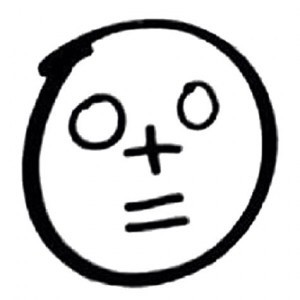
Toto also lends his name to - I don’t even know what to call it - a joke? A rebus? A riddle? - I’m not sure - let’s say to a kind of doodle that you draw by putting two zeros together, then an ‘equal’ sign, and then a circle around it, saying, as you draw it:
Zero plus zero equals Toto’s head (zéro plus zéro égale la tête à Toto)
You end up with the following drawing:
I have no idea why we do this. It’s not funny (even as a child), it makes no sense, it doesn’t get you anywhere, it doesn’t tell a story, there’s absolutely no point to it - yet weirdly enough,
when you find yourself in the vicinity of a child and happen to have a bit of paper and a pen, you’re taken by the irrepressible desire to draw that thing, saying ‘zéro plus zéro égale la tête à Toto’. I have no explanation to offer.
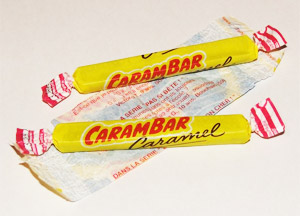
French children find their jokes and riddles, among other places, in various items of confectionery, the most famous of which is the
Carambar. In its classic form, the Carambar is a stick of caramel, though it exists in many other flavours.
"Une blague Carambar" (a Carambar joke) is a cultural by-word for a bad joke, a kid’s joke, a silly joke.
The tricky thing about Carambar jokes is that, unless you can postpone the Carambar-eating (you can’t, because Carambar is delicious), your teeth get entirely stuck by caramel while you’re trying to tell the joke.
Millions of milk teeth and braces are lost each year to Carambars, most of them by children too eager to unlock their jaws in order to tell the joke.
I’d be VERY curious to hear about other cultures’ or nations’ specific children’s jokes - pray tell! And also, British people, what would you say are the most prominent types of kids’ jokes here? (Knock-knock, etc.) I’d like to do a mirror blog post to this one in French.


 Today is Easter Sunday but, as the First of April, the date is also known as All Fools Day.
 It was midnight, and the librarian was at home by the fire, deep in a really interesting book. All at once, the phone rang. The librarian, a little concerned by the time, decided to answer.