Showing posts with label history. Show all posts

Tuesday, 9 June 2020

What has the past ever done for us? Anne Rooney

For a long time, I have wanted to write a book about the shameful roots of the UK's success — indeed the whole edifice of western culture. Of course, no publisher wants such a book for children; it undermines the national curriculum view of Britain and it has only a UK market. No one wants (or wanted, until this week) to admit that much of the wealth of Europe rests on slavery. (Though remember that Western Europe was already dominant and rich before slavery; the USA's wealth has slavery as its bedrock. We need to look further back, at other abuses, too, to understand Europe. We have a long history of criminal treatment of others.) No one wants to know that the entire American space mission and much of its technological success is built on whisking Nazi scientists away from Germany at the end of the Second World War and giving them immunity in exchange for their ideas and expertise. No one wants to know about the atrocities committed in Imperial India or colonial Africa, or how Europeans, possibly deliberately, infected indigenous Americans with diseases that would wipe them out, and certainly did nothing to prevent it, because it was a quick and easy way of freeing land from its troublesome owners.

Keren David said here yesterday that she didn't learn about slavery in school. I did, though I grew up in white rural England. And not only slavery. In ways that weren't apparent at the time, I was lucky to go to a large comprehensive (one of the first) with a very mixed intake. (Socially but not ethnically mixed; there were few pupils who were not white.) Even luckier, there was no national curriculum and the headmaster and his wife, who also taught there, were both historians. 

Our history began with anthropology, and how modern humans first emerged in Africa. The first picture in my history exercise book, drawn when I was eleven, was of a naked black man standing behind a rock and throwing a spear at an animal he wanted to eat. We did not do the Stone Age as white people wearing furs and living in caves. (I would now take issue with the idea that men were always the hunters, but no matter.) History didn't start with Romans; it started in Africa, with prehistory. Then we did Mesopotamia before we did Egypt, before we did a tiny bit on the Greeks and then quite a lot on Romans because it's easier to inspire a bunch of 12-year-olds to make a model gladiatorial sword or Colesseum than to get them to write a tragedy or establish a democracy — though we did have a democratic school council.

We did Saxons and Vikings, of course, and the Middle Ages and then all the usual Tudor stuff. I don't remember how those parts were presented as they have been overlaid by what I have done since, though there was a fair bit of plague death and emancipation of serfs. But then we did slavery, beginning with the terrible conditions in slave ships, and we did the Industrial Revolution with a major focus on abuse of the urban poor. We learned about England's part in the shipping of slaves. We did no American history except the plantations. We did abolition. I think we mostly stopped there, because the GCE curriculum started at 1848 so we would get enough of modern Europe. Britain didn't feature heavily in GCE, but it was all revolutions and wars: unification of Italy and Germany, Franco-Prussian war. A little bit about colonialism in Africa, but only as it fed into European conflicts. The First World War, the Treaty of Versailles, and a tiny look ahead at the Weimar Republic and the rise of fascism, but only as consequences of Versailles. A fair amount on Russia, the overthrow of the monarchy, the Bolsheviks, the rise of Communism. No mention of 1918 flu. No mention of the USA, Australia, India, the Far East — except a lesson the Boxer Rebellion and the Opium Wars because that could be called European. This was a curriculum set by an exam board, no longer by an enthusiast who wanted his pupils to understand where they came from. (We did Florence Nightingale and the Crimean, the great London fogs, and the cholera epidemics, but i think that was in biology.)

My father was disappointed that I couldn't give the dates of key battles, that I didn't know all the kings and queens of England in order and that I knew more about the slaughter of North American Indians (bad thing to know) than the glories of Empire dominating Indian Indians (good thing to know). He felt it unpatriotic to highlight the bad things in our history, and this, I fear, is at the root also of how history is usually taught in this country (and probably many others).

If you mix history with patriotism, it seems, you have to miss things out. Your own glories are writ large. The defeat of the Nazis was no doubt a great and essential achievement, but we are not allowed to examine it too closely. We aren't allowed to point to the fire-bombing of Dresden or the starvation of post-war German civilians in Berlin and ask if we can learn something useful about avoiding so many civilian casualties in future (especially when the war was actually over). Why do people now talk of the 70-year peace in Europe, supposedly achieved by crushing the Nazis? Why do we have to have an unmitigated story of success? What peace? Why did Europe stand by and let Srebenica happen?  Where were those peace-proclaimers looking when Greece was ruled by the Generals? During the Portuguese revolution? While CeauČ™escu, Tito and Hoxha killed their own nationals in vast numbers?  *While we killed our own citizens in Northern Ireland, ffs?* Our prosperity and our teaching of history are rooted in ignoring the people who aren't like 'us' — 'us' being privately-educated, rich, white men — and drawng a veil over our more shameful acts. Actually, it's even worse than that: sometimes, it's not even recognising the shameful acts for what they were, but glorifying them.

The picture at the top of this post hangs in the Houses of Parliament. It shows Elizabeth I delivering a commission to Raleigh in 1584 to go and steal the lands of the indigenous North Americans and slaughter or subjugate the inhabitants: 'to discover unknown lands, to take possession of them in the Queen's name, and to hold them for 6 years'. The painting is, like, Colston's statue recently toppled in Bristol, a product of empire and imperial pride, this one produced in 1925, 30 years after the statue. This is the sort of thing our MPs see on the walls, reinforcing — at best, not challenging — the idea that this was a Good Thing. It is in the series of works that, according to parliament's website, shows how our nation was built. Not even a hint of 'maybe it wasn't a good idea?' We now venerate the abolitionists (yes, they had their limitations, but still an improvement) and the suffragists, yet dare not, somehow, ask why they were needed and what that says about the events we glorify in 'building our nation'.

I don't claim any credit for knowing about slavery as a child. It was ENTIRELY down to good teaching. At the time, of course, I had no inkling how lucky I was, or that I had an amazing teacher, doing his best in a definitely very right-wing region to chip away at the carapace of complacency. I have recounted my patchwork of historical education only to show that if we can cover some of this, which is more important than the Battle of Trafalgar or some other white-men-kill-each-other history, maybe future children will look at such statues and paintings and ask why the hell we are venerating this shit? I was lucky — or was I privileged? I am very uncomfortable with the word 'privilege' as it's currently used, as it's lazy. I think it was a privilege to be taught by a humane, erudite, compassionate history teacher. If I had gone to a public school, I would have learned the invasion of America as a success story, not a violation that spawned further atrocities. In common parlance that would be considered 'privileged', yet I would consider it deprived — or deceived, lied to, misled, intellectually abused... We need to redefne privilege in a way that doesn't validate the views of the so-called privileged.

I'm not sure whether patriotism and honest history are really at odds. I would not say I am patriotic: I feel primarily European, so I'm not qualified to comment on nationalistic patriotism. But if patriotism is a kind of biggified local interest, it must surely benefit from forensic examination of its past, including — especially — the mistakes. We mustn't sweep them under the carpet. Or into the sea. Personally, I think the statue should be hauled out and left to moulder on the quay with a new plaque owning up to its disgraceful history. Or, as an archaeologist friend suggested yesterday, put in a museum, lying down, with its triumphant desecration intact and with a proper explanation. Out of sight is out of mind, all too soon. In sight, as we see with the painting of Gloriana's commission, is very much in mind.

If you feel that history should be taught more in this vein in the UK, there is a petition here you might like to sign.


Anne Rooney

Latest book (as far as I can tell, but who knows, these days?)
HarperColllins, May 2020:


Sunday, 15 March 2020

Reminiscing - by Rowena House


Between deadlines and family contingency planning for the covid-19 epidemic, my March blog about historical research is still languishing on the drawing board. Soz. Here instead is an article first published on March 18, 2018 on The History Girls’ blogsite just ahead of publication of my WW1 debut novel The Goose Road. It’s one that still means a lot me. Stay safe. 


At the going down of the sun and in the morning, we will remember them

At the start of the centenary of the 1914-18 war I had a notion that we would by now, as a nation, have found some sort of collective closure on the individual suffering of the dead of the Great War, and be ready to move on, to toss their bones in the air as it were, and free the spirits of the fallen to join with our distant ancestors.

As a writer, I agreed with Pat Barker’s comment that World War I had “come to stand in for other wars … it’s come to stand for the pain of all wars.” Our stories might be about that particular conflict, but the larger subject was war itself.

Researching and writing my own First World War novel, The Goose Road, dented that conviction. Wherever I looked, the power of individual suffering endured and the personal stories were endlessly shocking, intimate and enthralling.

I fell under their spell time and again while listening to the first-hand accounts of veterans of the Western Front, their scratchy voices forever locked in a sound archive, or when reading a collection of letters home, or interviews granted to earlier researchers. I’d suddenly be caught unawares by a moment of humanity or courage, or dark gallows’ humour.

Occasionally an old soldier would admit to cruelty. More often they shared memories of the drudgery of the trenches, punctuated by terror. To walk those trenches – or at least one of the few fragments that remain, in Beaumont Hamel, say, zig-zagging through a meadow – is to walk in a haunted place.
Near Verdun, there’s a hill called Mort Homme. The name isn’t connected to the 1914-18 war, although the WW1 artillery battles fought there between the French and the Germans were so fierce that engineers found afterward that meters of the entire hilltop had been blown off. Local farmers still aren’t allowed to plough its soil because of the human remains.


The French memorial to the fallen of Mort Homme: “They did not pass”
When researching closer to home I found that WW1 objects as well as places had the power to take my breath away. Once I was in the Royal Artillery Museum in Woolwich Arsenal, investigating a particular week in October 1916 and a specific section of the Western Front near the occupied French town of Peronne. The archivist bought me out a trolley laden with original material from that time and that place, on top of which was a small moleskin notebook, written in pencil by an English major, the pages still stained with the mud of the Somme. I sat and stared at it for ages, feeling as if the battle itself was within touching distance.
Just before I returned for the second of four research visits to France, my mother died unexpectedly. It was a release: she’d been ill for a long time. Among the heirlooms she left to me was a forget-me-not locket with a photograph of her father, Frederick Clarke, in his WW1 uniform. A stern old lady stares out of the locket’s other frame – my great-grandmother, Selena, I believe.


The memorial, cemetery and ossuary for the Battle of Verdun
Mum also left me a heart-shaped locket, which I think must have belonged to Selena as it contained the pictures of two uniformed soldiers, her sons. One is Frederick, who served in the 10th (Irish) Division as a medical clerk and stretcher bearer in the Dardanelles in 1916 and later in Salonika. The other is Frederick’s older brother, Thomas Clarke, a private in the 19th King’s Liverpool Regiment, killed in action on the Somme, on July 30th, 1916.


Private Thomas Clarke, 19th King’s Liverpool Regiment

I’d never seen Thomas Clarke’s picture before I inherited this locket. Mum thought he’d died near Ypres, and as far as I know, until my husband tracked down his regiment’s military records, no one in the family knew the details of his last day. The official War Diary and Intelligence Summary of that engagement is chilling:

“29/7/16 battle position in the MALTZ HORN TRENCH.
30/7/16 BATTLE began. Zero hour 4.45 am. The Battalion reached its objective, but suffered heavy losses, and had to evacuate its position owing to no reinforcements. At 12 noon the roll call was 7 officers and 43 men.
Total casualties were: Lieutenant-Colonel G. Rollo wounded.
KILLED. [Six officers named]
WOUNDED. [One officer named.]
WOUNDED AND MISSING. [Three officers named.]
Total casualties in Other Ranks: 425, of which 76 were killed, 172 wounded, 177 missing.”
Barry Cuttell’s account of that morning in 148 Days on the Somme is more detailed: “Morning mist prevented communication by visual signals, and almost all underground cables had been damaged. The only way of relaying messages to divisional headquarters was by runner, which would be a dangerous task once the fog had lifted as the runners had to cross the open ground between Guillemont and Trone’s Wood, over which German machine guns … enjoyed an excellent field of fire.
“While waiting for zero hour, 19/King’s Liverpool were subject to High Explosives and gas (shelling) … The 19/King’s in the centre was also badly hit by enemy fire, only a few men reaching the road. A little further north, a company of the 19/King’s succeeded in getting forward towards the south-eastern entry to Guillemont.” But later that morning, “Under the impression they were cut off, the 19/King’s withdrew from the edge of Guillemont.”
Thus out of 486 soldiers of the 19th King’s Liverpool Regiment who advanced at dawn on that summer’s morning, north and east from the Maltz Horn Trench towards the German artillery and machine guns, only fifty remained standing seven hours later. The rest were wounded, dead or “missing”, that is, their bodies were either too badly mutilated for individual identification or otherwise unrecoverable from the battlefield.
The rolling fields where Thomas Clarke fell were bronzed with ripening wheat when I saw them, flanked by the once devastated trees of Trone’s Wood. My husband, a former Royal Marine, returned there on July 30th, 2016, to pay our respects, both on the battlefield and at his graveside in the Bernafay Wood cemetery. Perhaps his locket – the brother to the forget-me-not one I inherited – is buried there with him.
Website: rowenahouse.com
Twitter @HouseRowena


Monday, 24 June 2019

Every Picture Tells a Story, by Saviour Pirotta

These last few months, I've been involved with after-school clubs in six Scarborough schools. Other artists are teaching children scriptwriting, performance poetry, interpretive dance and street art but my brief is 'storymaking'. That's creating stories to tell, whether it be in book form or performing to an audience.

Like most of us professional writers, the children found it difficult to come up with ideas from nothing, so I used one of my favourite techniques with them, one that I used myself as a child. My parents had a set of four framed prints in the hallway. They were given them, I think, by my Uncle Edward who travelled extensively around Italy. They showed the Italian lakes. My favourite one was a vista of Lake Como. It was devoid of people, showing only houses, the entrance to what I fervently believed was a palazzo and a church steeple. I would spend hours gazing at the scene, making up characters who lived in these sunlit abodes and connecting them with stories.


I would keep the project going for years, often revisiting the narrative months later, until every detail in the picture was part of the story. 

I still do this for my own books.  Every story I write has a central location, usually a building that acts as a backdrop to many of the scenes. In The Secret of the Oracle, it's the Oracle at Delphi. In The Pirates of Poseidon, the inspiration came from the temple of Athena Aphea on the island of Aegina. I couldn't visit Baghdad for The Golden Horsemen of Baghdad, so I found old artists' images of the city and visualised the rest from research.

For my after-school club project, I wanted to give the kids a sense of pride in their hometown. Scarborough is often dismissed as a faded seaside resort but it's full of hidden gems, from Italianate cliff-top gardens to reputedly haunted churches.  I took pictures of the locales and the children rose to the occasion. The stories we have created feature interesting characters inspired by our own landmarks. My favourite two are a girl who gets turned into a dragon while riding the ghost train on the seafront and a dead WW2 pilot who appears to warn Scarborians of the peril of plastic pollution. It's nice to share my solitary childhood game with so many eager participants. Long live imagination.


Saviour's latest book, The Golden Horsemen of Baghdad is published by Bloomsbury. His picture book The Unicorn Prince is illustrated by Jane Ray. Follow him on twitter @spirotta.

Thursday, 20 June 2019

Resources Worth At Least Two Cows - Joan Lennon

I write historical fiction for children and young people, so of course I think that is an excellent way of bringing the past to life.  I read historical fiction, and non-fiction, and have a long-standing unfulfilled dream of being an archaeologist.*  But I also keep stumbling across online resources that illuminate aspects of times gone stunningly.  Here are a few of my favourites:

I love any and all of Prior Attire's videos -


There's this mesmerising video showing how the borders and populations of Europe ebb and flow from 400 BCE to 2017 CE -


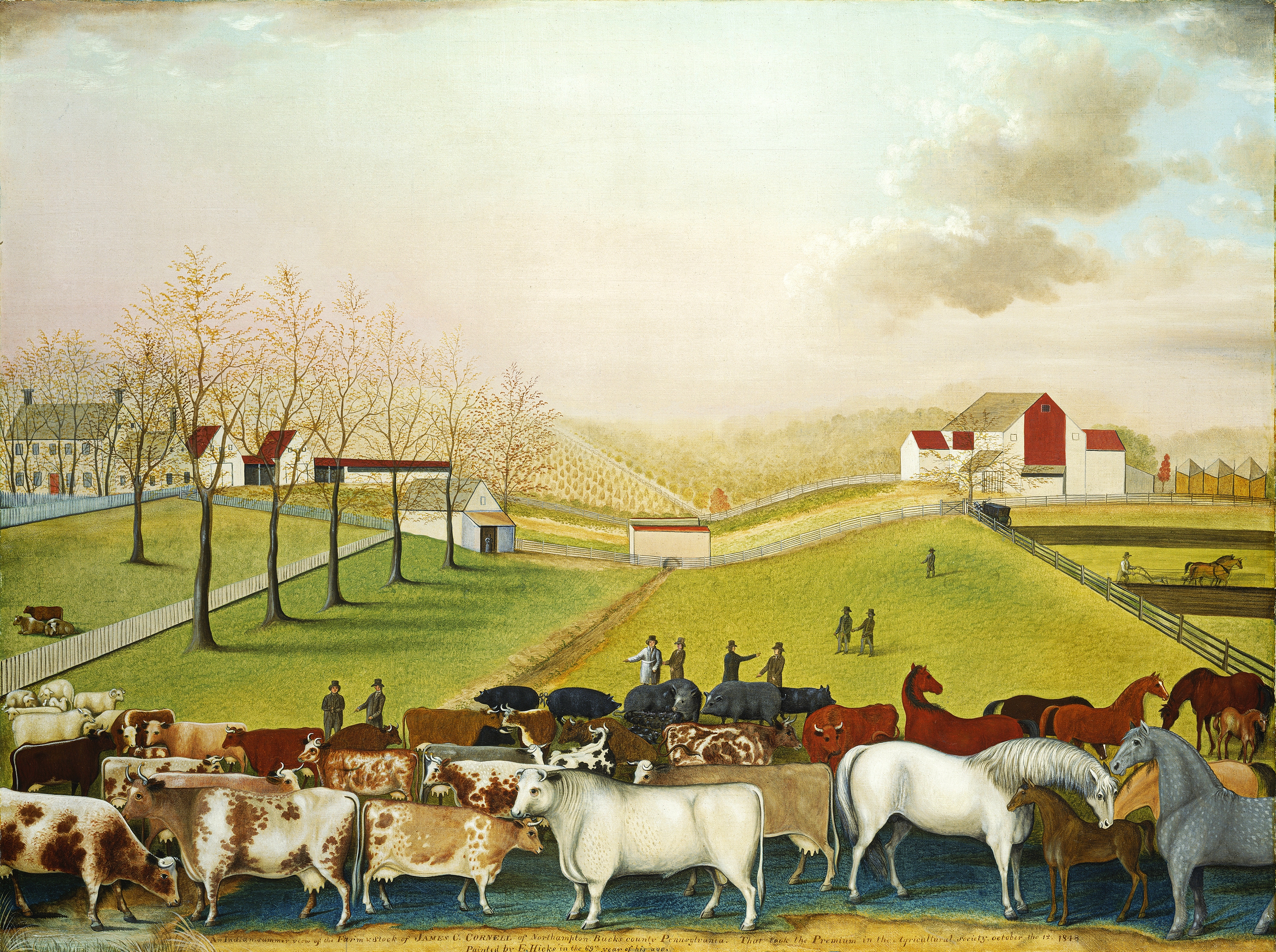
And I recently discovered this historical currency converter from The National Archives.  Did you know that in 1270, £1 was worth £729.83?  And that with it you could buy 1 horse, 2 cows, or pay the wages of a skilled tradesman for 100 days?  Two hundred years later, in 1470, it was worth £685.79 and you could still get a horse or 2 cows for it, but only 33 days of work from a skilled tradesman.  In 1850, you'd need £15. to get that horse or those 2 cows, or a whopping 75 days' worth of work from a skilled tradesman.  


Edward Hicks The Cornell Farm 1848
wiki commons

What online resources have you found that help to make the past more vivid and accessible, to yourself or to your pupils or children? 


* Ignore my cronky knees and dodgy back - just give me a trowel and a toothbrush!


Joan Lennon's website.
Joan Lennon's blog.
Silver Skin, The Slightly Jones Mysteries, The Wickit Chronicles


Sunday, 1 November 2015

A WEEKEND WITH GHOSTS or HINTS ON HISTORICAL FICTION by Penny Dolan


I had a wonderful time at the third Harrogate History Festival recently, an event that celebrates the reading and writing of historical fiction.  The Swan Hotel, where the long weekend takes place, is only a short walk across town from home. It is also, historically, the hotel where Agatha Christie “disappeared”.

Strangely, that's the second mention of the Queen of Mystery here this weekend, which seems spooky to me. . . (That’s enough about dear old Agatha! Ed.)
As the History Festival was about books written for adults, I felt none of that angst that sometimes seizes me during children’s book conferences. I thoroughly enjoyed being there as a simple audience member.
 
Even so, I now have a fat notebook, crammed with scribbled historical facts, and with comments about writing. As some of these seem relevant to fiction for children & young people too, I've put a few thoughts from the weekend into today's post, including some from the excellent writing workshop led by Emma Darwin and Sally O’Reilly.


- Aren’t we’re told to “write what we know”?  
We were advised that we should “Write what you want, and make the reader believe  – at least while they are  reading – that they know it.”

The topic of research came up a few times. When did you do it?  
The most common pattern seemed to be a) starting with general reading & research; b) write the crazy first draft, making notes alongside of what you now need to know; c) do the research you now know you need; d) then rewrite and revise the draft. However, several writers were keen to describe this as an ongoing, overlapping process, rather than a strict, scheduled formula.

- How do we get readers to believe in the past or, possibly, any other setting?  
Relate your writing to the senses. Using your imagination, think specifically and patiently about what you would see, hear, feel, smell and taste in that time and place, as well as any kinaesthetic feelings you would experience. Then use that sensory knowledge to add depth to your writing and build the emotional experiences of your characters.


- What is a good way into writing historical fiction?
Artefacts are very useful ways into writing about the past. During the workshop, we  imagined an object that had existed in the past; then we listed three “people” who were linked to the artefact at any time since it was made. 

This could, for example, be the maker, seller, owner, user, finder, observer or another character. Then we briefly imagined a scene where our selected item from the past was, in some way, involved, and wrote on that theme for a brief five minutes. 


Interestingly, first thing the following morning, Michael Morpurgo was speaking to a mixed group of adults and school children. 


To much delight, he walked around the crowded room, showing his "Lusitania Medal", the real object that inspired a recent book “Listen To The Moon” to the eager young audience. A fine coincidence!


Lastly, a fine point from author Andrew Taylor about the mind-set needed for writing historical fiction:
“Remember that people don’t know what’s going to happen to them: 
you have constantly to remind yourself these people are living in their present.” 
 
To accentuate Andrew's valuable point, I offer this “useful quote”, muttered somewhere during the Harrogate History Festival weekend in the "Things Not To Say" category:
“Oh when, oh when will the Thirty Years War end?”
 (No answers on postcards, thanks.)

Penny Dolan

(Emma Darwin is well known for her excellent "Itch of Writing" blog and several historical novels such as “The Alchemy of Love.” Sally 0 Reilly is a writer, editor and author of “How To Be A Writer: The Definitive Guide To Getting Published and Making A Living From Writing.” The weekend is run by Harrogate International Festivals in conjunction with the Historical Writers Association.)

Wednesday, 28 January 2015

Child Poets - Clementine Beauvais

‘The ink was in the baby, he was bound to write a tale
So he wrote the first of stories with his little fingernail’

Nathalia Crane was nine years old when, in 1924, she wrote ‘The First Story’ and many other poems, published in a collection called The Janitor’s Boy. She was one of many child poets in the 1920s, which saw a spate of precocious poetry and prose in the UK and the US. In the 19th century already, a cult of poetic precocity in children had erupted with the rediscovered works of Marjory (/Marjorie) Fleming, a little Scottish girl who wrote everyday from the age of six and conveniently died before she was nine, in 1811 - embodying forever the vision of glorious, pure and doomed childhood genius for the Victorians (this is a great article on the subject)

a rather haunting sketch of Marjorie Fleming by (?)Isa Keith
I’m currently looking at those works by child poets and at the adult discourse which developed around them, and it’s fascinating to see the extent to which such works were simply not allowed to be on their own: they were relentlessly explained, explored, excused, by the adults who read, published and critiqued them (another great article).
We get, of course, the usual amount of ‘how cute they are!’, and the associated Romantic claims that they were ‘close to nature’, ‘close to God’, ‘close to universal truth’. Not coincidentally, references to classics of children’s literature recur when critics analyse those poems: they talk of Alice in Wonderland and Rudyard Kipling, and James Matthew Barrie prefaced a novel by nine-year-old Daisy Ashford. This was around the so-called ‘Golden Age’ of children’s literature, at a time when children and childhood already had cult status; the verbal abilities of the precocious poets gave hope that their word might be interpreted, and ‘teach’ adults about the beyondness to which childhood supposedly had access.
But those poets were also thought of as dramatically unstructured and lacking technical skill. In 1926, an academic reviews ‘some child poets’ and gives Marjorie Fleming the kind of review anyone would cringe to see written about oneself:
‘An affectionate little soul, with a real joy in nature, and a strangely precocious taste for books, she found her surroundings prosy, though her heart expressed itself in bursts of pitifully inadequate song.’
He goes on to expose Marjorie Fleming’s ‘limitations’ by indicating that she often invents words to make up for a lack of rime (heaven forbid!) and:
‘Another shift which she found useful was the introduction of a purely irrelevant line:
At supper when his brother sat
I have not got a rhyme for that.’
Purely irrelevant indeed. Thankfully, George Shelton Hubbell reassures us that young Shelley was also a ‘juvenile blunderer’ in matters of poetry.
A strong concern of much of the general audience at the time was whether the children were actually writing those poems, or if adults were sneakily doing so. A passionate correspondence developed in Poetry: A Magazine of Verse in 1919, concerning little Hilda Conkling, who dictated poems to her mother:
‘Dear Poetry: Could you not give your readers more explicit information as to just how those poems of Hilda Conkling’s are done: To what extent does her mother select, rearrange and give form? Is it all actually improvised as given?… What a delightful little genius!… (E. Sapir.)’
‘I do not change words in Hilda’s poems,’ replied her mother, ‘nor alter her word-order; I write down the lines as rhythm dictates. She has made many poems which I have had to lose because I could not be certain of accurate transcription.’
The ‘accurate transcription’ of childly thoughts, the ‘authenticity’ of the child’s poetry needed to be ascertained at all costs, to the extent that Nathalia Crane, perhaps the most controversial of all child poets, was asked to produce a poem in the same room as a journalist. 
Nathalia Crane was quite unique in that her poetry got published in a newspaper without the editor’s knowledge that it was a child’s. The editor, Edmund Leamy, wrote an afterword to her collection, in 1924, in which he talked about his astonishment when he discovered the ‘imposture’:

My surprise is excusable. So many times I had received “poems” from youngsters who were careful to give their ages in addition to their names; so often I had received visits from doting parents or relatives requesting publication of verses by their children or sisters or cousins that I never dreamed any child would ever submit any work from his or her pen without adding the words “Aged — years”. But little Nathalia was the exception — and there was nothing in her poems that I received to indicate her age. The poems bought were accepted on their merits and on their merits alone.

‘On their merits alone’, with no ‘child-loving’ bias (to quote Kincaid’s famous study); this was, therefore, proper poetry. Yet it made adults feel relentlessly uncomfortable. Her poetry was more structured, more sexualised and more aware of the constraints of the adult world than other child poets, and adults didn’t know how to tackle it. Louis Untermeyer, in 1936, prefacing Crane’s new collection ‘Swear by the night’ (she was 22 by then), talks about the uncanny feeling he had when the poet was a little girl: 
‘She was ten and a half years old and she puzzled me. She puzzled me as a person even before she puzzled me as a poet. … There was even then a queerness about her, an almost too pronounced childishness coupled with a curious vocabulary.’
The blending of categories is always troublesome, the difficulty to draw lines between adulthood and childhood always a problem. Adults then, but still now, find it difficult to make sense of moments when the presence to the world of children is felt literally, fully, rather than wrapped in layers of symbols.
Nathalia Crane died in 1998 and I’ll leave you with one of her early poems, because it’s fair, after contributing myself to obscuring the works of those child poets with my own, to let her have the last words. I think the work might still be under copyright, so I'll only put the first stanza here; click to redirect to her collection on the Internet Archive.

LOVE


_____________________________________

Clementine Beauvais writes in French and English. She blogs here about children's literature and academia.