Showing posts with label The Glassmaker's Daughter. Show all posts

Thursday, 2 November 2017

SMOKE AND MIRRORS – Dianne Hofmeyr


I grew up in a small seaside village and spent my time after school wandering on my own on the beach and walking the harbour quay daring myself to be washed off in a Spring Equinox tide, drawn by the glitter and gleam of the sea. I was alone... but not lonely… sort of wrapped in a permanent state of melancholic wandering.

So when I first came across an illustration in 1981, from Beauty and the Beast by Fiona Moodie, of Beauty lying next to a stream idly dabbling her fingers in the water while she moped, I recognised her mood.

At school I was fascinated by Velázquez’s Infanta Margarita Teresa in Las Meninas. She looks back at her parents who we don't actually see, but stand where we the viewer stand, with a certain hesitancy as if she is exploring who she really is. The inclusion of the mirror reflecting her parents seems to draw us in and questions reality and illusion. Is it reflecting the actual parents or reflecting what Velázquez is painting?


Years later when I came to live in London, I visited Venice for the first time. Then in 1998 I saw an exhibition at the National Gallery called Mirror Image with the byline... there is more to looking at reflections than meets the eye. Somehow odd threads were working their way into a story of a melancholy girl and Venice and mirrors. I’m not exactly sure when I realised that mirror-glass was the key to the story, but water was also part of it. Reflection. Inward reflection and outward reflection. What you see and what you don’t see.

These are all huge themes for a picture book. How to condense them? I found my imaginary girl in Daniela, a glassmaker’s daughter and without any prompting from me, Jane Ray drew her in a very similar attitude to Beauty in that picture book of 1981, idly dabbling her fingers in the canal water.


While I was working I was often at the V&A making quick notes on glassmaking and began a hefty file but once the story started coming together I collected the notes in a book I made, using semi opaque paper and envelopes and gilded paper to give the illusion of the secrecy that was part of early glassmaking. The date on these notes from the V&A, is 1998. Nineteen years later The Glassmaker's Daughter is finally published. 


 Jane Ray has an amazing ability to add small details to her illustrations that resonate and play with our subconscious. Subtle, even esoteric references, are made that can be enjoyed by the more astute, attentive child, but that don’t diminish the story if they aren’t picked up. In The Glassmaker’s Daughter, she paints one side of Daniela’s cap stormy with clouds and the other side sunny.  With the opening page she gives us Venice in all her moods by day and by night… something I had to edit out of the original text. The translucency of the glassware, is achieved with white outlines. In the scene where the lion-tamer falls into the canal, the lion is patched and rouged, as if for some burlesque show. 


So when people ask how long it takes to write a picture book, I never know how to answer, except to say that most are laid down layer upon layer, sometimes so deep, they can be traced not just to 19 years ago, but right back to childhood wanderings. And then the illustrator takes up the story and lays down her own memories. And hopefully the book meshes by a process of smoke and mirrors

The Glassmaker's Daughter is published by Frances Lincoln and out now.

Jane Ray has been nominated by IBBY UK fro the Hans Christian Anderson Award.

Zeraffa Giraffa, the play with a script by Sabrina Mahfouz, based on Dianne Hofmeyr and Jane Ray's previous picture book, is on at The Little Angel Theatre Islington and will move to the Omnibus Theatre in Clapham on 25th Nov.
twitter: @dihofmeyr


Sunday, 2 July 2017

THE REBIRTH OF THE V & A – Dianne Hofmeyr


When I first arrived in the UK nearly twenty years ago, it was summer – the loneliest summer I’ve ever known. I longed for my ridgeback dogs, my thatch-roofed house and my garden with free-roaming ‘silkie’ bantams under purple jacarandas. I was saved by three institutions – the Society of Authors, the V&A and a local gym.

In 1998 the V&A was hardly welcoming. The rooms were cavernous and dark and the floors seemed covered with brown lino. (Is this possible or was my mood just bleak?) In the first room where the present shop is, was a collection of odd relics – a carved narwhal tusk, the Beckett casket and some clerical things I can no longer recall. It reminded me of my old convent school and around every pillar I expected to meet a nun who would say – ‘what mortal sin have you committed today my child?’

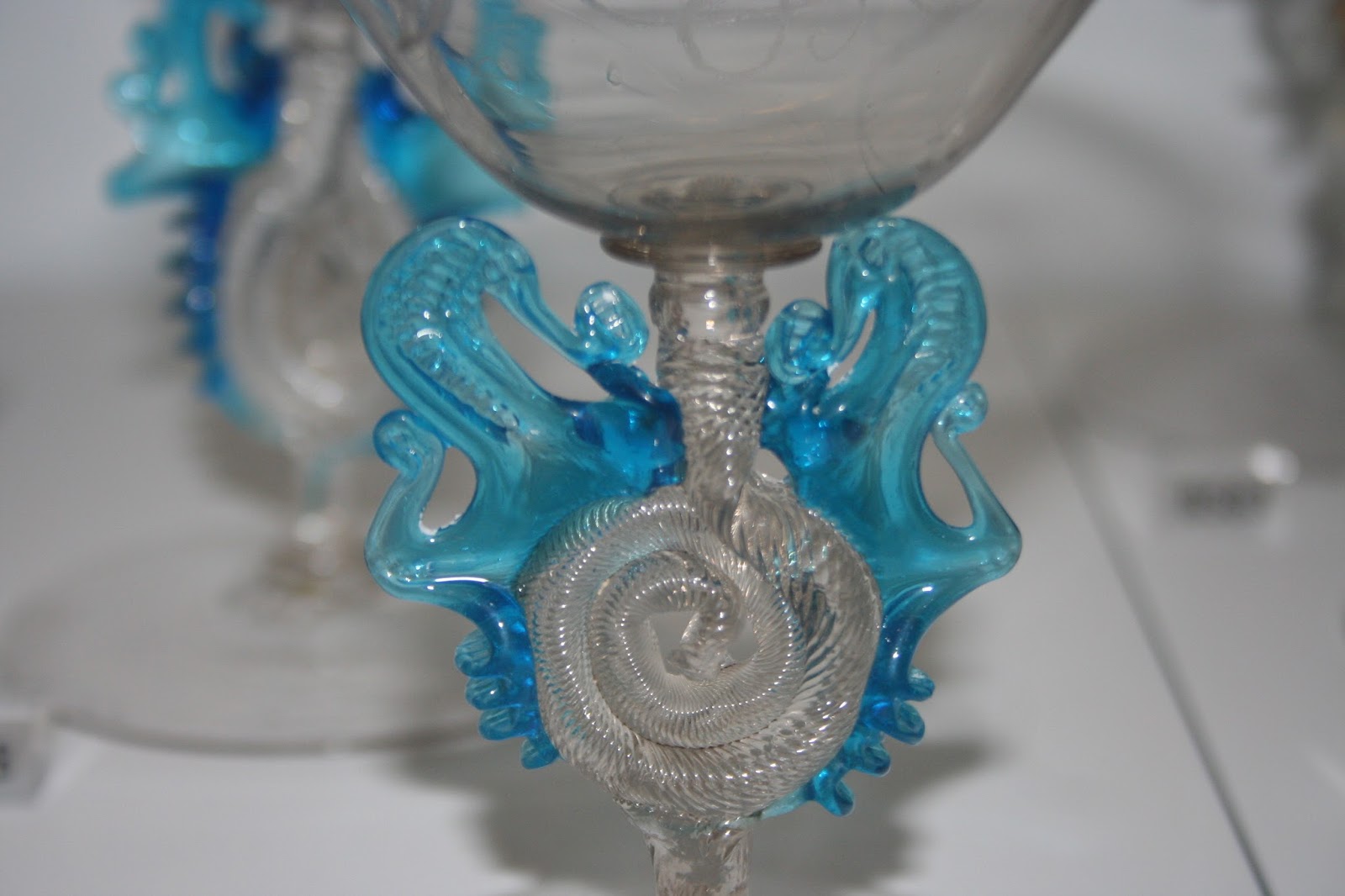
The loneliness of those cavernous dark rooms made worse by the smell of boiled milk and burnt coffee emanating from a low-ceilinged room in the northern parts of the building – not that lovely Gamble Room – no baristas, or lattes, or cappuccinos in sight. The only ray of light for me was the Glass Gallery that sparkled with dragons' wings, seahorses and curled creatures lurking on Venetian goblet stems of incredible thinness. I was already scribbling the first lines of The Glassmaker's Daughter. 


Slowly, imperceptibly, changes came. By 2005 there was the beautiful new planting and reflection pool of the Madejski Gardens at the heart of the Museum ­– the buildings of the terracotta courtyard taking inspiration from 15th century Italy, turning the water into a reflection not of pale Provençal rosé but of deep salmon Blanc de Noir where children paddle and splash on a hot day.


This last Friday 30th June, another dramatic change! The gates of the Sackler Courtyard swung open to the biggest architectural intervention in the last 100 years. Amanda Levete’s innovative opening up of what was previously the Boiler Room area, has revealed the historic facades of buildings that have long been hidden to the public. The old exterior wall in Exhibition Road has been replaced by a series of arches creating a new entrance and using the same beautiful stone and even replicating the bomb damage of WW2. 


Beyond the gates, visitors are drawn into world’s first porcelain courtyard. A pale, milky blue hue coloured by fine grooves of blue, and here and there red and yellow, positively gleamed in the sunshine on the opening evening. Fitting that in a building so filled with ceramic both in the fabric of the building in its freezes, staircases and columns, as well as in the exhibits themselves, that the architect should choose ceramic to pave this courtyard. 


3375 truckloads of soil were removed to create an underground exhibition space and a gleaming courtyard above, with a café bar made from a single 9 metre piece of steel forged in Como, Italy and a huge almost seamless curved glass wall created in Barcelona, also roofed with porcelain tiles. 


A wedge-shaped oculus in the courtyard casts light into the exhibition space below. For this week of the opening, Simon Heijen’s 'Shade' is creating a kaleidoscope of light and shadow that is choreographed by the wind passing over films of lead crystal on the oculus, which will reflect ever-changing light into the room below. 


   See video below:

The Gallery space below the courtyard is totally column free due to the support of mammoth Chinese red pillars of steel on the external outer periphery, where staircases of oak lined with black lacquer lead you down. Just this view alone is worth a visit. 


High up in the central cupola of the old building below where Victoria stands purveying her Empire via a spiral staircase (not for sufferers of vertigo) there was a chance to see an exhibition of 25 artists whose work was reflected onto a wall in a piece called Reality vs Virtual Reality. I spoke to the artist Gemma Therese Pearce who explored the concept of exotic flowers through photography, sometimes blowing up the photographs to huge proportions and photographing them again under rippling water. '

The brochure stated 'A self-created virtual world where anyone can generate unique content' –something not unfamiliar to writers who continually create other utopias and blur the edges between the real and the unreal.

This week-end the Museum is a far cry from the lonely place I spent time in, in 1998. It’s filled with people, music and energy – the Exhibition Road Quarter has brought the Museum far into the 21st century. While away your time on a summer's day in London and perhaps even venture inside.


Dianne Hofmeyr’s new book THE GLASSMAKER’S DAUGHTER set in Venice, illustrated by Jane Ray and published by Frances Lincoln, will be out in October.
-->
Twitter: @dihofmeyr