Showing posts with label public libraries. Show all posts

Monday, 25 September 2017

Why do we have to keep on saving the libraries? Sue Purkiss

I can’t think quite how many years it is since I first started making a fuss about libraries – it’s at least ten. Steve Barlow, of the Two Steves, who also lives in Somerset, had heard that cuts in funding to Somerset Libraries were affecting a service which was already among the worst funded in the country. So he suggested that as children’s authors, we ought to make ourselves heard – and together with Kathryn White, we did.

Well, to paraphrase the old saying – we hadn’t seen nuthin’ yet. Since those days, just about all the library managers we went to talk to have been made redundant or retired. There have been numerous reviews, all undertaken with a view to cutting costs. I remember a meeting very early on, where the idea of different services sharing premises with libraries was put forward. I was truly shocked when a fireman, a parent of young children, said that he couldn’t see the point of libraries – that he never read to his child because there were so many other things to do.

I don’t think he was typical. And most – though not all – of Somerset’s libraries are still here. But they’ve been pruned and pruned and pruned again, to the stage where everyone agrees that staffing levels can’t be reduced any further. In my own local library in Cheddar, the last round of cuts resulted in single working for part of the week - that is, one member of staff being on duty at a time. This is in a two storey building where the office and toilets and spaces for local groups to meet are upstairs, and the library is downstairs. The children’s library is at the back of the ground floor – it’s a lovely space, and like the rest of the library, it’s well-used. But it’s out of sight of the front desk, where that single member of staff may be taking in and stamping out books, explaining to a child and grandparent who have just joined up how to make best use of the library, signing another child up for the Summer Reading Challenge, helping an older person who wants to know how to get in touch with the Patient Group – and so on. I’m not exaggerating: this is how it is, I’ve seen it. And the staff members do all this with grace and patience. They do lots more too – the library hosts a number of local groups, and it has events, talks, and open days.

Here we all were, back in 2011, with Tessa Munt, our then MP, in the foreground.
But now, even more money has to be clawed back and so yet another review is taking place this autumn. Tomorrow, I’m going to talk to the Parish Council, to make sure they’re aware of the threat to the library and to enlist their support.

But why does this have to keep happening?

I could go on about the ancient library of Alexandria; about all the towns, like the one I come from in the industrial midlands, that benefitted from Andrew Carnegie’s generosity over a hundred years ago and were provided with libraries; about the thousands of children who benefit each year from the Summer Reading Challenge; about the elderly who go into libraries for a chat, to get help with new technology – and of course to take out the books which will take them into other lives, other worlds, which will make them think, keep their brains firing off sparks and making connections. But you know all this. The very fact that you’re here, reading a blog about books, means that you know how important books, and by extension libraries, are.

And it shouldn’t keep happening. The proportion of a council’s budget that goes on libraries is tiny. And anyway, for heaven’s sake, it’s a legal obligation that libraries must be provided: under the 1964 Public Libraries and Museums Act, local authorities have a statutory duty to provide ‘comprehensive and efficient’ library services.

It seems absurd to me that one of the wealthiest countries in the world says it can’t afford to provide a properly funded library service – in the grand scheme of things, it would cost peanuts. But then again, I was in a prosperous area of Bristol yesterday and saw people sleeping on the streets, and that seems even more absurd.

Still, it as it is. So here in Cheddar, as in so many other places where the library service faces ever-increasing cuts, we’ll continue to fight the good fight. Wish us luck!

Monday, 17 April 2017

Personal Publicist for a not so Celebrity Author - Chitra Soundar

When my first book came out in the UK in 2010, other than a card from my publisher Walker Books, I did not do anything to celebrate it, publicise it or promote it. Only my Mum knew and she was proud. Even though it was my 14th or 15th book internationally, in the UK it was my first and it had fizzled out like a firecracker on a wet Diwali night. 
While I placed four picture book titles in India in 2012, life went on in the UK in a pattern of day job and rejections. The Indian books started coming out in 2014 and it coincided with my moving from a full-time job to a part-time situation. Now I had time to go into schools and I had found my sea legs so to speak.
            In 2015 – after five years of waiting, I had a second book accepted with Walker Books and a picture book with Otter-Barry Books. And to top that, my Indian picture book Farmer Falgu series too was going to be distributed in the UK by Red Robin Books and suddenly I realised four books were all going to come out in the last quarter of 2016.
            I decided it was unusual and cruel for a writer to have four books coming out in the same quarter. At the same time it was opportunity. (The Law of Lemons and Lemonade).

I didn’t want to throw the opportunity into oblivion as I had done before in 2010. Here is what I did to maximise the air cover I got while the smell of new books was still lingering on my doorstep.  So I decided to hire a freelance publicist.


But before I go further, here is the disclaimer - I’m not saying this is for everyone - because it does cost hard-earned money (money I earned at the day job or the advance I got for these books whichever was on top of the pile at the ATM). But at that time, I wanted a boost to my brand and I wanted to do justice for these two "diverse" books to be noticed. Would I have done this (or been able to) if I didn’t have a day job? Perhaps not.

            So for those who are curious, here is how I handled hiring a personal publicist even though I was not a celebrity author.

Step 1: Write a publicity plan
            I looked up the guidelines in the SCBWI publicity grant guidelines and I modelled one on it. I didn’t get the grant. But I had done the research At least I knew what I wanted to do.
Step 2: Find a Publicist
            I looked for freelance publicists who could be commissioned to work directly with me for my books. I found five who specialised in children’s books out of which two responded. One said No and the other agreed. I met with her and we planned a campaign for the two books that had a definite date and also because it fit within her budget.


Step 3: Surprise the Publisher
            Firstly we informed our publishers that I was going to take care of my publicity by ploughing back the advance. It did make them sit back and watch what I was up to. I also wanted to make sure we were not stepping on toes and both the official publicist and the freelance publicist knew who was doing what.
Step 4: Send word to the world
            Then my freelance publicist sent out review copies, blog posts requests, bookshop and festival requests. And we had to wait. Ah the waiting game, I knew how to play it. I’m a writer. I knew how to chew bed sheets, go on walks, cry into the pillow and press the refresh button on my inbox a million times a day while I waited.
Step 5: Start the in-house campaign
            While the publicist was focussed on the outside world, I was focussed on what I could do in the meantime. Here are some things I did while I waited.
·      Spruce up my website – I reformatted my entire website to look new, fresh and welcoming for all the new people who might look me up when they receive our publicity requests
·      Create posters – this is where Canva.com came in. I spent an unhealthy number of days on Canva designing posters to print, blog graphics and post cards and stuff. Canva actually sent me an email saying, “You’re here a lot, do you want to go pro?”
·      Write blog posts for my own website – I started writing about the books ahead of the launch to create anticipation.
·      Find friends who would host my blog – in addition to whom the publicist was contacting – I reached out to friends who were happy to host me on their blogs.
·      Create classroom content and extras for school visits – I have a small site under my banner for kids stuff – it has puzzles and activities and intro to my illustrators and such. I updated a lot of this content for the new books.
·      Request the illustrator to do a blog post – Frané Lessac (illustrator of Pattan's Pumpkin) was amazing. She agreed to be interviewed for my site and hosted my content on her blog too. 
·      Request the illustrator for resources - Frané Lessac was kind enough to make me colouring sheets and craft activities etc.
Step 5: Plan the book launch
            I did hit a block when I came to this. My freelance publicist wasn’t going to arrange the launch and I had to cold-call a number of South London bookshops. Most of them turned me down and a few looked me up and then turned me down.
            I turned to the amazing Nicky Potter who did publicity for Otter-Barry Books for help and she introduced me to the North London bookshop Pickled Pepper Books. They are amazing, aren’t they?

            Of course I wasted more time on the Internet planning the launch. I invited everyone I knew, create events in Facebook and ordered matching cupcakes. A wise author once said, “A launch without cake is no launch at all.”


Step 6: Write insane number of blog posts
            The publicist had arranged for me to blog on different sites. I had to find an angle that was different and unique to their blog about the same two books. I wrote over 25 blog posts in a matter of five weeks, not including the ones I had promised friends to write on their blog too. At one point I was so worried I was going to run out of things to say. Luckily my early life as a chatterbox came in handy.
Step 7: Make a Trailer
            I loved wasting time on the computer while watching reruns of Big Bang Theory. So I decided to try my hand at making a trailer. My one day course with SOA on how to make videos using iMovie by Shoo Rayner, came in handy. Interestingly, I learnt a few things along the way.
·      Get permission from everyone before you release the trailer into the world. Of course my publisher Janetta Otter-Barry was impressed and so was her team. My illustrator Frane Lessac loved it and she was happy to consent.
·      Use original photos, text and permitted content. Luckily I had my own photos and where required those in public domain I could use and attribute.

Step 8: Prepare for diversions
            As the first book’s publicity was proceeding, the freelance publicist had landed a full-time job. Now she was no longer available to promote my second book. But before I could panic, she managed to secure the services of another publicist and made sure the work continued uninterrupted. Things are always fluid and coping with them as they come was one of the things I do at my day-job and that was useful in dealing with this.
Step 9: Keep a Calendar
            I had so many balls up in the air that I had to create a calendar of events and blog posts and keep them updated. By now bookshop visits were coming in and they were spread across a range of 3-4 months. My calendar resembled a jigsaw puzzle in colour. I hoped I could find the edges if everything fell apart. 
Step 10: Be grateful for kindness of friends
            Few days before the launch, a school librarian reached out to me and asked if I could do two libraries and her school in her borough as a pre-launch promotion. I was so grateful for the support. Except fate interfered and sent the flu virus to land on me and the day before the launch I was on the road armed with my books and a stack of tissues.

And so, the freelance publicists who worked on the campaign had opened many doors I hadn’t been able to approach. I got into some really wonderful festivals and bookshops, got noticed by some organisations who would not have heard of me otherwise, got some print reviews in teachers’ magazines and trade publicity magazines.
It gave me the boost I needed and putting in all the work on my own, hours in front of a computer not writing, sweating the details of fonts and images on websites proved very productive.
            Whether you are traditionally published and want a leg up for your new book or you are self-published and want to build a brand, it might be a worthwhile option to look into. It is hard work and it involves spending money and I did a lot of DIY work myself – like posting letters, printing posters, writing blog posts, sprucing my website etc. But it was a good learning experience and I can build on the contacts I have now been introduced to.

Follow me on Twitter : @csoundar
or Find me on Facebook at www.facebook.com/ChitraSoundarAuthor 
Visit my virtual home at www.chitrasoundar.com  

Saturday, 1 April 2017

WITH LIBRARIES IN MIND by Penny Dolan


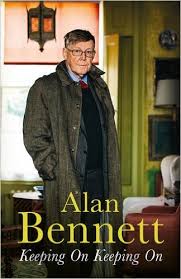
My current midnight reading is Alan Bennett’s KEEPING ON KEEPING ON. Once the sturdy hardback copy weighs me down, and Bennett’s gently opinionated voice is speaking, I feel calmer and less inclined to fret.

The volume – and that is the right word - starts with a decade from his Diaries, from 2005 to 2015, while the remaining half includes - or “is padded out” if one took on a Bennett frame of mind – with various essays and notes about his plays or productions. The first is a talk, BAFFLED AT A BOOKCASE, that Bennett gave at a Save the Library rally on behalf of his local Chalk Farm library, now Primrose Hill Library.

Bennett writes about many libraries he has known, about childhood visits to the substantial public libraries of Armley, Headingley and on to homework in the Reference Library in Leeds, before moving on to study within the grandeur of the Oxford college libraries.

His account started me thinking about my own rather different list of libraries. My childhood Library was the copper-green dome of Wood Green Public Library, then opposite the Tube Station in North London. (This photo, taken well before my time, I promise, comes from the collection held by the Big Green Bookshop, a very active and excellent bookshop now in the area.) 

Each week, while I trotted down the stairs to the Junior Library, my mother disappeared among the tall, dark shelves of the Adult Library. My strongest memory of being there is that, despite the gloom and dull library-bound books, I felt safe and calm and happy, protected by the stories and the promise of reading.

Once, aged nine, being a good reader with clean hands and tidy eating habits, I was allowed to borrow a big book from the Adult Library: A PILGRIMS PROGRESS by JOHN BUNYAN. Why? I suspect I had read LITTLE WOMEN and was in love with the thought of being the bookish, wilful Jo or with the hope of Being Good, as so often instructed.

Years after, Wood Green Public Library was moved into the enormous modern Shopping City mall and that venerable green-domed edifice was demolished. I haven’t had the heart or occasion to visit the “new” library though, times being what they are, maybe I had better do so, before it is too late.

I witnessed another of “my” Libraries being built. Hoddesdon Public Library had long been squashed, along with the local museum, into an old house in Broxbourne. However, with the small market town expanding, the County Council built a brand new library on the High Street, just wher the markets stalls appeared weekly. The entrance was hardly impressive but oh, the hidden size and the wonderful stock of the library within! This was a time of plenty!

By now, a wide selection of books for adults existed alongside a colourful children’s library area where brightly illustrated picture books sat stacked in easy-to-investigate boxes. 

This Library was the haunt of my children and I, after-school or in the holidays. It was like wealth to us and as I had a small car by then, it was easy to take home quantities of titles, especially big books on art and photography. 

These books were often far less easy to find and return on time, which was when – eventually-  I discovered that my hefty library fines would not be going into the library coffers (hooray, and easing my busy-working-mother guilt!) but into the general County Council pot instead, and who knew where then? Thank heaven, I often think now, for the online renewal system

I’ve spent time in many other libraries too, often within slightly-grim adult education colleges, both as student and tutor; a far cry from Bennett’s architectural gems. Yet, even when thinly stocked, those college shelves offered a range of subjects I didn’t see in public libraries. Back then, when inter-regional borrowing was allowed and funded, such titles could be requested and read wherever you were. Now – or until recently – I could borrow a book from any library premises within my own authority, not just my local Library.

For some years, I also welcomed the well-resourced professional libraries in Teacher’s Centres, which often sat neatly alongside School Library Service stock-rooms. From the SLS – at one time – one could select and collect more glorious new titles to add to the collection in one’s classroom or school.

But then the National Curriculum in its many incarnations came striding through the corridors, armed with thick files and official downloads. 

All that academic thought and reflection was boxed up, put away and lost somewhere because schools, reading and teacher development were told to change.


Almost as a contrast, I’ve been blessed by being an author, invited in to libraries all across England and Wales to talk to some brilliant children and witness some impressive library reading initiatives. Those times and places have been great, even though I have learned that the rooms of librarians are in no way the quiet scholarly havens I’d imagined, although quite often there is cake.

However, today, I need to end with the story of my current local Public Library. A few years ago, as part of a National Lottery-funded renovation, the gloomy interior space was opened out so that light flooded in from a glass lantern roof to the two floors below. Several study tables and reference collections disappeared but the library certainly felt a brighter space inside and the new Library proved popular and was well-used by a whole range of “customers”.

Then the second “big renovation” came: not just to this one building but to the whole County Library Service structure. Fortunately, because the Library is in a busy town, it was designated a regional “hub”, which means the Library will keep some staff of its own.

The Library will also act as a base for the (few) library staff now supporting all the community libraries in the district by phone and email. Halfway between are the three “hybrid” local libraries, which will get a few hours of real-person library staff contact on site each week too, at least for the moment.


Now, have no fear, folks. There will definitely be people within all these library buildings. Our Public Library Service will be held together by Volunteers and, so I have heard, “hundreds” have put their names forward for local training in this town alone. So this is where I must point out that my town is a prosperous place; the general level of education high; there is interest in - and loyalty to - the Library and there are people with spare time happy to help, at least during this first enthusiasm. Is this so everywhere? Or will only those who have, have libraries in the future? The rundown  estates in poorer cities? The wide-spread rural communities? Will everywhere have such resilience?

No matter: ever since Cameron’s Big Society, the word is out. There will be Volunteers.  However, for some years, I have been involved with the Committee of my local Library Friends Group. We organise various social events and minor fund-raising. We are all volunteers, and some are even Library Volunteers and Volunteers-To-Be.

Yet my time has made me see that Volunteers, though very wonderful and generous as individual people, do have other commitments, demands and priorities on their time and minds. I know that I do.  They may have current skill gaps. They may – if older - have erratic health. For example, over six years on our small Committee, has coped with two long illnesses (and absences), two deaths, a couple of sudden personal” disappearances and one person who returned to Amsterdam. At the moment, the Committee is fairly calm and all is set fair because those with tasks do do what was agreed but even so, because of everyone’s commitments, just deciding the date of the next Committee Meeting can be a struggle.  If this is a random example of volunteering, does it suggest the best model for good library support? That is what I keep wondering, even though all the people are good and lovely and generous individuals.

Volunteers must also be time-consuming for the remaining library staff to deal with. Managing fifty part-timers doing a few hours a week must be a more complicated act than three full-time employed staff. Besides, at the start of any new enterprise there can be great enthusiasm, even if people feel “blackmailed” by the prospect of  losing their library once the matter is being buzzed about by the local media.  Certainly, among my many bookish friends “Have you signed up?” has become a daily greeting.

My fear is that, over time, the initial energy may fade - maybe not here in our pleasant town and while funding is at the current levels - but elsewhere, when problems arise. While reading around this topic, I came across a set of poignant interviews with museum volunteers that seemed relevant to the national community library situation.

Also – hush! – it is possible that volunteers may not be the most biddable of people. By self-selection, they may tend to be individualistic rather than team-players. Some may have firm or biased ideas about people and subjects or little knowledge about books and IT. Who will manage that? Additionally, some may not be keen on the more uncomfortable aspects of library work, from litter collecting to cleaning up after certain visitors. Occasionally, amiable drinkers come in from outside and hang around our Friends Cake Stall, a situation easily and gently managed especially with library staff about in the building, but elsewhere, I have read of community library volunteers facing troublesome teenagers and more alone. Different areas will throw up different problems - and as I have said, my Library is a lucky library.

Moreover, as all the experienced librarians leave, what will happen when that level of expertise has gone? Even with rounds of “cascade training”, I fear that the library service will diminish further. Additionally, when the whole structure is only loosely held together, who can tell who what to do in a Volunteer world? How will it work out, other than by trusting in each other’s goodwill and understanding?

I am not yet convinced that the whole volunteer idea is as credible as some people would have us believe, despite the good intentions of those stepping forward to help.  It may work well in some places, but overall, I fear that library provision - if it even exists - will be very patchy. There have already been so many closures, and even Alan Bennett’s newly-named Primrose Hill Library has to raise substantial sums to stay open. Is this how things will be?

This post is appearing on Saturday 1st April, the start of the new financial year. This is the day when we move into the new regime, when the cuts in services County Councils are implementing because of central Government austerity cutbacks come into force. Libraries – as well as museums, galleries and parks - come well down on the list of essential services: all so easy to attack as a “luxury” and easy to cut or destroy our cultural store by slow attrition.

The first of April! Pinch and punch and who knows what surprises lie ahead? No jokes or joking, you can be sure of that, though there are certainly fools who believe that libraries are not needed any more.

Penny Dolan

Saturday, 17 October 2015

Markets, Institutions and Children's Books: Is there a problem? - Emma Barnes

This post is by way of being a Part 2. In Part 1 I wrote about how different kinds of books  reach a reader's hands in different ways. I used the example of my own favourite childhood reads to show that while some books make their way to the reader directly through the “market” (in my case this was often through the medium of DL's Book Exchange, a bookshop in Edinburgh), others may rely on “non-market” institutions – libraries, schools, prize committees – to champion them, and to allow them to reach what may often be much more of a slow-build or niche readership.
I argued that both the commercial mass market and the non-market institutions had a role to play in championing different kinds of books, and allowing a real variety for all tastes and all readers.
I summarised the advantages and disadvantages of both as follows:


Good Things About the Market


  • Not snobbish – if a child likes it, and parents prepared to buy it, they will publish it.
  • Interested in all age groups and tastes – all “markets” in fact.
  • Respects “genre” books – school stories, humour, ponies, mysteries etc
  • Want books to be attractive and so compete with other entertainment/consumer goods.

Bad Things About Market


  • Publicity potential, celebrity tie-ins, “hooks”, “high concept”, current fashions, may all end up more important than inherent quality.
  • Quieter” books, experimental books, unusual protagonists, niche interests etc may all get overlooked.
  • Responds to purchasing power – which means some groups of readers will be neglected.

Good Things About Non-Market Institutions


  • Don't just have to think about profit
  • May be more likely to reward innovation, experiment or pure literary quality
  • Can allow children to discover more 'educational” or worthy themes, or pursue minority interests by providing slow-burn, non-glitzy books
  • May help to include groups with low purchasing power

Bad Things About the Non-Market Institutions


  • May be overly “worthy” or snobbish – eg about genre books, overtly “commerical” titles – or inversely snobbish (eg the 1970s backlash against “elitist” titles)
  • Has its own fads and fashions
  • Adult-led – danger of losing touch with child readers
  • May have objectives which may come before pure quality or enjoyment.

Where are we now? 

It's often said that we live in a new “Golden Age” of children's books. But I think as a writer, a parent and a children's book lover, there are reasons for concern.

On one level, the market is doing its bit – there are an enormous quantity of books out there: 10,000 new titles for children are published every year in the UK. Most of them are available at the click of a button from Amazon – often very cheaply). There's also evidence at the moment that children's book sales are performing more strongly than other kinds of book.  But many of use know all too well that many kids are not coming into contact with this richness. Bookshops have been closing at a frightening rate. The choice in supermarkets is extremely narrow. (Many of those 10,000 titles surely never appear in a shop at all.) Inevitably, publishers are finding it hard to bring new books to the attention of the book-buying public (the decline in newspaper review space does not help) and to build up new authors: hence the growth in celebrity authors who can garner their own publicity. As for Amazon and co – well, if you don't already know what you want, the millions of titles available at the click of a button really doesn't do you a lot of good.

Meanwhile in schools libraries and librarians often do not exist. School Library Services – which provide vital support and expertise to individual schools – are closing fast. Public libraries have been targeted for closures and cutbacks. (There were 600 fewer libraries in the UK in 2014 than 2004, and 500 of these had closed since 2010. Source: CIPFA public library statistics.) The role of libraries is being squeezed in more subtle ways than simple closures also. For example, for cost reasons librarians often have to rely on private companies to choose their stock – and may have little time to read, assess and choose books. Teachers may also find it hard to choose and recommend books for their pupils's general reading, given that they are given little training in children's literature or time to keep up with new titles.

All this means that the non-market infrastructure is being eroded. The informed discussion about children's books – what's out there, what works and what doesn't – diminishes. That informed discussion doesn't always get it right, but as a counterweight and a complement to the purely commercial, it's important that it exists. These days I doubt very much that anybody would worry about some librarians who decided to go on a vendetta against a popular author such as Enid Blyton. (Thank goodness for that.) But the flip side is that librarians and teachers may no longer have the confidence or the clout to make any impact on market trends.

In Part 1 I referred to the life story of Kaye Webbe, and how the Puffin imprint she ran flourished in an environment of expanding library services and thriving independent bookstores. That environment is very different now.(In this respect the UK situation seems very different than the USA, where both school and public libraries are still vital and powerful shapers of which children's books succeed.) All this is why even an interested adult, whether teacher or parent, can end up struggling to find the books they need or want for their child, and can feel dependent on a limited choice of bestsellers, celebrity-authored books, or old favourites from childhood. Its frustrating knowing there are so many new books out there, and not being able to identify the ones you really want to buy and read. And certain kinds of books – the more “worthy” or "niche" kind, which maybe need a place on a library shelf where the right child will eventually happen upon them – may be overlooked. 

 Am I being too gloomy here? I hope so. Please let me know what you think...
 ------------------------------------------------------------------------------------------------------------

Emma's Wild Thing series for 8+ about the naughtiest little sister ever. (Cover - Jamie Littler)
"Hilarious and heart-warming" The Scotsman

 Wolfie is a story of wolves, magic and snowy woods...
(Cover: Emma Chichester Clark)
"Funny, clever and satisfying..." Books for Keeps

Emma's Website
Emma’s Facebook Fanpage
Emma on Twitter - @EmmaBarnesWrite