Showing posts with label French. Show all posts

Tuesday, 28 August 2018

Literary Translationese - Clémentine Beauvais


Last Wednesday, my latest YA book came out in France :


It’s the culmination of 12 years of observing the British, and gradually sort-of-becoming one myself, a process of transformation not as painful as it sounds. It’s the very first time one of my French books is set in Britain, and, as its almost-500 pages testify, maybe it was long overdue. 

Here’s my pitch, elevator-ready : in post-referendum Britain, a canny entrepreneur, 21-year-old Justine Dodgson, sets up a start-up – the eponymous Brexit Romance – to match young Europhilic Brits to generous-minded French people, for the purpose of entering into arranged marriages. Five years later, in theory, the former would gain the nationality of the latter, and thus get back their European citizenship. The only condition, however, is to Not Fall In Love. In practice, this is difficult. 

Aside from Justine, the main characters include an innocent and romantic French girl, her grumpy Marxist-Leninist singing teacher, a young lord – and son of the leader of UKIP – and a beautiful British-American lawyer. As you may have guessed, it’s a rom-com of sorts, often verging on screwball comedy, and it’s also, as the title indicates, not too far from social and political satire. But it’s also, eminently, about cultural and linguistic tensions, often endearing, sometimes exasperating, between France and Britain, and French and English.

Form matching content, it’s written in a kind of Frenglish, or rather what I’d call ‘literary translationese’. 'Translationese' is generally used derogatorily, to refer to sentences that 'feel translated' - think, for instance, of Facebook translating your international friends' statuses. But I mean it here positively, creatively: literary translationese, as I use it in Brexit Romance, is a way of writing in French that deliberately uses lexical calque and syntactic mimicry of English, as if to imitate the feel of a translation. It allows for a lot of fun things, from basic wordplay to painstaking rendering, in French, of the convoluted sentence structures of British politeness – je ne suppose pas que vous soyez libre dans trois semaines ?
 
Literary translationese occurs, famously, in Asterix in Britain, where all the ‘Bretons’ in the French version preface every sentence by ‘Je dis’, answer every statement with ‘Plutôt !’ and reinforce their assertions with an ungainly ‘n’est-il pas ?’, all of which baffled and delighted my 10-year-old self.
Image result for astérix chez les bretons
available in English translation by A. Bell and D. Hockridge
 More recently, francophone Swiss writer Joël Dicker wrote The Truth in the Harry Quebert Affair, which reads, in French, ‘like a bad translation’ of an American crime novel – quite in keeping with the story, which is about an American writer writing about a crime involving another American writer (available in English translation by Sam Taylor). Another favourite of mine in the literary translationese category is Marie-Aude Murail’s sprawling teenage novel Miss Charity, a fictionalised biography of a Beatrix Potter figure, which audaciously espouses, in French, the phrases and lexicon of 19th-century British novels and of their classic translations into French. 
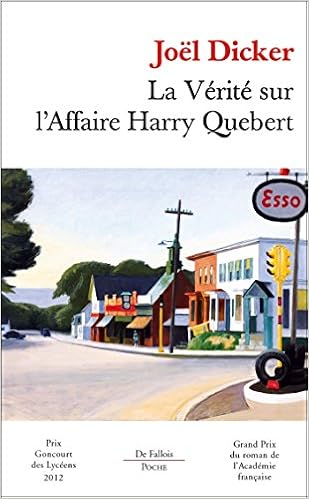
 Image result for la vérité sur l'affaire harry quebert

Literary translationese pushes to its comical and beautiful extremes the daily involuntary instances of translationese that texts all around the world occasionally slip into. It aestheticises Globish, glorifies lazy Englishisms. Few people are more guillotine-worthy, in French, than those who use the verbs ‘réaliser’ or ‘supporter’ to mean ‘become aware of’ and ‘support’ (a team) – but use them in the right literary context, and suddenly the repulsive statement ‘Il supporte l’équipe de France’ can take on a new texture, turning football devotion into some kind of existential burden.

I particularly love literary translationese when it elevates to the rank of the finest surrealistic devices two things which we learn at school to be ultimate crimes against literature : the calque, and the cliché. He stormed out of the kitchen, says the English author who’s completely run out of energy to find non-banal ways of expressing the character’s anger. But nothing cliché in the outrageous French calque il s’oragea de la cuisine, halfway between orage (very much not a verb) and s’arracher (a familiar way of saying ‘to get out of here’). That sentence is intolerable in any literary context that doesn’t firmly invite a reader to delight in its being written in literary translationese. Once it’s there, though, it speaks its own quirky, playful language.
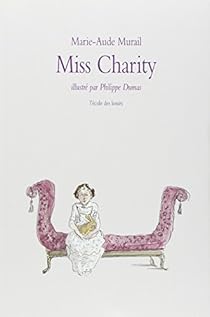
Image result for miss charity marie aude murail

Learning other languages, one dreams sometimes of multilingual adventures in literary translationese ; women who would ‘give light’ to babies, as they do in Spanish, or bold experiments in the acrobatic word orders of declension languages, in languages that aren’t graced with the same toolbox of suffixes. The point of literary translationese, however, is not to turn readers into supersleuths, working out which expressions in which language have been borrowed and exploited. It’s to create a literature that joyfully, weirdly and, sometimes, nonsensically, celebrates the impossibility of maintaining watertight boundaries between literary languages in the first place.

In doing so, it also celebrates, indirectly, translation and its literary influence. The texture of translations has profound consequences on the literature of any country ; translations and their conventions condition our reading, and they also modify our writing.  

We catch ourselves writing, in French, a million times per page, ‘Il haussa les épaules’, or ‘Elle cligna des yeux’, because English is a real spendthrift when it comes to telling us about people’s body language – even though French handles much more clumsily those innocuous He shrugged, she blinked. We are contaminated by the inbuilt English precision as to whether someone is currently standing or sitting, and we end up writing ‘elle était debout dans le couloir’, because we’ve read countless translated books where people are ‘debout dans le couloir’, instead of simply ‘dans le couloir’ – because in conventional French we can safely assume, unless otherwise stated, that a person in a corridor probably isn’t sitting, crouching or doing a headstand.

One interesting phenomenon of this ‘contamination’, as far as YA is concerned, has been the rise of the use in popular French YA of the term ‘marmoréen’ to refer to skin. ‘Marmoréen’ is an extremely literary, high-register way of saying ‘marble-like’ (‘marmoreal’ in English), and its incongruous use in contemporary popular YA otherwise written in low to mid register can probably be traced back to Luc Rigoureau’s French translation of Twilight, which used the word repeatedly to refer to Edward’s skin, translating Meyer’s more neutral ‘marble’. The word has become its own meme, and I can't imagine, as a French YA author, ever using the term ‘marmoréen’ today in any way other than humorously. But with the right crowd – one attuned to precisely those connotations of ‘marmoréen’ in French YA today – that humorous use could be very powerful indeed.
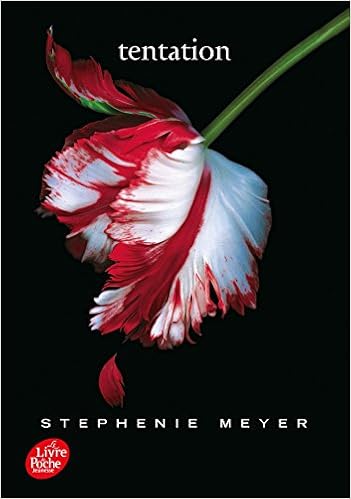
Image result for twilight luc rigoureau

From accidental translationese to literary translationese, the difference can be subtle – it’s about self-reflectiveness, artistic playfulness, and, to an extent, low-key political activism in literary form. It is indeed a political statement of sorts, especially when literary translationese is used with English as its point of reference, to calque English, and thus by definition make its influence visible, and thus makes its domination visible. It calls into question the ‘accidental translationese’ that happens all the time in countries where translations from English are ubiquitous (i.e., most countries), and suspends the transparency of that process for a moment. 

I suspect it is exactly the same for other languages that might use literary translationese with French, or other locally hegemonic languages. It’s an act of linguistic love, but also of linguistic teasing, or even linguistic nagging.

Unfortunately, I can’t think of any novels in other languages than French that use literary translationese with English. For a good reason, doubtlessly : those novels don't get translated into French, because literary translationese is horribly difficult to translate. It’s possible, of course – no such thing as untranslatability ! – but you can sort of understand why publishers are wary of it. And it’s also tricky because literary translationese is a linguistic love affair between two languages, so it would be quite difficult to get the gist of, say, a translation into French of a German novel that mimicks English turns of phrase. It’s the kind of in-joke that doesn’t travel very easily. 

Long post, sorry. Let me know in the comments of your favourite instances of literary translationese in English or other languages…


-----------------------------------
Clémentine Beauvais is a writer and literary translator. Her YA novels are Piglettes (Pushkin, 2017) and In Paris with You (trans. Sam Taylor, Faber, 2018).

Monday, 20 April 2015

How do you say 'Alaspooryorick' in French? - Clementine Beauvais

One of the questions you always get when you write in two languages is whether you're 'going to translate your own books'. This is a very flattering question, as it implies that (1) everyone uncontroversially wants your books from the other country, and (2) you're de facto blessed with perfect translation skills.

Of course, (1) is painfully wrong: the UK has so far never wanted any of my French books, which are too everything and not enough anything, but I suspect are also by default unattractive because they don't come with world rights. And (2) highlights the eternal plight of professional translators, whom no one believes when they say that their skills set goes beyond just 'being fluent' in two languages.

I'm fascinated with translation and have been for a long time: in my young days as a Harry Potter fan, I would work hard to understand the translation choices of Jean-François Ménard, who changed in the French version a great quantity of names invented by Rowling. Hogwarts became Poudlard ('hog lice'), a funny and meaningful find that is also cleverly English-sounding to a French ear. 

'Tom Marvolo Riddle', who needed to work as an anagram, became 'Tom Elvis Jedusor'. Though it is a little bit hilarious, in retrospect, that Voldemort is called 'Elvis', the name's connotations weren't that strong for me as a child, and I very much admire the lovely 'Jedusor', which evokes a 'jeu du sort', a twist of fate. And 'sort' is also a magic spell... Can we say 'Jedusor' is actually better than 'Riddle'? I think so.

but the Hallows turned 'Relics'. Good choice?
Until now, paths hadn't crossed between my French books and my English series, but for the first time, this year, one of my British series is getting translated into French. I'm not translating it, for reason (2), but the French publisher, Hachette, is aware of my secret Gallic roots, so I'm allowed to okay the translations of the place and character names.

It's been quite a funny and interesting process. The Royal Babysitters series, illustrated by Becka Moor, are set in a magical and nonsensical world, but which in many ways corresponds closely to the 'real' world. Many of the place names - Francia, Daneland, Britland, etc - are relatively easy to translate into French (Francie, Danelandie, Brittonie). But what of the Independent Republic of Slough? Having a French city name there would make no sense, since it all happens in Britland. The translator decided to invent an imaginary city name.

We didn't have to change it to 'Les babysitters républicaines'
Similarly, the two heroines are called Holly and Anna Burnbright, which the translator first translated as 'Brillante' (Bright), but we felt after discussing it that the allusion to a poem should be kept. We're still working on it, but the suggestions involve cutting up bits of famous French nursery rhymes or fables. Not quite the same, yet faithful.

Alaspooryorick or Oroméoroméo?

'King Alaspooryorick', the villain, is a tricky one to translate. On the one hand, recognising the reference doesn't matter very much (if at all), but we might as well keep it; and it has to sound funny, which 'Alaspooryorick' or its French equivalent 'Hélaspauvreyorick' doesn't (at all). He could have been King 'Tobeornottobe' (roi Etrounepazettre), but again, it's not very funny. The translator came up with 'Oroméoroméo', which sounds very funny and is also a Shakespeare reference, arguably more famous to a French ear.

Of course, the reference is no longer to Hamlet, so the King being from 'Daneland' and having a special mermaid called Ophelia is no longer relevant. Does it matter? Frankly, not at all. 'Le roi Oroméoroméo' is just perfect for the role.

And what of the title? 'Les babysitters royales' would have sounded flat. We're going for an inversion of adjective and noun, 'Les royales babysitters', a rarer construction in French but which by the very fact of the inversion calls to mind the English language.

The Royal Babysitters is not by any stretch of the imagination a difficult book, but it's full of those little details that can make translation tricky - as many children's books are. Translators can't get away with footnotes in translations of children's books. And they have to be clever and good at languages, but they also have to be 'good at' children's literature.

Most often we don't notice the translation work, because it's well done, and because we might not speak the two languages in question, or simply because we don't stop to wonder what something or someone was called in the original language...

Toby Alone in the original French
I'd be curious to hear your stories of what got lost or found in the translations of your books, if you're able to read some of them, or if you've even contributed to them.


_____________________________________

Clementine Beauvais writes in French and English. She blogs here about children's literature and academia.

Saturday, 15 November 2014

"I'm going to raise my voice for peace from now on..." by Miriam Halahmy

Take around seventy students from France, Germany, Spain and Turkey, put them in a room and tell them to speak English, think English, read English and write English about Peace and Tolerance.     What happens?
"Everyone wrote, said and did something about peace, they were creative, honest and nice." Gulsah, 14 years,Turkey.
"I learn sisterhood." Fatma, 16 yrs, Turkey.
 "I enjoyed the teamwork." Sami, 18 yrs, Syria


In October, 2014, I was invited for a second time to the Lycee Maurice Genevoix in Paris  to lead workshops on Peace and Tolerance. The school is part of an EU project and this time the partner schools from Germany, Turkey and Spain were joining us.


All the students were divided into two groups and each group would have a two hour workshop with me.
 How could I make sure that this mix of students with such varied abilities in English, whom I had never met before, had a positive and meaningful experience and gained some insight into working for peace and tolerance?


I need not have worried. The students came prepared to struggle with their English, listen, debate, question, laugh, say things out loud which are really quite difficult to admit to ...."I do not feel I can say that I am proud to be Jewish in France today".... and meet the Other from another country with an open heart and an open mind. It was a privilege to work with them.

I started with a poem by a boy who was an asylum seeker from Bosnia. Unfortunately his name is not known.

Sorry
Désolé
Verzeihung

Sorry, that we are here
Désolé d’être là
                                Verzeiht, dass wir hier sind

That we take your time
De prendre de vôtre temps
Dass wir eure Zeit stehlen

Sorry
Désolé
Verzeihung

Sorry that we breathe your air
Désolé de respirer vôtre air
Das wir eure Luft atmen,

That we walk on your ground
De fouler vôtre sol
Dass wir auf eurem Boden gehen,

That we stand in your view
D’être dans vôtre champ de vision
Dass wir in eurem Blickfeld stehen

Sorry
Désolé
Verzeihung

This the opening of the poem and we had it translated into French, German, Spanish and Turkish. Then students came forward to read the entire poem in all five languages. It was a very moving experience.


After the reading, we discussed the poem and then I asked the students to write a piece showing how they might respond to the boy. Here are examples of their writing :-


Even unhappy stories have to be listened, so raise your voice, tell it to everyone. The only ones to blame are those who refuse to pay attention.   Alex, 17, Spain.

I'm sorry that we look away, feel ashamed if we see you and that we hate ourselves afterwards. For this there is no apologise, for this I can't find any words. Ina, 15, Germany

You said sorry but you're not the only one. I know you suffered and I did too. But we're still here, in this world, maybe as strangers, but as humans. So raise your hands above the waves of sorrow and burn the sadness away. Sami Hazbon, 18, from Syria now living in Paris

I met Sami Hazbon for the first time earlier this year on my first visit to the Lycee. He had only recently arrived with his sister, escaping the war in Homs, Syria.  Sami speaks excellent English. It was lovely to see the progress he is making and how well he is settling into his new life, even though it has been very hard for him.
Sami has read my novel HIDDEN and commented on how he related to this story of asylum seekers.


For this visit I wrote a poem specifically for the students, which I hoped they could access easily and use as a model for writing their own pieces. The poem is called, 'Light a Candle' and there are five stanzas. You can read the full poem on  my website.   Here are the last two stanzas:-

Light a candle
when you are afraid
lonely, angry, sad
without words
and in despair

Light a candle
light another one
light seven billion candles
for Peace


The students then talked in groups before writing their own poems.


Here are some extracts from their writing :-


Light a candle for freedom/ for a free men, for prosperity/ light a candle for humanity/ light a candle for no war in the world/ light a candle to light way of peace. Mustapha, France.

Yes, light a candle/ because bad things only happen in darkness. Pablo, 17. Spain.

Light a candle and you have a way/ light a candle to help. Felix and Paula, Germany.

Light a candle for respect/... light a candle for the animals.   Rima, 15, France.

Peace is a necessary and we light a candle for peace. Thank you Miriam. It is good.  Fatma, 16, Turkey.


Light a candle for all the people who come from Adam and Eve, to understand that we are all brothers and sisters/ Why not light a candle for brotherhood and the peace of humanity?  Ahmet Murat, Teacher, Turkish Team.
On the feedback form at the end of the session, the students give us a sense of what they feel they gained from working together and writing together.

I'm going to raise my voice for peace from now on. Gulsah, 14, Turkey
The project is really great. You must keep doing this. Rima, 16, France
I enjoyed work with a group, communicate our ideas. Mehaddi, 16, France
It is great to talk with people who lives away of France and to listen to what they thought. Deradji, 17, France.
I learn words in English, tolerance and respect. Sedraoui, 15, France
I learn more about the issues in other countries. Pereira, 16, France
It was great to have a real author here and I thought about how I could change something in this world. Good job! Sebastian, 16, Germany
I learnt it is ok if you don't know what you would do in a situation. Elisabeth, Germany
I like when we must speak with our team and the not easy questions. Hannah, 15, Germany.
Be who you are, you are never alone! Sofie, 15, Germany.
I share the same way to think as the writer so I enjoy this a lot. David, 17, Spain
The conference help us to think about people who haven't our opportunities. Pablo, 17, Spain.
Great to have different points of view from different countries about peace. I really enjoyed it. Pablo Costas, 17, Spain.
We are better collaborating than we think. Raquel, 17, Spain
I'd like to thank Miriam for her amazing work and for the chance to be in her workshop again. Sami Hazbon, 18, Syria/ France

The pleasure was all mine. I could write much more about the sessions but I feel that the students words are more valuable.


I also had the chance to meet up with a group of older students I had first worked with on my previous visit. They particularly liked a poem of mine called, Corner Shop. The poem is set in my local shop just as the first Gulf War broke out. Standing in the queue were orthodox Jews, young children, Hindu aunties and the Japanese hairdresser from opposite. Someone said something about the war and there was a silence. Then the Muslim shopkeeper said,"We won't let that come between us."
 "No! Quite right!" everyone agreed.


It was an amazing moment.  To me it felt like peace had just broken out. I went home and wrote the poem.The last stanza reads :-

We are the peace process
the mother, the brother.
We are the news, the ceasefire
pressed like coriander in a wrinkled palm.
We are the voice, the banner,
the handshake, brown on white on olive.
We are the ear, the eye, the promise,
prisoner released, girl unharmed, bomber stilled.

Two of the girls translated this stanza into French and Arabic. We were filmed as we read out the stanza in all three languages.


You are the peace process!  Hania, 16, France.
Continue to do this workshop for peace. Lucas, 17, France.
The debate on HIDDEN was interesting. It make us think more deeply concerning world peace. Like it! Dora, 16, France.
The debate about Muslim and Jewish people was interesting. Thank you to Miriam for coming, she is an interesting woman. Dea, 17, France.
I learnt about the organisation English PEN and to be more open-minded. Keep doing that, it's awesome for you and the pupils. Chloe, 17, France.

I learnt about the very interesting motto of English PEN and Miriam's actions for peace and her meaning of peace.
My poem :-
We are the peace process
The Christians, the Muslims, the Jews,
We are the future, the hope,
We are citizens of a peaceful world.
Maxime, 17, France.


www.miriamhalahmy.com