Showing posts with label philosophy. Show all posts

Wednesday, 26 June 2024

Great Minds, written by Joan Haig and Joan Lennon and illustrated by Andre Ducci - reviewed by Sue Purkiss


Many, many years ago, when I arrived at Durham University, myself and all the other students of English were gathered together by our professor for an introductory talk. The only thing I remember about it is a piece of advice he gave us about the choosing the subsidiary subject which we would study for two years. "Many people have in the past chosen philosophy," he said. "I would caution you against this. People think that philosophy is easy. It is not. It is very, very hard."

I think he was probably right. It would have been hard. But if we'd been given this book as an introduction, it would have made it a whole lot easier.

In 73 pages, the two Joans, ably abetted by illustrator Andre Ducci, take us on a journey through the history of philosophy, starting with Confucius (551-479 BCE) and finishing with Kimberle Williams Crenshaw (1959-) Each vividly illustrated chapter covers a different thinker. It sets him/her in the context of the time and place in which they lived; explains the questions with which they grappled; discusses the ideas which they developed; and makes links with past and subsequent thinkers. The writers explain all this clearly and concisely, and the design of the book aids this by a creative use of colour and text boxes - it's lively, but not distracting. For example, look at this page.


The artist uses imagery relating to the culture of the thinker who is the subject of a particular spread: for example, see this spread on the Maoris.


The thinkers covered come from a wide range of cultures and countries. Many of them I'd heard of, but actually knew little about: some of them, particularly the more recent ones, I hadn't heard of at all. I was fascinated to read about Mary Midgley, whose interest was in how we view the rights of animals in relation to ourselves; her friend Philippa Foot (they were both at Somerville College, Oxford, after the war), who was interested in how we judge whether an action is morally good or not; and Henry Odera Oruka (1944-1995), who seems to have almost single-handedly established African Philosophy as a thing.

I realised, as I became more and more engrossed, that while I'd started reading it as a history of philosophy (incidentally, it's apparently aimed at upper primary/lower secondary), as I read on I was becoming drawn into thinking about the questions the philosophers posed - questions about what it means to be human, how we should live, how to think logically, how we relate to each other and to the world around us.

And those are all questions which matter so much - I'm tempted to say more than they ever have, but I think that probably isn't true: they have always mattered.

Definitely, a book which every school should have in its library.

Friday, 20 October 2023

Pupil review of GREAT MINDS: 2500 Years of Thinkers and Philosophy

Today's post is a book review by a pupil at Kingsland Primary School in Scotland, as part of the Blog Tour for GREAT MINDS, written by Joan Lennon and Joan Haig, and illustrated by André Ducci.


Templar Books, Bonnier Books, 2023


This fantastic book, GREAT MINDS, is full of heaps of motivating and factual stories of different inspiring people from around the world. One of the things that we thought was best about this book was the way that it is very inclusive to all cultures and religions of people all with different beliefs and philosophies.We love the way it splits the stories and ideas into different sections, it is a clever and uniform way to lay out the information.

💛💛💛💛💛


Thanks to Mrs. Grainne Smith and her bookworms!

Tuesday, 22 August 2017

Philosophers and Entertainers


[This Chapter,]‘Saying everything’, argues that contemporary fiction matters because it is how we work out who we are now, today. The novel is the best way of doing this. Of all the arts, the novel is the most thoughtful, the closest, and the most personal. It can be about anything, and can take any form or forms it chooses. The novel, like the human species, is now global and the form is still coming to terms with this deep and recent change.
I had cause to read the first chapter of this terrific series recently and the above passage started me thinking: Why do I write novels?

I don't think that when I write I am consciously trying to work out who I am, and it sure ain't for the glamour. I write to entertain; mostly myself, but also the audience, the readers. I want someone to have the experience I have had when reading - staying up past 1am to finish a book, falling slowing in love with the characters, and mourning them when the book is over.

So perhaps there are two schools of writers: the ones who work out 'who we are' and the people who write for the kicks. I call them the Philosophers and the Entertainers.


Philosophers: These authors write from the heart and their raison d'etre is to find out something about the characters, themselves, or the human race in general. Their primary focus is on finding the 'truth' in a novel. They are content in an unhappy/unsatisfactory event in a story as long as it is 'true'.


Entertainers: These are the raconteurs, the old storytellers who would retell a tale by the campfire, driven on by the reactions of their audience. Their primary goal is to elicit thrills, empathy, romance or rage in their readers, depending on their chosen genre.


Which are you? Let me know in the comments.

Friday, 28 August 2015

Little Platos and monthly philosophizing - Clémentine Beauvais


In the past year, as highlighted by my post a couple of months ago, I've become increasingly interested in philosophy for children. What fascinates me, among other things, is the astonishing variety of approaches that are ingeniously being created and deployed in various philosophy for children movements. There's much to learn from the ways in which philosophy for children writers and practitioners harness the distinctive powers of all kinds of formats, narratives, styles and types of discourse to enrich and diversify their purposes. 

I've been keeping an eye on what's going on on the continent, and after Wonder Ponder last time, I thought I'd introduce to you two others that take radically different perspectives. 

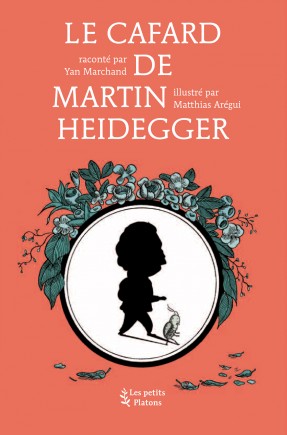
The first one is a publisher called Les petits Platons, which specialises in very high-quality fictionalised philosophical biographies of famous thinkers, from Socrates to Heidegger, from Lao-Tseu to Hannah Arendt. The graphic identity is edgy and sleek, the writing beautifully precise and elegant.  

Le Cafard de Martin Heidegger

The premise of the series is that children are not just able to play with complex ideas - a now commonly accepted notion, at the root of Philosophy for Children movements - but that they are also able to understand and appreciate the coherence of a system of philosophical thought in relation to its creator's life and historical context. It's not pure non-fiction, though - most of the Petits Platons books are heavily fictionalised, the style sometimes lyrical, the biographical elements selective and purposeful, with plenty of magical realism and fantastical elements.

Visite d’un jeune libertin à Blaise Pascal

In France, the Petits Platons series are very successful, and the publisher has done gorgeous box sets sold, among other outlets, by Le Monde and the quite bohemian-bourgeois Télérama. It's been sold to dozens of other countries, and, miraculously for a non-Anglophone book, to America - the series will be published in English in September by University of Chicago Press. Sounds elitist, but there's nothing forbidding about this mixture of dreamlike illustrations and solid historical facts, dramatic tension precipitating years of peaceful meditations into one striking concept, and the visible embodiment of these ideas into people. 

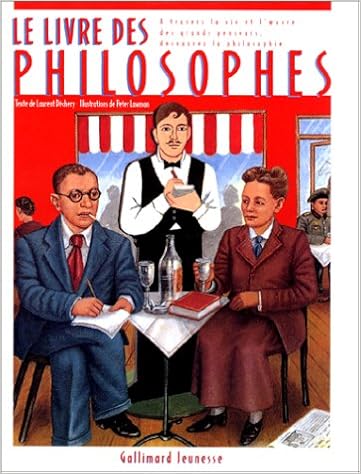
I remember, as a child, being struck by the pages devoted to Hypatia and Simone de Beauvoir in a big book of philosophers I'd been given by a well-meaning aunt. It seemed surreal to me that there could be women in a book of philosophers. I hope Petits Platons readers in America and elsewhere are equally struck by the variety of life experiences, backgrounds, and profiles that can coalesce into 'being a philosopher'. 

Another country, another medium, another perspective: the monthly magazine for children Philéas et Autobule, in Belgium. 

Que faut-il pour être heureux ?
'What do we need to be happy?'

I've written a number of short stories for the magazine in the past few months - very short stories: two pages long - and I've very much enjoyed reading the magazine itself. It's anchored in the tradition of children's monthlies, very popular in the francophone world (a common gift for children is a subscription to a monthly story magazine). But as far as I know, it's the only children' monthly that specialises in philosophy. 

All the traditional ingredients are there: one-page comics with recurring characters, multiple-choice personality tests, documentary features, games, trivia, and short stories; but all geared towards playing with ideas, thinking about how they fit together and with different worldviews. Philosophers are mentioned occasionally, but they're not centrestage. 

I'm impressed by the scope of media, techniques, formats, discourses that philosophy for children movements has invested. It's made itself fiction, non-fiction, card game, self-help book, comic, questionnaire, poem, play, conversation; it's in bookshops, magazine booths, on the internet, on video, and of course in the immaterial, everyday practices of teachers, activity leaders and philosophy for children experts. 


I admire this versatility not just for what it says of the strength of philosophy in current informal or extra-curricular educational endeavours, but also for what it can teach me about my own writing pratices; about how much more I could, or should, explore.

 _____________________________________

Clementine Beauvais writes in French and English. She blogs here about children's literature and academia. 


Sunday, 28 June 2015

Fear and Wondering - Clémentine Beauvais

Let me introduce you to the disturbing awesomeness of Wonder Ponder. Wonder Ponder is a small publishing imprint, founded by Anglo-Spanish writer Ellen Duthie, which produces desks of philosophical cards for children. On one side of each card, there’s a picture, on the other, a number of philosophical questions to be asked to the child about the picture. Simple. The first deck of cards is called Cruelty Bites (Mundo Cruel); the second, I, Person (Yo, Persona).

Look at how great these cards are:


Another one features a family eating cat soup. Actually, that’s even the one that’s the cover image for the box of cards:


 On the other side of the cards, the questions are thought-provoking whether one is a child or an adult. Is it less bad to kill an ant than another animal? Is it never OK to force someone to do something they don’t want to do? As with many works of philosophy for children, those are time-old, ageless questions, meant to be discussed or debated but not solved. They are not, in themselves, exceptionally original questions for this purpose, though they are certainly picked well and phrased crisply.

But Wonder Ponder is different, in its daringness, to other works I’ve seen of philosophy for children. The graphic style, to start with. The pictures are decidedly dark, hectic, perturbing. Daniela Martagon’s visual identity is that of a cheeky, misbehaving, imaginative child, who loves drawing scenes of war and desolation, squashing ants with a pen, and retorting ‘why not?’ to those who ask ‘why are you so cruel?’.

The provocativeness is, I think, brilliant. Of course, not everyone agrees, and unsurprisingly Wonder Ponder have received some criticism for the overt violence of some of the scenes. They’ve responded with typical wit:

More interesting than the straightforward haters, though, are the people who, in order to make sense of these merciless cards, have suggested that they in fact promote kind and positive messages: Wonder Ponder are pro-animal rights, aren’t they? They suggest ways of becoming nicer to one another, don’t they?

No, has been Duthie’s categorical reply. In a blog post, (which also contains some close-ups of other cards, and a video) she noted with palpable amusement that many people have tried to reclaim Wonder Ponder cards for their own ideological agendas - but she immediately specified that “we don't have contents we wish to insert in the reader, nor specific "right" values to transmit to them.” All they want is for the adult mediator “to have the guts not to indoctrinate”.

Duthie also states, again and again, that no one from Wonder Ponder will ever provide answers or guidelines for reflection to the adult mediators. To play the game, adults must lay their cards on the table, too; no bluffing allowed, no steering the child into specific perspectives or opinions planned in advance.

But surely, people enquired, Wonder Ponder could at least do a box showing nice things, instead of all this distasteful cruelty? Another no from Duthie, in another remarkably smart blog post entitled ‘Why we’d never do a box on “kindness” or accepting diversity’.

Duthie’s blog post is one of these calm, matter-of-fact pieces of writing whose radical nature only truly sinks in on the second or third rereading. Here’s a bit for those of you who are too tired to click on the link:

“The children's literature market is full of positive models of kindness, generosity and tolerance. Children are fed these messages non-stop: be good, be accepting of others, share.
To understand to what extent children are bombarded with these commandments and messages, check out a 6-7 year old's comment on the scene below: 

-Is it cruel?
-Yes.
-Why?
-Because he's not sharing it with the baby lions.”


What do you think of Duthie's words? agree? disagree? what do you think this example tells us? that the child is wrong? or right? that society is wrong?

I have a lot of time for didactic, political, committed literature for children - it was my PhD topic, and I enjoyed much of the primary material. And I tend to distrust educational enterprises that insist too much on the freedom they supposedly leave the child. I much prefer an openly committed book with a clear thesis to a benevolently liberal one that doesn’t acknowledge that it has a thesis. 

But in the case of Wonder Ponder, I’m completely on board. Perhaps it’s because of the iconoclastic, deliciously naughty feel of it. Perhaps it's because I like Duthie's coherent, plucky position, displayed both in the cards and in the extra-textual material - online, in her promotion plan, etc. Perhaps it's because I'm always in awe of people taking risks to launch cultural and educational projects like these, especially when they're sure to make at least a few people squirmish. But also more simply perhaps because it makes me want to sit down with some kids, and adults, and play the game with them.

Note: A big thank you to Celia, who got me my first Wonder Ponder box
_____________________________________

Clementine Beauvais writes in French and English. She blogs here about children's literature and academia. 

Wednesday, 26 February 2014

The Silent Einsteins - Andrew Strong

I was once a great believer in philosophy for children.  I’d read a class of children the wonderful chapter from Winnie the Pooh, ‘Eeyore’s Birthday’ in which  Pooh wants to give Eeyore a pot of honey but eats the honey, and Piglet has a balloon for Eeyore, but it bursts.  So Eeyore ends up with a burst balloon and an empty pot, but he’s delighted, he can put the burst balloon into the pot and take it out again. He’s happy.  Then, of course, the children can discuss happiness and what it is and what it means, and how it happens.  The wordy, confident pupils usually dominate the discussion, sometimes offering insight, often demonstrating some sort of philosophical approach.  “It depends what you mean by happiness,” one will say, and I will be delighted.

The quieter children will still be thinking about the story, or are lost somewhere along the way, maybe stalled at the point where Piglet falls on the balloon and thinks he’s dead.  But, you know, we have to move things along, get to the philosophy bit.

Except the other day a wordy confident child asked me if I knew what E=MC2 meant.  Well, I said, I do, sort of, but I can’t really explain it beyond the most superficial outline.  I did my best and he said he understood it.  I explained that Einstein had one of his first major breakthroughs when he thought of someone falling.  A person falling for long enough would achieve weightlessness.

I asked the wordy, confident boy to imagine he was in a lift, holding a pen, and then the cable broke and the lift fell, and kept falling until he was weightless.  Imagine, I said, you then let go the pen.  What happens to it?

Wordy boy mimicked the pen shooting up out of his hand.  And then, from behind him, I noticed a girl who had said nothing, but who was listening intently, suddenly leaning forward.  She was staring at me and her eyes were bright.

“It would stay there,” she said. “The pen would just stay there.”  She nodded to herself as if confirming her idea, and sat back, resuming her silent rumination.

These silent children, these children who don’t shine or sparkle, or who fail to make any early impression on the world, I am convinced their thoughts are quietly gestating.  Their minds are finding new ways to reimagine the world.  The wordy, confident ones, the brilliant academic children who fly through exams, they have often matured early, they know to repeat what they’ve been told, adding some calculated sparkle for good measure.

Here’s an example of a test question that so infuriated me I set fire to it and let it float, a fiery cloud, over the silent fields of my suppressed rage.  It asked pupils to read a text and then describe what a character was ‘feeling’.  In order to do this, it seems, a pupil scours the page for synonyms of the word ‘feel’ and then quotes these phrases.  ‘He sensed doubt’ ‘His worries compounded’ and so on. Yet throughout the passage there were louring skies, distant cries, a current in a pool eddies and swirls, all these things externalising the protagonists fears. Yet none of these were acceptable.  The limits of what the text could do had been set in stone by some evil test setter. 

Education rewards the wordy group, and more and more, demoralises the others.  The winners go on to become evil test setters.  And things like ‘Philosophy for Children’ just exacerbate it.  The quieter pupils allow images to rise and fall, let them simmer and settle.  The wordy ones want to pin them down as soon as possible, try and articulate something immediately. 

But literature is not a science, and art cannot have such simplistic one to one relationships.  A single word is a trove of associations, a text is a universe, and there is far too much to be found to expect everyone to discover the same things.


Wednesday, 9 October 2013

What makes you happy? (by Anne Rooney)

I'm writing a book for adults at the moment which is a set of philosophical questions. It's a sort of intellectual workout to help people to decide what they really think about various issues. It would be just as good for teenagers, though it won't be marketed directly at them. It's quite light-hearted, but it does drag in some old dead guys - some who have been dead for 2,500 years.

Yesterday I was working on the chapter How can I be happy? The possible answers given over the years range from "sex 'n' drugs 'n' rock 'n' roll" (the Cyrenaics, 4th century BC) to total disengagement with the material world so that the vicissitudes of fortune can't harm you - if you expect nothing, you won't be disappointed. Oh, and not forgetting 'you can't be happy, it's an illusion.' Most of the serious philosophers are agreed that just having a lot of money is not going to do it. A new iPhone doesn't get a look in.

As long as our basic needs for survival and health are met, companionship, thought and freedom seem to be the only things we really need. Epicurus (who set out that scheme only 100 hundred years after the party-guy Cyrenaics) spent his time living in a sort of commune with his friends outside Athens where they grew vegetables for their table and shared skills and tasks so that they didn't have to engage in commerce with the nasty, grasping Athenians. You can see that would be a nice life. (Philosophers are big on vegetables: Pythagoras thought beans should be protected from harm; Voltaire ended Candide with his hero growing vegetables; the Roman emperor Diocletian retired to Croatia to grow cabbages.) It's not quite having nothing, though, having a big villa outside Athens...

Of cabbages and kings...


Writing the chapter, and comparing all the ideas got me thinking about what - excluding those core elements already mentioned - makes me happy. And I came up with books; opera on the radio; a bit of free time. Isn't that mundane? And they are all free, or can be (there are libraries for the books). Another trick of the philosophers: think of something you want. How will your life be different if you have it? How will it be different if you don't? That helps you to judge how useful (in happiness terms) the object is. So a car might make you happy if it means you can travel to see friends and go to events. But a bigger car just so that you can look fancy in front of other road-users? No. Not so much.

On the whole, the things that get a tick serve those key things - companionship (drive to see your friends - or to meet essential needs), freedom (mobility gives you more choices), and thought (that's where the books and opera get in). Utility and happiness might seem unrelated, but of course they are not (look at the Utilitarians, calculating in terms of happiness and harm... but that's another chapter). When you want something, ask why - what does it do for you? Incidentaly, Epicurus thought fame and power to be both unnecessary and unnatural desires. A big car is a natural but unnecessary desire.

So - what makes you happy? That is, excluding health, enough to eat, somewhere to live and your family having the same essentials, which are givens in this question. Do you even know, or have we lost track somewhere along the line? I'll raise you books, opera and some free time. And maybe a bar of Lindt dark chocolate with sea salt.

Anne Rooney
aka Stroppy Author
The Story of Philosophy will be published on 15th October (that's not the book I'm still writing!)