Showing posts with label novels for adults. Show all posts

Saturday, 28 October 2017

A Child's view of the Woods - Clémentine Beauvais

Recently I read, one after the other, the two debut novels on the Booker shortlist:


Both Fiona Mozley's Elmet and Emily Fridlund's History of Wolves are (#imho), absolutely stunning novels and especially impressive for debuts - preciseness, delicateness and evocative power of the style, impeccable characterisation, a fabulous eye for detail, lively dialogues, etc. I won't go into that too much as most reviews concur on the matter. 

What fascinated me and is more relevant to our purposes here on ABBA is just how similar these two books are and how much they hover in an uncertain zone between 'adult' and 'young adult'. One is American, the other British - Yorkshire, to be precise; did I mention Fiona Mozley is a PhD student at my university? - but both are focused through a young person - no older than 14. 

They show us a child's view of the woods, and of traumatic events therein. We hear of grooming, sexual assault, psychological manipulation, health problems, fights, physical and mental decay, cults, the occult, nature versus industry, and pharmaceuticals lost and found among plants. I wouldn't be able to attribute any of those things to one or the other book - they strangely overlap in that way. 

And the whole time, reading them, I was wondering - what is it that makes them 'for adults'? Why are they not 'young adult'? I know we can have endless debates on the matter - and at the end of the day everything is decided by publishers anyway.

 But I think it might be down, narratively speaking, to the size and shape of what I'd call an 'air bubble' between narrator and events. 

The events are focalised through a young person, and none of the themes are out of the reach of contemporary YA fiction. But there is constantly time, space, and lots of other little things, pushing apart the narrative voice from the events. A slightly different, more distant voice, sometimes, commenting on the events from the perspective of the narrator become adult (or older). A more categorical judgment on the self that was then, and is no longer the same. 

In other words, moments where the first-person narrator considers her/himself as a character. I don't mean at all that YA fiction doesn't do this - nor, in fact, am I arguing that it's qualitatively superior to do so. There are of course narrative voices in YA with a lot of 'air bubbles' between narrator and events. Unreliable narrators are common. But I would argue that perhaps that tenuous line with something that 'feels like a YA book' and something that 'feels like an adult novel' might be set somewhere on that sliding scale of narrative detachment from the events.

Again, this is not at all (of course!) a value judgment. What they might gain in perspectival 'distance', adult novels might lose in intensity, sincerity, or even beauty. There is a kind of rawness, of honesty, in a perfectly crafted YA voice - a seriousness, one could say - which is pretty much unrivalled in literature for adults. 'Adult narrators' , even when they are children, tend to be apologetic about their feelings or about the gravity of what they are experiencing. Irony opens spaces in-between, but any such 'air bubble' is always also a cushioning: it protects and insulates the reader. In that view, perhaps adult novels, paradoxically, are more protective of their readers; less skin-to-skin in their contact.

This is of course an ongoing discussion, with very many parameters. But reading and analysing books like Mozley's or Fridlund's is particularly useful for working out those little nuances in our readerly and writerly experiences. I really recommend both, if you haven't tried them yet. And if you have, tell me what you think...

--------------------------------
Clémentine Beauvais is a children's and young adult author in French and English, as well as a literary translator. Her latest YA novel, Piglettes, is out with Pushkin Press.

Sunday, 11 June 2017

Too Good for Adults? - Catherine Butler


"No one understandeth me!"

One of the most irritating ways in which it’s possible to praise a children’s book is by claiming that it is “too good for children”.  Although ostensibly a compliment, this simple phrase manages to insult both children (seen as unworthy of, or least incapable of appreciating, high-quality literature) and children’s literature more broadly, which is implicitly dismissed as the kind of pap suitable for a juvenile underclass. Nevertheless, it’s a tactic frequently encountered, especially when the book under discussion is one that has found popularity among adults. It seems that some adults find the thought of sharing their literary taste with children uncomfortable – perhaps even infantilising – and so, like any playground bully, they not only claim that the books are for them too, but demand exclusive rights.

Well, two can play at that game. If it’s possible to read Northern Lights or The Curious Incident of the Dog in the Night-Time as adult literature, it’s no less so to read many so-called adult classics as YA or children’s literature, and to say, in effect, that they are “too good for adults”.

What do I mean by reading a book as YA literature? I mean reading it using the genre conventions of YA as a template for interpretation. To explain what I mean by that, let me use an example to which I’ve had frequent recourse. It is possible, as James Thurber proved, to read Macbeth as an Agatha-Christie-style murder mystery, finding in it all the things that the Whodunnit genre prescribes: a murder, suspects, clues, etc. Whether such a reading is helpful or not is of course a matter for debate (that’s why the country is crying out for English Literature academics), but it is one possible strategy.

To read something as YA literature, by the same token, means to read with an awareness of YA genre conventions. Thus, you will probably expect to find one or more young-adult protagonists at the text’s centre, or at least protagonists who have the “mind set” of that age group – young people who are engaged in self-discovery and self-fashioning; who are negotiating the tricky territory of the wider world beyond as well as within the family; who are tentatively (or not so tentatively) embarking on romantic and/or sexual relationships; who are not yet as adept at hiding their self-absorption as the more mature characters around them.

Many avowed YA texts fit that description – but what about “adult” texts? The example of Romeo and Juliet will occur to many people, and it has in fact almost been retrospectively canonised as YA by its perennial use as a GCSE text. Sons and Lovers is another shoo-in, as is Portrait of the Artist as a Young Man. Indeed, the early twentieth century was in many ways a golden age for YA literature. There’s Le Grand Meaulnes, of course, and The Great Gatsby is another YA classic. Although the main cast are a little old for the demographic, they all (particularly Gatsby) seem unnaturally “young” in their attitudes, their hedonism, their gaucheness, their desperation to impress, their priggishness and their recklessness.

It goes without saying that Hamlet, too, is a YA text – almost the quintessential one. So is Paradise Lost, although arguably Adam and Eve are a bit young to count.

What other so-called adult classics might we claim for the YA or children’s canon?

Saturday, 22 November 2014

FINDING MY VOICE by Adèle Geras

(This post appeared first on a blog called The Great British Bookshop. I'm very grateful to them for permission to publish it here again. Adele Geras)


It's been nearly eight years since I published a novel for adults. This is not because I've been lying around on sofas, eating peeled grapes, but because things have got in the way of my writing. These are both personal (moving from Manchester to Cambridge after living in the former for 46 years, my husband's last illness and death and so forth) and professional.
I haven't been idle.  Children's books have appeared during this time, but since A Hidden Life, I haven't published a novel for adults. And that's mainly because this particular novel, Cover your Eyes, has given me more trouble in the writing than any other of my books.  On the face of it, there's no obvious reason for this. I had the germ of the story right from the beginning, but in the first and second drafts and the subsequent fiddlings and fossickings that went on once the novel had actually been written, there were many different things to get right.
The first was that I needed to create convincing voices and stories for each of my heroines.  I like having more than one heroine in my books, and I enjoy going from one point of view to the other. Perhaps this is to stop myself from becoming tired of the single vision throughout, but it's also I think, (and hope!) a way of appealing to readers of different ages. The first thing you have to get right is the language. I made the decision early on to have Megan's sections in the first person, and that meant that the words had to be ones that were suitable for a young woman of 29. Eva's part of the story is in the third person, (a sort of modified form, which is really her point of view).
Also, I enjoy writing about the past. I blog on a site called The History Girls, which is for writers of historical fiction, and I count myself as one of those.  I like going back in time and to this end, I have always put a character who is about 75 or 80 years old in my novels to provide a view of the past. In my first adult novel, Facing the Light, (now only available as an e book from Quercus) the whole action of the novel takes place during the 75th birthday celebrations of my heroine, Leonora. Her memories of childhood, and of being young and middle-aged were layered into the narrative, and I wrote all seven of these 'past' bits first, before writing the rest of the book. I then slotted them into their appropriate positions at the end.
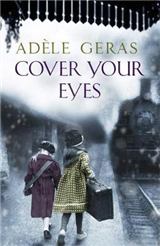
In Cover your Eyes, my elderly heroine is Eva, and she came to England in 1938 on the Kindertransport.  She has a secret that she has revealed to no one, and she is haunted, quite literally, by a ghost about whom she has never said a word.  She used to be a famous dress designer and she meets the other heroine of the novel, who's a journalist, when the latter (Megan), comes to interview her for a fashion magazine.  Eva's narrative is intercut with memories of times from her past, in the manner that I used in Facing the Light, but in this novel, I wrote the sections in the past as I went along.  Megan is recovering from being dumped by her married lover. Eva is sad because her beautiful home, Salix House, is going to be sold.  Stuff happens, and Megan ends up living in Eva's house, where she becomes aware of a certain strangeness - she sees and hears things that she can't explain.
I won't say more; I don't like spoiling the plot, but I hope that everyone who reads the book enjoys it. It went through several incarnations because it's very hard to weave a supernatural element into a typical 'women's fiction' story. I hope that there are things in this book which resonate with lovers of historical fiction* too. Even though only small sections of the actual story take place in the past, I like to think that what happened to Eva when she was four and came to England for the first time, tinges the book and gives it its flavour, rather like the Angostura in a drink of gin and bitters.
 * I have also written a children's book about the Kindertransport, called A Candle in the Dark, published by A&C Black, which is suitable for readers of seven and upwards.