Showing posts with label intertextuality. Show all posts

Sunday, 28 July 2019

Children's literature that refers to children's literature - Clémentine Beauvais

I want to talk today about a phenomenon I've noticed in children's and YA literature, and which seems to me to be on the rise: what I'd call 'lateral' intertextual and intervisual references in children's literature. Namely, children's texts that refer 'sideways' to other children's books, rather than 'up' to 'adult', clasical, 'real' literature, as used to be more common.

Children's literature has always tried to establish and consolidate its own status as worthy of existence and respect, and since hardly anybody helps it in that endeavour, it's had to help itself. One of the ways a text can inscribe itself into a prestigious literary family tree is to refer to (more) prestigious literary relatives. And so, since its early days, children's books have generously referred to 'adult' literature, especially to classics.


Those referential networks have been quite varied. Adaptations, rewritings, abridged versions - children's books have been, historically, often 'indebted' to adult classics. Among the first novels considered to be 'for children' is Fénelon's Télémaque, which was, of course, a rewriting of the Odyssey. Today, there are still many children's and YA books that align themselves with classic texts generally seen as being for adults. 
Image result for télémaque fénelon

Not all do so for educational reasons (and there's nothing wrong with those that do, of course, I hasten to say). Plenty of children's books use 'adult' literature as a playing field, referring to canonical texts and authors discreetly, in intertextual games of varied levels of irreverence. Daniel Pennac's Kamo series, for instance, play with Wuthering Heights in an extremely erudite way, but there is no pressure whatsoever to go read the 'source' text - that said, when you do read it later in life, you arguably enjoy the experience even more for all the moments of retrospective understanding. The same could be said, on this side of the Channel, for Philip Pullman's rewriting of Paradise Lost, His Dark Materials.

Image result for kamo the babel agency

Frequently, too, children's literature has established relations of a more parodic, pastichey or satirical nature with the 'prestigious' texts it references. In that tradition of children's literature, the intertextual or intervisual references to more canonical fields are sweet-and-sour: respectful sometimes, mocking often. From Lewis Carroll's 'How doth the little crocodile' to the whole works of Anthony Browne, those references have come in to question what one, as a child (or indeed adult) is supposed to like. Children's literature, of course, sets tastes - reading tastes, aesthetic judgments - and for a long time it took seriously its guiding role as an introduction to 'real', grown-up art. But then it decided it could do more than that, and critique from the inside the very concept of 'real', grown-up art. References here range from well-meaning and humorous to brutally acerbic.


Image result for how doth the little crocodile
All those references, however, whether respectful or irreverent, remain 'upwards' winks, towards that Other, Higher Literature that children's books have always looked up to in spite of themselves, hoping, secretly, to be helping children to reach it some day... They are also, of course, ways for authors to legitimise their own statuses - sure, I write for children, but look, I'm a real writer, I'm well-read, I know the canon.

Just in case it sounds like I'm being critical of my peers, let me plead absolutely (and unashamedly) guilty to that erudite crime, since a very large number of my children's books are extremely referential - and mostly to that Higher Literature, the literature that grown-ups consume and approve of.

More recently, children's literature has started playing with other webs of references, closer to itself, but still classical: the canon of children's literature. It is quite common to see references in children's literature to Peter Pan, Jules Verne, Alice in Wonderland, The Little Prince, and, of course, fairy tales, Aesop's fables, nursery rhymes. For instance, Thomas Taylor's Malamander is full of delightful intertextual references to Peter Pan. Those glances are more 'sideways' than 'upwards', but they still look 'up' to a canon.

But I've also been intrigued to see an increasing number of authors and children's books that make explicit, joyful and unashamed references to other contemporary, non-canonical authors and books. In other words, we now see children's literature establishing itself as a worthwhile field of references, weaving itself its own web of self-referentiality, finding itself worthy of winks. No inferiority complex anymore: it's about celebrating children's literature in children's literature, severing the links to that Other literature, that Great literature, and finding oneself quite satisfied with what's left.


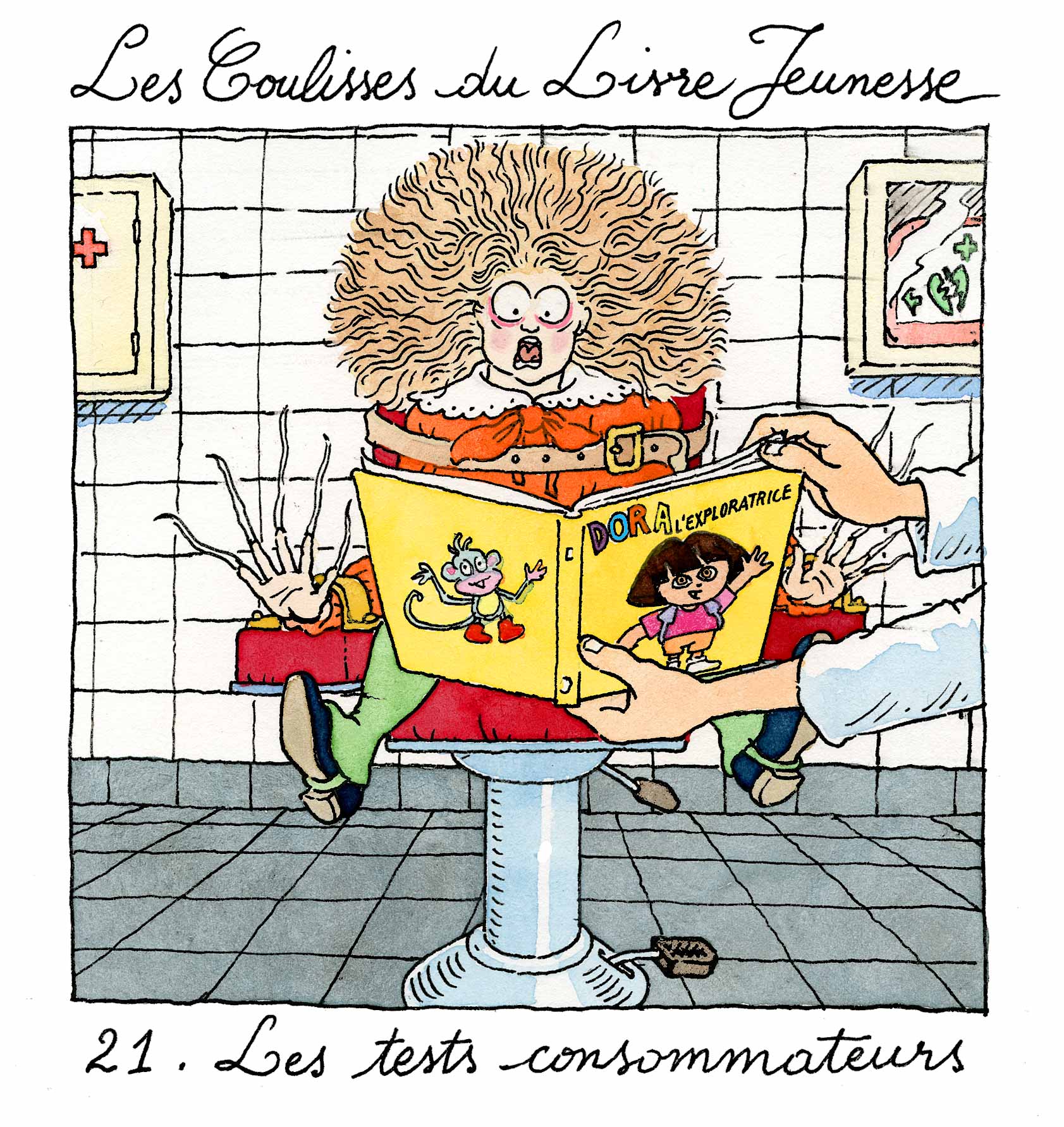
I started to notice this first in picturebooks - with French author-illustrators such as Gilles Bachelet and Claude Ponti, whose explicitly referential work started to feature other contemporary characters: Bachelet, for instance, references Pomelo, the pink elephant of Ramona Badescu and Benjamin Chaud's contemporary series.
Related image
Gilles Bachelet, referencing two pieces of children's culture at the same time, one canonical, one less so
I then started to notice it everywhere. In L’écrivain abominable, a French MG novel by Anne-Gaelle Balpe, the eponymous 'abominable writer' of the title (an evil children's writer) is called Roland Dale (pronounced, in French, 'Dahl'). In a recent MG novel by Paul Martin, Violette Hurlevent et le Jardin Sauvage, the wild wolves' names are of famous picturebook illustrators, including 'Sendak' and 'Nadja'. I've caught myself doing that in my own books, too, with references to other children's authors and their works, and in turn I've found my works, to (I'm not going to lie) my great delight, here and there referred to in the works of other children's authors in France.

I think that those 'lateral' winks are in part due to the fact that children's literature has become a field of its own, where authors read each other abundantly, know each other, keep a close eye on what's being published, and genuinely enjoy that vast and varied production. I'm not sure the same happens as much in 'adult' fiction, in part because the emotional investment and intellectual interest in one's contemporaries' books seems to me - admittedly from the outside - to be on the whole lower.

Through this recent-ish move, children's and YA literature is establishing its own field of knowledge and references and, to some extent, theorising itself as well as its reading and writing practices. Rainbow Rowell's Fangirl, which I actually recommend to my undergraduates as one of the best 'theoretical' works on fanfiction, refers to many teenage series, as well as to the whole extended universe, reading habits and creative offshoots of YA fiction-reading.
Image result for rainbow rowell fangirl

Those references are arguably anecdotal in comparison to the ocean of 1) non-referential works and 2) works that reference classic, adult literature or canonical children's literature, but I wouldn't be surprised to see them intensifying and normalising, as children's and YA literature increasingly asserts its own status as an artistic field of its own, full of contemporary vitality, and worth referring to. And adult literature, which already refers to canonical children's literature and to works such as Harry Potter, will look no longer downwards, but sideways, at us.

-------------------------------
Clémentine Beauvais is a writer and literary translator. Her YA novels in English are Piglettes (Pushkin, 2017) and In Paris with You (trans. Sam Taylor, Faber, 2018).

Monday, 28 September 2015

Joy of belated recognition - Clémentine Beauvais

One of the most common accusations levelled at children’s books with playful intertextual references is that children ‘won’t get it’. The claim is annoyingly predictable, as much from editors as from (adult) readers. There’s always an underlying sense, in this accusation, that you’re somehow wasting your time if you cram hidden references in children’s books. They won’t know the original, so there’s no point.

No point at all.


There’s two sides to that argument:
  • 1) the child-hating one: pearls before swine, basically: they’re not good enough for your clever references;
  • 2) the child-centred one: they won’t enjoy a passage with a reference they don’t recognise, just like you can’t enjoy a pastiche or parody of a film you haven’t seen, or a book you haven’t read.
There’s also the implicit notion that the author is somehow showing off; worse, that they might be a failed ‘adult’ author, who clearly has to compensate for the shame of writing for children by seducing the adult co-reader. The old ‘talking to the adult above the child’s head’ accusation surfaces here.

I think it’s a huge shame that this antagonistic approach to intertextuality is so common, even among children’s book people; not just because it’s strangely anti-intellectual, but mostly because it’s premised on the notion that intertextual references, in order to function, have to be encountered after the ‘original’. 

There’s an implicit chronology to our basic understanding of intertextuality, especially pastiche or parody: first the original, then the reference; that’s the way to do it. The same rule applies to everyone, but since children have, to put it simply, lived less long, and encountered fewer texts and cultural productions than adults, they’re particularly unlikely to understand most references to films, books, or works of art. This is especially of concern if the pastiched element is part of ‘adult’ culture and literature.

It’s obvious, though, that the intertextual game is much more erratic than that, and for everybody - not just children. Just a few days ago I was reading the slightly obscure 1884 French novel A Rebours, by J.-K. Huysmans. I was staggered when I found in it the gloriously synaesthetic description of a kind of organ which delivers, when played, different kinds of alcohol, forming symphonic cocktails. That description seemed to me to have fallen straight out of another French novel, this time an absolute classic - particularly among teenagers - Boris Vian’s 1947 Foam of the Days (L’écume des jours), which famously features a similar instrument, called a ‘pianocktail’. A quick Google search informed me that indeed, Vian had been inspired by Huysmans’s fictional instrument. The reference, I gather, would have been more obvious to a 1940s audience than to a Millennium one.

someone made a real pianocktail #yolo
So 15 years passed between my discovery of the pianocktail and the entirely accidental encounter with its literary ancestor. And of course I don’t resent, but love, this kind of (very) belated intertextual joy of recognition. It’s happened to me many times, and to you too, I’m sure. With children’s books, the joy is, if anything, even more awesome, because it’s tinged with that special tender hue that memories of childhood reading have. It’s also deeper-buried, so the resurfacing is all the more poignant.

Intertextual references that are ‘not immediately understood’ are not a big deal. It’s not as if you spend years wandering around in utter perplexity, feeling you’d missed out on something crucial, until you finally encounter the ‘key’ that you ‘should’ have had the first time around. You already find it funny and intriguing the first time around; or, quite simply you don’t notice it at all. In Asterix in Britain, everyone Asterix and Obelix meet speaks weirdly - in the original French, they keep saying ‘Je dis!’ before every sentence; and ‘n’est-il pas?’ after each clause.

'Goodness gracious!'

At the time, I thought it was hilarious, because it was so weird and seemed to correspond so well to this odd tribe of red-haired hot-water-drinkers. It’s only much later, in English class, that the revelation hit me: Goscinny and Uderzo were directly translating into French ‘I say!’ and ‘Isn’t it?’. I couldn’t stop giggling. Joy.

My villain in The Royal Babysitters is called King Alaspooryorick. Some schools I go to have gone to great lengths to tell the children where this name comes from. Others haven’t. I like to think that one day, in high school, or at a theatre somewhere, some kids will giggle to themselves when they encounter the phrase for the ‘second’ time. And it’s not as if they’re not giggling now - it’s not as if I’m forcing them to save their giggles for later. Alaspooryorick is a ridiculous enough name to be already funny.

Let’s not be inflexible with chronology when it comes to intertextuality. The ‘wrong order’ is perhaps the best one. It’s not the joy of erudite recognition; the wink, the nod, the handshake between two adults above the head of the child. It’s exactly the opposite: it’s the joy of accidental recognition, in an unpredictable future - the joy of stumbling upon a distant memory, resurfacing in the middle of today’s serious activity - and triggering an unexpected, slightly nostalgic laugh.
_____________________________________

Clementine Beauvais writes in French and English. She blogs here about children's literature and academia.