Showing posts with label creativity ideas and inspiration. Show all posts

Monday, 17 October 2022

Reader, it was beautiful - by Tracy Darnton

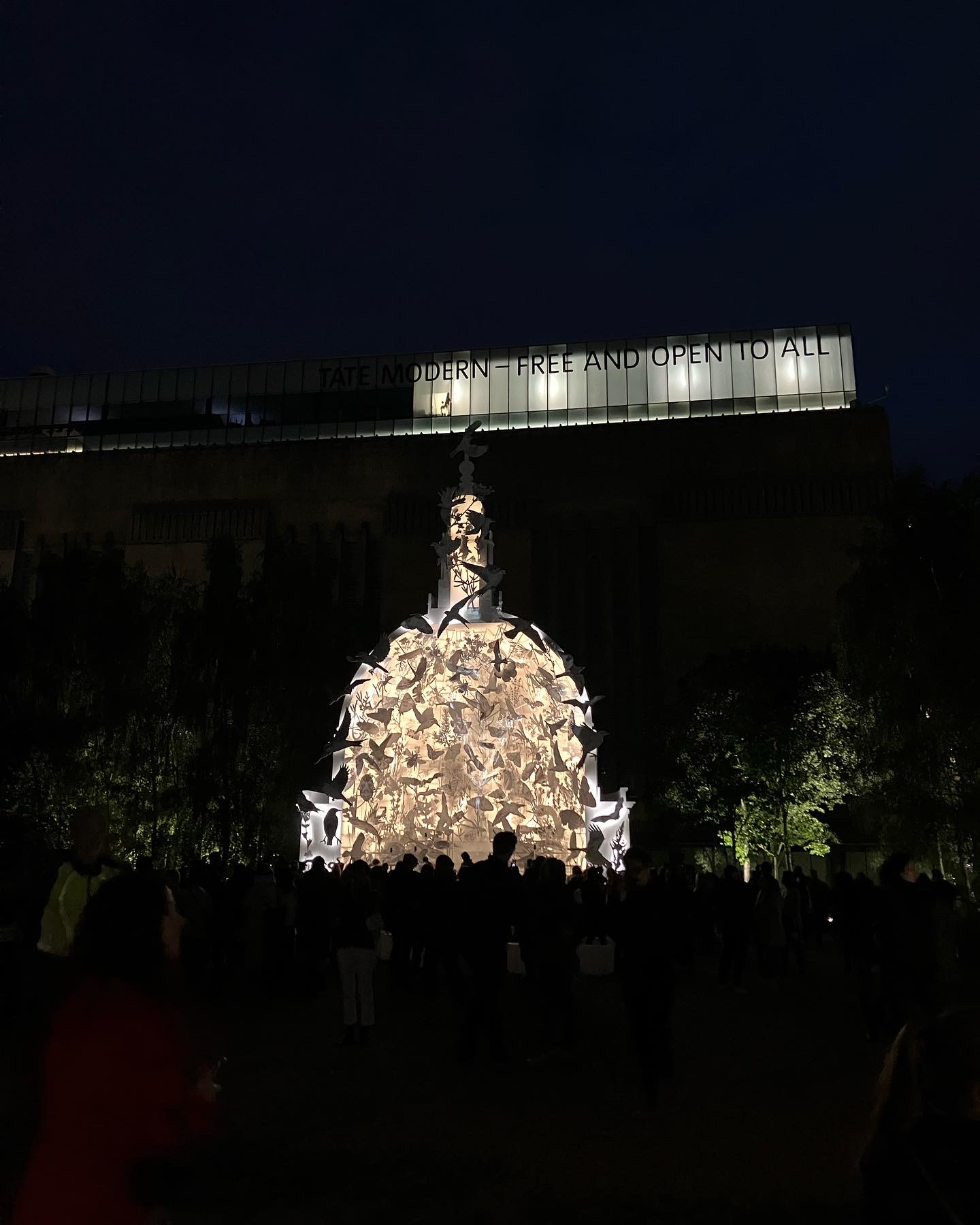
Recently, I came across something beautiful. I don't use that word often because I'm a sceptical, cynical old thing, but I was unexpectedly moved by a piece of public art in the Tate Modern garden on the edge of the Thames. 


What was it? 

An illuminated choral sculpture (yes, it's a thing) called Come Home Again by artist Es Devlin, sponsored by Cartier. As dusk fell, the barriers went back and we perched on the white cubes to await the small choir. 


For me, this installation successfully combined visual arts, words and music to provide a memorable experience. But this was also a piece so firmly rooted in its setting. London's wildlife was incorporated in an original way, with the involvement of London Wildlife Trust, to highlight flora and fauna on the biodiversity action plan. Birdsong and black and white illustrations brought them to life. This was all backed up by a website of further information which I'd recommend for a close up look of Es Devlin's gorgeous drawings. 


I loved how the dome of St Paul's across the water was reproduced in a scale model. The creator Es Devlin, who introduced it on one evening, said she'd developed the kernel of the idea when she was visiting the cathedral and could still hear the busker outside Tate Modern on the other side of the river. She urged us to go to evensong there - which I did the following evening. 


Different choirs brought a different atmosphere to each performance. I saw (and heard!) The Sixteen and the South African Cultural Gospel Choir UK on different evenings. Beautiful! 


The Sixteen choir

The music was interwoven with a soundtrack and descriptions of the wildlife evensong and dawn chorus, using light and projections to highlight particular birds and insects. Somehow, the solemnity and communal experience available at a church evensong was shared here by a group of people, both Londoners and tourists, who happened to be passing or joined the queue. Religious or not, it fed the soul. 

You can check out the full website here but sadly it finished on 1st October. Despite there being a kind of beauty in its ephemeral nature, I hope it comes back.

I'd have liked a different title but Come Home Again showed how good public art can inform and move us, and provide spectacle. How something unexpected on a chilly evening walk can just be simply beautiful. 

Beautiful.


Tracy Darnton is the author of YA thrillers Ready or Not, The Rules and The Truth About Lies. She'll be back to her cynical, thriller-writing self next month. 

You can follow Tracy on Twitter or Instagram @TracyDarnton


Friday, 5 April 2019

Lynda Barry's Daily Diary - Alex English

I am fascinated by the creative process, and lap up books on creativity. One of my favourite writers (and illustrators) on the subject is Lynda Barry, an American cartoonist, author and assistant professor of interdisciplinary creativity at the University of Wisconsin-Madison.


If you haven't heard of Lynda, I urge you to look her up and buy her books. Syllabus is a particular joy. It is what it says on the tin, the syllabus of her workshops at Wisconsin-Madison, set out like a densely-illustrated graphic novel. It feels like taking a sneaky look through someone's rather beautiful sketchpad.

Barry's class is a hybrid of comics and writing class for students of all disciplines. She believes that everyone can write and draw, and the class she runs is one of pure creativity. There's no 3-act-structure or how to find an agent, it's all about observation, imagination and not being scared to fail. She selects her students across disciplines, aiming for a mix of interests, ages and abilities. Then she gives everyone a code name (for one class, everyone was named for part of the brain).


While I dream of being able to take a class like this, reading Syllabus is the next best thing for someone who is not likely to be heading to Wisconsin any time soon. The key takeaway for me from the book was the incredible Daily Diary.

Now, I'm sure pretty much all writers keep some kind of notebook, whether it's a literal block of paper or a digital alternative. But what Lynda does is construct a format for daily notes that helps to train her students to hear, see and remember the world around them. It's a really simple way to 'fill the well' of inspiration. She insists her students complete it every day, but the format is so simple that it's not at all intimidating, even for a beginner.
"The point of the daily diary exercise is not to record what you already know about what happened to you in the last 24 hours. Instead, it’s an invitation to the back of your mind to come forward and reveal to you the perishable images about the day you didn’t notice you noticed at all." Lynda Barry
The daily diary takes five minutes. You split your page into four. The first quarter is for 7 things you did (2 minutes). The second quarter is for 7 things you saw (2 minutes). The third quarter is for something you overhead (30 secs). The fourth quarter is a quick sketch of something you saw (30 secs). Easy. Five minutes! Even the busiest person ever could fit this in to their life.


It's very simple, but an incredibly useful tool. I love looking back over my daily diaries.


One day in August, I saw a man with the tip of his pinkie finger missing, a man holding a baby with a napkin balanced on its head (while he ate lunch over it) and a giant bee sculpture. I also ate moon ice cream. All in one day! I can feel the story ideas bubbling already.


I have no idea what I drew here, but I know I told off my son for tearing leaves from a tree. Quote of the day was 'it's so I don't drop my lunch on her head!' Presumably about the aforementioned baby.

I am sure I would never have remembered these little gems without Lynda Barry's daily diary. Even my ordinary notebook habits would not have picked up these miniscule morsels, but they're a great resource for characters, dialogue and story ideas.

I really do urge you to give Lynda's daily diary a go and to check out her books. There are also plenty of other variations on the daily diary format on her fantastic tumblr page.

Alex English is a graduate of Bath Spa University's MA Writing for Young People. Her picture books Yuck said the Yak, Pirates Don't Drive Diggers and Mine Mine Mine said the Porcupine are published by Maverick Arts Publishing and she has more forthcoming from Bloomsbury and Faber & Faber.
www.alexenglish.co.uk

Tuesday, 5 March 2019

Getting inspired... by myself aged six - Alex English

At a recent writing for children workshop, we were invited to think about ourselves aged six. What did we like? Who were we friends with? What did we read? What happened in the world that year (I had to look this up on wikipedia)? Which of these events had an impact on us?

It was a very enlightening exercise, but for some of the questions I found it difficult to remember. I was a huge bookworm as a child, but I had phases of reading Blyton adventures, horse stories, school stories (The Chalet School and Trebizon series were huge favourites at various points in time), sci-fi, and all sorts of others. Trying to remember which books came when was tricky.

Fortunately, my mum had kept all my writing books from school. They made enlightening reading and it was inspiring to get back into my own head circa 1980-something.


You could perhaps have predicted that I was going to make a picture book author by reading my first piece of published writing, aged five, complete with Pop! Bang! Whizz! 

I love the fact that the school magazine was typed on an actual typewriter and photocopied. The line-breaks also make this little tale strangely poetic. 


I read the whole magazine from cover to cover and found lots of little gems like this one above. It was a great way to get back to thinking like a child. A boot getting sucked off in the mud! What a story.


I'd forgotten those hairbands with windmills that go round. Love the last line. I'm never one for a completely happy ending.


Getting older now, I think I was six or seven when I came up with this cracker of an inciting incident. Suddenly a flying saucer landed in the garden! Wicked aunties featured in my stories heavily circa 1986. As did Sarah W, best friend of the moment.


My favourite foods haven't changed much since age six. Fish and chips is a solid choice, plus who doesn't love ice cream with sliced strawberries?


Once upon a time there was (sic) four children and their names were Edmund, Lucy, Peter and Susan.... 

Hmm, this story sounds somewhat familiar. I can vividly remember picking The Lion, The Witch and The Wardrobe from the school library at the end of term, and from this excerpt it seems that I got hooked on C.S.Lewis around age six. Interesting to note that I thought the Pevensies went to stay with the professor during their summer holidays, rather than being Blitz evacuees.


"A punk has colourful hair. She goes to the disco every day." 


I have no memory whatsoever of Prince Andrew and Sarah Ferguson's wedding. However it obviously had enough impact on me aged six to inspire the names for two gerbils in this story!

Do you ever re-read your childhood writing? Maybe you should give it a try, I really found it helped me tap into young me and gave me lots of ideas in the process.

Alex English is a graduate of Bath Spa University's MA Writing for Young People. Her picture books Yuck said the Yak, Pirates Don't Drive Diggers and Mine Mine Mine said the Porcupine are published by Maverick Arts Publishing and she has more forthcoming from Bloomsbury and Faber & Faber.
www.alexenglish.co.uk


Thursday, 16 August 2018

What to Write About When You Can't Think What to Write About


This month I am between.

Between projects, between inspiration. Between the excitement of the last book and the fresh excitement of a new idea that absolutely must be written.

This is quite a normal phase. I’ve been through it many times and it hasn’t stopped me writing yet. I have been reminding myself that everyone knows 90% of writing consists of waiting. In fact, just last winter at the Scattered Authors’ Folly Farm retreat, we talked about the rhythm of the seasons and the danger of trying to be constantly productive when we need the fallow periods for stories to put down roots. I’m a gardener. I should understand that.


Just because there’s nothing growing, it doesn’t mean I am not working on it.

In some ways, the between times were easier to deal with before I went full-time as an author. I could take a break from writing, go to work and still feel like I’d achieved something by the end of the day. And if I stamped around, irritable and idea-less, annoying my colleagues, at least I did it outside the house.

I don't mean to sound ungrateful. I am incredibly lucky to be able to write full-time. I'm even luckier to have author friends in Cardiff so we can share the ups and downs of the writing life. But what do you do to get out of a 'down' patch?

Here's some of what I've been doing.

Reading


I find it increasingly difficult to read when I’m in the middle of editing. After spending my whole day looking at words, my eyes just can’t take any more. So I buy books, stack them up artistically and dive into them in the between periods. Occasionally, it’ll spark off new ideas. Mostly, though, I simply enjoy being in other people’s stories without any pressure.

Getting Outside

Last week, I took a trip up to Abergavenny to meet the local members of the Society of Children’s Book Writers and Illustrators. Much cake was eaten and, as my next book is set in Abergavenny, the lovely Jo Thomas offered to take me on a research trip.


This is Cwmcelyn (Holly Valley) nature reserve. It’s a small pond between housing estates. If you turn in one direction you’ll see red roofs everywhere. But stand at the right spot and gaze the length of the pond and you’re staring straight up into the mountains. I've lived 40 minutes away from this place for the past 20 years and I've never visited before. I wonder how many other little spots lie just around the corner, waiting to be discovered. 

The landscape is a great source of inspiration. I can imagine fairies living around Cwmcelyn, dragons nesting in the long grass...


Create Something Else

Creativity sparks creativity. Whether it’s learning a new piano piece, sewing, baking, gardening. The act of turning away from the blank notebook and doing something else can allow ideas to form in the dark recesses of the mind.


Gardening definitely sparks creativity as you struggle to find a use for yet another batch of tomatoes.


Write Rubbish

Really, the best way to get rid of a blank notebook is to fill it up. 

In the between times I will abandon my computer, grab one of my many notebooks and scrawl whatever comes into my head. Lists of all the things I like. Character names. Books and films I've enjoyed. What I can see out of the window. The idea is to take away the pressure of creating something good. I like to think that the random words are like the primordial atoms that floating in the Great Void before the Big Bang. Maybe something will draw them together and they’ll explode into a new universe. If not, you can look at them some time later and laugh.

Finally, if all else fails, you can also write a blog post. Deadlines are the best motivator in the world!


Friday, 10 February 2017

Friendships between Children and Animals - by Jess Butterworth

As a child, like many others, I adored animals. I still do. I’m grateful that I grew up around them: whether it was our family pet dog, Tiny (he came with the name), a dachshund corgi mix with the smallest legs ever; the horses and sheep in the fields around the village; or the goats and cows wandering outside our house when we lived in India.
I remember forming incredibly close bonds with animals, especially during our time in India, where the remoteness of the mountain we lived on meant that there wasn't always other children around. The other profession I dreamed of (along with writer and explorer) was vet.

For some children, animals lead to their first encounters of life and death. When I was six and in India, one of our dogs got taken and eaten by a leopard at dusk. I was devastated and my Grandma tried to explain to me about wild animals and food chains. A few years later in England, I went to feed our chickens in the morning and found only feathers and some orange fur stuck to the wire of the hatch.

I’ll never forget the look of horror on my sister’s face when she got home from school one day to discover one of her hamsters eating the other.

Months later, my other sister thought she’d unearthed alien worms in the rabbit cage. It turned out the rabbit had mated with a wild rabbit on one of her escapes from the garden run, and the wriggling pink things were, in fact, baby rabbits.

This part of my childhood is reflected in my writing and my books are filled with animals and the friendships that can happen between children and animals.  

Here are some of my favourite stories that also explore this friendship.

Northern Lights by Philip Pullman 

In this world, every human has a daemon, an animal companion that is also their soul. A child’s daemon is free to change form, from creature to creature, whereas an adult’s daemon remains the same.

Winnie-the-Pooh by A. A. Milne 

Christopher Robin explores the Hundred Acre Wood, going on adventures with its inhabitants, Winnie the Pooh, Eeyore the donkey, Piglet, Kanga and Roo, Tigger, Rabbit and Owl.

The Last Wild by Piers Torday 

This story begins in a sterile world where animals no longer exist, until a cockroach asks Kester for help and he’s flung into an adventure to save the last of the animals and the wild.

James and the Giant Peach by Roald Dahl 

In a bid to escape his wicked aunts, James befriends oversized insects inside a giant peach.  

The Butterfly Lion by Michael Morpurgo 

Bertie rescues a white lion cub in Africa but when he’s sent to boarding school he’s forced to give the cub away and the lion ends up in a circus. Bertie promises to find the lion one day.  

The Jungle Book by Rudyard Kipling 

Mowgli the boy is raised by wolves in the jungle and has many animal friends including Bagheera the black panther and Baloo the bear.


There are so many wonderful books out there and I’m certain I’ve missed a bunch. What are your favourite books that explore friendships between animals and children?

Jess Butterworth

Thursday, 10 November 2016

Snapshot of my Year by Jess Butterworth

This has been my first year as a writer under contract, and also my first year as a newlywed.


Today I’m excited that my second novel is almost ready to send off to my lovely agent.

I’m also upset because I had to wave goodbye to my husband at the airport for another stint of heart-breaking long distance.                                                

My husband is from outside the EU and with neither of us able to live or work in each other’s country yet, we’ve had to be creative in how we manage to be in the same place at the same time. So far we’ve lived in England, Australia, India and the US together.

In March we flew to the beaches of South India for our honeymoon. I spent much of my childhood in India and my second book is set there. Before we arrived, I was just beginning to have an idea of the story I wanted to write. Travelling was the perfect accompaniment to filling notebooks, reading, and doing all the research and nurturing a story seed requires.

But then my editor emailed me with the main round of edits for my first novel, Running on the Roof of the World, and I knew I needed a desk, some sort of regular internet connection and a base for a while. So we boarded a 36-hour train and headed into the foothills of the Himalayas, to stay near my father. This had its own challenges. There were frequent electricity blackouts and internet cuts. I remember preparing to speak to my editor by gathering every phone and placing them in a corner of a bedroom (the only place that received signal apart from a big boulder halfway down a slope). We made contact before a storm blew in and cut us off several times.  


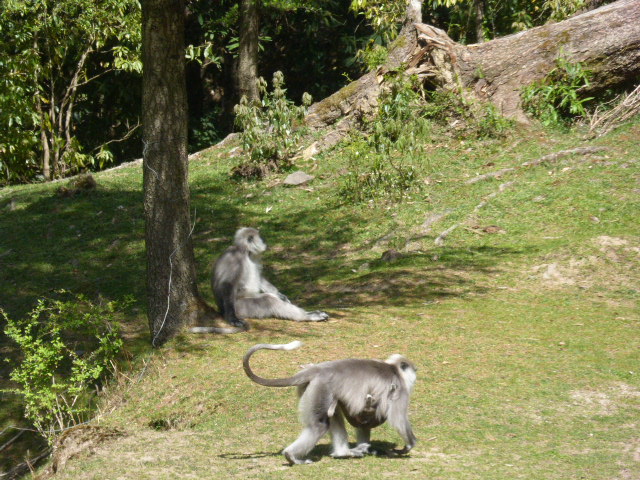
The foothills are full of wonderful distractions. I spent many days watching Himalayan grey langurs bounce from branch to branch and sneak into our garden to the eat the flowers.  


We stayed through monsoon which meant that we lived in a cloud for two months. If I opened a window, the cloud drifted inside. Everything was damp, even our pillowcases. The cover of my notebook went mouldy.


Now as I sit back at my desk in Frome, Somerset, putting the last touches to my book, I pull from my memories to fill the pages with the sounds and smells of the mountains, and in the process remind myself of the wonderful times I had there with my partner.

Jess Butterworth