Showing posts with label children reading. Show all posts

Wednesday, 16 February 2022

'A Kestrel for a Knave' by Alex Cotter

Cor, I wasn’t half chuffed to be included in this year’s recent Read for Empathy Collection 2022 from Empathy Lab. It’s an organisation that does incredible work developing empathy skills with children and young people through the power of reading.

And – empathy and power – it got me thinking about stories that have ignited deeper feelings and connections within me as a young person. Amongst the many, there’s one my mind spot-lit in a heartbeat. A Kestrel for a Knave by Barry Hines.

It was a class book we read together in Year 8 (or 2nd year to me). A story about a boy who 'hates and is hated', yet finds hope and trust in his relationship with a kestrel; ultimately doomed. It was something completely different from the books I was feverishly borrowing from the library at this time (every Judy Blume, a little Agatha Christie, and, ahem, possibly a few too many Sweet Dreams). Up to this point, stories had mostly been a route to escape, tonic for a bad mood, fodder for my imagination, and, more latterly, a welcome reflection of my own experiences and feelings.

And then came . . .  A Kestrel for a Knave. (Accompanied soon after by Ken Loach's film Kes.)
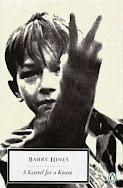
A Kestrel for a Knave

Only connect . . . 

It wasn’t a story I’d have chosen for myself – and what a loss that would have been. It did something to me so visceral, so powerful, that I can still feel its effects in the pit of my stomach today. Beyond escapism and storytelling; more than a reflection of my own emotions; I walked in the shoes of Billy Casper, a boy whose harrowing experiences were alien to me – and I made a connection. A connection that definitely helped shape and deepen my understanding for the other young people around me.

We were a Catholic comprehensive in Sheffield; its inner-city location meant the intake came from all parts of town – from leafy suburbs to tower blocks to our Traveller community. The setting of A Kestrel for a Knave, in Barnsley, was physically close to us, as were many of its issues. Ours was Sheffield in the mid-80s: a diminishing steel industry, rising unemployment and miners’ strikes. Arthur Scargill was our local hero (along with Human League, ABC and Heaven 17).

Times were especially hard for some students in my class, not least, with an increasing number of parents on the dole. But we were close-knit, we looked out for one another and began confiding in each other more too; and some confessions were tough ones. I can still remember not knowing quite how to process these, especially distressing topics like domestic violence. I recall feeling real sympathy, yet, at the same time, also feeling confused – of not being able to make sense of such unfamiliar, upsetting experiences.

The power of books

Reading Kestrel – it really helped. By getting inside the bleak and bullied life of lonely Billy Casper – with his violent brother and his detached mother and his troubled school life – I started to walk in his well-worn shoes, to live and learn from his gritty experiences. And then, by sharing his love for the hawk he rears, trains and cares for, I found myself making an unlikely connection with Billy. And an enlightening discovery, through the inevitable tragedy he faced, that in our differences, we weren’t that dissimilar.

Kestrel

Cue the big TV on legs being wheeled into the hall once we’d finished the book. And our Year 8 class watched the film adaptation, Kes, together, in total silence; for once, I don’t remember anyone messing about. But I remember our discussions afterwards.

Walking in the shoes of a troubled boy who no one seemed to care about, I suppose it showed me – my class too – that the first step with empathy can simply be to care . . .  to really, really care.

If you’ve not read it, I can’t recommend it enough . . . A Kestrel for a Knave by Barry Hines


Click here to find out more about EmpathyLab, its Read for Empathy Collections, and Empathy Day 2022.

Alex Cotter’s middle-grade novel THE HOUSE ON THE EDGE came out in July 2021 with Nosy Crow. Find her at www.alexcotter.co.uk or on Twitter: @AlexFCotter


Thursday, 12 April 2018

On Writing and Small Children - by Ruth Hatfield

Every month I watch the 12th day creeping towards me with a sense of increasingly desperate panic. What on earth am I going to write a blog post about? Every month I swear to myself that I’ll give up writing this blog, and every month I realised I’ve left it too late to quit and I’ll have to write at least one more blog post anyway, so I might as well get on with it. And then I have to climb right inside the barrel, get down on my knees and begin scraping around for absolutely anything.

The trouble is that with two very small children, I really don’t do much writing at the moment. I do a lot of thinking about why I’m not writing, and planning times to write (i.e. when the children are in bed, and asleep), and then finding that when those times come all I want to do is curl up with a book, and my brain’s full of fluff anyway. I do a lot of reading children’s books, so I really ought to find some inspiration there. But re-reading Mog and the Granny for the ninetieth time doesn’t spark off that many original thoughts about writing. I also do spend a lot of time wondering when I’ll ever get time to properly write again – by ‘properly’ write, I mean what I used to do, which was bury myself in it for hours and days on end without having to once consider whether I ought to break of at some point and scrape the dried sardine from the front room carpet.
Well, I guess the answer to that is – not for a long time. And what I’m left with is the reality of what writing means to someone with two tiny demanding dependents. I’ve definitely learnt some lessons about books: I’ve discovered that quite a few modern picture books have texts with self-referential humour that’s clearly more aimed at adults than children, and that the kids, far from being happy just to look at the lovely pictures, actually get bored when there’s all this arch stuff in the text they don’t understand. Obviously many of the books I find grindingly repetitive and annoying (a thousand apologies to Judith Kerr, but I’m looking at you, Mog) are the ones my daughter loves best. But there are some that we both love love love. Oh, Julia Donaldson! – she writes texts that sound great, and that remind me of what a living, laughing joy language can be. They make me think about how I sat down from the earliest age and began to try to paint my own pictures with the language I knew, just because it seemed like such an exciting and beautiful thing to do.
My Naughty Little Sister
Then in the past month or so I’ve been reading longer stories at bed time, and on the recommendation of my own mum, I first went through the entire five volumes of My Naughty Little Sister stories by Dorothy Edwards, and am now working my way through the collected works of Milly Molly Mandy. My daughter loves them so much that she lies listening in silence, not interrupting for the whole story (which given that she normally doesn’t stop to draw breath  is an absolute miracle). I didn’t get them at first – I remembered loving them myself as a kid, and I quite liked reading them, but it took a while for the charm to really grab me, and then I started to see what my daughter saw. They’re stories in which often absolutely nothing happens. A tiny, very domestic incident is described in great detail, from the point of view of a child. Of course it’s exactly how my daughter sees the world – things she can understand completely, written as intensely as she herself notices them. Swinging on a swing is a really interesting, thrilling and relatively new experience to a small child. (Actually, it was a relatively forgotten experience to me until a short while ago, as I hadn’t been on a playground swing since I was a teenager). You can make an entire short story out of it that a child will love. Watching your friend get a haircut. Being frightened by a vacuum cleaner. It’s all there.
Milly-Molly-Mandy
I’ve tried stories with more adventure in them, but it’s clearly not what a child of my daughter’s age wants. Which is the real thing I’ve learnt recently – the best way to find out what children like to read is to read with them. Then not only do you remind yourself of how they see the world, what matters to them and how they want to be entertained, but if you’re lucky and they like the books you liked, you might get to experience again the real pleasure of reading children’s book through the eyes of the child you once were.
So after all, it turns out that my small children are both a hindrance and an inspiration when it comes to writing. Must hold on to that. Must hold on to that…

Friday, 9 December 2016

Normalise it!


Horse pulling the chariot of the Sun.
Note the horse also has wheels (National Museum, Denmark)
I was in Copenhagen recently and went to the National Museum. To get in, I had to pay 75 kroner (about £8.50). If I had been under 18, it would have been free. But if I had been me,  accompanied by a young person under 18, it would have cost me only 60 kroner. Isn't that a brilliant idea? Encouraging people to involve children with cultural or educational activities by making it not just free but profitable to do so - it's genius. And it works on a more subtle level, too. It shows that the entire country believes in the value of children learning about the world around them and becoming embedded in culture.

In the UK, entry to many museums is free at any age. But within the museums, there are often special exhibitions you have to pay to enter. Perhaps those should adopt this policy of a discount if you take a child. Maybe people would actually seek out children - nephews and nieces, grandchildren, children of friends - to take to a museum. 

Someone told me the other day that where he has his hair cut, children can have a free hair-cut as long as they read aloud while it happens.

Prehistoric trephined skull (hole
cut or drilled as medical
treatment), National Musuem
There must be lots of things we could do to encourage parents in getting their children reading and knowing and being involved in our shared culture. Maybe bookshops could offer a discount on a children's book when you buy an adult book (and vice versa) to encourage reading across the ages. It wouldn't cost them any more than the 3-for-2 deals. Maybe cafes could give a free drink to children who are reading (or being read to) while waiting for their meal. It wouldn't cost much and could increase footfall. I'd have chosen the cafe that did that over a cafe that didn't. Even just a cafe that had a box of children's books alongside the newspapers would be nice.

Treating reading and cultural engagement as something that is encouraged by society as a whole, and mirrored by society as a whole, so that it's not just associated with school, will surely raise levels of literacy and cultural understanding? Children reading or listening to books in cafes and hairdressers or on buses or whatever, making it visible to children who don't read for pleasure or aren't read to, would slowly have a wider impact, too, surely? At least, it wouldn't do any harm.

Have you heard of any other imaginative initiatives like these? Perhaps if we all share and encourage them, some might be replicated elsewhere.