Showing posts with label biography and memoir. Show all posts

Monday, 13 November 2023

Life gets in the way by Sheena Wilkinson

Regular readers might remember that, about eighteen months ago, I started writing memoir, using this blog as an opportunity to check in with myself, to hold myself accountable, and even to tease out some of the complicated feelings I had about putting my own life on the page. 

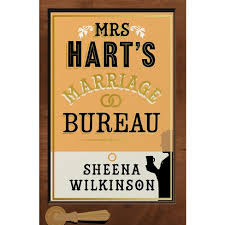
I haven't written in this vein for some time, ironically because, I suppose, life has rather got in the way: 'real' life with home and family, which includes pets of course, and professional life, which this year has included not one but two novel projects. Mrs Hart's Marriage Bureau was published in March 2023; I have written the first draft of a sequel, AND I've just delivered my next book, another children's historical, to a new publisher. So I haven't not been writing; I've just been avoiding truth-telling. 

The memoir project, which I had been so excited about, seems to have dropped down the list of priorities. At the time of writing I have completed about 30,000 words, enough to feel like a viable project, but oh, such a very long way from completion.

I haven't written any memoir for a few months now, apart from occasionally reading read over the essay-in-progress, which is already over 10,000 words and nowhere near finished, so I really don't know what on earth I could do with it. Also, it's about religion: probably a hard sell. 

The fact is, writing fiction is so much easier -- both aesthetically, and emotionally. Of course, you have to make up stories and characters, but that's what I've been doing all my life. Putting real life and people on the page feels so much more complicated. The aspect of my new life which is most challenging, and perhaps therefore most interesting, is being a stepmother having never had, or especially wanted, children -- but it's not something I can write about. I am happy to discuss all sorts of private things, but writing about a child who didn't have a choice about the situation is a line I won't cross. 

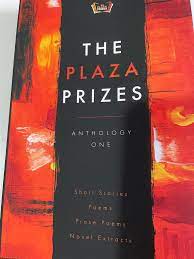
That's not to say I have given up on the project, or that there hasn't been encouragement along the way.  Luckily there are some competitions for short memoir, and I've always loved the discipline of a competition deadline. The best memoir award around seems to be the Briport Award, but as a writer with an agent I'm not eligible for that. But 'Saddo', a story about doing things alone all my adult life, won second prize in the Fish Short Memoir Award 2022, and 'Plan B: 38 Pictures of Irene' won first prize in the inaugural Plaza Prizes Memoir First Chapter Award. I was very tickled when the judge of the latter, Toby Litt, commented that the narrative voice was 'not straightforwardly likeable'. This felt like success: that essay, about learning to find my place in the home of the dead woman whose husband I married, was probably the rawest thing I have ever written. I don't always like the person I was at that time in my life, though I think I understand her better for having written about her. 


And maybe, now that I have checked in again, I will write about her some more. 


Friday, 13 May 2022

Three cheers for memoir writing -- and ABBA! by Sheena Wilkinson

As those of you who tune in regularly on the 13th of each month know, I’ve recently dipped my toes into the waters of memoir writing. I was trepidatious at first, but once I started submerging myself in my own experience, I was surprised by how much I – enjoyed is not the right word, but I seem to be able to do it not too badly and now I have reasonable body of work – far short of a full-length manuscript, but probably about 25,000 words which is, for me, the point at which a thing feels like a Thing. 


starting to look a lot like a Thing
 

Three things have boosted me along the way.


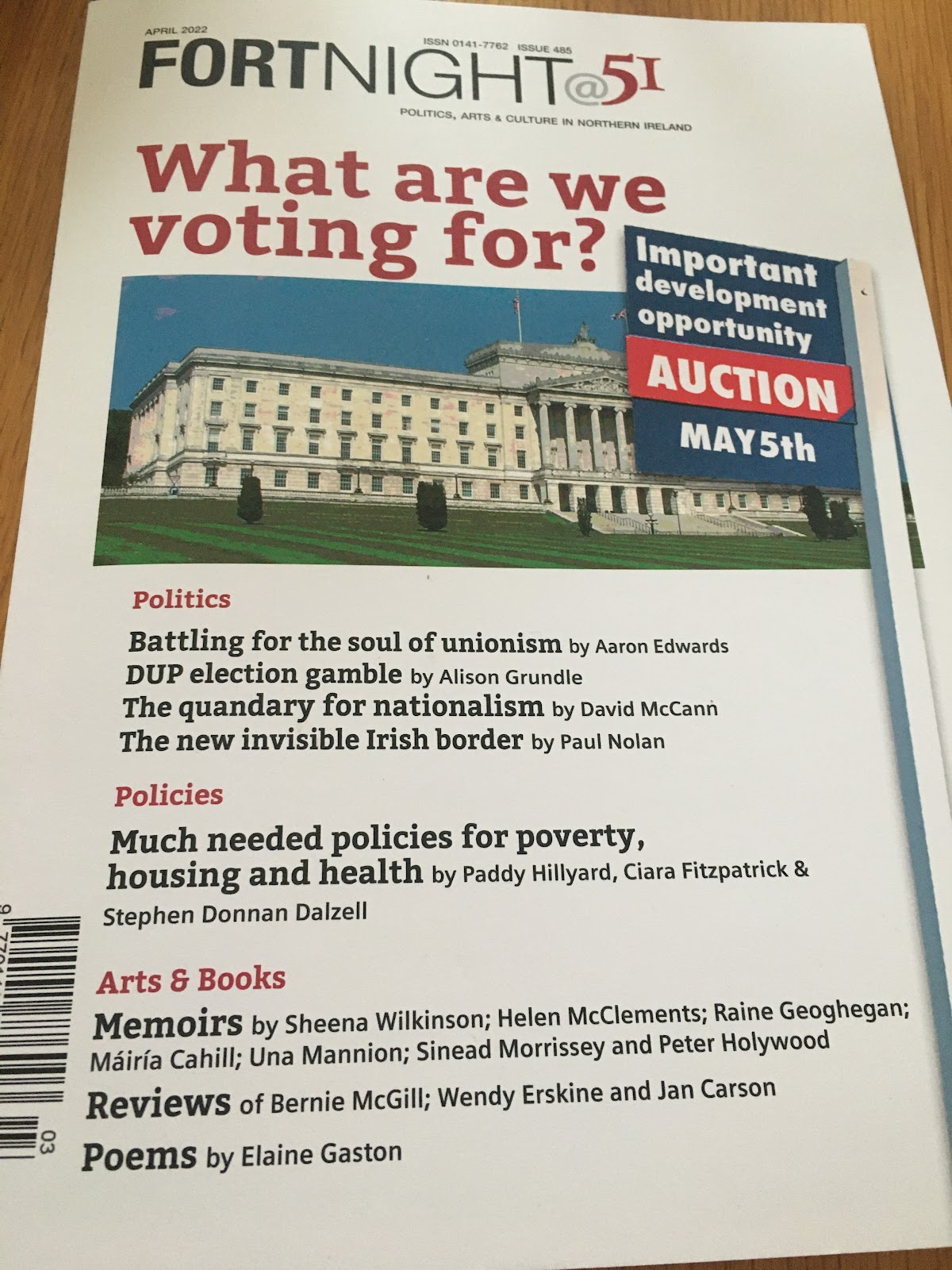
First, the poet Maureen Boyle, reading my first post on the subject, invited me to expand on it with an article in Northern Ireland’s magazine Fortnight.   https://fortnightmagazine.org/wp-content/uploads/2022/04/Issue-485-full-text-1.pdf She was guest editing a special Arts section on memoirs. What perfect timing! This was my first commissioned article in a few years, and at a time when I was waiting anxiously for news of a novel on submission, having a real deadline gave me focus and enthusiasm. And being published alongside writers I hugely admire, in a magazine that I grew up with, made me proud. It also reminded me that you never know who is reading ABBA!


Proud to be in such company 


 Second, I enrolled on a six-week memoir-writing course run by Curtis Brown Creative, with materials by the acclaimed and popular memoirist Cathy Rentzenbrink. Having to complete exercises was more good discipline and Cathy’s materials were thought-provoking and inspiring.  I received helpful feedback but more importantly, a small number of us have stayed together to form a critique group. I have never met anyone in this group, and chances are I never will, but there was an atmosphere of mutual trust and support from the start, partly because of the nature of what we are writing. These generous strangers have given me honest and insightful feedback and in seeking to do the same I have been encouraged to look at my own work with fresh eyes.


Third, one of the short pieces I wrote for the Fish short memoir prize won second prize. The Fish is a very respected competition so naturally that gave me a great boost too. I have a strange relationship with writing competitions. About a decade ago I had a fair amount of success in short story competitions, but in later years, despite being a better writer, my stories haven’t seemed to hit the mark in the same way so I hadn’t bothered. Success in the Fish reminded me of the subjectivity and serendipity involved – I had entered three pieces, all, I reckon, of comparable standard, and while one was placed second, the other two didn’t even make the (pretty long) longlist. Funnily enough, this encouraged me to dust down some ‘also-ran’ stories from a few years back, give them another edit, and send them back out to their fate. One never knows. In fact, I’ve decided to use my prize money as an entrance fees fund, and I won’t stop submitting till the money runs out! 


Sunday, 13 March 2022

Some Favourite Memoirs by Sheena Wilkinson

As regular readers know, I've started writing a memoir and have been using this monthly blog as a kind of check in. Memoirs have been very much on my mind -- my own, those of my peers on the Curtis Brown Creative memoir course I'm doing -- a wonderful, generous and insightful group  of individuals, and of course published memoirs. 

When I'm writing a novel I try not to read anything too close to what I'm writing, because of the fear of influence. My most recent novel -- now on submission -- is set in 1933, and I avoided recent novels set between the wars, preferring to read books actually written in the thirties. Now that I'm writing a memoir, there isn't the same tension, because the stories themselves are so personal. I know my story; I know what happened and what I want to say, and reading twenty memoirs about other people isn't going to change that. It's wonderfully freeing: I can learn so much about different approaches to true-story-telling.

Of course there are myriad ways to tell personal stories. I can't say I've actually fixed on one yet, except that I intend not to write chronologically but to take a more thematic approach. The writers of these memoirs -- all favourites of mine -- have taken various approaches too. It's a while since I've done a Top Five, so here, in no particular order, are Five Favourite Memoirs:


I am, I am, I am (Maggie O'Farrell)

Everything she writes is original, unusual and unforgettable so it's no surprise that this memoir, arranged around a series of near-death experiences, is on so many people's Must-Have-Memoirs lists. I read it when it first came out, and intend to read it again soon. 


Bookworm (Lucy Mangan)

My favourite memoirs, like my favourite conversations, are all about books, so I had to include one* memoir of reading. Lucy Mangan and I are about the same age -- OK, she's slightly younger -- and share similar tastes in books, so this is an old friend, one of the first books to take me out of my first lockdown reading slump. 

* two


Bookworm (Patricia Craig) 

Published a few years before Mangan's book, with the same title and even subtitle, this book also enchanted me. Belfast-born Craig's childhood in the late 50s and 60s predates both Lucy's and mine, but she grew up to be one of the first critics of the girl's school story. I love books set in places I know,  and this one has the added charm of including not only some favourite books but also some libraries I know well. 


Why Be Happy When You Could Be Normal? (Jeanette Winterson)

This covers much of the same ground as Winterson's novel Oranges Are Not The Only Fruit and it's fascinating to read both books, seeing how they differ. Like the novel it's darkly comic, heartbreaking and sharply observed. 


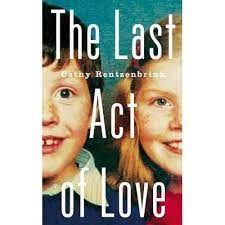
The Last Act of Love (Cathy Rentzenbrink)

OK, if I'm honest, my favourite Rentzenbrink memoir is Dear Reader which is all about -- yes, reading. But in the interests of balance, and because it's a thumpingly good book, I've included her debut. Cathy's sixteen-year-old  brother was knocked down and spent the remaining eight years of his live in a permanent vegetative state, with devastating effects on Cathy and her family. It's heartbreaking -- why are so many memoirs heartbreaking? -- but compulsively readable.

On a different day I might have picked five different memoirs -- I've got a stack of them on my desk as I type this, but these are all books I've enjoyed and books which have encouraged me to have a go at writing a book where I don't have to make things up.

Tuesday, 18 January 2022

Life Recipes - by Lu Hersey

 My 94 year old father had a nasty fall this week and needed some TLC to get over it, so I've been spending time at his house in Plymouth.

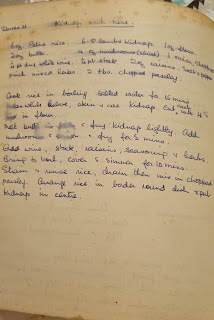
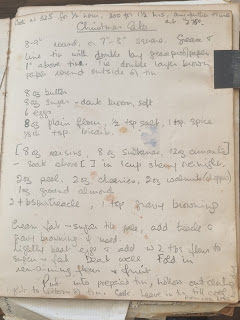
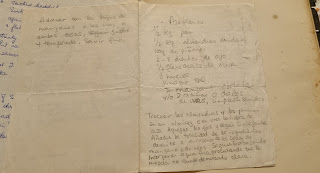
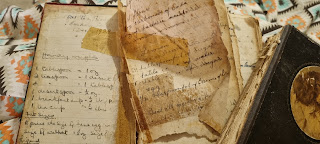
While here, helping him get about and cleaning up the place, I found two old hand written recipe books, one kept by my grandmother, and one by my mother, both complete with yellowing pages and splots of cake mix (hopefully cake and not kidneys or liver) throughout. And I thought about how much of these women's lives went into all that cooking, and how the books are almost like memoirs in recipe form.


To anyone else, they are simply recipe books. But they brought back so many memories of family history, and with such intensity, I was moved to tears. 

Who'd have thought my mother's endless recipes for Christmas cake could ever make me cry? If you didn't know her, you'd wonder why she had half a dozen recipes for the same thing. For me, it was my entire childhood in annual Christmas cake disasters, as my mother battled with different ovens in different places. We never stayed in one place for long as my father was in the navy, so she constantly had to adjust recipes to the laws of temperamental ovens - and never once succeeded. Every Christmas she'd be filled with the same boundless optimism that maybe this year the cake wouldn't sink in the middle, and every year, over changing recipes and changing ovens, it did. 

She died well over thirty years ago now, but I can still visualise her in the kitchen, filling the sunken middles of Christmas cakes with marzipan to make them flat, and covering them in royal icing that set so hard it could break your teeth. I hated those cakes, but looking at the recipes now, I can only wish she was still around to bake another.


So many of the recipes reflect her social life, scribbled on scraps of paper, some written at dinner parties, some sent in letters by friends. All of them dishes she had once enjoyed. A recipe for Swedish apple cake from the time my father was working in Sweden - the only cake I ever remember her managing to make successfully. A recipe for some Spanish dish, which she obviously wrote down as the cafe owner dictated it to her - how could I have forgotten that she spoke fluent Spanish, so she didn't need to translate?


My grandmother's recipe book, so old it's held together with yellowing sellotape, brought back different memories, from when she came to live with us when I was about eight. The parkin she made in quantities so vast it fed the family, me and my friends at teatime up until she cooked the next batch a fortnight later. I loved her parkin. Even my father, who disliked his mother-in-law intensely, loved her parkin. She'd written the same recipe out three times in different quantities, because coming from a family of 14 children, she'd had to adjust it down by half, then half again.


I noticed on the inside cover that she'd started her recipe book in 1929 - by which time she was already well over 40. I only wish she'd kept one from earlier in her life too - but as she left school aged 12 to work in the woollen mill, she was probably too busy to write recipes down before then. 

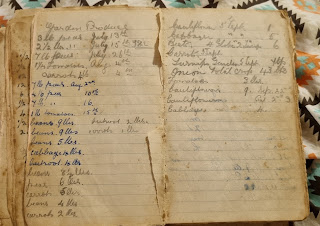
As it is, her book gives a fascinating insight into what she and her family were eating in the first half of the 20th century. There are several wartime recipes, along with a record of the vegetables my grandfather grew in his allotment. I remember seeing his Digging for Victory certificate from WW2, but my grandmother's careful record of the annual allotment produce, written with such pride in her recipe book, is something else. 


I notice her careful copperplate writing becomes looser, more wobbly towards the end of her book as she grows old. And my mother's writing, never neat, becomes almost illegible after she became ill. But she never gave up wanting to record a good recipe. Never accepted that she might not live long enough to make that lemon syllabub again. 

These books may be painful for me to read, but I've brought them back home with me. Somewhere at the back of my mind I have this idea to make them into new books, combined with photographs, and perhaps my own memories of both women - making a more complete family record to pass on to the next generation. Though whether they'd find it interesting or not is another matter entirely...


Lu Hersey


Thursday, 13 January 2022

Which I? by Sheena Wilkinson

Last month on this blog I shared my first tentative thoughts about writing a memoir. Many people – OK, a few people, but more than usual, commented or contacted me to say they thought it was a great idea. That they’d love to read it. I’m easily flattered, and this felt like the best reason to start it for real. There’s nothing like putting your intentions out there in the world to make you feel accountable. 

I’ve been listening to relevant podcasts, as well as reading lots of good memoirs and one or two books about life writing, of which the most thoughtful and useful has been the brand-new Write It All Down by Cathy Rentzenbrink, who knows a thing or two about memoir and is brilliant at communicating it. I’m attending an online course run by her later in the month. I always recommend that people go on courses to learn about new genres, and it’s exciting to be following my own advice. 


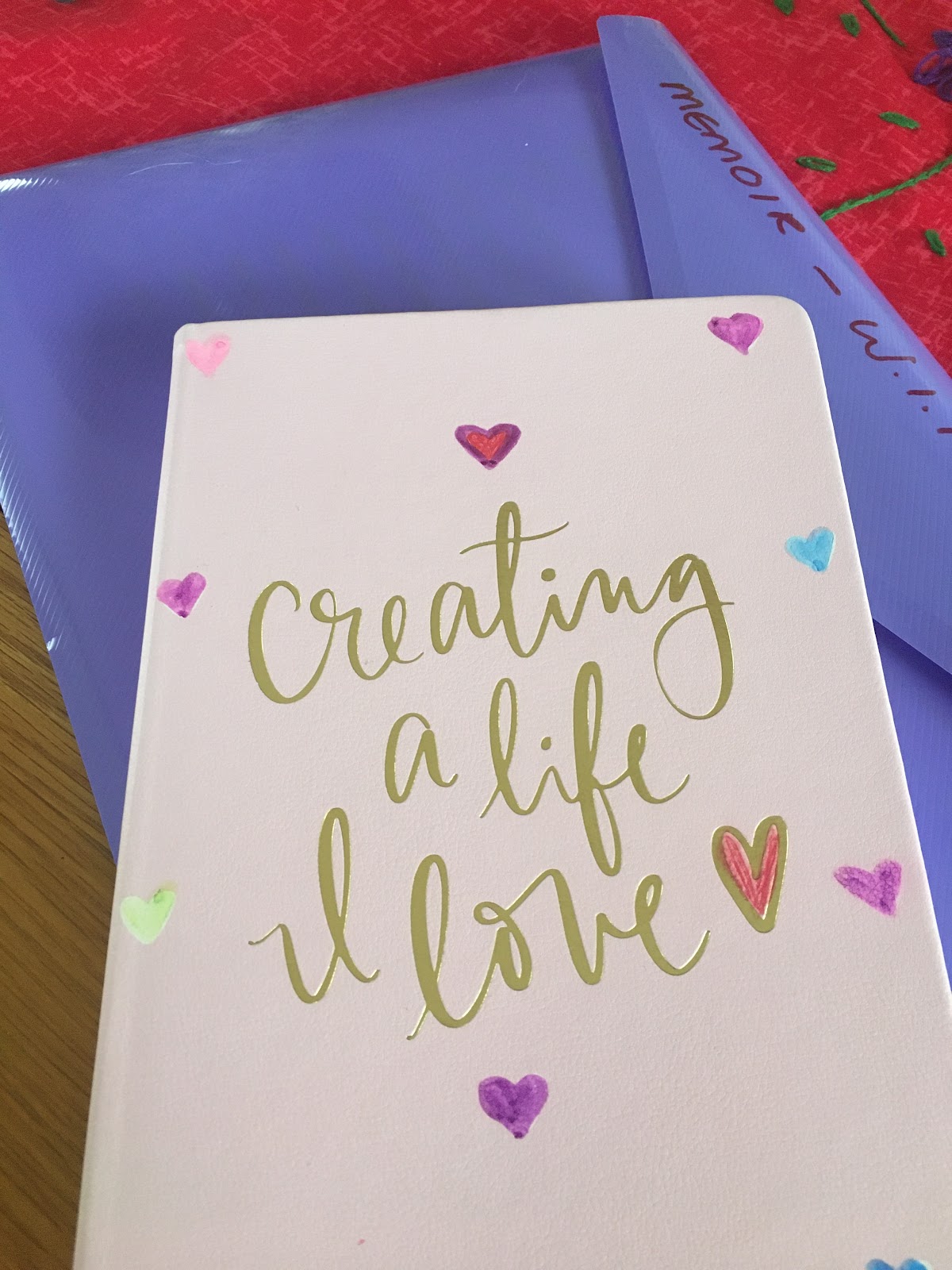
But I can’t keep reading and thinking.  I need to start writing. So I’ve done what I always do at the start of a project. I found a special notebook, dug out some coloured pens, made a lot of notes about what I wanted to say, and then started writing. I’d already decided I wasn’t going to write a linear story, but organise the chapters – self-contained personal essays, really – thematically. I’d worry about structure later. 


I knew it would be harder in some ways than writing fiction. I understood that there would be other people’s feelings and privacy to consider. And even leaving that huge issue aside, I wasn’t sure how open I would want to be. All very well to plan a chapter about falling in love at the same time as going through the menopause – how much about my hot flushes and mega-periods and murderous mood swings did I want to reveal? How much would anyone want to read? Thank God for the notebook, repository of stuff that I definitely wouldn’t want to see the light of day. 


One thing I didn’t expect to struggle with was voice. After all the voice would just be me, wouldn’t it? How hard could that be? I’ve been using my own voice for 53 years. As a child I used to get into trouble for being too outspoken; as a writer I’ve always tried to harness that frankness to dig down for the kind of uncomfortable truths that often make for powerful writing. Surely writing my own story would come naturally. Just use the voice you have. Put the I on the page and that’s you. Isn’t it?


But which I?


So far I’ve written two chapters. First, the one I mentioned last month, written in response to the prompt A Haunted House. ‘38 Pictures of Irene’ was painful to write, forcing me back to a time when this house I live in wasn’t my home and felt like it never could be, when jealousy and guilt blighted the strongest love I’d ever felt and turned me into someone I barely recognised. Yet at the same time I was happy in an entirely new way. Then, by way of relief,  I wrote ‘Oh my God, I forgot to have children!’ which is about – yes, you got there before me. Being childfree has never caused me pain, so this chapter was fun to write. There were even jokes. I felt much less self-conscious, and it shows in the writing.  The I of ‘OMGIFTHC!’ is much chirpier than the I of ‘38POI’. I think she’s more me. Every word of both chapters is true, and yet the minute I write I in this context, I start to worry about who I mean by that, what am I trying to project, in a way that I don’t even consider when writing, for example, this blog post. 


Maybe that’s normal. It’s early days and I suppose it takes time to find the ‘right’ voice. When I put all my chapters together and edit, and edit, and edit, the voices will cohere and the I on the page speak in one consistent voice. Or maybe we all have more than one voice, and it’s a matter of finding some version of that that can speak for the whole book?


I can’t answer that yet. One thing I do know: writing it all down in this public place definitely helps me to ask the questions, even if it’s going to take some time to figure out the answers. So thank you to ABBA, and its community, for indulging me. It won’t be the last time. 


Monday, 13 December 2021

Me? Write a Memoir?????? by Sheena Wilkinson

It’s almost midwinter and my writing has been in winter limbo. One novel (re)written and waiting for submission in the new year. The abandoned middle grade historical I planned to go back to has, after briefly sniffing the cold air, retreated back into hibernation. What is itching at me, like a chilblain, is the idea of a memoir.


memoir? Me? Write about real things? Not make it up? Who the hell do I think I am, that people might be interested in reading about me? My agent didn’t seem that keen either.  I’m just a woman who was single for twenty years, sliding into a comfortable, if solitary middle age, only to fall in love at fifty with one of her oldest friends, a widowed man. Big deal. 


Except it was a big deal. It was life-changing. And I’d have loved to read a book like that when I was first negotiating the challenges of being the one-after-the-perfect-dead-wife; dealing with the legacy in-laws; moving into another woman’s house; walking down the aisle with an HRT patch under my wedding dress; becoming a stepmother to a sixteen-year-old when the only kids I ever wanted were the ones I wrote about. Learning – in my fifties – about compromise. Feeling like nobody ever walked this path before. 


And of course I’d have liked to read about love being the most amazing adventure and worth all the difficulties. 


But actually write it? That felt too scary. I’ve always been confident about writing, never doubted my right or ability to express myself in words. So why now, after eight novels, should I feel imposter syndrome about writing my own story? 


So I let the idea hibernate. I’d write it in the spring. Maybe.


And then last week I saw an advert for a local writing group. New writers welcome. Deep down I suspected it would be the kind of group I’d grown out of decades ago. After all, I have plenty of professional writer friends for feedback and support. And then I told myself not to be such a snob. I’ve just moved to this area; I know hardly anyone. At the very least I would meet some local folk who enjoyed writing. 


The town, still alien to me, sparkled with fairy lights the length of its main street. It felt exciting to be in an arts centre again, and very weird not to be the one responsible for the evening’s activities. 


I’ll be honest. It was the kind of group I’d grown out of around the time of my first publishing deal. But it was lovely to give myself up to listening and participating. The facilitator – a respected local poet whom I knew by repute – gave us a list of questions to help invent a character. It was very much the kind of exercise I’d set myself. But for once I didn’t have a character in mind. So I cheated. I answered the questions about myself. That felt strange and self-conscious – who is this I am writing about? – but being with strangers made it easier. Then we had to put the character into a story with a choice of titles. One was The Haunted House. It wasn’t hard to put my character/me into that situation – when I first spent time in the house that’s become my home, photos of my now-husband’s late wife smiled down from every wall in every room, covered every surface.  Including in the guest room where I slept. So I knew a fair bit about being haunted.
 

I was with strangers who wrote just for fun. It was easy to forget about agents and readership and book deals and just write, letting my fountain pen fly over the notebook pages. The writing was painful in a way but it flowed. And when we had to share, nobody guessed that it wasn’t a story. 


At home I went straight to my desk, I took out the notebook and typed it up and edited it. It’s not a full-blown memoir, but it’s a start.  A tiny hopeful shoot, and now that I’ve started I’ll keep it nurtured through the winter.


And see what emerges in the spring. 


Friday, 28 June 2019

A Biography of Dreams - Clémentine Beauvais

I dream of a dream autobiography. One that would let us see nothing of a person’s waking life, but everything of their night-time wanderings, and the evolution throughout a lifetime of that dreamscape.

Infant visions, of god knows what - some light blue and very soft, others the worst shadows? Childhood nightmares of monsters, of hunger, of parents transformed into uncanny-valley creatures. Ecstatic dreams of flying, eating and peeing in awkward places, the young camouflage of eros. Adolescent dreams of shame, of triumph, of sex - some seemingly scarily misguided, others terrifyingly bang-on.

Within all that, other circumstantial variances : pregnancy dreams around one’s period, the thirst dreams of hot summer nights, the smothering nightmares of thick duvets. Those strange phases, days, weeks, when dreams seem to vanish, where have they gone, because of what? Stress, business, other things on one’s mind, too much joy. Other phases, the opposite: hyperactive psychedelic nightmares, Technicolor musical dreams.

The old clichés: naked-in-public dreams, lost teeth? I never had those, but apparently it’s common. A hefty dose of those are needed in the dream biography, to give it the appropriate effet de réel.

Adulthood and its lamentable wastes of good dreaming time: sleep squandered in work dreams, admin dreams, train dreams and more toilet dreams. The atrocious dreams at the confines of horror and dark desire: seeing one’s children dead, one’s parents dead, one’s partner dead. Dreams of piles of washing. More erotic dreams (more guilt).

Once in a blue moon, dreams of, well, blue moons, and other fantasy lands. As an adult, dreaming of actual monsters can be considered a privilege. Flying is a rare occurrence.

Old age. I don’t know. What do you dream of in old age? Tell me.

When I was a child, and a huge Harry Potter fan (which I still am), I would dream very often of flying around on brooms and doing magic with wands, but also just with my hands, or any object. My nightmares were terrifying and absolutely uncontrollable, but my dreams were pliable and kind. I wandered around Hogwarts at least a couple of times a week with Harry, Ron and Hermione.

But I remember well the time, around 14 years old, when wizard dreams started to malfunction. I used to be able to murmur ‘Lumos!’ and there would be light. Gradually, there wasn’t. I had weird frustrating dreams where I had a wand, but it didn’t work very well.

In one of them, I said ‘Lumos, Lumos,’ and the light went on, but that was because I’d tapped the light switch with the tip of my wand. I was aware it was cheating, but didn’t want to acknowledge it.

I remember I told my mother this dream and she burst out loud laughing, and said something like, ‘it’s the end of childhood, my darling’. It made me enormously sad at the time, because you can always count on children to romanticise their own childhood and mourn its loss even more than adults do.

Soon, I could no longer fly in dreams, but merely jump very high.

These days I never dream of making magic Evil magical things being done to me, yes. And I hardly ever dream of flying. Falling, yes. 

I don’t think it’s because I’m unhappy, or unimaginative. Maybe my superego’s become too strong for my id. It’s most definitely a Mr Banks kind of superego, not a Mary Poppins.

Graham Greene wrote a wonderful book of his dreams. Many encounters with famous people, politicians, writers. Normally, there’s nothing more boring than someone’s dream narratives. But those ones he manages to make fascinatingly universal. Just like the best (auto)biographies.
Who is the most famous person you’ve ever met in a dream? I nearly only meet minor starlets, for mostly incomprehensible reasons. JK Rowling I met often as a child and a teenager, but I never do now. She must be too busy being on Twitter to drop by.

The dream biography would see dead people and exes and long-forgotten friends come back and drift away again according to mysterious rules and cycles. My cat Opaline died seven years ago but she is with me at least once a month, generally very ill, and I have to protect her. Same with my sister, today a fiercely independent, strong and brave 24-year-old, but who appears in my dreams almost always as a tiny baby under my sole responsibility. My dead grandfather is often there. I always know he’s dead, and feel pleasantly surprised that, in spite of that, he’s bothered to turn up at whichever dream event I meet him.

A biography of dreams worthy of the name would require a strategic approach to data, of course; based on dream diaries, but also day diaries, for information to be triangulated as seriously as the exercise requires. But the day life must only be mentioned extremely allusively, and in small touches, and only insofar as it illuminates the central narrative. As in any writing project, it’s important to have a clear focus.

When the dream autobiography becomes a successful publishing trend, you can trust quantitative researchers will turn to the data for content analysis. We’ll start distinguishing patterns and predicting trends. It’s that time of life again when you’re going to sleep with all of your exes, sorry! Then, in a few months’ time, it will only be dreams of missing buses and your debit card not working. You’ll be utterly incapable of sending any text or email in any dream. It will only be random letters and hieroglyph-like symbols. Oh, and you’ll accidentally send your boss dick picks you didn’t even know you had in your phone. After that, for weeks you’ll eat a lot of cake and be stalked by monsters. At some point, apocalypse nightmare! The land will fold under your feet and volcano eruptions will be spectacular. You’ll hate it while it happens, but then you’ll have something to talk about when you wake up.

I have a friend with whom I discuss dreams almost every morning, like we’d comment on the latest news. It is a kind of intimacy I’d wish on anyone.

Psychoanalysts would hate this dream biography, because writing down a dream is forbidden in that science. You have to speak it, because there’s no such thing as a dream narrative, they say, only what you do with those pictures when you tell them to someone, free-associate, and hesitate and ramble. I agree fundamentally, I think, but still: I want to read that literary effort, that attempt to make sense of it, to chronologise it all. I want it to be aesthetic.

Who will write that autobiography for us? Someone hopefully very normal, with dreams like ours. But someone diligent and with a sense of humour. They’d need to write down their dreams from the earliest ages. Illustrate them, that’d be nice too. Then select (necessary stage) with a razor-sharp sensitivity for pertinence. And then tell us that story.

I don’t read much in the manner of biographies and only slightly more when it comes to autobiographies. But that one I’d read from cover to cover. An existence’s flipside.

-------------------------------
Clémentine Beauvais is a writer and literary translator. Her YA novels in English are Piglettes (Pushkin, 2017) and In Paris with You (trans. Sam Taylor, Faber, 2018).

Tuesday, 4 June 2019

Boggled by Biographies - Ciaran Murtagh


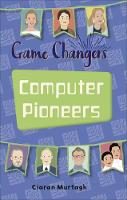
This month I have a series of four educational titles published by Rising Stars. They’re called ‘Game Changers’ and each is a series of biographies of people grouped around a theme. There’s Music Makers, Computer Pioneers, Brave Leaders and Hidden Heroes and they were four of the hardest books I’ve ever had to write!


One of the surprisingly tough things about all the books was agreeing who to put in them. Music Makers sparked a lot of debate – I mean, who really changed the game for modern music if you had to narrow it down to six people? And while you’re at it, remember that these biographies are for children in an educational setting so can’t contain any of the usual sex, drugs and rock and roll stories that often pepper the life of a rock star. Then we also have to consider diversity in our choices.  I think we can all agree on some people – Elvis is there, so is Bowie - but would you have chosen Dolly Parton over Patsy Cline? How about Nina Simone over Aretha Franklin? And was there really no room for John Lennon? I look forward to the parental backlash.


The ‘Brave Leaders’ category was also a fun debate and total minefield. We were looking for people who changed the world through their ideas. This was particularly tricky for gender representation. The ‘go to’ brave leader for gender representation used to be Aung San Suu Kyi, but she’s blotted her copy book of late. I pushed hard for Malala Yousafzai, but there was a reluctance to include anyone who wasn’t yet dead for fear they may do an ‘Aung San’ in later life. Mother Teresa might have worked, but we weren't allowed religious figures.  We went for Eva Peron and Emmeline Pankhurst.


Then there's the issue that to change the game as a leader you often have to break the rules a bit. How do you explain to children that it's OK to break the law if it's for a just cause? It's a nuanced debate -  one man's hero is another man's villain after all - and it's only after the passage of time that the true validity of a cause can be appraised. But that's a tricky concept for a 6 year old who may want to fight against the injustice of having to eat broccoli. 


The Hidden Heroes category was also a fun dance. We had to find people who had achieved something game changing but who hadn’t necessarily received the recognition that achievement warranted. A long back and forth was had over how unknown was ‘unknown’ and what constituted a game changing achievement. The Venn diagram overlap of those two was surprisingly small.


Once the subjects had been decided the hard work began. Each book contains at least six biographies and due to the various word counts and language levels that had to be adhered to they were between 400 and 1200 words each. Condensing Martin Luther King and the concept of racial segregation into 1200 age appropriate words was hard, getting Bowie into 400 was even harder. Over the course of four months I researched, condensed and wrote biographies on 30 people.

I learned many things, but perhaps the most valuable thing I learned was where my skills lie. I find it much easier to make something up than make something accurate! Ask me to write 1000 words off the top of my head – give me an hour. Want me to write the right 1000 words about a much revered historical figure -  give me a week.


Game Changers are out on the 28th June. I’m very proud of them. I doubt there’ll be a second series!

Tuesday, 13 December 2011

12 Gifts of Christmas - For Writers


           By Ruth Symes / Megan Rix

There are so many lovely gifts for writers out there, from extremely cheap to lavishly expensive. We must be the easiest people to buy for! Here’s my top 12 Christmas list:

1. Journals and notebooks and paper: You can never have too many or too much, in my opinion, (recycled paper best if poss). A4 books for getting down to some serious writing. Smaller notebooks for stuffing in a handbag or pocket, along with a pen, for when inspiration strikes!

When walking on the beach this spring I even found a waterproof notebook that you could use in the rain or in the bath.

2. Yearly Planner Wall-chart: I love being able to put a daily sticker (occasionally two) on my yearly wall-chart to mark off each 1000 words written. The best part is coming to the end year of the year and having a wall-chart covered in them - very satisfying.


3. Timer: If I’m needing help to get motivated I put a timer on for an hour and tell myself I can’t have another coffee or lunch etc until the hour is up. A friend of mine used to tie herself to her chair so she couldn’t stop until her designated time was over. I think tying yourself up is too extreme - but a timer is good to have. 

4. Books to read: Reading for pleasure and reading for research. Books you like and ones you don’t. When I was thinking of writing my memoir ‘The Puppy that came for Christmas’ my non-fiction agent told me to read as many animal memoirs as I could. I must have read over 20 before I put pen to paper.

All that reading must have helped because it made the Sunday Times Non-Fiction Bestseller List last year.

5. Mobile phone: With email on it, so the writer never misses a precious publisher or agent’s email while out walking the dogs.

6. Incense sticks: These help me focus when I’m not in a writer-ly frame of mind. I also find them very good for getting me in a mystical, magical mood for when I’m writing the Bella Donna books.

Export your documents to the cloud
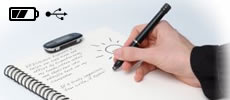
7. Smart Pen: I love writing by hand and although this pen is expensive, along with the special notebooks it needs, it lets my scribbled handwriting be converted into print - it also lets you write anywhere as you just plug it into the computer once you’ve finished – and voila you have text - just remember to turn it on! (I forgot to do this when we were on holiday and came back with tons of handwriting that couldn’t be converted into print - v. annoying.)

8. Dragon Dictate:  For when the poor writer’s hands are too tired from typing and mouse manoeuvring. Seriously though, RSI should not be taken lying down - if a writer starts getting twinges of pain in  their hands they should try to vary the way they write.

9. Pens and pencils: Must haves! You can never have too many pens because you can never find one when you need one.
10. Diary: To record all those things that can be turned into a story or go in a memoir one day.

11.Subscriptions to Writing Magazines: How To ones and Book Review ones. I loved getting this one from America last week: So you've made your list. You've checked it twice, but if "The Puppy That Came for Christmas" isn't on it, you need to check again.’ Thanks Terri Schlichenmeyer.

12. Writers holidays/retreats/courses: A luxury, I know,  but it’s very important for a writer to be rejuvenated every now and again - to keep them going for the next year or two!

 Wishing you a very Merry Christmas and Power to your Pen in 2012!  xxx


More details of my holiday gift ideas can be found on my website www.ruthsymes.com or www.meganrix.com

Monday, 15 February 2010

Living with the dead

A few years ago I wrote a biography of Einstein. In fact, it was half anthology and half biography, being a collection of Einstein's bon mots on myriad different topics, set in a roughly but not entirely chronological account of his life. Now I am writing six science biographies, this time for children, and beginning again with Einstein.

Writing a biography is a strange process, something akin to starting a love affair if it goes well and you hit it off with your biographee. It begins with some cautious exploration. Could this be someone you can really like? He looks interesting enough. (I will stick with the masculine, it being Einstein.) As you learn more, you become entranced, and then even obsessed. Soon, I was eager to get back to him in every spare moment that could be stolen from domestic responsibilities and other work. It was a deep pleasure to discover every foible, every quirk of character. I spent far longer than was sensible researching every esoteric detail I could find. I stalked him shamelessly around the web and around the University Library. I kept the first edition of the General Theory of Relativity on my dining table for six weeks. His idiosyncracies - and he had many - became endearing. Character traits that other people might find irritating or alienating raised a wry smile and a feeling of familiarity and tolerance. Sometimes he would retreat into areas I didn't understand. Sometimes he didn't want to reveal anything I could work with. He could be frustrating and sometimes downright annoying. But his appeal did not diminish and the more I came to know him the more I felt he was mine. I learned to relax with him, to accept the bits I didn't understand and just work round them. He was my daily companion who understood everything I was doing, a rare treat for a writer whose work is usually solitary.

But then I came to the end of the book and, reader, I killed him. The worst part of writing a biography is that your character dies - and it is a terrible shock. The months you have put into knowing and loving him, showing him off to other people and doing your best by him as far as you can, only store up pain for the day you have to write his death. Of course I knew when I started that Einstein was dead. So in one way it's nothing like a love affair, for a love affair is nourished by its sense of the future, and my relationship with Einstein was doomed from the start. I didn't have to agonise about what I had done, and whether if I'd done things differently it could have turned out better. It was never going to be any different.

Einstein was a determinist, so he would have liked this conclusion. He believed (as many physicists do) that everything was fixed by the laws of science and we live in the illusion of freewill because it is essential to survival. I willfully ignored his inevitable death and frolicked with freewill, enjoying the moment. And his death hit me hard. 'He died!' I would say, shocked, to friends who asked about the book and how it was going. So maybe it is still like a love affair after all. We love - and write - knowing death will come, and not holding back. And now I'm writing about him again. Will it be like returning to an old lover, starting a new affair but with the benefit of established love and comfort? Or will his magic have gone? Maybe he won't excite me any more and I'll just be anxious to get him out of the way and move on to my next great scientist. I hope not. But I have learnt to write the death scene first. My heart has become cautious, with regard to biographees.

Sunday, 19 April 2009

Truth and Dare: Gillian Philip

Hands up, confessions and sackcloth all round: yes, I’ve been sniffy about celeb biographies. Well, I’m a convert now, and I don’t even care if they’re ghosted or not. I went on my Easter hols to remote Colonsay and I thought I’d take along a little light gossip, so along came Russell Brand and Jade Goody. And what do you know, I loved ’em both. It turns out that celeb memoirs work the same way for me as books of any genre – the crucial thing is the truth of it all.

Honesty: isn’t that the one thing you ask of a book? (Well, all right – likeable characters and decent spelling obviously come into it.) Russell Brand’s Booky Wook is just hilariously honest (and I don’t just mean ‘frank enough to make your granny wince’). There was a generational divide over the Andrew Sachs affair and I was on the grumpy-old-woman side of it (on grounds of kindness rather than taste). But really, Brand is so truthful, I defy anyone not to respect his writing (even if liking him is a stretch for you). He tells you stuff about himself whether it paints him in a flattering light or not (and mostly it doesn’t). He’s even honest about his dishonesty.

Jade Goody’s swiftly revamped autobiography – I liked that too. The funny thing is, she confesses to being economical with the truth in the first version. She seems to have got that sorted, because Version Two rings touching and true. Maybe it’s skewed in perspective, who knows? But it’s honest in her own terms.

You can tell. Or I’m pretty sure you can. I had a low tolerance for Holden Caulfield when I was younger (‘get a life, young man!’). Now that I’m getting old and crabbit, ironically, I can see where he’s coming from with the ‘phoney’ thing. They say fiction writers tell lies for a living, but there’s true lies as well as the other kind.

I have this ongoing argument with my husband, who hates fantasy fiction (even mine! I ask you!), because ‘it isn’t real.’ To my last breath I’ll argue that fantasy fiction can be as real or unreal as any other kind. All a writer has to do is tell the truth – whether it’s the truth about your holiday in Barcelona or your Journey of Self-Discovery with Chickens. It doesn’t matter if it’s the truth about ancient Romans, the Battle of Britain, hobbits, dragons or mermaids. So long as it’s the truth, it’s real, and for a writer it’s an obligation. Anyway, readers can tell.

There are writers who have told the truth about Hungry Caterpillars, stuffed cats, boy wizards, and dragons called Smaug or Shona. You can tell it comes straight from the marrowbone of the soul. And some writers can take real life, and real people, and fake it. I’ll never convince the husband of that, but I’ll keep trying.

Anyway, Russell Brand’s book has a very funny dedication. Honestly, have a look.